Forgot your password?
typodupeerror

Submission + - "Artificial creativity" music software for Commodore Amiga unearthed (breakintochat.com)

Kirkman14 writes: Josh Renaud of breakintochat.com has recovered two early examples of "artificial creativity" software for the Commodore Amiga that generate new music by recombining patterns extracted from existing music.

Developed by cartoonist Ya'akov Kirschen and his Israeli software firm LKP Ltd. in 1986-87, "Computer Composer" demo and "Magic Harp" were early attempts at AI-like autonomous music generation. Kirschen's technology was used to help score a BBC TV documentary in 1988, and was covered by the New York Times and other major newspapers. None of the Amiga software was ever sold, though the technology was ported to PC and published under the name "The Music Creator" in 1989.

Submission + - Efforts To Ban Books Jumped An 'Unprecedented' Four-Fold In 2021 (npr.org)

An anonymous reader writes: Book banning is not new — in the U.S. alone the practice goes back to Puritan times, when Thomas Morton's book New English Caanan and others opposing this way of life were tossed from Massachusetts. But the American Library Association said Monday that this year there have been more challenges to books than they have seen since they started tracking it in 2000.

The ALA's Office for Intellectual Freedom counted 729 challenges to library, school, and university materials in 2021. It's a significant jump: Last year the group noted 156 challenges — and in 2019, there were 377. Although the 2020 number was impacted by the pandemic, which forced schools and libraries to shut down, the ALA said they don't usually get more than 500 book challenges in any given year. And sometimes, those challenges contain more than one book title. The number of individual books challenged in 2021 totaled 1,597.

Submission + - Parker Solar Probe captures the first visible light images of Venus' surface (dpreview.com)

dargaud writes: NASA's Parker Solar Probe has captured its first images of Venus' surface in visible light. The images show distinctive areas on the planetary surface, including continental regions, plains and plateaus. The images were taken on the night side of the planet where the heat re-emitted by the various surface areas has differing characteristics.

Submission + - Rolls-Royce gets funding to develop mini nuclear reactors (bbc.com)

PolygamousRanchKid writes: Rolls-Royce has been backed by a consortium of private investors and the UK government to develop small nuclear reactors to generate cleaner energy. However, critics say the focus should be on renewable power, not new nuclear.

Rolls-Royce SMR said one of its power stations would occupy about one tenth of the size of a conventional nuclear plant — the equivalent footprint of two football pitches — and power approximately one million homes. The firm said a plant would have the capacity to generate 470MW of power, which it added would be the same produced by more than 150 onshore wind turbines. Warren East, Rolls-Royce chief executive, said the company's SMR technology offered a "clean energy solution" which help tackle climate change.

However, Paul Dorfman, chairman of the Nuclear Consulting Group think tank, told the BBC's Today programme there was danger that the money spent on nuclear power would hit funding for other power sources. "If nuclear eats all the pies which it is looking to be doing we won't have enough money to do the kind of things we need to do which we know practically and technologically we can do now," he said.

Submission + - Good news for climate change: India gets out of coal and into renewable energy

Lasrick writes: In a stunning change, India has been aggressively pivoting away from coal-fired power plants and towards electricity generated by solar, wind, and hydroelectric power. "The reasons for this change are complex and interlocking, but one aspect in particular seems to stand out: The price for solar electricity has been in freefall, to levels so low they were once thought impossible." This is a piece of exceptionally good news, as it follows on the heels of the general chaos and weakening of goals that seem to have come out of last week's UN climate conference in Madrid, where the United States, Australia, and Brazil pushed for carbon loopholes, sending the conference into overtime and diluting the call for countries to strengthen their commitments under the Paris Agreement.

António Guterres, the UN Secretary-General, had been pushing for the world's biggest emitters to do much more. Guterres took to Twitter over the weekend: "I am disappointed with the results of #COP25. The international community lost an important opportunity to show increased ambition on mitigation, adaptation & finance to tackle the climate crisis. But we must not give up, and I will not give up."

Submission + - Researchers have eliminated HIV in mice for the first time. (usatoday.com)

pgmrdlm writes: Is a cure for humans next?

Researchers say they've successfully eliminated HIV from the DNA of infected mice for the first time, bringing them one step closer to curing the virus in humans.

Scientists from Temple University and the University of Nebraska Medical Center were able to eliminate the virus using a combination of gene-editing technology and a slow-release antiviral drug, according to a study published Tuesday in Nature Communications.

"The possibility exists that HIV can be cured," Howard Gendelman, chairman of UNMC's pharmacology and experimental neuroscience department and study author. "It’s going to take a little bit of time but to have the proof of concept gets us all excited."

Nearly 37 million people are living with HIV, according to UNAIDS, which if left untreated can develop into AIDS. Current HIV treatment involves daily, lifelong antiretroviral therapy (ART) which suppresses the virus' ability to replicate, but doesn't eliminate the virus from the body.

If a patient stops taking the drugs, HIV is able to rebound because the virus is able to "integrate its DNA sequence into the genomes of cells of the immune system, where it lies dormant and beyond the reach of antiretroviral drugs," according to a press release.

Researchers used a new form of ART called LASER ART on 23 "humanized mice," animals genetically modified to bear similarities to the human immune response. They were able to control the release and metabolism of the drug which allowed it to suppress virus replication for longer period of time.

The team then excised the remaining integrated HIV genome using a gene-editing tool called CRISPR-Cas9 which allows scientists to operate on DNA to add or disable certain genes.

Submission + - Teaching Wind Turbines How to Share (ieee.org)

carbonnation writes: As Spock so elegantly opined, “Logic clearly dictates that the needs of the many outweigh the needs of the few.” Today Stanford U researchers presented the clearest proof to date that self-sacrifice can also benefit wind farms. In their demonstration at an Alberta wind farm, one turbine sacrifices a fifth of its generating potential to enable better performance by neighboring turbines, boosting the group's collective output. And all it takes to harness this altruistic behavior is a small (but intelligent) tweak to their control systems.

Submission + - Early Soyuz Spacecraft Had a Peculiar User Interface, Says Charles Simonyi (ieee.org)

Tekla Perry writes: When WYSIWIG pioneer Charles Simonyi went to space, he couldn't but help notice the awkward user interface on the rocket's control panel. It was a case of legacy systems, not wanting to change training and documentation, and an emulator that ran Unix on a 386 chip, he reported during a recent discussion on space software held at the Computer History Museum.

Submission + - Arizona fire highlights challenges for energy storage (apnews.com)

pgmrdlm writes: PHOENIX (AP) — Arizona’s largest electric company installed massive batteries near neighborhoods with a large number of solar panels, hoping to capture some of the energy from the afternoon sun to use after dark.

Arizona Public Service has been an early adopter of battery storage technology seen as critical for the wider deployment of renewable energy and for a more resilient power grid.

But an April fire and explosion at a massive battery west of Phoenix that sent eight firefighters and a police officer to the hospital highlighted the challenges and risks that can arise as utilities prepare for the exponential growth of the technology.

Submission + - The ENIAC Programmers (boingboing.net)

AmiMoJo writes: The programmers of the ENIAC — the Electronic Numerical Integrator and Computer, the first modern computer — whose first programmers were six women: Kathleen McNulty Mauchly Antonelli, Jean Jennings Bartik, Betty Snyder Holberton, Marlyn Wescoff Meltzer, Ruth Lichterman Teitelbaum and Frances Bilas Spence.

The ENIAC programmers had to invent programming as we know it, working without programming codes (these were invented a few years later for UNIVAC by Betty Holberton): they "broke down the differential calculus ballistics trajectory program" into small steps the computer could handle, then literally wired together the program by affixing cables and flicking the machine's 3,000 switches in the correct sequences. To capture it all, they created meticulous flowcharts that described the program's workings.

Submission + - The Man Whose Bizarre Looking Tank Designs Made The D-Day Victory Possible (bbc.com)

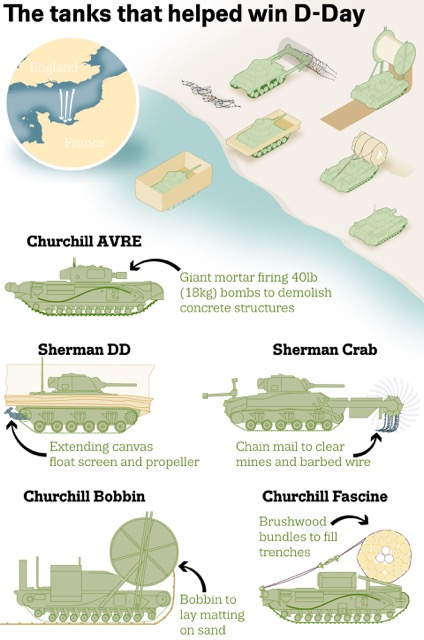
dryriver writes: In 1942 Allied troops tried to invade a French port at Dieppe. The troop landing was a distaster — within 10 hours, 60% of the 6,000 allied troops that landed were dead, and all 28 tanks that were supposed to support the troops had been picked off by mines and anti-tank weapons. The Allies realized that conventional tank designs were next to useless when landing on heavily fortified sandy beaches. A British army commander named Percy Hobart had the solution. Over two years, he designed completely new and unconventional tanks ( images: http://ichef.bbci.co.uk/images... ) like the Churchill AVRE, Sherman Crab and and Churchill Fascine that were custom-made to storm a mined beach defended by an enemy army. Commander Hobart had initially fallen out of favor, been retired early from the British army for his "unconventional thinking" and demoted, humiliatingly, to guarding his home village in Britain. When he managed to set up a meeting with Winston Churchill, Churchill reinstated Hobart, and Hobart went on to design some of the strangest looking beach lading tanks anyone had seen at that time. Hobart's tanks carried everything from flamethrowers intended to frighten German soldiers into surrendering to fascines (essentially a huge bundle of sticks) that could be dropped and allowed other tanks to drive over deep ditches and trenches, to huge mortars firing shells the size of dustbins that were designed to blow holes into seawalls and concrete fortifications. The tank designs performed as Hobart had intended, and the D-Day victory would not have been possible without them. A man who had once demoted to Corporal and retired for rubbing the British army brass the wrong way went on to make D-Day winnable for the Allied forces.

Submission + - France to build 1000km of road with solar panels (solarcrunch.org)

An anonymous reader writes: France is planning on a project to build 1000 kilometers of road with specially designed solar panels. This project will supply 5 million people in France with electricity if it is successful. Though many solar experts are skeptical of this project, the french government has given the go ahead to this venture.

  According to France’s minister of ecology and energy, Ségolène Royal, the tender for this project is already issued under the “Positive Energy” initiative and the test for the solar panels will begin by this spring.The photo voltaic solar panels called "Wattway" which will be used in the project is jointly developed by the French infrastructure firm "Colas" and the National Institute for Solar Energy. The specialty of "Wattway" is that its very sturdy and can let heavy trucks pass through it, also offering a good grip to avoid an accident. Interestingly, this project will not remove road surfaces but instead, the solar panels will be glued to the existing pavement.

Submission + - Canadian Music Industry Faces Competition Complaint Over Public Domain Records (michaelgeist.ca)

An anonymous reader writes: A Canadian record label specializing in public domain releases has filed a complaint with the Competition Tribunal over alleged anti-competitive conduct by Universal, Sony, and host of other music industry leaders. The complaint tells a fascinating behind-the-scenes tale, with the recording industry doing everything in its powers — including posting false reviews, pressuring distributors, and lobbying for changes to the law — to stop the sale of competing public domain records.

Submission + - Enormous Red Sprites Seen From Space (discovery.com)

astroengine writes: This gorgeous photo, captured from the International Space Station on the night of Aug. 10, 2015, shows an orbital view of thunderstorms over the city lights of southern Mexico as a recumbent Orion rises over Earth’s limb. But wait, there’s more: along the right edge of the picture a cluster of bright red and purple streamers can be seen rising above a blue-white flash of lightning: it’s an enormous red sprite caught on camera! First photographed in 1989, red sprites are very brief flashes of optical activity that are associated with powerful lightning. So-called because of their elusive nature, sprites typically appear as branching red tendrils reaching up above the region of an exceptionally strong lightning flash. These electrical discharges can extend as high as 55 miles (90 kilometers) into the atmosphere, with the brightest region usually around altitudes of 40–45 miles (65–75 km). Sprites don’t last very long — 3–10 milliseconds at most — and so to catch one (technically here it’s a cluster of them) on camera is a real feat... or, in this case, a great surprise!

Submission + - One Professional Russian Troll Tells All (rferl.mobi)

SecState writes: Hundreds of full-time, well-paid trolls operate thousands of fake accounts to fill social media sites and comments threads with pro-Kremlin propaganda. A St. Petersburg blogger spent two months working 12-hour shifts in a "troll factory," targeting forums of Russian municipal websites. In an interview, he describes how he worked in teams with two other trolls to create false "debates" about Russian and international politics, with pro-Putin views always scoring the winning point. Of course, with the U.S. government invoking "state secrets" to dismiss a defamation case against the supposedly independent advocacy group United Against a Nuclear Iran, Americans also need to be asking how far is too far when it comes to masked government propaganda.

Slashdot Top Deals

Nondeterminism means never having to say you are wrong.

Working...