Forgot your password?
typodupeerror

Submission + - Amid K-12 AI Pushback, OpenAI Named Lead Partner of 'Hour of AI' for Kids

theodp writes: On the heels of announced AI moratoriums by the nation's two largest K-12 school districts (NYC, LA), tech-backed nonprofit CodeAI (aka Code.org) this week named OpenAI 'Lead Partner' for the 2026 Hour of AI, which has replaced the Hour of Code (RIP, 2013-2024) as the premier event for the nation's K-12 schoolchildren during December's CS Education Week. OpenAI investor and partner Microsoft was named as one of two 'Supporters' for the event/infomercial (the other being U.S. defense contractor Northrop Grumman).

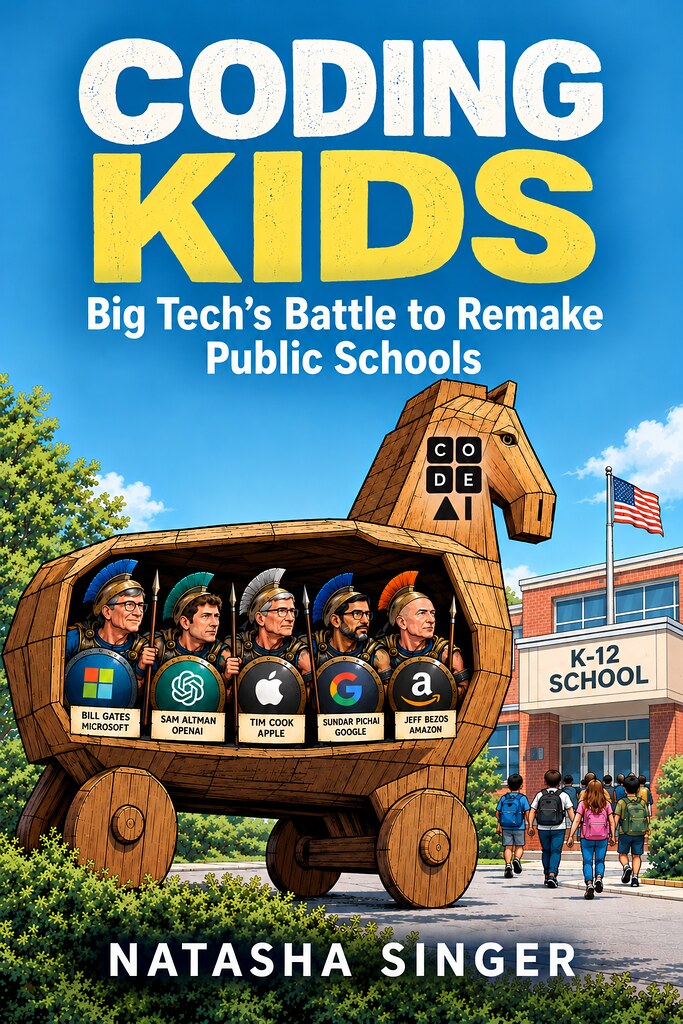
In August, as it launched ChatGPT for Teens, OpenAI announced a new signature partnership with Code.org to 'prepare the first AI generation', explaining that 'through the Hour of AI, OpenAI and CodeAI will introduce millions of students to the basics of using AI thoughtfully and responsibly.' OpenAI and Microsoft last year teamed up with the American Federation of Teachers to 'bring AI into the classroom', but that honeymoon is over. For more on the inside story of how Big Tech is applying the same playbook it used to scale coding lessons nationwide to now mainstream their AI tools in schools, check out Coding Kids: Big Tech's Battle to Remake Public Schools.

So, much like the Hour of Code that preceded it, will the Hour of AI serve as tech's 'Trojan Horse' (ChatGPT-generated parody cover) in its 'Odyssey' to push its agenda and curriculum into schools?

Submission + - First Nuclear Clocks Start Ticking in Vienna and Beijing (phys.org)

necro81 writes: Two groups, one in Vienna and one in Beijing, have successfully demonstrated the world's first nuclear clocks. Standard atomic clocks, like the caesium clocks that define the second, operate by observing the transition of electrons between different orbits about the nucleus. The resulting radiation is usually in the microwave range, and can produce clocks accurate to one second in 100 billion years.

Nuclear clocks go a step further, and probe energy transitions within the nucleus itself. Nuclei can arrange their protons and neutrons into different configurations, called isomers. The isomer with the lowest energy is the one usually found; higher-energy ones are only metastable and decay quickly. Usually it takes serious energy — x-rays and gamma rays — to excite a nucleus into a higher-energy arrangement. It so happens that thorium-229 can be excited using UV light with a wavelength of 148 nm — just within the capabilities of some exotic lasers.

It's still been quite a challenge. For one thing, Th-229 is not found in nature; it must be extracted from the decay chain of uranium-235. The Beijing team used just a microgram mixed in a crystal of calcium fluoride.

Although these prototype nuclear clocks are not yet more accurate than existing atomic clocks (one second in millions, rather than billions, of years), they show the way towards what may be possible. Because the energy transition is in the nucleus, rather than the electron cloud, it is less susceptible to outside disturbances like magnetic fields. And the fundamental frequency is much higher (five orders of magnitude), which should yield more precise timing. This development could lead to smaller and more reliable time standards across the world (and solar system).

Comment Re:Summary ... (Score 1) 280

If you had any critical thinking skills, you'd realize that my original point applies not only to keeling over, but also to feeling unwell.

More feeble people would suffer throughout the year with either permanent DST or standard time than the current one bad night in March. (Which, BTW, could be totally avoided by planning ahead and adjusting your bedtime a few minutes per day in the preceding week.)

Biology matches DST adjustments more than a fixed clock. Most everyone woke up with the sun from the dawn of humanity until the late 19th century, and adjusting the clock for the seasons stays closer to that.

Comment Re:Summary ... (Score 3, Insightful) 280

Permanent ST is more closely aligned with circadian biology, although earlier dusk may limit some evening activities

You know what's aligned even more with circadian biology?

Keep the current system, get up off your ass, and change your clocks twice per year without whinging like a precious snowflake.

That way you you don't have to deal either with the sun beating down on you while you try to sleep at 4am or with your poor children getting run over in the dark on their way to school.

Sure, a couple of codgers might keel over in march, but they were probably gonna die soon anyway. It's much harder to measure the statistics of all the other people who would die steadily throughout the year due to the aforementioned issues, as well as similar problems caused by a static clock that doesn't adjust at all to when the sun actually rises. However, I would bet good money that it would add up to far more casualties overall.

For some reason, I seem to be in a small minority on this issue, though. It's probably because everybody would rather believe in a solution to the problems of living on a tilted axis that's clear, simple, and wrong.

Submission + - Wisconsin U–Madison Prof Francis Halzen named 2026 Nobel laureate in physi (wisc.edu)

schwit1 writes: Halzen is the principal investigator of the NSF IceCube Neutrino Observatory, the world’s largest — and perhaps strangest — telescope. The U.S. National Science Foundation-funded observatory is operated by an international collaboration of scientists led by the Wisconsin IceCube Particle Astrophysics Center based at UW–Madison.

Embedded in a cubic kilometer of Antarctic ice, IceCube uses thousands of light sensors to survey the universe for neutrinos, nearly massless particles that rarely interact with other matter. Neutrinos provide information about the workings of black holes, galaxies and other objects in the cosmos.

“IceCube is like no other telescope in the world,” says UW–Madison interim Chancellor Eric M. Wilcots. “And there is no other scientist quite like Francis Halzen, whose idea to create a neutrino detector under almost a mile of ice has led to a remarkable multinational and multi-institutional scientific collaboration and a fundamental shift in how we think about the universe.”

Comment Re: IANAL, but... (Score 1) 90

Right⦠because EVERYBODY fully reads and understands the TOCs of every service they useâ¦

People don't read a lot of things that they agree to, especially if it's 20,000 words in a postage stamp-sized text box on the new toy they just turned on. However, anybody who's not an idiot realizes that most everything in an agreement that they haven't read is against their interests, and plans accordingly. I personally always look for binding arbitration agreements and make sure to opt out of those whenever possible.

Oddly enough, the Anthropic TOS and privacy policy actually aren't all that obtuse and can be skimmed in a few minutes. They make it clear that they'll be looking for problems with what you upload and what kinds of problems those might be. Like I said, you can easily avoid all that by using a paper notebook for your diary.

Comment Re:IANAL, but... (Score 1, Insightful) 90

There is a clause in the statute: "in any manner in which it may be viewed by another person". I would argue that it's her diary and not meant to be viewed by anyone. I don't disagree that turning her in was the right thing to do but I doubt she'll be convicted.

If you look at Anthropic's terms of service and privacy policy, it clearly states that they can look at your content in order to enforce their usage policy. You have to agree to this when you set up an account or use their service. Given that this is an AI company, you can bet your content will be screened for violations more efficiently than if humans were involved at every step.

If she really didn't mean for anyone else to view it, she would have scribbled it down in a notebook instead of uploading into a cloud owned and policed by strangers and their robots.

Submission + - New Ai-Powered "America.gov" Government Website Uses Gemini and Grok (cnn.com) 3

fahrbot-bot writes: CNN is reporting (and others) that President Donald Trump on Tuesday unveiled America.gov, a government website meant to serve as a one-stop shop for people trying to accomplish basic tasks like renewing a passport, enrolling in Medicare or applying for disaster relief.

The site, which launched with some basic functions ahead of a full rollout next year, is designed to serve as an AI-powered guide through the thicket of government agencies that Trump officials pledged would ultimately save people a whole lot of frustration.

The administration’s new initiative aims to allow Americans to access dozens of federal websites through a single point, making America.gov akin to a search tool that pulls information from across the government. And in the same way that people increasingly use AI models like ChatGPT or Google Gemini to compile information and provide customized answers, Trump officials claimed that America.gov would be able to do the same for people’s interactions with the federal government.

Enrolling in Medicare, for example, will become a matter of typing the request into the America.gov AI tool and following its step-by-step instructions. The same goes for applying to a government job — the new tool will now let people upload their resume directly to the site — or answering questions about federal benefits, publicly available documents or other necessities that fall under the federal government’s vast umbrella.

“Our vision is that one day, this type of convenience and simplicity will be across every government service,” said Joseph Gebbia, who leads the government’s National Design Studio.

But the reality is that the most advanced actions won’t be available until some point in 2027, raising questions about how long it will take for the administration to revamp the way the people interact with the government’s websites. The current version of America.gov can only do “answers.”

In related news, Variety notes that America.gov confirms, for now anyway, that Biden won the 2020 election.

Submission + - Microsoft Makes Linux Containers Native on Windows 11 (nerds.xyz)

BrianFagioli writes: Microsoft has made WSL Containers generally available, giving Windows 11 developers a built in way to build, run, and deploy Linux containers through Windows Subsystem for Linux.

The release includes wslc.exe for managing containers, GPU support, networking improvements, health checks, storage mounts, and integration with Microsoft Defender for Endpoint and Intune. Microsoft also claims up to twice the performance when Linux environments access files stored on Windows.

Docker Desktop, Podman Desktop, and Rancher Desktop are not going anywhere, but developers who only need basic container functionality now have another option built around WSL. One notable feature is still missing: Compose support. Microsoft says adding it is now a priority.

Slashdot Top Deals

Weekends were made for programming. - Karl Lehenbauer

Working...