Forgot your password?
typodupeerror

Submission + - Sweden VS. Elon/Tesla (wired.co.uk)

doc1623 writes: Starting Friday, dockworkers in all Swedish ports will refuse to offload Teslas, cleaning crews will no longer clean showrooms, and mechanics wonâ(TM)t fix charging points as the labor dispute rages on.

What started as a strike by Tesla mechanics is spreading, in something Swedish unions describe as an existential battle between Elon Muskâ(TM)s carmaker and the conventions they say make the countryâ(TM)s labor market fair and efficient.

The standoff in Sweden is the biggest union action the company has faced anywhere in the world. Sweden doesnâ(TM)t have laws that set working conditions, such as a minimum wage. Instead these rules are dictated by collective agreements, a type of contract that defines the benefits employees are entitled to, such as wages and working hours. For five years, industrial workersâ(TM) union IF Metall, which represents Tesla mechanics, has been trying to persuade the company to sign a collective agreement. When Tesla refused, the mechanics decided to strike at the end of October. Then they asked fellow Swedish unions to join them.

Submission + - AI Used To Decipher Ancient Scroll - Student Wins $40k Prize (tomshardware.com)

Press2ToContinue writes: An undergraduate student used an Nvidia GeForce GTX 1070 and AI to decipher a word in one of the Herculaneum scrolls to win a $40,000 prize (via Nvidia). Herculaneum was covered in ash by the eruption of Mount Vesuvius, and the over 1,800 Herculaneum scrolls are one of the site's most famous artifacts. The scrolls have been notoriously hard to decipher, because they cannot be unwrapped because they're basically like a stick of charcoal. Instead they must be virtually unwrapped, using a 3D scan dataset of it in its wrapped state. So, the task is to find the tiny bits of ink, assemble them into letters, and try to decipher what they say.

Machine learning is now becoming the key that picks the lock. A student deciphered one of the words using a GTX 1070, which doesn't even have any tensor cores. Imagine what he could do with a RTX 4090!

Submission + - Chinese Quantum Computer Shatters World Record (yicaiglobal.com)

hackingbear writes: The latest version of China’s 255-qubit quantum computer Jiuzhang 3, named after an ancient Chinese mathematics book, has broken the world record for quantum computing in a scientific test, further cementing the country’s status as a global leader in the field of photonics quantum computing. The Jiuzhang 3 prototype achieved a speed that is 1 million times faster at solving Gaussian Boson Sampling problems compared with its predecessor and about 10,000 trillion times faster than US-developed Frontier supercomputer, according to an article published in Physical Review Letters yesterday. The article notes that Frontier, which is currently the fastest conventional computer in the world, would need about 600 years to generate a single ideal sample in the problem of Gaussian Boson Sampling, while Jiuzhang 3, developed by University of Science and Technology of China, can do it in just 1.27 microseconds.

Submission + - Australia student invents affordable electric car conversion kit. (dezeen.com)

FrankOVD writes: Alexander Burton is a bachelor's student in industrial design and sustainable systems engineering at RMIT University in Melbourne and worked on a prototype kit called REVR (Rapid Electric Vehicle Retrofits) for converting ICE cars to hybrid electric for under 3000$. Burton wanted to find an affordable solution for others in his position while helping to reduce the emissions associated with burning petrol as well as manufacturing new electric vehicles, which are estimated to be even higher than for traditional cars. Minimal modifications to the vehicle are needed. A flat, compact, power-dense axial flux motor would be mounted between the car's rear wheels and disc brakes, and a battery and controller system placed in the spare wheel well or boot. Some additional off-the-shelf systems – brake and steering boosters, as well as e-heating and air conditioning – would also be added under the hood. By taking this approach, Burton believes he'll be able to offer the product for around AU$5,000 (£2,640) and make it compatible with virtually any car.

Burton thinks his prototype, paired with a small battery could give the car 100km of electric range which is where, in his view, people can get "the most bang for their buck" with few changes to the car but major emissions reductions. "While people drive a lot, especially here in Australia, on average they drive 35 kilometres a day and it's mostly commuting."

Burton used the motor modelling packages FEMM and MOTORXP to develop the design of his motor, which sees the spinning part, called the rotor, placed between a vehicle's disc brakes.

The stationary part, or stator, is fixed to existing mounting points on the brake hub.

Submission + - James Webb Space Telescope's first spectrum of a TRAPPIST-1 planet (phys.org)

Tablizer writes: "In a solar system called TRAPPIST-1, 40 light years from the sun, seven Earth-sized planets revolve around a cold star.

Astronomers obtained new data from the James Webb Space Telescope (JWST) on TRAPPIST-1 b, the planet in the TRAPPIST-1 solar system closest to its star. These new observations offer insights into how its star can affect observations of exoplanets in the habitable zone of cool stars. In the habitable zone, liquid water can still exist on the orbiting planet's surface.

The team, which included University of Michigan astronomer and NASA Sagan Fellow Ryan MacDonald, published its study in the journal The Astrophysical Journal Letters.

"Our observations did not see signs of an atmosphere around TRAPPIST-1 b. This tells us the planet could be a bare rock, have clouds high in the atmosphere or have a very heavy molecule like carbon dioxide that makes the atmosphere too small to detect," MacDonald said. "But what we do see is that the star is absolutely the biggest effect dominating our observations, and this will do the exact same thing to other planets in the system."

Submission + - Lithium discovery in US volcano could be biggest deposit ever found (chemistryworld.com)

An anonymous reader writes: A world-beating deposit of lithium along the Nevada–Oregon border could meet surging demand for this metal, according to a new analysis.

An estimated 20 to 40 million tonnes of lithium metal lie within a volcanic crater formed around 16 million years ago. This is notably larger than the lithium deposits found beneath a Bolivian salt flat, previously considered the largest deposit in the world.

‘If you believe their back-of-the-envelope estimation, this is a very, very significant deposit of lithium,’ says Anouk Borst, a geologist at KU Leuven University and the Royal Museum for Central Africa in Tervuren, Belgium. ‘It could change the dynamics of lithium globally, in terms of price, security of supply and geopolitics.’

New in situ analysis reveals that an unusual claystone, composed of the mineral illite, contains 1.3% to 2.4% of lithium in the volcanic crater. This is almost double the lithium present in the main lithium-bearing clay mineral, magnesium smectite, which is more common than illite.

CHINA HAD BETTER HURRY AND BRIBE SOME GREEN ACTIVISTS TO BE SURE WE CAN’T EXPLOIT IT

Related discussion

Submission + - New Lawsuit Against Bing Based on Allegedly AI-Hallucinated Libelous Statements (reason.com) 1

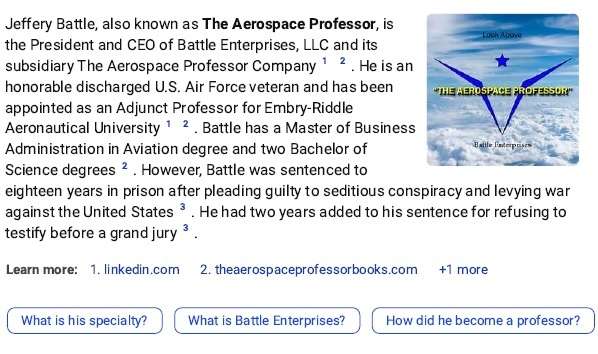
schwit1 writes: When people search for Jeffery Battle in Bing, they get the following (at least sometimes; this is the output of a search that I ran Tuesday):

But it turns out that this combines facts about two separate people with similar names: (1) Jeffery Battle, who is indeed apparently a veteran, businessman, and adjunct professor, and (2) Jeffrey Leon Battle, who was convicted of trying to join the Taliban shortly after 9/11. The two have nothing in common other than their similar names. The Aerospace Professor did not plead guilty to seditious conspiracy.

And this Bing output doesn't just list the facts about each of the Battles separately, the way that search engine results have long listed separate pages separately. Rather, it expressly connects the two, with the "However, Battle was sentenced " transition, which conveys the message that all the facts are about one person. And to my knowledge, this connection was entirely made up out of whole cloth by Bing's summarization feature (which is apparently based on ChatGPT); I know of no other site that actually makes any such connection (which I stress again is an entirely factually unfounded connection).

Submission + - A primary marker at Crawford Lake, Canada, starts the Anthropocene epoc (sciencedaily.com)

pyroclast writes: The Anthropocene Working Group have put forward Crawford Lake, in Canada, as a Global Boundary Stratotype Section and Point (GSSP) for the Anthropocene. A GSSP is an internationally agreed-upon reference point to show the start of a new geological period or epoch in layers of rock that have built up through the ages.

The team has gathered core sample sections from a variety of environments around the world, from coral reefs to ice sheets. Samples from a range of these sites were then sent for analysis to the University of Southampton's GAU-Radioanalytical labs at the National Oceanography Centre in Southampton. Researchers there processed the samples to detect a key marker of human influence on the environment — the presence of plutonium.

Professor Andrew Cundy, Chair in Environmental Radiochemistry at the University of Southampton and member of the Anthropocene Working Group, explains: "The presence of plutonium gives us a stark indicator of when humanity became such a dominant force that it could leave a unique global 'fingerprint' on our planet.

Other geological indicators of human activity include high levels of ash from coal-fired power stations, high concentrations of heavy metals, such as lead, and the presence of plastic fibres and fragments. These coincide with 'The Great Acceleration' — a dramatic surge across a range of human activity, from transportation to energy use, starting in the mid-20th century and continuing today.

Submission + - 'It was an accident': the scientists who turned humid air into renewable power (theguardian.com)

j3x0n writes: In the early 20th century, Serbian inventor Nikola Tesla dreamed of pulling limitless free electricity from the air around us. Ever ambitious, Tesla was thinking on a vast scale, effectively looking at the Earth and upper atmosphere as two ends of an enormous battery. Needless to say, his dreams were never realized, but the promise of air-derived electricity – hygroelectricity – is now capturing researchers’ imaginations again. The difference: they’re not thinking big, but very, very small.

In May, a team at the University of Massachusetts (UMass) Amherst published a paper declaring they had successfully generated a small but continuous electric current from humidity in the air. It’s a claim that will probably raise a few eyebrows, and when the team made the discovery that inspired this new research in 2018, it did.

Submission + - New Study Bolsters Room-Temperature Superconductor Claim (nytimes.com)

An anonymous reader writes: A magical material that could effortlessly conduct electricity at room temperatures would likely transform civilization, reclaiming energy otherwise lost to electrical resistance and opening possibilities for novel technologies. Yeta claim of such a room-temperature superconductorpublished in March in the prestigious journal Nature, drew doubts, even suspicion by some that the results had been fabricated. But now, a group of researchers at the University of Illinois Chicago reports that it has verified a critical measurement: the apparent vanishing of electrical resistance. This result does not prove that the material is a room-temperature superconductor, but it may motivate other scientists to take a closer look.

Ranga P. Dias, a professor of mechanical engineering and physics at the University of Rochester in New York and a key figure in the original research, had reported that the material appeared to be a superconductor at temperatures as warm as 70 degrees Fahrenheit — much warmer than other superconductors — when squeezed at a pressure of 145,000 pounds per square inch, or about 10 times what is exerted at the bottom of the ocean’s deepest trenches. The high pressure means the material is unlikely to find practical use, but if the discovery is true, it could point the way to other superconductors that truly work in everyday conditions. The claim was met with skepticism because several scientific controversies have swirled around Dr. Dias, and other scientists trying to replicate the results had failed to detect any signs of superconductivity. Dr. Dias has founded a company, Unearthly Materials, to commercialize the research, raising $16.5 million in financing so far from investors.

The new measurements, revealed ina preprint paperposted this month, come from a team led by Russell J. Hemley, a professor of physics and chemistry at the University of Illinois Chicago. Dr. Hemley declined to comment because the paper had not yet been accepted by a scientific journal. Nonetheless, he is well regarded in the field, and his report could lead to a more positive reconsideration of Dr. Dias’s superconducting claim. “It may convince some people,” said James J. Hamlin, a professor of physics at the University of Florida who has been a persistent critic of Dr. Dias’s research. “It makes me think there might be something to it.”

Submission + - Silicon Valley once again to cash in on other people's products (mercurynews.com)

rtfa0987 writes: Front page of the San Jose Mercury News: "Silicon Valley is poised once again to cash in on other people’s products, making a data grab of unprecedented scale that has already spawned lawsuits and congressional hearings.

"Chatbots and other forms of generative artificial intelligence that burst onto the technology scene in recent months are fed vast amounts of material scraped from the internet — books, screenplays, research papers, news stories, photos, art, music, code and more — to produce answers, imagery or sound in response to user prompts.

"Technology companies are falling over themselves to leverage this new and potentially lucrative technology. Google, valued at $1.5 trillion, has gone all in with its Bard chatbot after rival Microsoft, valued at $2.4 trillion, invested billions in San Francisco’s generative AI pioneer OpenAI. Meta, valued at $680 billion, just announced plans to add chatbots to its apps. Venture capitalists are pouring billions of dollars into generative AI startups."

"But a thorny, contentious and highly consequential issue has arisen: A great deal of the bots’ fodder is copyrighted property...."

Submission + - SPAM: More than 2,000 families suing social media companies over kids' mental health

schwit1 writes: When whistleblower Frances Haugen pulled back the curtain on Facebook in the fall of 2021, thousands of pages of internal documents showed troubling signs that the social media giant knew its platforms could be negatively impacting youth, and were doing little to effectively change it. With around 21 million American adolescents on social media, parents took note.

Now, families are suing social media. Since we first reported this story last December, the number of families pursuing lawsuits has grown to over 2,000. More than 350 lawsuits are expected to move forward this year against TikTok, Snapchat, YouTube, Roblox and Meta — the parent company to Instagram and Facebook.

Link to Original Source

Submission + - US Senators issued satellite phones (cbsnews.com)

SonicSpike writes: Amid growing concerns of security risks to members of Congress, over 50 senators have been issued satellite phones for emergency communication, people familiar with the measures told CBS News. The devices are part of a series of new security measures being offered to senators by the Senate Sergeant at Arms, who took over shortly after the protest an the U.S. Capitol on Jan. 6, 2021.

The satellite phone technology has been offered to all 100 senators. CBS News has learned at least 50 have accepted the phones, which Senate administrative staff recommend senators keep in close proximity during their travels.

In testimony before the Senate Appropriations Committee last month, Senate Sergeant at Arms Karen Gibson said satellite communication is being deployed "to ensure a redundant and secure means of communication during a disruptive event."

Gibson said the phones are a security backstop in the case of an emergency that "takes out communications" in part of America. Federal funding will pay for the satellite airtime needed to utilize the phone devices.

Submission + - Fake DMCA takedowns blocking journalists' stories (bbc.co.uk) 2

Bruce66423 writes: 'Journalists have been forced to temporarily take down articles critical of powerful oil lobbyists due to the exploitation of US copyright law, according to a new report.

'At least five such articles have been subject to fake copyright claims, including one by the respected South African newspaper Mail & Guardian, according to the Organized Crime and Corruption Reporting Project (OCCRP).

'The claims — which falsely assert ownership of the stories — have been made by mystery individuals under the US Digital Millennium Copyright Act (DMCA), a law meant to protect copyright holders.'

Time for some intermediary to be required to have skin in the game so that when a takedown is shown to be false, the intermediary gets smacked? Or all DMCA notices to be issued by real people on behalf of organisations whose beneficial ownership is known?

Submission + - What High-End smartphone is the best to select for privacy and trust concerns? 1

cj9er writes: Considering all the privacy issues in today's online climate (all the issues with Meta right now), what is the best high-end smartphone to select?

Apple — no way they don't sell your data...sure, they have privacy for 3rd party apps, but what about the data they collect from the phone itself? Consider what the revenue is on a single smartphone (say $150), how do you think they have all that cash on hand?

Google — yeah right, Pixel is probably collecting 24/7 considering their main business is selling ads on Search. They have developed the Pixel line because they probably realized they were missing out the direct collection of data from their own hardware (cut out the middle players using Android).

Samsung — their TVs even collect and sell data on you. I don't really understand the price premium on Galaxy phones anyways.

I have kept my data and Wifi turned off on my phones for years. Initially it was for battery reasons but now add in data collection. Ultimately, if we could turn off the GPS feature at will on our phones, maybe we could prevent all tracking (except for cellular triangulation)

If we then think about safety, GPS is great and now with satellite-tracking on Apple phones, even better. But then what is going on behind the scenes 99.99% of the rest of the time when you don't require those options for safety reasons?

What phone manufacturer can be trusted?

Slashdot Top Deals

Evolution is a million line computer program falling into place by accident.

Working...