Comment Re:New Religious War (Score 1) 179
NO! This is an outrage! [slams table]
Our religious war should be about reader's choice vs writer's choice!
NO! This is an outrage! [slams table]
Our religious war should be about reader's choice vs writer's choice!
Ok, but which of those things came with the new law? A lot of what you're describing (I suspect all of it) was already in place. What changed for non-banned users?
Oh, so they're doing it the same way I take "good" photographs: by taking a fuckton of mostly-shitty photographs and trawling through them for the rare few which actually look decent.
Vaporware. If this feature doesn't make it into the Open Source driver so that I can know where my computer is, then I'm not going to buy any Nvidia hardware!
That's IMHO really overplaying it. I don't want to downplay food production effort difficulty, but saying "because we've never done it we can't" is like saying "Because we've never built a 5-meter-tall statue of a puffin made of glued-together Elvis dolls, we can't". We absolutely can, it's just a question of whether one thinks the investment is worth it. And I'm not talking out my arse, I have a degree in horticulture with a specialty in greenhouse cultivation. So much of the "keep the plants alive" systems we already do on Earth - you just need to get them there in an affordable manner.
The primary consumables are water and fertilizer. Nobody seriously is proposing building a colony that can't produce its own water. As for fertilizer, that would start off as an import, but a much smaller import than the food mass. On Earth, open-loop fert systems are fairly common, but they're slowly losing ground to closed-loop where you just maintain the EC, filter the returning solution, and every now and then due a nutrient-level test on the solution and individually adjust whatever nutrient might be lacking vs. the others.
We can consume lots of growing medium, like disposable rock wool cubes and the like, but we can also not do that. For example, it's perfectly fine to grow plants in clean sand / fine gravel - just clean it and sterilize it between uses. Something like pumice is better, though it slowly breaks down between uses. But you don't have to use anything special.
If you do LED lights, you may get a decade or so out of them. You can reduce shipping mass for replacement by going with designs that let you replace just the light boards from them (Mechatronix has lights like this for example), no need to resend e.g. the heavy heat sink, etc.
There's a million random things you use or that can wear out, from cleaning solutions to solution pumps to climate computers and and on and on. But they're not a meaningful import-mass, at least compared to food. Really, the big thing is fert. But regenerating fertilizer from waste (plant waste, human waste) should not be - industrially - immensely complicated. For the metals, burn to oxides / hydroxides, dissolve in acid, fractionally crystallize. You'll always lose some from the system, but we're not talking large amounts. For nitrates, Haber-Bosch is nothing exotic to adapt, and you have easy feedstocks (mining is complex, sucking in gases isn't).
(To elaborate about PELs: Venus's middle cloud layer is ~1-10mg/m3, depending on altitude, latitude, and what study you trust (our existing data isn't great). OSHA PELs are 1mg/m3 for an 8-hour shift. NIOSH's RELs are also 1mg/m3 for a 10-hour shift, with IDLH of 15mg/m3. Now, this has the two aforementioned caveats. On the downside, Venus's aerosols are higher molarity - 75-85% concentrated vs. ~20% on Earth. On the upside, the vast majority of the PEL/REL/IDLH risk is from inhalation, which obviously, you can't be doing in any atmosphere in our solar system other than Earth. Dermatitis thresholds are far higher. So again, so long as there's not rain/snow/dew/frosts, and you're at the right altitude/latitude combination**, you could probably spend some time outside in shirtsleeves and a facemask, and feel an alien breeze against your skin.
** One also has to stress latitude, not just altitude, as it's cooler for a given altitude as you get closer to the poles. While Venus's middle cloud layer climate is "similar" to Earth's, it's a bit on the warmer side for a given pressure than Earth's - and because an aerostat rides "down" in the atmosphere vs. its internal pressure, esp. at night when it's no longer being heated by the sun, it amplifies the impact. So if you're going to be living in the envelope, you need to find the right balance between how far you want to go below 1atm and how hot you want to have it be outside. Shifting more poleward helps find a better balance between the two (at the cost of lower sunlight availability for solar power vs. the super-bright equatorial regions). It also shortens your effective day (faster superrotation period). You probably don't want to go fully to the poles, though, because of the polar vortices (though how turbulent they are is still an open question).
BS. There's no ozone and at the height these balloons would float the UV and assorted stuff from the sun would fry you in seconds.
They are, however, correct. Venus has no (innate) magnetic field, only a weak induced one (about 2x that of Mars's induced field), but it has a massive atmosphere. The mass of matter over your head at a reasonable habitat altitude/latitude combination is equivalent to that of about 5 meters of water. Way more shielding than is necessary for human life. Of course, having even more shielding would be even better, as it would of course be nice to have Earthlike protection levels. But you could survive even a Carrington Event on Venus. Getting 5 meters of water-mass-equivalent over a Mars habitat, while doable, is quite an undertaking, and means you're living basically in a bunker.
Wtf re you smoking? Archimedes principle holds on Venus just as on Earth. Lose your lifting gas and you sink and on Venus you'll soon start to cook.
Aerostat internal pressures are very similar to the pressure outside of them, and they hold a tremendous amount of gas. A 1 cm hole is basically irrelevant in an aerostat; it's just some extra work for your gas generators, vs. what it already has to overcome due to gas diffusion through the envelope. By contrast, a 1cm hole in a tin-can habitat on Mars will kill you in minutes.
Venus's middle cloud layer is quite similar in most properties to Earth's troposphere, with convection cells, wind speeds, etc seemingly having a similar distribution to that on Earth. There's also lighting, seemingly at roughly Earth levels (though a lot of uncertainty), although we know very little about it, including even where it occurs (incl. whether it's in the middle layer), and why. Because Mars hogs most of the planetary exploration budget
Aerostats generally deal better with turbulence than fixed wing aircraft. They interact with it sort of like a ship at sea, with long, slow undulations rather than sharp jerks.
Uhh,, are you crazy?? It's got an atmosphere with clouds of pure acid that snows lead sulfide on a surface that'll melt you face in 5 seconds.
So, this is not only wrong, but it'd actually be more convenient if it were true
Venus's middle cloud layer (the one in question) is actually more like vog (volcanic fog) on Earth. It's not an acid bath, it's a sparse aerosol, with visibility measured in kilometers. The particulates are higher molar than on Earth, but otherwise, it's not a very aggressive environment, and if not for the molarity difference it would be on the order of standard worker PEL levels. You could be out in shirtsleeves for quite a while before you started getting dermatitis (but you would need face protection, both for breathing, and to protect your eyes - not just from the aerosols, but also e.g. carbon monoxide).
(Here I should add the caveat that we don't know if there's any precipitation or dew/frost in Venus's middle cloud layer; it's still a debated topic. We've put so damned little resources into studying Venus, unfortunately, and as a result there's still massive unanswered questions)
Lead sulfide has absolutely nothing to do with Venus's middle cloud layer. It is a (probable) surface phenomenon in Venus's highest regions. The fact that Venus's surface is a natural chemical vapor deposition lab (plus has some interesting volcanic fractionalization / selective thermal erosion possibilities) does, however, raise interesting resource possibilities. The surface, though hostile, was accessible even to Soviet tech developed in the 1960s; much of what we build for industry has to endure vastly more hostile conditions than Venus's surface. The air is so dense that it makes landing much easier than on Mars - it's been calculated that with the right trajectory, you could fire a hollow titanium sphere at Venus, have it enter the atmosphere, decelerate from orbital velocity, and land intact on the surface, without any entry/descent system whatsoever). One probe lost its parachute during descent and still landed intact. The atmosphere is dense enough that you can "dredge" loose material, and fly around with a small metal bellows balloon (controlling flight with small winglets), and return to altitude with a phase-change balloon.
(There is - probably - a metal in Venus's middle cloud layer, but it's small amounts of iron chloride, a soluble salt)
As for the comment I made earlier about how it would be easier if the middle cloud layer had more acid: sulfuric acid is a resource to a Venus habitat. While it's not needed for lift (lift on Venus can be done with just normal, breathable Earth air, with about half the lift of helium on Earth - you can live inside your envelope, with N2 straight from the atmosphere and O2 made from CO2), H2SO4 is your main source of *hydrogen*. Specifically, heating the aerosols first releases free water vapour. Further heating splits it into SO3 and more H2O. You can then further heat the SO3 over a vanadium pentoxide catalyst to split it to SO2 and O2, or you can inject the SO3 into the front of your scrubber to help extract more free water vapour (it's not all in the aerosols) .
Hydrogen is needed not just for your habitats's water needs (note: gases will always slowly permeate in and out of your envelope, it's not a closed system), but also for propulsion for ascent stages and for producing polymers (including the envelope itself). Ascent stages need lots of hydrogen, unless you go hydrogen-free (carbon monoxide, cyanogen, etc), but these have either poor ISP or big problems with things like toxicity, stability, and/or esp. combustion chamber temperature); even "low hydrogen" fuels like acetylene, diacetylene, H additives to hydrogen-free props, etc still need massive amounts of hydrogen to reach orbit. Chemical rockets would need to be at least two stages, be recovered by balloons, hang and be manipulated from the bottom of the envelope, and would take up the majority of your lift capacity. Far more realistic are nuclear thermal rockets - while they burn pure hydrogen, they're so efficient at it that they don't use that much, they give you SSTO capability, and a number of designs can allow for propellantless atmospheric flight / hover (for easier docking).
Your three limiting resources are hydrogen, fluorine (from HF in the atmosphere, but there's not that much HF in the atmosphere if you plan to use a lot of fluoropolymers), and "metals" - the latter being limited by how much you're dredging or digging the surface (with the exception of small amounts of iron from iron chloride).
BTW, hydrogen on Venus isn't the same as on Earth - it's over 2 orders of magnitude higher deuterium percentage (H+ was lost via the solar wind). Probably not high enough to be a health threat, but high enough to be a resource. If you store energy via reversible fual cells/electrolysis, you can wire them in a cascade to separate deuterium every time you charge and discharge. Fuel cells and electrolysis have quite high separation factors for deuterium. At about $1k per tonne, deuterium wouldn't be a viable export commodity at *current* launch pricing, but if launch costs get down enough, it certainly could become one. The other thing Venus has in abundance is power - both solar (though it depends on your latitude and altitude), and of particular note, wind between different altitudes. If you hang a winged wind turbine off a long cable from the main altitude, having it fly many km lower or higher than the habitat, you have a nonstop, quite intense wind differential to generate from.
Yeah, this report reeks of the people promoting Lunar exploration in order to mine Helium 3: a solution in search of a problem. They already have the thing in mind that they want to happen (in this case, settle Mars) and are searching backwards for a means to justify it.
In no way, if the actual goal is "studying life", will $100B buy you more results by sending humans than by sending robots, and nor will it shorten the schedule.When you put humans into the mix, suddenly all of the resources for your project end up going to delivering, sustaining, and retrieving that "smart hammer" you're sending, rather than the actual scientific equipment.
I'm not saying that there can't be good justifications for settling other planets - their can be. Musk's is the most defensible, IMHO (that it's a long, slow, expensive project, but is needed to learn how to make this rare thing (consciousness) redundant against natural and manmade disasters (the latter risk of which grows every year), and we never know how much time we'll have left to do the very-long project needed to do so. Though Musk IMHO grossly downplays the timescales and costs for true resource-independence (or rather, independence to the degree that *if necessary*, it could develop full resource independence on its own, even if shipments of key supplies from Earth are more efficient), and his "quick terraforming" notions are fantasy.
He's listed like a dozen things that he wants to pay for with the tariff money, each of which would individually consume anywhere from "a large minority of it" to "more than all of it".
Not to say that spending money to do "cool things" is inherently wrong, but just as a reminder: the Trump administration cut $8B from USAID's annual budget and it's projected to lead to 14 million extra deaths by 2030, 4,5m of them children.
[William Stanley Jevons has entered the chat]
It's this observation that makes me skeptical about the whole humanoid hype fest.
You have a strange definition of humanoid.
The second thing is that people are damn cheap.
Depends entirely where you are. Labour in our greenhouses here (Iceland) is insanely expensive and makes it difficult to compete on the global market against imports (even imports of perishable things that are expensive to ship). Replacing workers with machines on a given task might not be economical, in, say, Uganda, while it might be a complete no-brainer here.
That said, there are also things that we could do to bring labour costs down, but don't. For example, at the same time we struggle with high labour costs and shortages in fields like agriculture, we also have problems with too many asylum seekers, most of whose cases get rejected and kicked out (economic migrants), but not for many months of limbo, living at taxpayer expense, when what they really want to do is work here. The obvious solution is to make an agricultural worker visa, where while you're guaranteed the same labour/safety standards but you're not guaranteed Icelandic minimum wages and benefits - but still far better than these people would get in their homeland. The vast majority of them would be thrilled to sign up for such a thing if it would guarantee them residence. But migration-politics is such a hotbutton political issue right now globally, it's hard to do any commonsense stuff like that.
. At the moment, making such a robot that can even perform that task well, let alone be cheap and, importantly, reliable, is a very difficult problem.
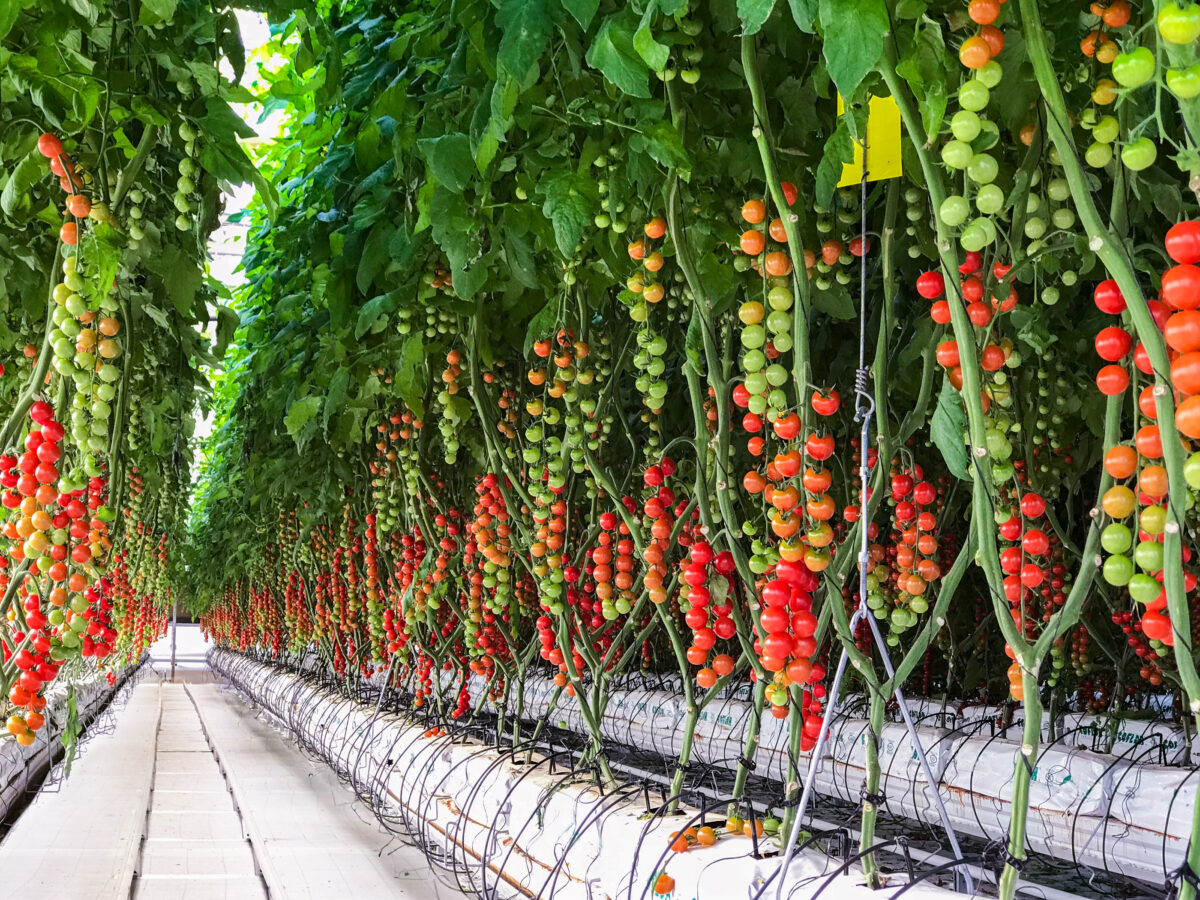
I'd also add that while picking is the glamorous AI task, it's only part of the work. In greenhouses at least (I don't have field-tomato cultivation experience) we do an awful lot to manage the plants**. You have to remove the suckers at every internode on the plant (except those at the base to get the proper number of vines per plant), you have to remove the lower leaves at regular intervals, you have to wind the plants around the string that they grow up, when the plants get tall you have to slide the tops over so that they grow at a diagonal, and on and on. And that's just the management for the mature plants - you also replace your plants at regular intervals, so you have to start new plants grow them, repot them, grow them, then plant them out (not just the planting, but also replacing the growing medium) - plus all of the side stuff like cleaning, managing irrigation, and on and on. Harvesting the fruit is just one task among many.
** To anyone reading this who is surprised about all of the plant manipulation, think of it this way: you have a finite amount of surface area for light to hit, and a finite amount of root volume for each plant. So once your plants get to a size where they're basically using all the light and basically have rooted through the whole growing medium, the only way you can keep their growth in balance as they continue to grow is to keep removing old leaves. And you need to stop any branching immediately because again all that branches would do is just grow into your other plants. And once your plants are so long that they've hit the top of your wires, the only thing you can do is slide the wires over so that the plants are growing (ever-increasingly) diagonally. Nothing you can do about the fact that the stems just keep getting longer and longer as the top continues to grow except replace the plants at regular intervals - you need to let the plant continue to grow because that's how you get new blossoms for fruiting. Removing the lower leaves also has the nice side effect that the tomatoes that are maturing lower down are left fully exposed, making them easy to harvest. You harvest as they hit maturity. Once your plants have hit their max size, you top them and go hard on top/branch removal until the majority of your tomatoes left on the plant are harvest-ready, then take them all. A good trick BTW to boost flavour right before harvest is to significantly up the EC in the irrigation solution (to levels that would normally be wasteful or even detrimental to the plant), as it results in effectively "salting" the tomatoes.
Leave it to Slashdotters to complain about tomato-picking going from "repetitive mindless activity at maximum velocity" to "only the cases that you have to use your brain to think about because a robot isn't smart enough".
I guess we should have people manually screwing the caps onto toothpaste tubes also.
"Don't worry about people stealing your ideas. If your ideas are any good, you'll have to ram them down people's throats." -- Howard Aiken