Forgot your password?
typodupeerror

Submission + - Microsoft wants to kill Docker Desktop on Windows with WSL containers (nerds.xyz)

BrianFagioli writes: Microsoft has opened the public preview of WSL containers, bringing native Linux container support directly into the Windows Subsystem for Linux. The new wslc tool allows developers to build, run, and manage Linux containers without installing separate software such as Docker Desktop.

While Microsoft insists Docker Desktop, Podman Desktop, and Rancher Desktop remain important parts of the ecosystem, the direction seems obvious. If Windows eventually ships with a capable container platform built directly into WSL, many developers may decide they no longer need third-party container tools for everyday work.

The announcement also includes APIs that allow Windows applications to launch Linux containers programmatically, along with enterprise management features, improved file performance, new networking technology, and tighter integration with existing Windows tooling.

Comment Checks can be be useful. (Score 1) 176

Handed directly to recipient institutions or individuals they serve as a firewall against online account compromise.

Checks have use when internet is interrupted during natural disasters and I have so used them. I've never had a check problem in my many decades on the planet because I think before writing. I bank locally and those I pay are protected thereby.

Redundant payment methods including cash come in handy. I keep a couple thousand (small enough to lose, large enough to be useful) bucks handy because buying for cash is preferred at yard sales, estate sales, flea markets, Fecesbook Marketplace etc. It's nice to have an electronic fetish, but that does not address every use case.

I also have two bank accounts, one in each state where I own land. I don't believe in being one-deep where backup is an option.

Submission + - Privacy wins at SCOTUS on geofence warrants (supremecourt.gov)

schwit1 writes: The case Chatrie v. United States (No. 25-112), decided by the Supreme Court on June 29, 2026, centers on the constitutionality of "geofence warrants" under the Fourth Amendment.

The Background
The case originated from a 2019 armed robbery of a credit union in Midlothian, Virginia. Lacking leads, law enforcement obtained a "geofence warrant" directed at Google. This warrant required Google to provide location data for all mobile devices within a 150-meter radius of the bank during a one-hour window around the time of the robbery.

Through a three-step process, Google provided anonymized data for devices in the area, then narrowed the data to specific users, and finally "de-anonymized" three individuals. Okello Chatrie was one of those individuals, and the resulting location history was used to identify him as the suspect and secure his conviction.

The Supreme Court's Ruling
On June 29, 2026, the Supreme Court ruled (6–3) that the government's use of a geofence warrant to acquire this location data constitutes a "search" under the Fourth Amendment.

Reasonable Expectation of Privacy: Writing for the Court, Justice Elena Kagan held that an individual has a reasonable expectation of privacy in their cell phone location information, even when that data is held by a third party like Google.

Rejection of the Third-Party Doctrine: The Court rejected the government's argument that users "voluntarily" shared their location data with Google, noting that modern cell phone use essentially requires this data collection and that such sensitive, detailed tracking creates an expectation of privacy that the Fourth Amendment protects.

The Outcome: By establishing that these actions constitute a search, the Court essentially determined that such warrants must meet constitutional standards of probable cause and particularity. The Court vacated the lower court's decision and remanded the case, instructing the lower courts to determine if the specific warrant in this instance met those Fourth Amendment requirements.

In short, the decision represents a significant victory for privacy advocates, clarifying that the digital "sweeping" of location data through geofence warrants is subject to the same constitutional protections as other government searches.

Submission + - Microsoft fake Windows error ended in a $280 million secret settlement (makeuseof.com)

joshuark writes: Facing real competition from Digital Research's DR DOS, Microsoft secretly embedded a sabotaging mechanism known as "AARD code" into beta versions of Windows 3.1 to prevent it from running on Digital Research's competing DR DOS operating system.
This code triggered fake, alarming error messages to convince developers that DR DOS was unstable, effectively eliminating a significant market threat through fear, uncertainty, and doubt. Although the company disabled the feature in the final retail release, the California-based firm Caldera, Inc., which had acquired DR DOS assets, sued Microsoft for anti-competitive practices.
Microsoft settled the lawsuit out of court in 2000 for $280 million, a figure that remained sealed until it was unsealed in 2009. Nothing says taking ownership and responsibility than keeping it a sealed secret for a decade. Microsoft paid for being clumsy enough to write the intent down in an email. The lesson the industry took away wasn't "don't do it." It was "don't put it in writing." Something Bill Gates forgot with Epstein.

Comment Re:Tooling exceeds Machinist Cost (Score 1) 121

"If you the same programmer can be x20 more productive"
That's a big "if". Most studies show a 50-100% increase in code output at best, and code produced with AI assistance requires more rework. Measuring end-to-end, AI increased developer productivity by 10-30% or so. Sure, the tools are still improving, and developers are still learning how to use them to best advantage, but we're a long long way off from a x20 increase. That will likely require a breakthrough rather than incremental improvement of AI coding tools. The only other way this will ever make sense if the cost of running AI decreases dramatically.

Comment This is an interesting topic, at least to me. (Score 1) 2

I have been stress-testing AIs with increasingly complex projects for some time. The Chinese AIs struggle, but actually do a FAR better job of handling massively complex tasks than Grok, and Gemini just rolls over and whimpers at anything above a very low level of complexity.

What I've found is that the Chinese AIs tend to be sycophant but do "understand" complex projects properly in that you can ask specific technical questions and the answers will be generally very accurate. Any sort of critical analysis is beyond them, though. (Ether that, or I'm a mega-genius. Which....doesn't sound terribly likely.)

Of the "Top AIs", ChatGPT is good on basics but is incapable of any kind of detailed generation. Claude is brilliant at detailed generation, but overloads with anything but a tiny data set.

I've been putting up the projects on Gitlab for a while, so anyone who wants to see an AI break down and cry in despair is able to do so.

The secret tools don't bother me - they'll have long understood how to use Big Data and Analysis of Competing Hypotheses. AI isn't going to find out any more than combinations of those tools will, because that's basically all AI is - a Big Data classification system.

Submission + - The MOST artificial intelligence is Chinese? (linkedin.com) 2

shanen writes: Pardon my clickbait and quasi-joke Title suggestion, but the topic has been on my mind for a while. I have not been pursuing the research topic seriously, though I did take several close looks at DeepSeek when it was the center of hoopla and have sometimes benchmarked against it since then. But this summary of new Chinese AI was just pushed at me by the AI-empowered algorithms of LinkedIn and I'm wondering how seriously I should take it.

If we (non-Chinese?) were actually technically ahead of them (Chinese heathens?) then this would not be an issue. Unlike the computer security race we lost a few years ago? However the real concern is not with these public AI tools, but with the secret ones, both government and private... (Bond villain conspiracy theories, anyone?) But I don't think there is likely to be an outspoken and authentic expert from inside China also inside the (Slashdot) house.

Personal disclaimers needed? Lately most of my AI games of the non-fun type have involved Claude, but Gemini keeps sticking it's remarkably unintelligent nose into my business to the point where I've become much more tolerant of Bing than I used to be. More broadly, there used to be a time when I would have high confidence of seeing useful discussions on Slashdot with some known experts who were probably the real people to boot (in at least two senses of "real"), but these days Slashdot has also been infected with the lack-of-trust virus. Another terminal case? I can't say, but I'm no longer surprised when one of the oldtimers keels over. Bash.org had a great collection of jokes...

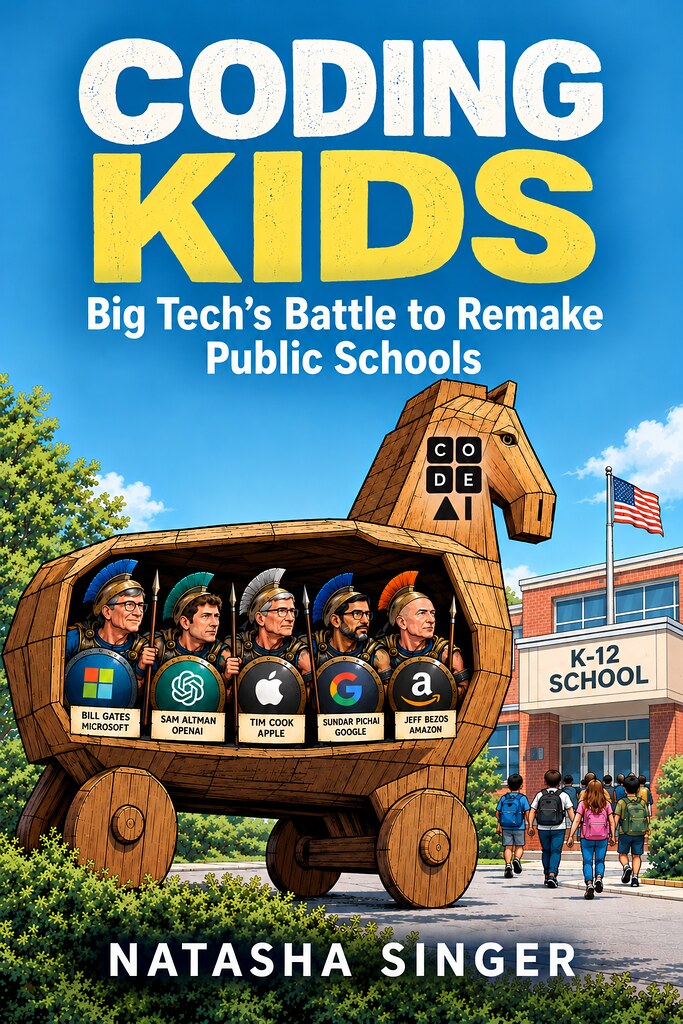
Submission + - LA Schools Chief Resigns Amid FBI Probe Into Failed K-12 AI Chatbot Company

theodp writes: "Four years after leaving Miami-Dade County Public Schools for one of the nation’s most prominent education jobs, Alberto Carvalho has resigned as superintendent of Los Angeles schools amid an FBI investigation," reports the Miami Herald. "The FBI has conducted raids on Carvalho’s Los Angeles home and office as part of a probe into a multimillion-dollar contract awarded to a failed AI-focused education company [AllHere Education]. Investigators also raided the Broward County home of a lobbyist connected to the deal. Carvalho led Miami-Dade public schools for 14 years before joining Los Angeles Unified School District in Feb. 2022. The lobbyist, Debra Kerr, had previously sold hundreds of thousands worth of textbooks to the Miami-Dade County school district and was retained as a salesperson for the startup chatbot company when it dealt with the Los Angeles district."

In What Will It Take to Get A.I. Out of Schools?, The New Yorker's Jessica Winter points out that "Carvalho, who has denied any wrongdoing, is also on the board of [tech-backed nonprofit] Code.org [recently rebranded to CodeAI], purveyors of Mix & Move with AI," Code.org's signature tutorial for its 2025 Hour of AI, which was built on the Carvalho-endorsed Music Lab, Code.org's signature tutorial for its 2024 Hour of Code that was developed with Amazon ("Code.org has mastered the art of bringing joy and curiosity into the classroom," Carvalho gushed in a press release, "while preparing students with essential computer science skills, and Music Lab is the perfect example.”). Winter is not as big a fan of the nonprofit's edtech software as Carvalho, writing that the "Certificate of Completion," her 3rd grader brought home from school for "demonstrating an understanding of the basic concepts of Artificial Intelligence" was for "playing a computer game produced by the nonprofit Code.org in partnership with Amazon Future Engineer, called Mix & Move with AI, in which the student 'designs' a cartoon dancer and 'remixes' a popular song—available, needless to say, on Amazon Music. The game is an inane drag-and-drop affair that has little to do with A.I.; the certificate, it turned out, was merely a memento of a pointless and deceptive branding exercise [Amazon is a $30+ million Code.org Lifetime Supporter]."

Carvalho has been scrubbed from the Code.org Board of Directors page — archive.org webpage captures suggest a change was made on Wednesday, three days after his Sunday resignation and on the same day that Carvalho's replacement was named by the Los Angeles Unified School District (LAUSD). Curiously, the Miami Herald earlier reported a firm registered to current Code.org Board Member and former Broward County (FL) Schools Superintendent Robert Runcie is listed as a creditor in bankruptcy files for AllHere Education, the provider of LAUSD's failed "Ed" AI chatbot that's at the center of the FBI investigation.

And on Tuesday — two days after Carvalho's resignation — LAUSD banned screen time before the second grade and enacted limited use for older students, among the strictest policies in the nation, reflecting growing backlash from parents and educators concerned about an over-reliance on computers and technology in K-12 learning.

Comment Why should a mere eight-mile gas pipeline be news? (Score 3) 46

It's the most efficient, safest way to move fuel without burdening rail and road nets with LNG tankers which are large mobile fire and explosion hazards.

That's why there are well over two million miles of natgas pipeline in the US so far. Eight miles should impress no one. Andrew Carnegie drilled natgas wells and built a twenty mile pipeline to Pittsburgh steel plants in the 1880s.

Comment Ok. (Score 4, Interesting) 81

So you're telling Claude something vague and washy, then Claude invents a prompt that might vaguely possibly be somehow related to what you want along with a drink that is almost but not entirely quite unlike tea. Claude then recurses through this until it has a Celtic knot so intricate that it has its own Hausdorff dimension. What burps out is a product that is completely useless and patented to the Sirius Cybernetics Corporation.

Slashdot Top Deals

Know Thy User.

Working...