Forgot your password?
typodupeerror

Comment Re:Honesty (Score 1) 82

> I think this is the result of their trainers trying to reduce hallucination.

Most probably. I don't like LLMs burning my precious tokens blathering on about being honest, but I will accept the tradeoff. Grudgingly haha.

> My iron rule is that Claude is not allowed to modify git state, not even to stage or unstage, and definitely not to commit. As long as that rule is followed, any mistakes can be cleaned up easily.

I have a repo in a sandbox with no remote. Claude is quite good at pushing commits to this repo during its own milestones during development, and it will use it to hunt down bugs when tests fail after a commit, stepping back to a commit before this session's work to see if this is a new bug , or a new way to expose an existing bug. If it sees that it is a new way to exercise an existing bug, it will binary search its way through the commits until it narrows down what changed, and then looks at how to fix it.

Comment Re:Honesty (Score 1) 82

I disagree with all your assertions.

> AI has access to your command line to autonomously execute commands. No no no.

Ok, I must admit that I did cast that line off the back of the good ship ColaMan without any further information in order to see if anyone would bite.

You think that particular command line has anything of worth in it? The only thing in there that I can't recreate with one command is the local Git repository that the LLM commits its changes to. And that's only because I manually copy it out of the LLM's sandbox on occasion. I should probably automate that one day.

> you enabled an LLM to do destructive things and then complain when there is destruction.

There has been no destruction in it's little sandbox that I care about. It created a faulty command that got escaped by the shell, and oh shit, nothing of importance happened, because even if that command had been 'rm -rf /' I just would have had to return to the last backed up git that I had. That takes about 5 minutes I suppose. The amount of effort that LLM has saved me over the last two months is probably about a year's worth of full time coding, so I'm going to look past any accidental nuclear holocausts where it turns all the sand in its sandbox to glass.

Look. LLMs are just tools. Some tools are great, some tools are shit. This particular class of tool is great at all that boilerplate stuff that can get you 50 - 80 percent of the way to completing a task that you need to do today, if you already have enough skill to know how to do the task. It's been quite useful going through all my old projects in 'code review' mode, because it can often see security/usability/structural issues or improvements that I frankly could not be arsed to deal with when I wrote them. It is in no way ready to replace a human for any sustained length of time, and anyone with a shred of intellect can see that.

Personally, I don't think the AI bubble is going to last much longer. So I'm quite happily burning up Anthropic's compute time finishing off/cleaning up heaps of small home and work projects before a single question costs $8.25 for the LLM to answer.

Comment Honesty (Score 5, Insightful) 82

I'm seeing more and more references to "Honest" in AI output, or AI-related comments.

The AI didn't make an "Honest" mistake. It does not have the capacity for honesty. The output from a LLM is phrased in such a manner to provoke empathy, in a similar way to how Microsoft re-jigged all their user interaction dialogs to include "We" to soften the blow of their crappy software failing the user for the 5th time today. (Side note: "Something went wrong" is the most infuriating error message ever.)

When I ask a LLM for a code review it often blurts out "Honest note:" about some shortcomings. I don't care about "honesty". I care about safe, working, robust, code. The fact that LLMs are tripping over themselves trying to be "Honest" about mistakes in their "path of most statistics" output is a concern if you care about trying to make them operate outside their sandbox in the real world.

Yesterday Claude quoted a word in backticks during an automatic git commit and my shell escaped it tried to execute it. Luckily the word was just an English word with nothing matching in my path. But this is basic, basic, basic stuff. It's been committing things to git ever since it was built, and yet, it keeps tripping over itself. In my code one of the tests keeps failing due to seed data timestamps not lining up with the datetime the test was run. I can see that. Every time Claude runs the tests, it burns up tokens going, "Oh this particular test failed I'll just dig into things and see what's going on, **$$**$$**$$** oh it's just a timestamp issue". Never once does it commit that to its memory file, so eventually I told it to remove the test, and it just added a comment to it saying "Ignore this test due to timestamp misalignment", which it could have done the very first time, if it actually had a brain.

LLMs are a very handy tool if used right. I can get huge chunks of boilerplate code out of them with just a few sentences and that's great when I'm hashing out a concept. But to promise the world (and your investors) that LLMs are ready to replace people out in the real world, where "Honest Mistakes" have Real World Repercussions, that's outright fraud at this stage.

Comment Re:Archiving data (Score 1) 85

> It will randomize over a surprisingly short time if it doesn't have power for data maintenance.

If you plug in a USB stick, you just power up the controller and the flash memory chip. You have to read everything and write everything to charge the cells back up again, there is no background refresh going on like in DRAM.

Submission + - Fifteen Years Later, Citizens United Defined the 2024 Election (brennancenter.org)

NewYorkCountryLawyer writes: The influence of wealthy donors and dark money was unprecedented. Much of it would have been illegal before the Supreme Court swept away long-established campaign finance rules. Citizens United v. Federal Election Commission, the Supreme Court’s controversial 2010 decision that swept away more than a century’s worth of campaign finance safeguards, turns 15 this month. The late Justice Ruth Bader Ginsburg called it the worst ruling of her time on the Court. Overwhelming majorities of Americans have consistently expressed disapproval of the ruling, with at least 22 states and hundreds of cities voting to support a constitutional amendment to overturn it. Citizens United reshaped political campaigns in profound ways, giving corporations and billionaire-funded super PACs a central role in U.S. elections and making untraceable dark money a major force in politics. And yet it may only be now, in the aftermath of the 2024 election, that we can begin to understand the full impact of the decision.

Submission + - Anti-Trump Searches Appear Hidden on TikTok (ibtimes.com)

AmiMoJo writes: Searches for anti-Trump content are now appearing hidden on TikTok for many users after the app came back online in the U.S. TikTok users have taken to Twitter to share that when they search for topics negatively related to President Donald Trump, a message pops up saying "No results found" and that the phrases may violate the app's guidelines. One user said that when they tried to search "Donald Trump rigged election" on a U.S. account, they were met with blocked results. Meanwhile, the same phrase searched from a U.K. account prompted results. Another user shared video of them switching between a U.S. and U.K. VPN to back up the user's viral claims, which has since amassed more than 187,000 likes.
Crime

Silk Road Creator Ross Ulbricht Pardoned (bbc.com) 339

Slashdot readers jkister and databasecowgirl share the news of President Donald Trump issuing a pardon to Silk Road creator Ross Ulbricht. An anonymous reader shares a report from the BBC: US President Donald Trump says he has signed a full and unconditional pardon for Ross Ulbricht, who operated Silk Road, the dark web marketplace where illegal drugs were sold. Ulbricht was convicted in 2015 in New York in a narcotics and money laundering conspiracy and sentenced to life in prison. Trump posted on his Truth Social platform that he had called Ulbricht's mother to inform her that he had granted a pardon to her son. Silk Road, which was shut down in 2013 after police arrested Ulbricht, sold illegal drugs using Bitcoin, as well as hacking equipment and stolen passports.

"The scum that worked to convict him were some of the same lunatics who were involved in the modern day weaponization of government against me," Trump said in his post online on Tuesday evening. "He was given two life sentences, plus 40 years. Ridiculous!" Ulbricht was found guilty of charges including conspiracy to commit drug trafficking, money laundering and computer hacking. During his trial, prosecutors said Ulbricht's website, hosted on the hidden "dark web", sold more than $200 million worth of drugs anonymously.

Submission + - Trump Pardons Silk Road Founder (nypost.com)

databasecowgirl writes: President Trump announced Tuesday night that he had granted a âoefull and unconditionalâ pardon to Ross Ulbricht, founder of the notorious dark web site Silk Road.

Submission + - Decentralized Social Media Is the Only Alternative to the Tech Oligarchy (404media.co)

An anonymous reader writes: If it wasn’t already obvious, the last 72 hours have made it crystal clear that it is urgent to build and mainstream alternative, decentralized social media platforms that are resistant to government censorship and control, are not owned by oligarchs and dominated by their algorithms, and in which users own their follower list and can port it elsewhere easily and without restriction. [...] Mastodon’s ActivityPub and Bluesky’s AT.Protocol have provided the base technology layer to make this possible, and have laid important groundwork over the last few years to decorporatize and decentralize the social internet.

The problem with decentralized social media platforms thus far is that their user base is minuscule compared to platforms like TikTok, Facebook, and Instagram, meaning the cultural and political influence has lagged behind them. You also cannot directly monetize an audience on Bluesky or Mastodon—which, to be clear, is a feature, not a bug—but also means that the value proposition for an influencer who makes money through the TikTok creator program or a small business that makes money selling chewing gum on TikTok shop or a clothes brand that has figured out how to arbitrage Instagram ads to sell flannel shirts is not exactly clear. I am not advocating for decentralized social media to implement ads and creator payment programs. I’m just saying that many TikTok influencers were directing their collective hundreds of millions of fans to follow them to Instagram or YouTube, not a decentralized alternative.

This doesn’t mean that the fediverse or that a decentralized Instagram or TikTok competitor that runs on the AT.Protocol is doomed. But there is a lot of work to do. There is development work that needs to be done (and is being done) to make decentralized protocols easier to join and use and more interoperable with each other. And there is a massive education and recruitment challenge required to get the masses to not just try out decentralized platforms but to earnestly use them. Bluesky’s growing user base and rise as a legitimately impressive platform that one can post to without feeling like it’s going into the void is a massive step forward, and proof that it is possible to build thriving alternative platforms. The fact that Meta recently blocked links to a decentralized Instagram alternative shows that big tech sees these platforms, potentially, as a real threat.

Submission + - TikTok is censoring anti-Trump content (newsweek.com)

smooth wombat writes: After going dark for 12 hours in response to a U.S. law saying it must divest from Chinese ownership, TikTok came back on line when the new administration took office. However, once up and running, users found one unexpected change. Anti-Trump content is now being censored. Words, phrases, and videos which were readily accessible pre-blackout were now unavailable or being removed entirely.

A post on X, formerly Twitter, which has received 4.5 million views at the time of reporting, claims that "TikTok is now region locking Americans from looking up things like "fascism" and "Donald Trump rigged election"."

The post includes two screenshots of the TikTok app. The screenshot is of the search page, and in both the search term is "Donald Trump rigged election." The post states that: "On the left are results from a device in America, and on the right are results from one in the UK."

The post on the left shows a results page stating "No results found," while on the left it shows two videos of the President.

Another post from the account Dustin Genereux said that, "Censorship on TikTok is at an all time high with accounts being deleted, posts going back years being flagged, people losing access to the creator fund for saying anything Anti-Trump, MAGA, Elon, etc. But free speech and all that right?"

Earth

Great Barrier Reef Hit By Its Most Widespread Coral Bleaching, Study Finds (theguardian.com) 15

More than 40% of individual corals monitored around a Great Barrier Reef island were killed last year in the most widespread coral bleaching outbreak to hit the reef system, a study has found. The Guardian: Scientists tracked 462 colonies of corals at One Tree Island in the southern part of the Great Barrier Reef after heat stress began to turn the corals white in early 2024. Researchers said they encountered "catastrophic" scenes at the reef.

Only 92 coral colonies escaped bleaching entirely and by July, when the analysis for the study ended, 193 were dead and a further 113 were still showing signs of bleaching. Prof Maria Byrne, a marine biologist at the University of Sydney and lead author of the study, has been researching and visiting the island for 35 years.

Communications

Brendan Carr is Officially in Charge of the FCC (theverge.com) 71

An anonymous reader shares a report: Brendan Carr is now formally the chair of the Federal Communications Commission, giving him the power to set the agency's agenda and usher through a host of regulations with major implications for the tech and media industries as soon as he has a Republican majority. In a statement, Carr named a few areas of focus: "issues ranging from tech and media regulation to unleashing new opportunities for jobs and growth through agency actions on spectrum, infrastructure, and the space economy."

Carr's priorities might also be gleaned from a document you might have already heard about: Project 2025. That's because he authored the FCC chapter of the Heritage Foundation's wishlist for a Donald Trump presidency. In that chapter, Carr proposes actions including: limiting immunity for tech companies under Section 230 of the Communications Decency Act, requiring disclosures about how platforms prioritize content, requiring tech companies to pay into a program that funds broadband access in rural areas, and more, quickly approving applications to launch satellites from companies like Elon Musk's Starlink.

AI

Authors Seek Meta's Torrent Client Logs and Seeding Data In AI Piracy Probe (torrentfreak.com) 15

An anonymous reader quotes a report from TorrentFreak: Meta is among a long list of companies being sued for allegedly using pirated material to train its AI models. Meta has never denied using copyrighted works but stressed that it would rely on a fair use defense. However, with rightsholders in one case asking for torrent client data and 'seeding lists' for millions of books allegedly shared in public, the case now takes a geeky turn. [...] A few weeks ago, the plaintiffs asked for permission to submit a third amended complaint (PDF). After uncovering Meta's use of BitTorrent to source copyright-infringing training data from pirate shadow library, LibGen, the request was justified, they argued. Specifically, the authors say that Meta willingly used BitTorrent to download pirated books from LibGen, knowing that was legally problematic. As a result, Meta allegedly shared copies of these books with other people, as is common with the use of BitTorrent.

"By downloading through the bit torrent protocol, Meta knew it was facilitating further copyright infringement by acting as a distribution point for other users of pirated books," the amended complaint notes. "Put another way, by opting to use a bit torrent system to download LibGen's voluminous collection of pirated books, Meta 'seeded' pirated books to other users worldwide." Meta believed that the allegations weren't sufficiently new to warrant an update to the complaint. The company argued that it was already a well-known fact that it used books from these third-party sources, including LibGen. However, the authors maintained that the 'torrent' angle is novel and important enough to warrant an update. Last week, United States District Judge Vince Chhabria agreed, allowing the introduction of these new allegations. In addition to greenlighting the amended complaint, the Judge also allowed the authors to conduct further testimony on the "seeding" angle. "[E]vidence about seeding is relevant to the existing claim because it is potentially relevant to the plaintiffs' assertion of willful infringement or to Meta's fair use defense," Judge Chhabria wrote last week.

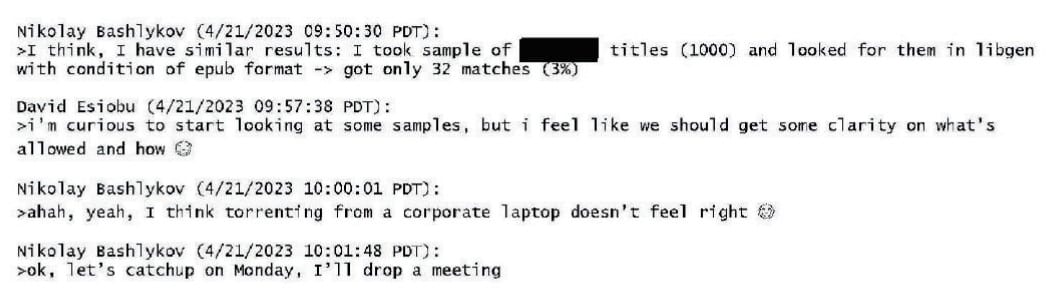
With the court recognizing the relevance of Meta's torrenting activity, the plaintiffs requested reconsideration of an earlier order, where discovery on BitTorrent-related matters was denied. Through a filing submitted last Wednesday, the plaintiffs hope to compel Meta to produce its BitTorrent logs and settings, including peer lists and seeding data. "The Order denied Plaintiffs' motion to compel production of torrenting data, including Meta's BitTorrent client, application logs, and peer lists. This data will evidence how much content Meta torrented from shadow libraries and how much it seeded to third parties as a host of this stolen IP," they write. While archiving lists of seeders is not a typical feature for a torrent client, the authors are requesting Meta to disclose any relevant data. In addition, they also want the court to reconsider its ruling regarding the crime-fraud exception. That's important, they suggest, as Meta's legal counsel was allegedly involved in matters related to torrenting. "Meta, with the involvement of in-house counsel, decided to obtain copyrighted works without permission from online databases of copyrighted works that 'we know to be pirated, such as LibGen," they write. The authors allege that this involved "seeding" files and that Meta attempted to "conceal its actions" by limiting the amount of data shared with the public. One Meta employee also asked for guidance, as "torrenting from a corporate laptop doesn't feel right."

Slashdot Top Deals

Tomorrow's computers some time next month. -- DEC

Working...