Forgot your password?
typodupeerror

Submission + - Biden DOJ Halts Trump Admin Lawsuit Against California Net Neutrality Rules (arstechnica.com)

An anonymous reader writes: The Biden administration has abandoned a Trump-era lawsuit that sought to block California's net neutrality law. In a court filing today, the US Department of Justice said it "hereby gives notice of its voluntary dismissal of this case." Shortly after, the court announced that the case is "dismissed in its entirety" and "all pending motions in this action are denied as moot."

The case began when Trump's DOJ sued California in September 2018 in US District Court for the Eastern District of California, trying to block a state net neutrality law similar to the US net neutrality law repealed by the Ajit Pai-led FCC. Though Pai's FCC lost an attempt to impose a blanket, nationwide preemption of any state net neutrality law, the US government's lawsuit against the California law was moving forward in the final months of the Trump administration.

The Biden DOJ's voluntary dismissal of the case puts an end to that. "I am pleased that the Department of Justice has withdrawn this lawsuit," FCC Acting Chairwoman Jessica Rosenworcel said today. "When the FCC, over my objection, rolled back its net neutrality policies, states like California sought to fill the void with their own laws. By taking this step, Washington is listening to the American people, who overwhelmingly support an open Internet, and is charting a course to once again make net neutrality the law of the land."

Submission + - Did Linux Kill Commercial Unix? (howtogeek.com) 3

sbinning writes: Did Linux killed its ancestor by becoming a perfectly viable replacement, like an operating system version of Invasion of the Body Snatchers? Or, did Linux stop Unix in its tracks, and then jumped in its shoes.

A short history of UNIX and how Linux got its start.

Submission + - Why is America getting a new $100 billion nuclear weapon? (thebulletin.org)

DanDrollette writes: A comprehensive look at the US' new (and expensive, unnecessary, and highly vulnerable) land-based nuclear missile. Many of the missile’s critics are former military leaders, and their criticism has to do with its immovable silos. Relative to nuclear missiles on submarines, which can slink around undetected, or nuclear bombs on airplanes—the two other legs of the nuclear "triad"—America’s land-based nuclear missiles are easy marks.

Submission + - Darkened SpaceX Satellites Can Still Disrupt Astronomy, New Research Suggests (gizmodo.com)

Anonymouse Cowtard writes: SpaceXâ(TM)s attempt to reduce the reflectivity of Starlink satellites is working, but not to the degree required by astronomers.

It's an improvement, but still not good enough, according to the team, led by astronomer Takashi Horiuchi from the National Astronomical Observatory in Japan. These "DarkSats", as they're called, also continue to cause problems at other wavelengths of light.

The first batch of orbiting Starlink satellites is brighter than 99% of objects in low Earth orbit. This is a huge concern, given Elon Muskâ(TM)s desire to launch upwards of 12,000 Starlink satellites and possibly as many as 42,000.

Submission + - SPAM: Japan team maps 'semi-infinite' trove of rare earth elements

schwit1 writes: Japanese researchers have mapped vast reserves of rare earth elements in deep-sea mud, enough to feed global demand on a “semi-infinite basis,” according to a new study.

The deposit, found within Japan’s exclusive economic zone waters, contains more than 16 million tons of the elements needed to build high-tech products ranging from mobile phones to electric vehicles, according to the study, released Tuesday in the journal Scientific Reports. The team, comprised of several universities, businesses and government institutions, surveyed the western Pacific Ocean near Minamitori Island.

In a sample area of the mineral-rich region, the team’s survey estimated 1.2 million tons of “rare earth oxide” is deposited there, said the study, conducted jointly by Waseda University’s Yutaro Takaya and the University of Tokyo’s Yasuhiro Kato, among others.

The finding extrapolates that a 2,500-sq. km region off the southern Japanese island should contain 16 million tons of the valuable elements, and “has the potential to supply these metals on a semi-infinite basis to the world,” the study said.

Link to Original Source

Submission + - Regionally encoded toner cartridges 'to serve customers better' (techdirt.com)

sandbagger writes: The latest attempt to create artifical scarcity comes from Xerox according to the editors at TechDirt who cite German sources: Xerox uses region coding on their toner catridges AND locks the printer to the first type used. So if you use a North America catridge you can't use the cheaper Eastern Europe cartridges. The printer's display doesn't show this, nor does the hotline know about it. When c't reached out to Xerox, the marketing drone claimed, this was done to serve the customer better,

Submission + - Think Tanks: How a Bill [Gates Agenda] Becomes a Law

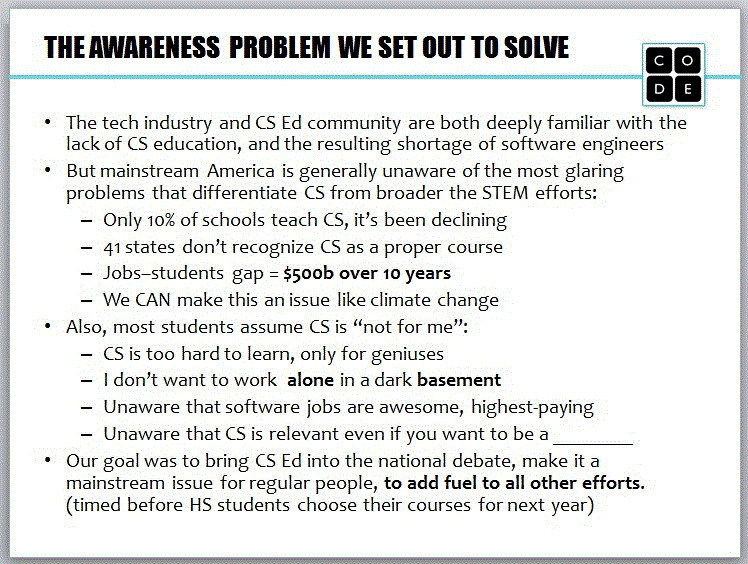
theodp writes: The NY Times' Eric Lipton was just awarded a 2015 Pulitzer Prize for investigative reporting that shed light on how foreign powers buy influence at think tanks. So, it probably bears mentioning that Microsoft's 'two-pronged' National Talent Strategy to increase K-12 CS education and the number of H-1B visas — which is on the verge of being codified into laws by the President and lawmakers — was hatched at an influential Microsoft and Gates Foundation-backed think tank mentioned in Lipton's reporting, the Brookings Institution. In 2012, the Center for Technology Innovation at Brookings hosted a forum on STEM education and immigration reforms, where fabricating a crisis was discussed as a strategy to succeed with Microsoft's agenda where earlier lobbying attempts by Bill Gates and Microsoft had failed. "So, Brad [Microsoft General Counsel Brad Smith]," asked the Brookings Institution's Darrell West at the event, "you're the only [one] who mentioned this topic of making the problem bigger. So, we galvanize action by really producing a crisis, I take it?" "Yeah," Smith replied (video). And, with the help of nonprofit organizations like Code.org and FWD.us that were founded shortly thereafter, a national K-12 CS and tech immigration crisis was indeed created. Last December, as Microsoft-backed Code.org 'taught President Obama to code' at a White House event to kick off the nations's Hour of Code (as a top Microsoft lobbyist looked on), Microsoft CEO Satya Nadella was also in D.C. publicly lobbying for high-skilled immigration and privately meeting with White House officials on undisclosed matters. And that, kids, is How a Bill [Gates Agenda] Becomes a Law!

Submission + - Reporters Without Borders unblocks access to censored websites (betanews.com)

Mark Wilson writes: Online censorship is rife. In many countries, notably China, citizens are prevented from accessing certain websites at the behest of their government. To help provide access to information and unbiased news, freedom of information organization Reporters Without Borders has set up mirrors to nine censored websites so they can be accessed from 11 countries that blocked them.

As part of Operation Collateral Freedom, Reporters Without Borders is mirroring the likes of The Tibet Post International which is blocked in China, and Gooya News which is blocked in Iran. Mirrored sites are hosted on Amazon, Microsoft and Google servers which are unlikely to be blocked by a censoring country.

Submission + - Facebook founder presents vision for New Republic and (nearly) everyone resigns (nytimes.com)

SkiTee94 writes: Chris Hughes, one of the original founders of Facebook, is in damage control mode to save his recently acquired century old publication The New Republic. In response to Hughes' vision to turn the highly respected, and most would say old school, publication into a "digital media company" dozens of senior editors and writers simply quit. As a, likely now former, reader myself it seems Hughes doesn't understand that the publication's edge in the market is precisely that it isn't a fluffy clickbait "digital media company." Is simply Hughes a visionary cleaning out dead wood or a clueless one-hit wonder tech star now leaving destruction in his wake? More from the NY Times: http://nyti.ms/1FZs2zL

Submission + - The Guardian reveals that Whisper app tracks 'anonymous' users (theguardian.com)

qqod writes: After visiting the offices of Whisper to discuss future journalistic collaborations, from the article:

"The practice of monitoring the whereabouts of Whisper users â" including those who have expressly opted out of geolocation services â" will alarm users, who are encouraged to disclose intimate details about their private and professional lives.

Whisper is also sharing information with the US Department of Defense gleaned from smartphones it knows are used from military bases, and developing a version of its app to conform with Chinese censorship laws."

Submission + - Physicist Proves Mathematically Black Holes Don't Exist (wncn.com) 2

Koreantoast writes: Black holes, the stellar phenomena that continues to capture the imagination of scientists and science fiction authors, may not actually exist. According to a paper published by Physics professor Laura Mersini-Houghton at the University of North Carolina and Mathematics Professor Harald Pfeiffer of the University of Toronto, as a collapsing star emits Hawking radiation, it also sheds mass at a rate that it no longer has the density necessary to become a black hole; the singularity and event horizon never forms. While the ArXiv paper with the exact solution has not been peer reviewed, the preceding paper by Mersini-Houghton with the approximate solutions was published in Physics Letters B.

"I'm still not over the shock," said Mersini-Houghton. "We've been studying this problem for a more than 50 years and this solution gives us a lot to think about... Physicists have been trying to merge these two theories – Einstein's theory of gravity and quantum mechanics – for decades, but this scenario brings these two theories together, into harmony."

Submission + - Biggest "patent troll" slapped hard by appeals court (arstechnica.com)

mpicpp writes: Dozens of companies were sued over an old Polaroid digital imaging patent.

The most litigious "patent troll" in the US has lost a major case after the US Court of Appeals for the Federal Circuit found its patent was too abstract.

Court declines to stop software patents altogether.

The ruling from last week is one of the first to apply new Supreme Court guidance about when ideas are too "abstract" to be patented. In the recent Alice v. CLS Bank case, the high court made clear that adding what amounts to fancy computer language to patents on basic ideas shouldn't hold up in court.

The patents in this case describe a type of "device profile" that allows digital images to be accurately displayed on different devices. US Patent No. 6,128,415 was originally filed by Polaroid in 1996. After a series of transfers, in 2012 the patent was sold to Digitech Image Technologies, a branch of Acacia Research Corporation, the largest publicly traded patent assertion company. A study on "patent trolls" by RPX found that Acacia Research Corporation was the most litigious troll of 2013, having filed 239 patent lawsuits last year.

Submission + - Norway scraps online voting (bbc.com)

An anonymous reader writes: The BBC writes that Norway will no longer experiment with online voting.

Submission + - US Court Rules Against Government for Using Seized Data Beyond Scope of Warrant

An anonymous reader writes: The U.S. Court of Appeals for the 2nd Circuit last week reversed a tax evasion conviction against an accountant because the government had used data from his computers that were seized under a warrant targeting different suspects. The Fourth Amendment, the court pointed out, 'prevents the seizure of one thing under a warrant describing another.' Law enforcement originally made copies of his hard drives and during off-site processing, separated his personal files from data related to the original warrant. However, 1.5 years later, the government sifted through his personal files and used what it found to build a case against him. The appeals court held that '[i]f the Government could seize and retain non-responsive electronic records indefinitely, so it could search them whenever it later developed probable cause, every warrant to search for particular electronic data would become, in essence, a general warrant', which the Fourth Amendment protects against. The EFF hopes that the outcome of this appeal will have implications for the NSA's dragnet surveillance practice.

Slashdot Top Deals

Evolution is a million line computer program falling into place by accident.

Working...