Forgot your password?
typodupeerror
Patents

Submission + - Acacia sues Amazon over Fire (cnet.com)

walterbyrd writes: "A company called Smartphone Technologies filed the suit last Friday in Texas Eastern District Court accusing the Fire tablet of violating four of its patents. Smartphone Technologies is owned by Acacia Research, a firm that buys and licenses patents and is seen by many as a patent troll."
Software

Submission + - Opera ditches browser scrolling for "pages" (pcpro.co.uk)

Barence writes: "Opera has unveiled a new Reader system that ditches scrolling on websites in favour of flippable pages. The Norwegian browser maker is looking to remove the side scroll bar for documents or articles in favour of "pages" of a set-size, similar to an ebook. Text can be reflowed into a column layout, and ads will be moved into the right spot in the text, with different ones displayed depending on the orientation of the device. Pages are flipped with gestures on tablets or with mouse clicks on the desktop. It's an “opportunity to rethink the ads on the web and the user interface”, said Hakon Wium Lie, Opera's CTO."

Submission + - Cloned drug sniffing dogs prove successful in S. K (singularityhub.com)

Rexdude writes: A prize drug sniffing dog at Incheon Airport in S Korea was cloned 4 years ago, and now the clones have proved to be much more successful at becoming sniffer dogs themselves compared to regular dogs. Not as controversial as human cloning, but are we going to see genetic copyrights on prized animal breeds in the future?
Hardware Hacking

Submission + - Chinese Magical Hard-Drive (jitbit.com)

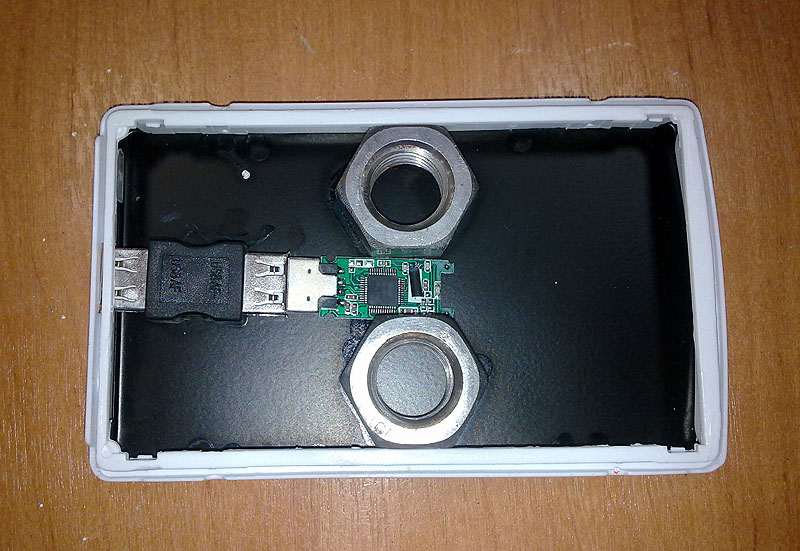
jamax writes: From TFA: "A Russian friend .... works at a hard-drive repair center in a Russian town, located near the Chinese border. A couple of days ago a customer has brought a broken 500Gb USB-drive that he had bought in a Chinese store across the river, for an insanely low price. But the drive was not working: if you, say, save a movie onto the drive, playing the saved movie back resulted in replaying just the last 5 minutes of the film."
    Apparently the contents of the external HDD box included: two nuts, glued to the inner surface of the box with a 128MB flash drive wedged between them (image)..
  And it was a clever hack too — if ever an attempt was made of writing a file that's too large it got sort of cycled — rewriting itself over and over from the beginning, while leaving the existing files intact. And it reported everything correctly — file sizes and all!

Hardware Hacking

Submission + - Sony Plans Serial Keys for PlayStation3 Games (thinq.co.uk)

Stoobalou writes: Rumour has it that Sony is looking to the PC games market to help solve its growing piracy problem on the PlayStation 3 — with the introduction of serial keys to its games.

According to 'a very reliable source' quoted by PS3-Sense, Sony is attempting to address the recent revelation that it failed to properly secure the private signing key for its flagship console — leading to clever tinkerers producing third-party firmware that allows unofficial software and illegitimately downloaded games to run on unmodified hardware — by looking to the PC retail market for solutions.

Unlike the PS3, the PC doesn't have a hardware DRM system built in to it — despite attempts by groups like the Trusted Computing Group, formerly the Trusted Computer Platform Alliance, to introduce such a thing — relying instead on software-based DRM and a surprisingly old-fashioned guarantee of a game's uniqueness: a serial key.

Google

Submission + - Google Discontinues On2 Flix Engine Video Encoder (on2.com)

trawg writes: Google have recently discontinued sales of the Flix Engine, the last remnants of the purchase of On2 that they were selling directly to users. On2, developers of the VP8 video codec that formed the basis of their new WebM video format, was bought by Google early in 2010. The Flix Engine was a comprehensive API for Windows and Linux that allowed integration of On2 encoders directly into any software product. While you can still buy some On2 products from another company, it's not clear what effect this will have on Google's ultimate video strategy.
Image

Hi-Tech Nativity Security 110

To combat vandalism and theft of their holiday displays, many churches and cities are turning to a technological answer. After one of their cows was stolen, St. Marks Episcopal Church in Glen Ellyn, Ill. installed GPS devices in the figurines of its nativity scene. This year the village of Wellington, Fla. added security cameras to protect their display. From the article: "BrickHouse Security in New York City offered churches and synagogues free GPS and cameras to protect their displays this season. Seventy have signed up so far. About 24 of them are also installing security cameras. In Merrick, N.Y., the Chabad Center for Jewish Life is putting GPS in its 8-foot menorah on display in a park."
Robotics

Submission + - Japan’s Robot Picks Only the Ripest Strawber (singularityhub.com)

kkleiner writes: The Institute of Agricultural Machinery at Japan’s National Agriculture and Food Research Organization, along with SI Seiko, has developed a robot that can select and harvest strawberries based on their color. Ripened berries are detected using the robot’s stereoscopic cameras, and analyzed to measure how red they appear. When the fruit is ready to come off the vine, the robot quickly locates it in 3D space and cuts it free. From observation to collection, the harvesting process takes about 9 seconds per berry. Creators estimate that it will be able to cut down harvesting time by 40%.
Education

Submission + - Using the Web to Turn Kids into Autodidacts

theodp writes: Autodidacticism — self-education or self-directed learning — is nothing new, but the Internet holds the promise of taking it to the masses. Sugata Mitra, an Indian physicist whose earlier educational experiments inspired the film 'Slumdog Millionaire,' is convinced that, with the Internet, kids can learn by themselves so long as they are in small groups and have well-posed questions to answer. And now, Mitra's Self-Organized Learning Environments (SOLE) are going global, with testing in schools in Australia, Colombia, England and India. On their own, children can get about 30% of the knowledge required to pass exams, so to go further, Dr. Mitra supplements SOLE with e-mediators, amateur volunteers who use Skype to help kids learn online. While the U.S. has been slow to embrace SOLE, America does its autodidacticism evangelists. Dr. Yung Tae Kim (another physicist) similarly espouses setting up smaller high school and college classes as 'problem solving workshops' where students can work together in groups, with the teacher acting less as an instructor and more as a troubleshooter, helping students if and when they get stuck.

Slashdot Top Deals

The first rule of intelligent tinkering is to save all the parts. -- Paul Erlich

Working...