Forgot your password?
typodupeerror

Comment Re:Very Annoying (Score 2) 115

Actually, I suspect this is part of the continuing effort to drive individuals to use hosting services, offloading the management to a vendor, no matter how cheap. Us hobbyists are a thorn in the side of Internet security, where making a small, seemingly insignificant mistake, leads to your host being a trampoline sending nasty security threats all over the world.

The Internet is still at risk of becoming the even-more-exclusive domain of the corporations. While I worry that RS is a bit too vigilante, truth is we need to defend access for those who just want to do it their way. Responsibly? The biggest of the big boyz screw it up often enough, thank you, we are not the worst problem you have.

Comment Re:How about no rectal divacups (Score 1) 35

Reddit is pus. Has been for a long time. The 10% that isn't vulgar, cruel, abusive, or outright fabricated isn't valuable enough for me to see except accidentally. My search engine still often leads results with pages of Redditt posts.

Hard to believe something worse than Usenet came to be, but there it is...

Submission + - LLM-inspired study sheds light on how brain cells encode the meaning of words (medicalxpress.com)

alternative_right writes: To investigate how the brain encodes the meaning of words, the researchers first recorded the activity of individual neurons in the hippocampus of 10 people who were listening to stories. Their recordings were collected using tiny wire electrodes that were implanted in the participants' brains as part of clinical monitoring procedures for epilepsy.

The team then used mathematical models to analyze the language used in the stories and the brain recordings. This allowed them to examine whether information about the meaning of words could predict the recorded neuronal activity.

"We recorded responses of hippocampal neurons while individuals listened to narrative speech," wrote Melissa Franch and her colleagues in their paper. "Using an encoding model approach, we find robust encoding of semantics, even after controlling for phonemics and grammar. Individual words had complex selectivities that included multiple words in multiple semantic categories."

Comment Re:We also need better programmng (Score 1) 94

>Please just put a sock in it.

No.

The OP complained about low quality programmers and "slop"; clearly a reference to AI generated code.

My retort was to challenge that - to point out that fronteir LLMs are now much better at writing software than most programmers. That is objectively true. It doesn't "feel true"; it _is_ true.

Then someone replied to me to try and snipe at ESR and DHH, as if they weren't both excellent programmers. Both of them are. That wasn't a person arguing against my point; that was the response of someone who COULDNT argue against my point, but was upset about it.

There are some bright and accomplished people here. That's part of what makes the place interesting and valuable.

There are also a lot of drive by haters.

Comment Re:We also need better programmng (Score 1) 94

Those are two examples.

You can also go read what Carmack says about it. (example: x.com post from 2026/9/11)

I hope you won't be so stupid so as to try dunking on Carmack.

I apologize for not knowing you or your accomplishments, but just playing the law of averages, both ESR and DHH have significantly larger bodies of successfully and daily-used code than you do, with bigger impacts on the field and the industry, than you do.

You probably don't have the right to shit on them, given your own lack of contributions.

(But to be fair, I'm just assuming, based on the law of averages. I apologize if I should know you and your great contributions, but do not)

I can say that both of them certainly eclipse _me_ so greatly that I can't be seen on any map that is zoomed out enough to show both of them. And while I am a relative nothing, I've had a handful of patches accepted in my life... and I've secured a few software patents in my day. That puts me in above-average territory. But there's more accomplishment gap between them and I, than there is between me and a person who cannot code at all.

There's no harm in admiring outstanding people. A particular fault of our age is that men do not know how to truly compliment and admire greatness when they find it.

ESR is a great man. DHH is a great man. My world and our industry is better for both of them. When they say that LLMs have completely changed the way they do the thing that they are better than almost all other human beings at... you should listen.

Comment Re:We also need better programmng (Score 1) 94

I agree we need better programmers.

We have better programmers.

The frontier models _are_ better programmers than all but the very best.

Look at the AI related posts from ESR and DHH on twitter. They are _all in_ on AI.

(DHH has been showing benchmarks of web apps being machine-re-written in Rust. Unsurprisingly, the apps get much faster)

A rough estimate is that the best LLMs do software engineering about as well as IQ 150 software engineers do it. That makes them better at it than the vast majority of people who write code.

People see an AI do something they dont like and then conclude "the AI sucks". But lets use honest weights and measures: Human programmers make worse mistakes, and make them more often, and iterate 1000x more slowly.

The way to think about it is this: generally the AI will write better code than the person prompting it would write, and it will do it several OOM faster. That means more code getting written than would otherwise get written, AND, it means that code is higher quality than it would be otherwise.

"Perfect" isn't the bar. "Better and in less time than if the human doing the prompting had written it themselves" is the bar. And that bar has been cleared with by a mile of daylight.

Junior engineers don't normally get to tell IQ 150 engineers what to go do. LLMs change that.

Comment Re:data || GTFO (Score 2) 94

I'm reminded of the arguments had over SCSI RAID controllers, and turning off read-after-write-verify... Since, at the time, SCSI drives did RAWV in hardware, that was redundant on the controller. And in software.

This came to a head, for me, when I queried a Novell Labs fellow about the 'non-media defects' I saw deactivating SCSI drives on servers. They finally gave in and explained, it was a controller defect. Which I challenged. And they finally stated that a drive hardware write error (RAWV fail) would report as 'non-media' because the intervening RAID controller gave it back as a controller error, which was usually wrong, but that was the way it worked. And since SMART didn't exactly work on SCIS, and log sense was not implemented in most RAID controllers, we had minimally useful diagnostics. So I would keep track of the drives that elicited 'non-media defect' messages, and schedule them for replacement.

It's almost a pleasure to read discussions about RAM doublers, etc., and no one remembers when these were bits of software that actually did not do anything useful at all. Ah, the 80s.

Submission + - Amid K-12 AI Pushback, OpenAI Named Lead Partner of 'Hour of AI' for Kids

theodp writes: On the heels of announced AI moratoriums by the nation's two largest K-12 school districts (NYC, LA), tech-backed nonprofit CodeAI (aka Code.org) this week named OpenAI 'Lead Partner' for the 2026 Hour of AI, which has replaced the Hour of Code (RIP, 2013-2024) as the premier event for the nation's K-12 schoolchildren during December's CS Education Week. OpenAI investor and partner Microsoft was named as one of two 'Supporters' for the event/infomercial (the other being U.S. defense contractor Northrop Grumman).

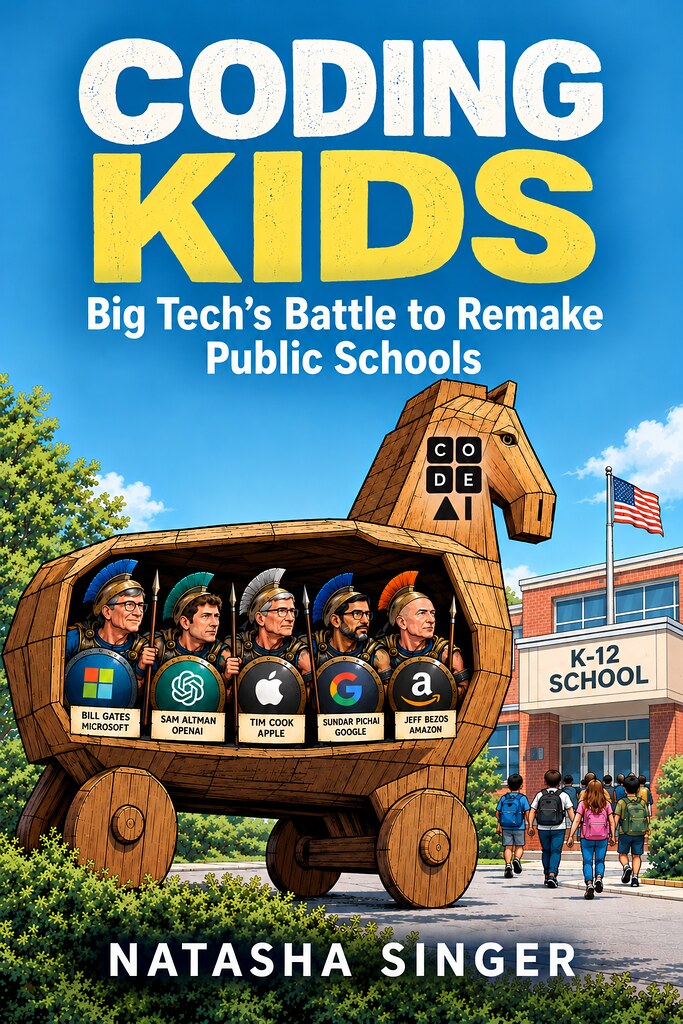
In August, as it launched ChatGPT for Teens, OpenAI announced a new signature partnership with Code.org to 'prepare the first AI generation', explaining that 'through the Hour of AI, OpenAI and CodeAI will introduce millions of students to the basics of using AI thoughtfully and responsibly.' OpenAI and Microsoft last year teamed up with the American Federation of Teachers to 'bring AI into the classroom', but that honeymoon is over. For more on the inside story of how Big Tech is applying the same playbook it used to scale coding lessons nationwide to now mainstream their AI tools in schools, check out Coding Kids: Big Tech's Battle to Remake Public Schools.

So, much like the Hour of Code that preceded it, will the Hour of AI serve as tech's 'Trojan Horse' (ChatGPT-generated parody cover) in its 'Odyssey' to push its agenda and curriculum into schools?

Comment Re:Excellent Move (Score 4, Informative) 197

Sure.

That was not the case here.

Microsoft did not require masters degrees for entry level dev jobs.

It's common for Indian/Chinese folks to _have_ masters degrees, because going to the US for graduate school is a common "first step" in the process to get their feet on US soil - F1 student visas.

The way it typically works for an Indian or Chinese software engineer to get into Microsoft (or any of the majors, I assume)

- get 4 year degree (real or fake) back home
- get accepted to US grad school; get student VISA (F1)
- do grad school
- look for US company that will sponsor/supply an H1-B slot
- get OPT status for STEM (up to 3 yr extension of residence permit w/ industry work authorization)
- start at new company under H1-B status
- start the Greencard process

This is the normal path.

Now, here is what is structurally fraudulent about this.

1) The F1 visa is intended for students who plan to leave when they are done. It is not intended to be the on-ramp into the US labor force.
2) the OPT extension to the F1 VISA is not intended to be a long term resident work permit. They max out at 3 years for software people
3) Greencard sponsorship in this scenario is supposed to be downstream of the assertion that there is no human being already in America willing/able to do the work.

From a company POV
The converion rate from OPT to H1B varies; the # of H1B lottery slots are fixed, and people who run out their OPT clock without securing an H1-B lottery slot are allegedly supposed to go home.

The corps know that. So the OPT period essentially turns out to be a "no risk try out" where the company gets to see who is productive and supplicant.

This continues once someone has an H1B; that person knows that the moment they lose their job, they have n days to find a different H1B slot before they are subject to a removal order.

An H1B friend explained it to me: as long as he's on H1B, he never says no to working late; he never says no to taking the extra incident case, he never says no.

So he wants a Greencard for safety/security reasons; so he can stop being as much of an indentured servant.

The colleges love this system because F1 students can be charged full price to attend. The companies love this because they get indentured servants with a tryout period. And because they have an infinite supply of young 3rd world labor who is fighting over the scraps of available slots, which causes dramatic wage suppression.

When they find a gem, they can move forward with a fraudulent PERM claim and start the greencard sponsorhsip process.

There may be other things going on here. If you've been in the industry long enough, you may have come across the claim that "indians hire indians", and then if you look back at all the teams you've been on, the claim appears to fit the observed data.

(which is not to say that the claim is _true_... just that my experiences don't refute it)

Comment Re:Uncalled for (Score 2) 197

> unless said workers have the same skills and experience.

At Microsoft, its usually the hypocritical scenario.

There were very few specialized dev roles at Microsoft. Either you're thought to be smart enough and adaptable enough to work on whatever you're told to do, or, you aren't hired.

Exceptions would be "face characters" - unique individuals with unique contributions; people slashdot might have heard of. But those are far less than 1% of the company.

When you are cutting staff by thousands and hiring staff by thousands, none of them are special, none of them are differentiated. Its just bodies.

The layoff policy at Microsoft when I was observing it was pretty brutal. Each round was slightly different, but the mechanisms were usually similar: Each layer of management hierarchy, starting at the top, would get an "NTE" number, "Not to Exceed". As in, "your headcount is NTE 514" or whatever the number was for that manager. And whatever number you got, you subdivided it amongst the mangers beneath you, they subdivided to their child managers, and on downards, so most people in certain org-trees had some quota of people they were responsible for cutting.

Often, the layoffs were not based on the skills the person had, or how good or bad they were at their job, or anything like that. Usually entire teams would be eliminated, even if they had great people the company should have wanted to keep.

Yes, you did sometimes have awful situations where you lost really outstanding people just because they were on the wrong team when it came time to conduct random firings/layoffs.

The company seemed to have the idea that if they were good, they would reapply and find their way back in at some point.

The mechanism had a certain sort of "trapped by corporate America stupidity" feel to it. "We need to cut xx people and we can't be very intelligent or selective about it.. we cant make it about the specific person [because that invites lawsuits], so we make it about 'reducing investment in product [xyz]"

I am aware of possibly 2-3 RIF ("reduction in force") actions where the performance of the affected individuals was a factor in them getting chosen. More often it was whole-team cuts.

Slashdot Top Deals

"Don't worry about people stealing your ideas. If your ideas are any good, you'll have to ram them down people's throats." -- Howard Aiken

Working...