Forgot your password?
typodupeerror

Submission + - AMD A10 Kaveri APU Details Emerge, Combining Steamroller and Graphics Core Next (hothardware.com)

MojoKid writes: There's a great deal riding on the launch of AMD's next-generation Kaveri APU. The new chip will be the first processor from AMD to incorporate significant architectural changes to the Bulldozer core AMD launched two years ago and the first chip to use a graphics core derived from AMD's GCN (Graphics Core Next) architecture. A strong Kaveri launch could give AMD back some momentum in the enthusiast business. Details are emerging that point to a Kaveri APU that's coming in hot — possibly a little hotter than some of us anticipated. Kaveri's Steamroller CPU core separates some of the core functions that Bulldozer unified and should substantially improve the chip's front-end execution. Unlike Piledriver, which could only decode four instructions per module per cycle (and topped out at eight instructions for a quad-core APU), Steamroller can decode four instructions per core or 16 instructions per quad-core module. The A10-7850K will offer a 512 core GPU while the A10-7700K will be a 384-core part. Again, GPU clock speeds have come down, from 844MHz on the A10-6800K to 720MHz on the new A10-7850K but should be offset by the gains from moving to AMD's GCN architecture.

Submission + - How to Hijack Any Drone for $400 In Less Than an Hour

Trailrunner7 writes: The skies may soon be full of drones–some run by law enforcement agencies, others run by intelligence agencies and still others delivering novels and cases of diapers from Amazon. But a new project by a well-known hacker Samy Kamkar may give control of those drones to anyone with $400 and an hour of free time.

Small drones, like the ones that Amazon is planning to use to deliver small packages in short timeframes in a few years, are quite inexpensive and easy to use. They can be controlled from an iPhone, tablet or Android device and can be modified fairly easily, as well. Kamkar, a veteran security researcher and hacker, has taken advantage of these properties and put together his own drone platform, called Skyjack. The drone has the ability to forcibly disconnect another drone from its controller and then force the target to accept commands from the Skyjack drone. All of this is done wirelessly and doesn’t require the use of any exploit or security vulnerability.

Submission + - Spotify's Own Math Suggests Musicians Still Getting Hosed (slashdot.org)

Nerval's Lobster writes: Spotify wants to change the perception that it’s killing artists’ ability to make a living off music. In a new posting on its Website, the streaming-music hub suggests that songs' rights-holders earn between $0.006 and $0.0084 per stream, on average, and that a niche indie album on the service could earn an artist roughly $3,300 per month (a global hit album, on the other hand, would rack up $425,000 per month). “We have succeeded in growing revenues for artists and labels in every country where we operate, and have now paid out over $1 Billion USD in royalties to-date ($500 million of which we paid in 2013 alone),” the company wrote. “We have proudly achieved these payouts despite having relatively few users compared to radio, iTunes or Pandora, and as we continue to grow we expect that we will generate many billions more in royalties.” But does that really counter all those artists (including Grizzly Bear and Damon Krukowski of Galaxie 500) who are on the record as saying that Spotify streaming only earns them a handful of dollars for tens of thousands of streaming plays? Let’s say an artist earns $0.0084 per stream; it would still take 400,000 “plays” per month in order to reach that indie-album threshold of approximately $3,300. (At $0.006 per stream, it would take 550,000 streams to reach that baseline.) If Spotify’s “specific payment figures” with regard to albums are correct, that means its subscribers are listening to a lot of music on repeat. And granted, those calculations are rough, but even if they’re relatively ballpark, they end up supporting artists’ grousing that streaming music doesn’t pay them nearly enough. But squeezed between labels and publishers that demand lots of money for licensing rights, and in-house expenses such as salaries and infrastructure, companies such as Spotify may have little choice but to keep the current payment model for the time being.

Submission + - WWII Japanese Aircraft-Carrying Super Submarine Located Off Hawaii (www.cbc.ca)

Freshly Exhumed writes: Scientists plumbing the Pacific Ocean off the Hawaii coast have discovered a Second World War era Japanese submarine, a technological marvel that had been preparing to attack the Panama Canal before being scuttled by U.S. forces. The 122-metre "Sen-Toku" class vessel — among the largest pre-nuclear submarines ever built — was found in August off the southwest coast of Oahu and had been missing since 1946, scientists at the University of Hawaii at Manoa said. The I-400 and its sister ship, the I-401, which was found off Oahu in 2005, were able to travel one and a half times around the world without refueling and could hold up to three folding-wing bombers that could be launched minutes after resurfacing, the scientists said.

Submission + - An App to Catch Neo-Nazis by the Music They Listen To (vice.com)

Daniel_Stuckey writes: German newspaper Der Spiegel reported that the country’s interior ministers will meet this week to discuss use of the app, which was developed by local police in Saxony and has attracted the unofficial name of "Nazi Shazam." Just like Shazam works out what song you're hearing from just a few bars, the system picks up audio fingerprints of neo-Nazi rock so police can intervene when it’s being played.

The whole situation sounds pretty insane to an outsider, but apparently far-right music is a big problem in Germany, where it’s considered a “gateway drug” into the neo-Nazi scene. The Guardian reported that in 2004, far-right groups even tried to recruit young members by handing out CD compilations in schools.

That sort of action is illegal in Germany, where neo-Nazi groups are outlawed and the Federal Review Board for Media Harmful to Minors is tasked with examining and indexing media—including films, games, music, and websites—that may be harmful to young people. They explain on their site:

Submission + - R2-D2: Mall Cop

theodp writes: Q. What do you get when you cross R2-D2 with Paul Blart: Mall Cop? A. The K5 Autonomous Data Machine. "The night watchman of the future," explains the NY Times' John Markoff, "is 5 feet tall, weighs 300 pounds and looks a lot like R2-D2 – without the whimsy. And will work for $6.25 an hour." California-based Knightscope has developed a mobile robot known as the K5 Autonomous Data Machine as a safety and security tool for corporations, as well as for schools and neighborhoods. "But what is for some a technology-laden route to safer communities and schools," writes Markoff, "is to others an entry point to a post-Orwellian, post-privacy world."

Submission + - Bitcoin Thefts Surge, DDoS Hackers Take Millions (informationweek.com)

CowboyRobot writes: In November, Denmark-based Bitcoin Internet Payment System suffered a DDoS attack. Unfortunately for users of the company's free online wallets for storing bitcoins, the DDoS attack was merely a smokescreen for a digital heist that quickly drained numerous wallets, netting the attackers a reported 1,295 bitcoins — worth nearly $1 million — and leaving wallet users with little chance that they'd ever see their money again. Given the potential spoils from a successful online heist, related attacks are becoming more common. But not all bitcoin heists have been executed via hack attacks or malware. For example, a China-based bitcoin exchange called GBL launched in May. Almost 1,000 people used the service to deposit bitcoins worth about $4.1 million. But the exchange was revealed to be an elaborate scam after whoever launched the site shut it down on October 26 and absconded with the funds. The warnings are all the same: "Don't trust any online wallet.", "Find alternative storage solutions as soon as possible.", and "You don't have to keep your Bitcoins online with someone else. You can store your Bitcoins yourself, encrypted and offline."

Submission + - Ask Slashdot: How do you protect your privacy when it's out of your control?

An anonymous reader writes: A week ago, Slashdot was asked, "How do you protect your privacy?" The question named many different ways privacy is difficult to secure these days, but almost all of the answers focused on encrypting internet traffic. But what can you do about your image being captured by friends and strangers' cameras (not to mention drones, police cameras, security cameras, etc.)? How about when your personal data is stored by banks and healthcare companies and their IT department sucks? Heck; off-the-shelf tech can see you through your walls. Airport security sniffs your skin. There are countless other ways info on you can be collected that has nothing to do with your internet hygiene. Forget the NSA; how do you protect your privacy from all these others? Can you?

Submission + - Dial 00000000 to blow up the world... no really (todayifoundout.com) 2

Charliemopps writes: For 20 years the password for the US Nuclear arsenal was 00000000

Kennedy instituted a security system on all nuclear warheads to prevent them from being armed by someone unauthorized. It was called PAL, and promised to secure the entire US arsenal around the world. Unfortunately for Kenedy (and I guess, the whole world) US military leadership was more concerned about delaying a launch than securing Armageddon. They technical obeyed the order but then set the password to 8 Zeros or 00000000

Submission + - Why Competing for Tenure is Like Trying to Become a Drug Lord 1

Hugh Pickens DOT Com writes: Scott Jaschik writes in Inside Higher Education that the academic job market is structured in many respects like a drug gang, with an expanding mass of outsiders and a shrinking core of insiders and with income distribution within gangs extremely skewed in favor of those at the top, while the rank-and-file street sellers earned even less than employees in legitimate low-skilled activities. According to Alexandre Afonso, academic systems rely at least to some extent on the existence of a supply of “outsiders” ready to forgo wages and employment security in exchange for the prospect of prestige, freedom and reasonably high salaries that tenured positions entail. "What you have is an increasing number of brilliant PhD graduates arriving every year into the market hoping to secure a permanent position as a professor and enjoying freedom and high salaries, a bit like the rank-and-file drug dealer hoping to become a drug lord," says Afonso. "To achieve that, they are ready to forgo the income and security that they could have in other areas of employment by accepting insecure working conditions in the hope of securing jobs that are not expanding at the same rate." The Chronicle of Higher Education recently reported on adjunct lecturers who rely on food stamps to make ends meet. Afonso adds that he is not trying to discourage everyone from pursuing Ph.D.s but that prospective graduate students need to go in with a full awareness of the job market.

Submission + - Zuck Shows Kindergartners Ruby Instead of JavaScript

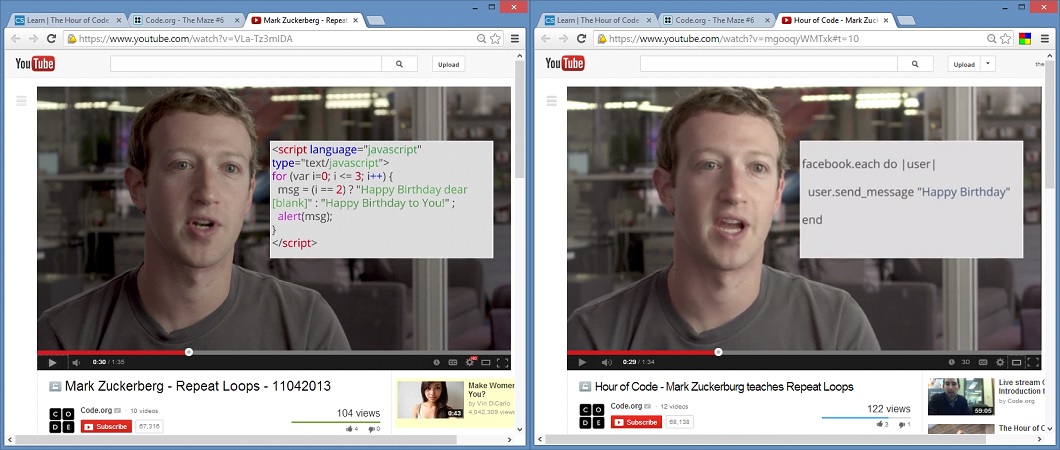
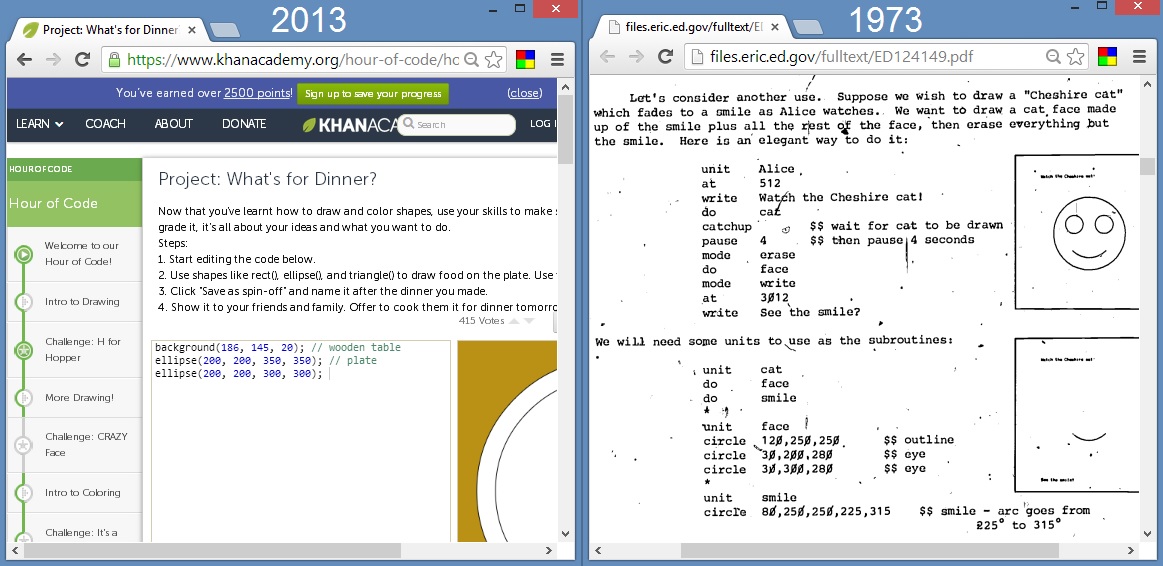
theodp writes: If one was introducing coding to 10 million K-12 kids over 5 days, one might settle on a programming language for examples more than a few weeks before D-Day. But the final tutorials for the Hour of Code aren't due now until the day they're to be taught, so Code.org was able to switch the example Facebook CEO Mark Zuckerberg uses to illustrate Repeat Loops from JavaScript to what looks like Ruby (earlier /. discussion of the JavaScript example), which will no doubt make things clearer for the kindergarten set working on the accompanying Angry Birds tutorial. Khan Academy, on the other hand, is sticking with JavaScript for its Hour of Code tutorial aimed at middle-schoolers, which culminates in a project showing the kids how they can draw a circular plate by invoking an ellipse function with equal major and minor axes. By the way, as Bret Victor might point out, the 2013 Khan Academy lesson looks a lot like circa-1973 PLATO!

Feed Google News Sci Tech: Worm targets Linux PCs and embedded devices - ComputerworldUK (google.com)


Worm targets Linux PCs and embedded devices
ComputerworldUK
A new worm is targeting x86 computers running Linux and PHP, and variants may also pose a threat to devices such as home routers and set-top boxes based on other chip architectures. According to security researchers from Symantec, the malware spreads...

and more

Submission + - Sailfish Can Officially Be Installed To Android Devices (talouselama.fi)

jones_supa writes: Talouselämä Magazine met Jolla CEO Tomi Pienimäki and asked a puzzling question. If Jolla truly is compatible with Android devices, is Jolla going to let individual users to install the Sailfish operating system on the Android devices that they already have? Pienimäki answers: 'That is the plan. We are on device business and OS business. It is fairly easy to install the OS on Android devices'. He says that especially in China, changing firmwares is a mainstream thing. About half of the smartphone buyers are upgrading their older or cheaper devices with a better version of Android. Therefore, Jolla's plan is to get some Sailfish installations sneaked in, too.

Submission + - Heavy metal shows piracy is not killing music, offers new business model (deathmetal.org)

hessian writes: Despite being extensively pirated worldwide, Iron Maiden have managed to put themselves in the £10-20m for 2012. This means that despite the growing popularity of the band on social media, and the extensive and pervasive torrent downloading of the band’s music, books and movies, the band is turning a profit. This is in defiance of the past business model, and the idea that piracy is killing music. In fact, piracy seems to be saving music in Iron Maiden’s case.

One reason for this may be metal itself. It has a fiercely loyal fanbase and a clear brand and identity, even down to the uniform-style black tshirts that fans wear that differ only in band logo and art. The audience identifies with the genre, which stands in contrast to genericized genres like pop, rock and rap. It doggedly maintains its own identity and shuns outsiders. As a result, fans tend to identify more with their music, and place a higher value on purchasing it.

Submission + - Intel Linux Driver Now Nearly As Fast As Windows OpenGL Driver (phoronix.com)

An anonymous reader writes: Intel's open-source Linux graphics driver is now running neck-and-neck with the Windows 8.1 driver for OpenGL performance between the competing platforms when using the latest drivers for each platform. The NVIDIA driver has long been able to run at similar speeds between Windows and Linux given the common code-base, but the Intel Linux driver is completely separate from their Windows driver due to being open-source and complying with the Linux DRM and Mesa infrastructure. The Intel Linux driver is still trailing the Windows OpenGL driver in supporting OpenGL4.

Slashdot Top Deals

Real Users find the one combination of bizarre input values that shuts down the system for days.

Working...