Programming

Is The C Programming Language Declining In Popularity? (dice.com) 286

An anonymous reader writes: Java overtook C as the most popular language in mid-2015 on the TIOBE Programming Community index. But now over the last 13 months, they show C's popularity consistently dropping more and more. C's score had hovered between 15% and 20% for over 15 years but as 2016 ended, the language's popularity is now down to 8.7%. "There is no clear way back to the top," reports the site, asking what happened to C? "It is not a language that you think of while writing programs for popular fields such as mobile apps or websites, it is not evolving that much and there is no big company promoting the language."

But the Insights blog at Dice.com counters that TIOBE "has hammered on C for quite some time. Earlier this year, it again emphasized how C is 'hardly suitable for the booming fields of web and mobile app development.' That being said, job postings on Dice (as well as rankings compiled by other organizations) suggest there's still widespread demand for C, which can be used in everything from operating systems to data-intensive applications, and serves many programmers well as an intermediate language."

i-programmer suggests this could just be an artifact of the way TIOBE calculates language popularity (by totaling search engine queries). Noting that Assembly language rose into TIOBE's top 10 this year, their editor wrote, "Perhaps it is something to do with the poor state of assembly language documentation that spurs on increasingly desperate searches for more information." Maybe C programmers are just referring to their K&R book instead of searching for solutions online?
Programming

Can Learning Smalltalk Make You A Better Programmer? 343

Slashdot reader horrido shares an article that "has done more for Smalltalk advocacy than any other article in memory." It was the second-most popular article of the year on the Hewlett Packard Enterprise site TechBeacon (recently passing 20,000 views), with Richard Eng, the founder of the nonprofit Smalltalk Renaissance, arguing that the 44-year-old language is much more than a tool for teachers -- and not just because Amber Smalltalk transpiles to JavaScript for front-end web programming. It's a superlative prototyping language for startups. It's an industrial-strength enterprise language used by businesses both big and small all around the globe... Smalltalk's implementation of the object-oriented paradigm is so excellent that it has influenced an entire generation of OO languages, such as Objective-C, Python, Ruby, CLOS, PHP 5, Perl 6, Erlang, Groovy, Scala, Dart, Swift, and so on. By learning Smalltalk, you'll understand how all of those useful features in today's OO languages came to be.
The article also argues that Smalltalk pioneered just-in-time compilation and virtual machines, the model-view-controller design paradigm, and to a large extent, even test-driven development. But most importantly, Smalltalk's reliance on domain-specific languages makes it "the 'purest' OO, and one of the earliest... It is often said that programming in Smalltalk or Python is rather like Zen; your mind just flows effortlessly with the task. This is the beauty and value of language simplicity, and Smalltalk has this in spades... Smalltalk, by virtue of its object purity and consistency, will give you a profoundly better understanding of object-oriented programming and how to use it to its best effect."
Security

How Russia Recruited Elite Hackers For Its Cyberwar (nypost.com) 236

Lasrick quotes a report from The New York Times (Warning: source may be paywalled; alternate source): For more than three years, rather than rely on military officers working out of isolated bunkers, Russian government recruiters have scouted a wide range of programmers, placing prominent ads on social media sites, offering jobs to college students and professional coders, and even speaking openly about looking in Russia's criminal underworld for potential talent. From the New York Post: "Russia's Defense Ministry bought advertising on Vkontakta, the country's most popular social media site, to lure those who were more talented with a keyboard than an AK-47 rifle. 'If you graduated from college, if you are a technical specialist, if you are ready to use your knowledge, we give you an opportunity,' the ad promised, according to the Times. The ad went on to assure recruits that they would be part of units called science squadrons based at military installations where they would live in 'comfortable accommodation' and showed an apartment outfitted with a washing machine, the Times reported. The Defense Ministry even dangled the chance to dodge Russia's mandatory draft by allowing university students to join a science squadron instead and then questioned them about their proficiency with programming languages, the report said."
Microsoft

Latest Microsoft Skype Preview Adds Real-Time Voice Translation For Phone Calls (zdnet.com) 37

Microsoft has added the ability to use Skype Translator on calls to mobiles and landlines to its latest Skype Preview app. From a report on ZDNet: Up until now, Skype Translator was available to individuals making Skype-to-Skype calls. The new announcement of the expansion of Skype Translator to mobiles and landlines makes Skype Translator more widely available. To test drive this, users need to be members of the Windows Insider Program. They need to install the latest version of Skype Preview on their Windows 10 PCs and to have Skype Credits or a subscription. Skype Translator, available in nine languages, uses artificial intelligence (AI) techniques such as deep-learning to train artificial neural networks and convert spoken chats in almost real time. The company says the app improves as it listens to more conversations.
Security

Zeus Variant 'Floki Bot' Targets PoS Data (onthewire.io) 25

Trailrunner7 quotes a report from On the Wire: Malware gangs, like sad wedding bands bands, love to play the hits. And one of the hits they keep running back over and over is the Zeus banking Trojan, which has been in use for many years in a number of different forms. Researchers have unearthed a new piece of malware called Floki Bot that is based on the venerable Zeus source code and is being used to infect point-of-sale systems, among other targets. Flashpoint conducted the analysis of Floki Bot with Cisco's Talos research team, and the two organizations said that the author behind the bot maintains a presence on a number of different underground forums, some of which are in Russian or other non-native languages for him. Kremez said that attackers sometimes will participate in foreign language forums as a way to expand their knowledge. Along with its PoS infection capability, Floki Bot also has a feature that allows it to use the Tor network to communicate. "During our analysis of Floki Bot, Talos identified modifications that had been made to the dropper mechanism present in the leaked Zeus source code in an attempt to make Floki Bot more difficult to detect. Talos also observed the introduction of new code that allows Floki Bot to make use of the Tor network. However, this functionality does not appear to be active for the time being," Cisco's Talos team said in its analysis.
Canada

Canada's Prime Minister Justin Trudeau Makes Game For Third Annual Hour of Code (gamasutra.com) 135

Eloking writes: Canadian Prime Minister Justin Trudeau's Twitter account lit up today with a message all too familiar to many indie devs: Mr. Trudeau has made a video game, and he'd like everyone to play it. It was a cute bit of promotion for Hour of Code, the computer science education event masterminded every year by the Code.org nonprofit. While the Hour of Code websites hosts one-hour tutorials (in 45 languages) for coding all sorts of simple applications, game developers may appreciate that the lion's share appears to be game projects, like the one Trudeau modified into a sort of hockey-themed Breakout variant.
Communications

Google's AI Translation Tool Creates Its Own Secret Language (techcrunch.com) 69

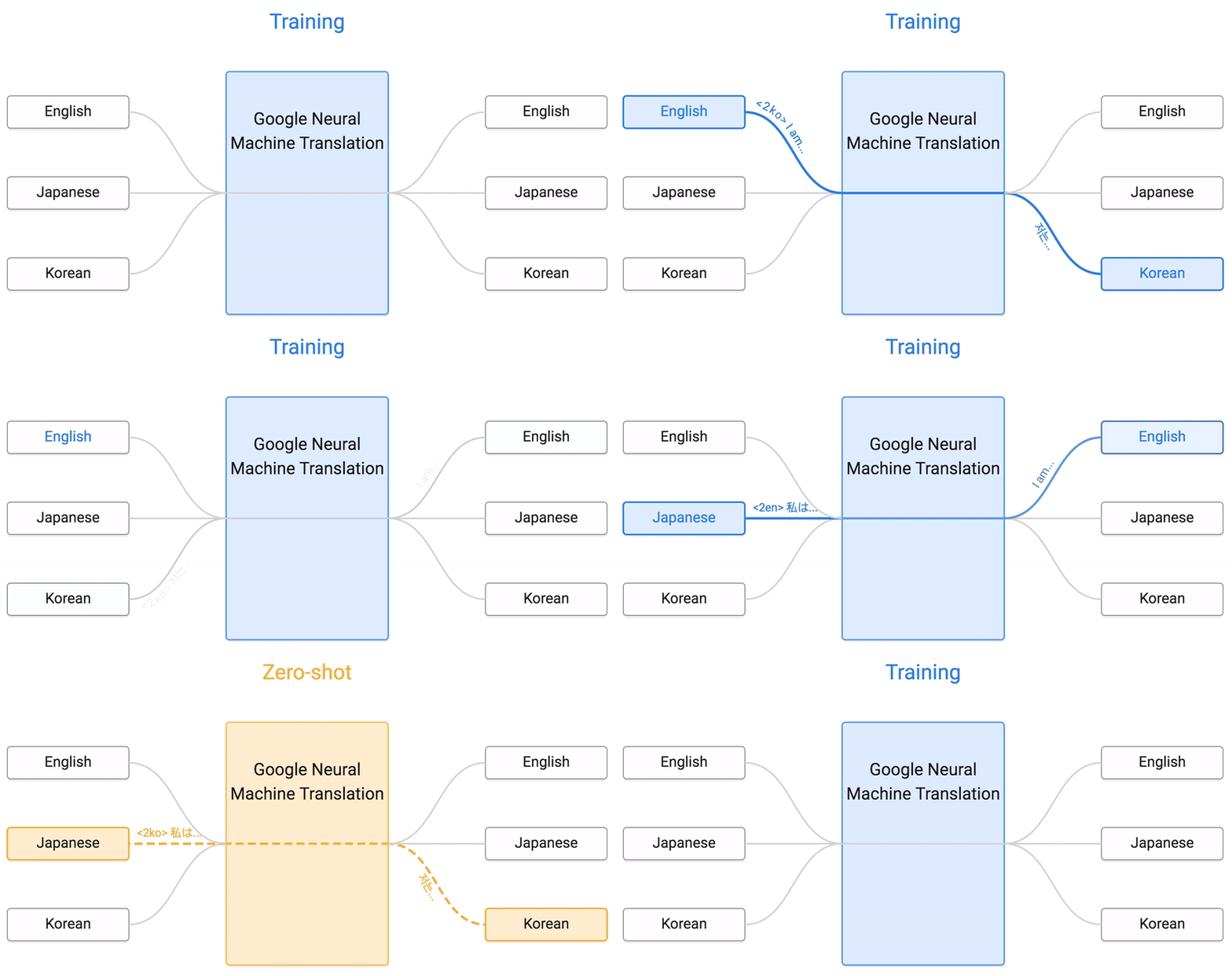
After a little over a month of learning more languages to translate beyond Spanish, Google's recently announced Neural Machine Translation system has used deep learning to develop its own internal language. TechCrunch reports: GNMT's creators were curious about something. If you teach the translation system to translate English to Korean and vice versa, and also English to Japanese and vice versa... could it translate Korean to Japanese, without resorting to English as a bridge between them? They made this helpful gif to illustrate the idea of what they call "zero-shot translation" (it's the orange one). As it turns out -- yes! It produces "reasonable" translations between two languages that it has not explicitly linked in any way. Remember, no English allowed. But this raised a second question. If the computer is able to make connections between concepts and words that have not been formally linked... does that mean that the computer has formed a concept of shared meaning for those words, meaning at a deeper level than simply that one word or phrase is the equivalent of another? In other words, has the computer developed its own internal language to represent the concepts it uses to translate between other languages? Based on how various sentences are related to one another in the memory space of the neural network, Google's language and AI boffins think that it has. The paper describing the researchers' work (primarily on efficient multi-language translation but touching on the mysterious interlingua) can be read at Arxiv.
Google

Google Will Display Election Results As Soon As Polls Close (techcrunch.com) 174

An anonymous reader quotes a report from TechCrunch: Google has been highly involved with connecting U.S. voters to timely information throughout this election cycle, by offering everything from voter registration assistance to polling place information in its search result pages. Today, the company announced plans to display the results of the U.S. election directly in search, in over 30 languages, as soon as the polls close. Web searchers who query for "election results" will be able to view detailed information on the Presidential, Senatorial, Congressional, Gubernatorial races as well as state-level referenda and ballot propositions, says Google. The results will be updated continuously -- every 30 seconds, as indicated by a screenshot shared by the company on its official blog post detailing the new features. Tabs across the top will let you switch to between the various races, like President, House, and Senate, for example. The results will also include information like how many more electoral votes a presidential candidate needs to win, how many seats are up for grabs in the House and Senate, and how many Gubernatorial races are underway, among other things. This data is presented in an easy-to-read format, with Democrats in blue, Republicans in red, and simple graphs, alongside the key numbers.
Government

Prosecutors Say NSA Contractor Could Flee To Foreign Power (go.com) 44

An anonymous reader quotes a report from ABC News: The NSA contractor accused of stealing a gargantuan amount of sensitive and classified data from the U.S. government was studying Russian before he was arrested and would be a "prime target" for foreign spies should he be released on bail, prosecutors argued ahead of a court hearing for Harold Martin, III, today. The government said it is "readily apparent to every foreign counterintelligence professional and nongovernmental actor that the Defendant has access to highly classified information, whether in his head, in still-hidden physical locations, or stored in cyberspace -- and he has demonstrated absolutely no interest in protecting it. This makes the Defendant a prime target, and his release would seriously endanger the safety of the country and potentially even the Defendant himself." Prosecutors noted that Martin purportedly communicated online "with others in languages other than English, including in Russian" and that he had downloaded information on the Russian language just a couple months before he was arrested in August. Martin's attorneys, however, said in their own court filing Thursday that there is still no evidence he "intended to betray his country" and argued that he was not a flight risk. All the talk of foreign spies and potential getaway plans, the defense said, were "fantastical scenarios." Martin's defense team said in part: "The government concocts fantastical scenarios in which Mr. Martin -- who, by the government's own admission, does not possess a valid passport -- would attempt to flee the country. Mr. Martin's wife is here in Maryland. His home is here in Maryland. He hash served this country honorably as a lieutenant in the United States Navy, and he has devoted his entire career to serving his country. There is no evidence he intended to betray his country. The government simply does not meet its burden of showing that no conditions of release would reasonably assure Mr. Martin's future appearance in court. For these reasons, and additional reasons to be discussed at the detention hearing, Mr. Martin should be released on conditions pending trial."

UPDATE 10/21/16: Slashdot reader chromaexursion writes: "Harold Martin was denied bail. The judge agreed the the prosecution in his decision."
Google

Google's Go Language Surges In Popularity (infoworld.com) 252

2016 saw a big spike in the popularity of Go, attributed to the rising importance of Docker and Kubernetes. An anonymous Slashdot reader quotes InfoWorld: Ranked 65th a year ago in the Tiobe Index of language popularity, it has climbed to 16th this month and is on track to become Tiobe's Programming Language of the Year, a designation awarded to the language with the biggest jump in the index...which gauges popularity based on a formula assessing searches on languages in popular search engines...

Elsewhere in the index, Java again came in first place, with an 18.799 rating while C, still in second place, nonetheless continued its precipitous drop, to 9.835% (it had been 16.185% a year ago). In third was C++ (5.797%) followed by C# (4.367%), Python (3.775%), JavaScript (2.751%), PHP (2.741%), Visual Basic .Net (2.66%), and Perl (2.495%).

The article also cites an alternate set of rankings. "In the PyPL index, the top 10 were: Java, with a share of 23.4%, followed by Python (13.6%), PHP (9.9%), C# (8.8%), JavaScript (7.6%), C++ (6.9%), C (6.9%), Objective-C (4.5%), R (3.3%), and Swift (3.1%)."
Google

Google Releases An Open Source Font That Supports 800 Languages (googleblog.com) 175

An anonymous Slashdot reader quotes Hot Hardware: It's been working on the project over the past five years in collaboration with Monotype in hopes of eradicating so-called "tofu" -- the blank boxes you see when a PC or website can't display a particular text -- from the web. Noto, or No more tofu, is Google's answer, and it's available now to download...

"We are thrilled to have played such an important role in what has become one of the most significant type projects of all time," said Scott Landers, president and CEO of Monotype... Monotype played the biggest role, though Google also collaborated with Adobe and had a network of volunteer reviewers. As far as Monotype is concerned, Noto is one of the expansive typography projects ever undertaken.

There's 110,000 characters, and Google says the project "required design and technical testing in hundreds of languages."
Programming

Are Flawed Languages Creating Bad Software? (techcrunch.com) 531

"Most software, even critical system software, is insecure Swiss cheese held together with duct tape, bubble wrap, and bobby pins..." writes TechCrunch. An anonymous reader quotes their article: Everything is terrible because the fundamental tools we use are, still, so flawed that when used they inevitably craft terrible things... Almost all software has been bug-ridden and insecure for so long that we have grown to think that this is the natural state of code. This learned helplessness is not correct. Everything does not have to be terrible...

Vast experience has shown us that it is unrealistic to expect programmers to write secure code in memory-unsafe languages...as an industry, let's at least set a trajectory. Let's move towards writing system code in better languages, first of all -- this should improve security and speed. Let's move towards formal specifications and verification of mission-critical code.

Their article calls for LangSec testing, and applauds the use of languages like Go and Rust over memory-unsafe languages like C. "Itâ(TM)s not just systemd, not just Linux, not just software; the whole industry is at fault."
Programming

Which Programming Language Is Most Popular - The Final Answer? (zdnet.com) 401

An anonymous Slashdot reader writes: Following a common technique among political pollsters, a technology columnist combined the results from various measures of programming language popularity for a more definitive answer about the most important languages to study. He used IEEE Spectrum's interactive list of the top programming languages, which lets you adjust the weight given to the number of job listings and number or open source projects, then combined it with the TIOBE Index (which is based on search engine results), and the PYPL Index, which checks the number of tutorials for each programming language on Google.

The results? "The top cluster contains Java, C, Python, and C++. Without a doubt, you should attain familiarity with these four languages." He points out they're not tied to a specific programming platform, unlike languages in the second cluster -- JavaScript, C#, PHP, and Swift -- while the last two languages in the top 10 were Objective-C and R. "The C-family of languages still dominates. Java, C++, C, C#, and even Objective-C are all C-based languages. If you're only going to learn one language, you should pick one of those." But his ultimate advice is to "learn multiple languages and multiple frameworks... Programming is not just an intellectual exercise. You have to actually make stuff."

Cloud

A New Programming Language Expands on Google's Go (infoworld.com) 173

"One sure sign your language is successful: When people build other languages that transpile into it." An anonymous Slashdot reader quotes a report from InfoWorld: The Have project uses Go's toolchain, but sports a different syntax and makes key additions to the language... Previously, a language named Oden worked with Go's toolchain to add features that Go didn't support. Now Polish developer Marcin Wrochniak has introduced Have, a language that transpiles to and expands on Go.

In the blog post that introduces the project to Go developers, Wrochniak describes Have as a hobby project, with the goal of becoming a "companion" to Go that addresses some of its common "landmines"... Go uses curly braces in the manner of C/C++, while Have uses block indents, like Python... The way that variable declaration, structs, and interfaces work have all been modified in Have to be more consistent with each other and to avoid internal inconsistencies that Wrochniak feels are a common source of bugs.

Earth

Dolphins Recorded Having a Conversation For The First Time (telegraph.co.uk) 305

For the first time Russian researchers have recorded a conversation between two dolphins -- Yasha and Yana -- who were talking to each other in a pool. An anonymous Slashdot reader quotes The Telegraph: Scientists developed an underwater microphone which could distinguish the animals' different "voices" [and] have now shown that dolphins alter the volume and frequency of pulsed clicks to form individual "words" which they string together into sentences in much the same way that humans speak...

"This language exhibits all the design features present in the human spoken language, this indicates a high level of intelligence and consciousness in dolphins, and their language can be ostensibly considered a highly developed spoken language, akin to the human language... Humans must take the first step to establish relationships with the first intelligent inhabitants of the planet Earth by creating devices capable of overcoming the barriers that stand in the way of using languages and in the way of communications between dolphins and people."

The dolphins listened to an entire "sentence" before replying, according to the article, which points out that dolphin brains are larger and more complex than the brains of humans.
Programming

400,000 GitHub Repositories, 1 Billion Files, 14TB of Code: Spaces or Tabs? (medium.com) 391

Here's a debate that refuses to die: given a choice, would you rather use spaces or tabs? An episode of Silicon Valley last season had a bit on this. Now we have more data to analyze people's behavior. A Google developer has looked into 400,000 GitHub repositories -- 1 billion files, 14 terabytes to find that programmers with interest in specific languages do seem to prefer either tabs or spaces. Spoiler alert: space wins, like all the time.
Java

Slashdot Asks: What Are Your Favorite Java 8 Features? (infoworld.com) 427

New submitter liveedu shares with us a report from InfoWorld: When Java 8 was released two years ago, the community graciously accepted it, seeing it as a huge step toward making Java better. Its unique selling point is the attention paid to every aspect of the programming language, including JVM (Java Virtual Machine), the compiler, and other help-system improvements. Java is one of the most searched programming languages according to TIOBE index for July 2016, where Java ranks number one. Its popularity is also seen on LiveCoding, a social live coding platform for engineers around the world, where hundreds and thousands of Java projects are broadcasted live. InfoWorld highlights five Java 8 features for developers in their report: lambda expressions, JavaScript Nashorn, date/time APIs, Stream API and concurrent accumulators. But those features only scratch the surface. What makes Java 8 amazing in your opinion? What are your favorite Java 8 features that help you write high quality code? You can view the entire list of changes made to the programming language here.
Programming

C Programming Language Hits a 15-Year Low On The TIOBE Index (businessinsider.com) 232

Gamoid writes: The venerable C programming language hit a 15-year low on the TIOBE Index, perhaps because more mobile- and web-friendly languages like Swift and Go are starting to eat its lunch. "The C programming language has a score of 11.303%, which is its lowest score ever since we started the TIOBE index back in 2001," writes Paul Jansen, manager of TIOBE Index. With that said, C is still the second most popular programming language in the world, behind only Java. Also worth noting as mentioned by Matt Weinberger via Business Insider, "C doesn't currently have a major corporate sponsor; Oracle makes a lot of money from Java; Apple pushes both Swift and Objective-C for building iPhone apps. But no big tech company is getting on stage and pushing C as the future of development. So C's problems could be marketing as much as anything."
Robotics

Intel Demos A New Robotics Controller Running Ubuntu (hackerboards.com) 21

Intel demoed their new robotics compute module this week. Scheduled for release in 2017, it's equipped with various sensors, including a depth-sensing camera, and it runs Ubuntu on a quad-core Atom. Slashdot reader DeviceGuru writes: Designed for researchers, makers, and robotics developers, the device is a self contained, candy-bar sized compute module ready to pop into a robot. It's augmented with a WiFi hotspot, Bluetooth, GPS, and IR, as well as proximity, motion, barometric pressure sensors. There's also a snap-on battery.

The device is preinstalled with Ubuntu 14.04 with Robot Operating System (ROS) Indigo, and can act as a supervisory processor to, say, an Arduino subsystem that controls a robot's low-level functions. Intel demoed a Euclid driven robot running an obstacle avoidance and follow-me tasks, including during CEO Brian Krzanich's keynote (YouTube video).

Intel says they'll also release instructions on how to create an accompanying robot with a 3D printer. This plug-and-play robotics module is a proof-of-concept device -- the article includes some nice pictures -- but it already supports programming in Node.js (and other high-level languages), and has a web UI that lets you monitor performance in real-time and watch the raw camera feeds.

Slashdot Top Deals