Google

Google Urged the US To Limit Protection for Activist Workers (bloomberg.com) 224

Google, whose employees have captured international attention in recent months through high-profile protests of workplace policies, has been quietly urging the U.S. government to narrow legal protection for workers organizing online. From a report: During the Obama administration, the National Labor Relations Board broadened employees' rights to use their workplace email system to organize around issues on the job. In a 2014 case, Purple Communications, the agency restricted companies from punishing employees for using their workplace email systems for activities like circulating petitions or fomenting walkouts, as well as trying to form a union. In filings in May 2017 and November 2018, obtained via Freedom of Information Act request, Alphabet's Google urged the National Labor Relations Board to undo that precedent.

Citing dissents authored by Republican appointees, Google's attorneys wrote that the 2014 standard "should be overruled" and a George W. Bush-era precedent -- allowing companies to ban organizing on their employee email systems -- should be reinstated. In an emailed statement, a Google spokeswoman said, "We're not lobbying for changes to any rules." Rather, she said, Google's claim that the Obama-era protections should be overturned was "a legal defense that we included as one of many possible defenses" against meritless claims at the NLRB.

Chrome

Chrome API Update Will Kill a Bunch of Other Extensions, Not Just Ad Blockers (zdnet.com) 93

An anonymous reader writes: A planned update to one of the Google Chrome extensions APIs would kill much more than a few ad blockers, ZDNet has learned, including browser extensions for antivirus products, parental control enforcement, phishing detection, and various privacy-enhancing services. Developers for extensions published by F-Secure, NoScript, Amnesty International, and Ermes Cyber Security, among others, made their concerns public today after news broke this week that Google was considering the API change. Furthermore, efforts to port NoScript from Firefox to Chrome are also impacted, according to the plugin's author, who says the new API update all but cripples the NoScript for Chrome port.
Software

Program Allows Ordinary Digital Camera To See Around Corners (theguardian.com) 54

An anonymous reader quotes a report from The Guardian: Science may never tell us what lies round the next corner, but researchers have come up with the nearest thing: a computer program that turns a normal digital camera into a periscope. In a demonstration of "computational periscopy" a U.S. team at Boston University showed they could see details of objects hidden from view by analyzing shadows they cast on a nearby wall. Vivek Goyal, an electrical engineer at the university, said that while the work had clear implications for surveillance he hoped it would lead to robots that could navigate better and boost the safety of driverless cars.

In the latest feat, Goyal and his team used a standard digital camera and a mid-range laptop. The researchers, writing in the journal Nature, describe how they pieced together hidden scenes by pointing the digital camera at the vague shadows they cast on a nearby wall. If the wall had been a mirror the task would have been easy, but a matt wall scatters light in all directions, so the reflected image is nothing but a blur. They found that when an object blocked part of the hidden scene, their algorithms could use the combination of light and shade at different points on the wall to reconstruct what lay round the corner. In tests, the program pieced together hidden images of video game characters -- including details such as their eyes and mouths -- along with colored strips and the letters "BU."
The program takes about 48 seconds to work out a hidden scene from a digital image, but the researchers believe it could be sped up with a faster computer. Eventually, it may be fast enough to run on video footage.

Goyal also said "it is even conceivable for humans to be able to learn to see around corners with their own eyes; it does not require anything superhuman."
Transportation

Boeing's First Autonomous Air Taxi Flight Ends In Fewer Than 60 Seconds (cnn.com) 108

Boeing has completed the first flight of its autonomous air taxi Tuesday at a small airport outside Washington, D.C. "The flight lasted less than a minute, according to Boeing, and it didn't actually go anywhere," reports CNN. "Instead, it hovered above the runway. Boeing declined to share how high above the ground it flew." From the report: But Boeing is hailing the achievement as a milestone for its NeXt division, which develops autonomous airplanes. The flying car prototype is 30 feet long and 28 feet wide. It's designed to fly up to 50 miles at a time. Boeing and its competitors such as Airbus are betting that small, self-flying airplanes -- technically dubbed electric vertical takeoff and landing (eVTOL) -- will revolutionize transportation, especially in urban areas. Boeing believes the vehicles, more commonly referred to as air taxis or flying cars, will be a solution to traffic congestion.
Emulation (Games)

Emulator Project Aims To Resurrect Classic Mac Apps, Games Without the OS (arstechnica.com) 74

An anonymous reader quotes a report from Ars Technica, written by Sean Gallagher: Want to be able to run classic Mac OS applications compiled for the Motorola 68000 series of processors on your ever-so-modern Mac OS X machine? Or maybe you'd rather run them on a Raspberry Pi, or an Android device for that matter? There's an emulation project that's trying to achieve just that: Advanced Mac Substitute (AMS). Advanced Mac Substitute is an effort by long-time Mac hacker Josh Juran to make it possible to run old Mac OS software (up to Mac OS 6) without a need for an Apple ROM or system software. Other emulators out there for 64000 Mac applications such as Basilisk II require a copy of MacOS installation media -- such as install CDs from Mac OS 7.5 or Mac OS 8. But AMS uses a set of software libraries that allow old Mac applications to launch right within the operating environment of the host device, without needing to have a full virtual hardware and operating system instance behind them. And it's all open source.

I got a demo of AMS from Juran at Shmoocon in Washington, DC, this past weekend. He showed me an early attempt at getting the game LoadRunner to work with the emulator -- it's not yet interactive. A version of the project, downloadable from Github, includes a "Welcome" screen application (a sort of Mac OS "hello world"), Mac Tic-Tac-Toe, and an animation of NyanCat. Applications are launched from the command line for now and are executed by the emulation software, which interprets the system and firmware calls. Unfortunately, there's still a lot of work to be done. While AMS works on Mac OS X up to version 10.12 -- both on Intel and PowerPC versions of the operating system -- the code currently won't compile on MacOS Mojave. And the Linux implementation of AMS does not yet support keyboard input. I was unable to get the front end to execute at all on Debian 9 on Intel.

Advertising

Social Media Stars Agree To Declare When They Post Ads For Products (bbc.com) 40

"Britain's Competition and Markets Authority (CMA) has threatened prominent social media stars with heavy fines or prison time if they advertise commercial products on social media without making it clear that they are doing so in exchange for financial rewards," writes Slashdot reader dryriver. The BBC reports: Sixteen social media stars including singers Ellie Goulding and Rita Ora, models Rosie Huntington-Whiteley and Alexa Chung, and vlogger Zoella have agreed to change how they post online. They will have to clearly state if they have been paid or received any gifts or loans of products they endorse. It follows warnings from the Competition and Markets Authority that their posts could break consumer law. Online endorsements can boost brands but can also mislead, said the CMA. The CMA has not made a finding on whether the influencers named breached consumer law, but said all of them volunteered to change their practices following an investigation. However, if they fail to comply with the agreement reached with the CMA, they could be taken to court and face heavy fines or prison sentences of up to two years.
Security

How Web Apps Can Turn Browser Extensions Into Backdoors (threatpost.com) 34

"Threatpost has a link to some recent research about ways web pages can exploit browser extensions to steal information or write files," writes Slashdot reader jbmartin6. "Did we need another reason to be deeply suspicious of any browser extension? Not only do they spy on us for their makers, now other people can use them to spy on us as well. The academic paper is titled 'Empowering Web Applications with Browser Extensions' (PDF)." From the report: "An attacker [uses] a script that is present in a web application currently running in the user browser. The script either belongs to the web application or to a third party. The goal of the attacker is to interact with installed extensions, in order to access user sensitive information. It relies on extensions whose privileged capabilities can be exploited via an exchange of messages with scripts in the web application," researchers wrote. They added, "Even though content scripts, background pages and web applications run in separate execution contexts, they can establish communication channels to exchange messages with one another... APIs [are used] for sending and receiving (listening for) messages between the content scripts, background pages and web applications."

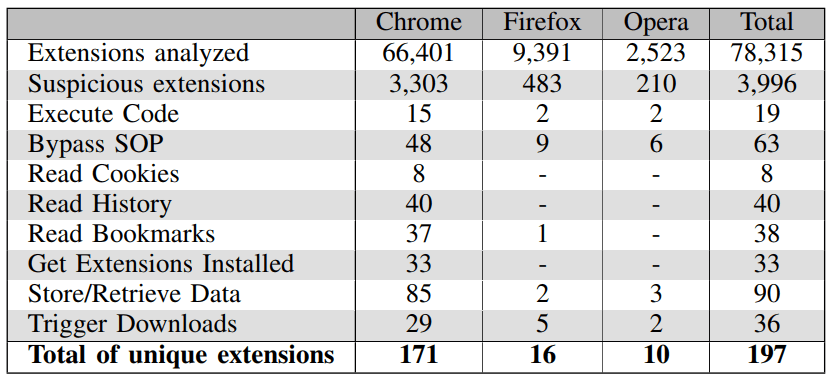
The researcher behind the paper focused on a specific class of web extension called "WebExtensions API," a cross-browser extensions system compatible with major browsers including Chrome, Firefox, Opera and Microsoft Edge. After analyzing 78,315 extensions that used the specific WebExtension API, it found 3,996 that were suspicious. While it seems voluminous, they noted that research found a small number of vulnerable extensions overall, and that concern should be measured. However, "browser vendors need to review extensions more rigorously, in particular take into consideration the use of message passing interfaces in extensions."

Businesses

Comcast Lowered Cable Investment Despite Net Neutrality Repeal (arstechnica.com) 96

An anonymous reader quotes a report from Ars Technica: Comcast's cable division spent 3 percent less on capital expenditures last year, despite promises that the repeal of net neutrality rules would boost broadband network investment. Comcast's cable division spent $7.95 billion on capital expenditures during calendar year 2017, but that fell to $7.72 billion in the 12 months ending on December 31, 2018. Comcast's overall capital expenditures went up 2.3 percent, from $9.6 billion in 2017 to $9.8 billion in 2018. But that company-wide capital expenditure number includes the Comcast-owned NBCUniversal, which spent $1.7 billion in 2018, a 15.2 percent increase, "primarily reflecting investment at Theme Parks," Comcast said.

The cable capital expenditure statistic thus provides a more accurate picture of whether Comcast increased or decreased investment in its broadband network. Cable capital expenditures as a percentage of Comcast's cable revenue dropped from 15 percent in 2017 to 14 percent in 2018. Comcast's network spending should have risen in 2018 if predictions from Federal Communications Commission Chairman Ajit Pai and Comcast had been correct. Pai's net neutrality repeal took effect in June 2018. But the vote to repeal net neutrality rules was in December 2017, and Pai claimed in February 2018 that the repeal was already causing increased broadband investment.
While Comcast's cable capital expenditures did rise year over year in the fourth quarter, from $2.15 billion to $2.32 billion, it wasn't enough to offset the full-year decline. Ars Technology also notes: "The corporate tax cut implemented as 2018 began also didn't stop job cuts at Comcast and AT&T, despite promises that the tax cut would create new jobs."
Government

Should Lawmakers Be Able To Hold Hearings, Debate and Vote On Legislation Virtually From Their District Offices? (thehill.com) 149

Applehu Akbar shares an old report raising a very good question for today's Congress: why not use today's videoconferencing tech to allow representatives to perform most Congressional activity from their home districts?" The ability to "work from home" would be especially beneficial during a government shutdown, like the one we're currently in, where money is tight and Congressional members are "sick and tired of Washington and don't want to show up anymore to vote." Slashdot reader Applehu Akbar writes: Because Congress people serve short terms and campaign largely on constituent service, they have to spend a large percentage of their time shuttling between home and Washington. Virtualizing most of their Washington presence would save fuel and energy while giving them more time with their constituents. In addition, there could be a long-term societal benefit in making Congress less vulnerable to lobbyist influence by keeping them out of the Beltway. Pearce told The Hill in a statement back in 2013: "Thanks to modern technology, members of Congress can debate, vote, and carry out their constitutional duties without having to leave the accountability and personal contact of their congressional districts. Keeping legislators closer to the people we represent would pull back Washington's curtain and allow constituents to see and feel, first-hand, their government at work. Corporations and government agencies use remote work technology; it's time that Congress does the same."
Twitter

Twitter CEO Jack Dorsey Says Biometrics May Defeat Bots (duo.com) 60

Trailrunner7 shares a report from Duo Security: From the beginning, Twitter's creators made the decision not to require real names on the service. It's a policy that's descended from older chat services, message boards and Usenet newsgroups and was designed to allow users to express themselves freely. Free expression is certainly one of the things that happens on Twitter, but that policy has had a number of unintended consequences, too. The service is flooded with bots, automated accounts that are deployed by a number of different types of users, some legitimate, others not so much. Many companies and organizations use automation in their Twitter accounts, especially for customer service. But a wide variety of malicious actors use bots, too, for a lot of different purposes. Governments have used bots to spread disinformation for influence campaigns, cybercrime groups employ bots as part of the command-and-control infrastructure for botnets, and bots are an integral part of the cryptocurrency scam ecosystem. This has been a problem for years on Twitter, but only became a national and international issue after the 2016 presidential election.

Twitter CEO Jack Dorsey said this week that he sees potential in biometric authentication as a way to help combat manipulation and increase trust on the platform. "If we can utilize technologies like Face ID or Touch ID or some of the biometric things that we find on our devices today to verify that this is a real person, then we can start labeling that and give people more context for what they're interacting with and ideally that adds some more credibility to the equation. It is something we need to fix. We haven't had strong technology solutions in the past, but that's definitely changing with these supercomputers we have in our pockets now," Dorsey said.
Jordan Wright, an R&D engineer at Duo Labs writes: "I think it's a step in the right direction in terms of making general authentication usable, depending on how it's implemented. But I'm not sure how much it will help the bot/automation issue. There will almost certainly need to be a fallback authentication method for users without an iOS device. Bot owners who want to do standard authentication will use whichever method is easiest for them, so if a password-based flow is still offered, they'd likely default to that."

"The fallback is the tricky bit. If one exists, then Touch ID/Face ID might be helpful in identifying that there is a human behind an account, but not necessarily the reverse -- that a given account is not human because it doesn't use Touch ID," Wright adds.
China

Microsoft's Bing Search Engine Goes Offline In China (france24.com) 65

An anonymous reader quotes a report from France 24: The Microsoft-run search engine Bing was unavailable in mainland China late Wednesday, raising concerns among some social media users that it could be the latest foreign website to be blocked by censors. Attempting to open cn.bing.com results in an error message, though users can still access Bing's international site using a virtual private network (VPN), which allows people to circumvent China's "Great Firewall" of censorship. It is not clear whether or not Bing has joined China's long list of prohibited websites or if its China service is experiencing technical difficulties.

On Weibo, China's Twitter-like social media site, people complained about the lack of access, with some speculating that Bing too had been "walled off." Others aired their dissatisfaction about having to use Baidu, China's largest domestic search service. "I can't open Bing, but I don't want to use Baidu -- what to do?" wrote one user. "Bing is actually dead -- is this to force me to use Baidu??" said another, cursing.
Update January 24, 00:10 GMT: Microsoft says it is aware that some users are unable to access Bing in China and says it is investigating the matter.
Microsoft

Microsoft Fights Fake News With NewsGuard Integration in Its Mobile Edge Browser (pcworld.com) 180

In a bid to fight fake news read while on your phone, Microsoft's mobile Edge browser on Android and iOS now includes the NewsGuard extension. From a report: The addition needs to be toggled on within the Edge settings menu to be enabled. Once it is, Edge will display a small shield icon next to the site's URL in the search bar: a green shield with a checkmark for a trusted news site, and a red shield with an exclamation point inside of it for a site that NewsGuard believes isn't always accurate. (Some sites haven't been evaluated, and these will simply show a gray shield.)
Google

Google Commits $3.1 Million and Free Cloud APIs To Wikimedia (venturebeat.com) 44

Google is expanding its support of Wikimedia, the parent company of Wikipedia, as the search giant chases the next billion users. From a report: At World Economic Forum this week, Google committed to offer Wikipedia an additional $3.1 million, along with providing several of its machine learning tools to the editors of Wikipedia at no cost, the companies said. Google.org, thanks in part to contributions from employees, will be giving $1.1 million to the Wikimedia Foundation and $2 million to the Wikimedia Endowment, an independent fund that supports Wikipedia and other long-term Wikimedia projects.

As part of the announcement, the companies said they will be expanding Project Tiger, a joint initiative they launched in 2017 to increase the number of articles in underrepresented languages in India. They intend to provide editors with resources and insights to create new Wikipedia articles across 10 languages in India, Indonesia, Mexico, Nigeria, and the Middle East and North Africa (MENA) region. The initiative is being rebranded as GLOW, which is supposed to stand for Growing Local Language Content on Wikipedia.

Privacy

Why Free Software Evangelist Richard Stallman is Haunted by Stalin's Dream (factordaily.com) 375

Richard Stallman recently visited Mandya, a small town about 60 miles from Bengaluru, India, to give a talk. On the sidelines, Indian news outlet FactorDaily caught up with Stallman for an interview. In the wide-ranging interview, Stallman talked about companies that spy on users, popular Android apps, media streaming and transportation apps, smart devices, DRM, software backdoors, subscription software, and Apple and censorship. An excerpt from the interview: If you are carrying a mobile phone, it is always tracking your movements and it could have been modified to listen to the conversations around you. I call this product Stalin's dream. What would Stalin have wanted to hand out to every inhabitant of the former Soviet Union? Something to track that person's movements and listen to the person's conservations. Fortunately, Stalin could not do it because the technology didn't exist. Unfortunately for us, now it does exist and most people have been pressured or lured into carrying around such a Stalin's dream device, but not me.

I am suspicious of new digital technology. I expect it to have new malicious functionalities. It has happened so many times that I have learned to expect this, so I have always checked before I start using some new digital technology. I asked to find out what is nasty about it and I found out these two things. It was something like 20 years ago, and I decided it was my duty as a citizen to refuse, regardless of whatever convenience it might offer me. To surrender my freedom in this way was failing to defend a free society. This is why I do not have a portable phone. I refuse to carry a portable phone. I never have one and unless things change, I never will. I do use portable phones, lots of different ones. If I needed to call someone right now, I would ask one of you, "Could you please make a call for me?" If I am on a bus and it is late and I need to tell somebody that I am going to arrive late, there is always some other passenger in the bus who will make a call for me or send a text for me. Practically speaking, it is not that hard.

Businesses

Hiring Based on Skills Instead of College Degrees is Vital for the Future, IBM CEO Says (gizmodo.com) 319

What does the future of getting a job in the tech industry look like? According to the CEO of IBM, Ginni Rometty, it's important that tech companies focus on hiring people with valuable skills, not just people with college degrees. From a report: Rometty made the comments yesterday at the World Economic Forum in Davos, Switzerland. The CEO said that technology's fast-moving pace here in the 21st century makes it harder for people to find jobs and has led to disillusionment with the future. "With the new technologies that are out there, I think there is a huge inclusion problem, meaning there's a large part of society that does not feel this is going to be good for their future," Rometty said. "Forget about whether it is or it isn't or what we believe. Therefore they feel very disenfranchised."

[...] "So when it comes to education and skills, I think the government can't solve it alone," Rometty said. "I think businesses have to believe I'll hire for skills, not just their degrees or their diplomas. Because otherwise we'll never bridge this gap." "All of us are full of companies with university degrees, PhDs, you've got to make room for everyone in society in these jobs," Rometty said as other business leaders on the panel nodded their heads.
She added, "We have a very serious duty about this. Because these technologies are changing faster with times than their skills are going to change. So it is causing this skill crisis. [...] We have to have a new paradigm. You would have to have new pathways that don't all include college education and you would have to have respect for that job -- not blue collar or white collar, I call it new collar."
Security

More Than Half of PC Applications Installed Worldwide Are Out-of-Date (helpnetsecurity.com) 151

Avast's PC Trends Report 2019 found [PDF] that users are making themselves vulnerable by not implementing security patches and keeping outdated versions of popular applications on their PCs. From a news report: The applications where updates are most frequently neglected include Adobe Shockwave (96%), VLC Media Player (94%) and Skype (94%). The report, which uses anonymized and aggregated data from 163 million devices across the globe, also found that Windows 10 is now installed on 40% of all PCs globally, which is fast approaching the 43% share held by Windows 7. However, 15% of all Windows 7 users and 9% of all Windows 10 users worldwide are running older and no longer supported versions of their product, for example, the Windows 7 Release to Manufacturing version from 2009 or the Windows 10 Spring Creators Update from early 2017.
The Courts

Supreme Court Won't Hear a Lawsuit Over Defamatory Yelp Reviews (theverge.com) 70

The U.S. Supreme Court has declined to hear a case regarding whether Yelp is culpable for removing defamatory reviews from its site, resolving a case that could have affected web platforms' legal protections. Today's list of Supreme Court orders denies a complaint brought by Dawn Hassell, an attorney who requested that Yelp take down false, negative reviews about her practice. This means that a California Supreme Court decision will stand, and Yelp isn't liable for the reviews. The Verge reports: Hassell v. Bird was filed in 2016 as a complaint against one of Hassell's former clients, not Yelp. However, Yelp protested a court order to remove the reviews, arguing that it was protected by Section 230 of the Communications Decency Act. (Yelp has said it independently removes reviews it finds to be defamatory since they violate its terms of service.) Lower courts disagreed, but in mid-2018, the California Supreme Court ruled in Yelp's favor. Then, the firm of Charles Harder -- a member of President Donald Trump's legal team who's known for high-profile defamation lawsuits -- petitioned the Supreme Court to hear a complaint against Yelp.

Yelp praised the California Supreme Court's decision last year, calling it a win for "those of us who value sharing one another's opinions and experiences" on the internet. It commended today's decision as well. "We are happy to see the Supreme Court has ended Hassell's efforts to sidestep the law to compel Yelp to remove online reviews. This takes away a tool that could have been easily abused by litigants to obtain easy removal of entirely truthful consumer opinions," a spokesperson told The Verge.

Power

Carbon Capture System Turns CO2 Into Electricity and Hydrogen Fuel (newatlas.com) 155

Researchers at Ulsan National Institute of Science and Technology (UNIST) and Georgia Tech have developed a new system that absorbs carbon dioxide and produces electricity and useable hydrogen fuel. New Atlas reports: The new device, which the team calls a Hybrid Na-CO2 System, is basically a big liquid battery. A sodium metal anode is placed in an organic electrolyte, while the cathode is contained in an aqueous solution. The two liquids are separated by a sodium Super Ionic Conductor (NASICON) membrane. When CO2 is injected into the aqueous electrolyte, it reacts with the cathode, turning the solution more acidic, which in turn generates electricity and creates hydrogen. In tests, the team reported a CO2 conversion efficiency of 50 percent, and the system was stable enough to run for over 1,000 hours without causing any damage to the electrodes. Unlike other designs, it doesn't release any CO2 as a gas during normal operation -- instead, the remaining half of the CO2 was recovered from the electrolyte as plain old baking soda. The research was published in the journal iScience.
Earth

Oceans Are Getting Louder, Posing Potential Threats To Marine Life (nytimes.com) 127

An anonymous reader quotes a report from The New York Times: Slow-moving, hulking ships crisscross miles of ocean in a lawn mower pattern, wielding an array of 12 to 48 air guns blasting pressurized air repeatedly into the depths of the ocean. The sound waves hit the sea floor, penetrating miles into it, and bounce back to the surface, where they are picked up by hydrophones. The acoustic patterns form a three-dimensional map of where oil and gas most likely lie. The seismic air guns probably produce the loudest noise that humans use regularly underwater, and it is about to become far louder in the Atlantic. As part of the Trump administration's plans to allow offshore drilling for gas and oil exploration, five companies have been given permits to carry out seismic mapping with the air guns all along the Eastern Seaboard, from Central Florida to the Northeast, for the first time in three decades. The surveys haven't started yet in the Atlantic, but now that the ban on offshore drilling has been lifted, companies can be granted access to explore regions along the Gulf of Mexico and the Pacific. And air guns are now the most common method companies use to map the ocean floor.

Some scientists say the noises from air guns, ship sonar and general tanker traffic can cause the gradual or even outright death of sea creatures, from the giants to the tiniest — whales, dolphins, fish, squid, octopuses and even plankton. Other effects include impairing animals' hearing, brain hemorrhaging and the drowning out of communication sounds important for survival, experts say. So great is the growing din in the world's oceans that experts fear it is fundamentally disrupting the marine ecosystem, diminishing populations of some species as the noise levels disturb feeding, reproduction and social behavior. A 2017 study, for example, found that a loud blast, softer than the sound of a seismic air gun, killed nearly two-thirds of the zooplankton in three-quarters of a mile on either side. Tiny organisms at the bottom of the food chain, zooplankton provide a food source for everything from great whales to shrimp. Krill, a tiny crustacean vital to whales and other animals, were especially hard hit, according to one study.

Wine

Wine 4.0 Released With Vulkan Support, Initial Direct3D 12 and Better HiDPI (phoronix.com) 73

Michael Larabel writes via Phoronix: Wine 4.0 is now officially available as the new annual stable release to Wine for running Windows programs and games on Linux and other operating systems. Following seven weekly release candidates, Wine 4.0 was ready to ship today as judged by Wine founder Alexandre Julliard. Wine 4.0 is a big release bringing initial Vulkan graphics API support, Direct3D CSMT is enabled by default, early Direct3D 12 support via VKD3D, continued HiDPI work, various OpenGL improvements, multi-sample D3D texture support, 64-bit improvements, continued Android support, and much more. The release announcement and notes can be read via WineHQ.org. The source can be downloaded here.

Slashdot Top Deals