Facebook

Facebook Brings Express Wi-Fi To Ghana, Quietly Expands Free Basics To Morocco and Laos (venturebeat.com) 39

More than a year after Facebook commercially launched Express Wi-Fi in five markets, it is ready to bring the connectivity service to the sixth: Ghana. From a report: In partnership with telecom operator Vodafone Ghana, Facebook today launched Express Wi-Fi, part of Internet.org initiative, in the suburban communities of the Western African nation. The service, available locally in Nima, James Town, Kanda, Pig Farm, and Abossey Okine in the capital city Accra, will aim to offer "carrier-grade Wi-Fi" to people living in some remote communities that lack fiber optic cables.

Ever since India booted Free Basics in early 2016, Facebook has seemingly grown cautious about its connectivity efforts. The company has stopped updating the social media page and press page of Internet.org. Last year, we learned that Facebook had quietly pulled Internet.org from a handful of emerging markets. In recent months, however, it has quietly expanded Internet.org to two new markets -- Morocco (in North Africa) and Laos (in Southeast Asia).

Youtube

Right To Repair Advocates Are Hosting YouTube Town Halls To Show You How To Get Involved In the Movement (vice.com) 52

iFixit, a company that advocates for the right for users to repair their own devices, is hosting live town halls on YouTube to help get new people involved in the movement. "We're going to do them every two weeks while the legislative season is in full swing," Kyle Wiens, CEO of iFixit, told Motherboard in an email. Motherboard reports: The first town hall aired on Thursday, and featured prominent right to repair leaders like Repair.org's Gay Gordon-Byrne and US PIRG's Nathan Proctor. The broadcast covered topics such as the benefits of right to repair to consumers and the environment, and gave out information on how to talk to legislators about right to repair laws. Thanks to the right to repair movement's efforts, 15 states have introduced right to repair legislation in 2019 so far. Repair.org and iFixit's livestream gives people in those states information to help push their legislators to vote for bills protecting the people's right to repair. People living in states where legislation isn't yet being considered can learn all about how to kickstart their own local movements.

Getting involved in the push for right to repair legislation is as simple as watching a recording of the first town hall broadcast. From there, you can then head over to Repair.org's advocacy page, where, you can navigate to a direct link for each state that will tell you where right to repair legislation stands in your community, who your legislators are, and how to get in contact with them. If folks across America agitate for change, we can enjoy a future where people can freely repair their own devices.

Google

Google Play Apps With Over 4.3 Million Downloads Stole Pics, Pushed Porn Ads (arstechnica.com) 48

Google has banned dozens of Android apps downloaded millions of times from the official Play Store after researchers discovered they were being used to display phishing and scam ads or perform other malicious acts. Ars Technica reports: A blog post published by security firm Trend Micro listed 29 camera- or photo-related apps, with the top 11 of them fetching 100,000 to 1 million downloads each. One crop of apps caused browsers to display full-screen ads when users unlocked their devices. Clicking the pop-up ads in some cases caused a paid online pornography player to be downloaded, although it was incapable of playing content. The apps were carefully designed to conceal their malicious capabilities. The apps also hid their icons from the Android app list. That made it hard for users to uninstall the apps, since there was no icon to drag and delete. The apps also used compression archives known as packers to make it harder for researchers -- or presumably, tools Google might use to weed out malicious apps -- from analyzing the wares.

Trend Micro researchers discovered another batch of apps that falsely promised to allow users to "beautify" their pictures by uploading them to a designated server. Instead of delivering an edited photo, however, the server provided a picture with a fake update prompt in nine different languages. The apps made it possible for the developers to collect the uploaded photos, possibly for use in fake profile pics or for other malicious purposes. The developers took pains to prevent users from detecting what was happening. "The remote server used by these apps is encoded with BASE64 twice in the code," Wu wrote. "In addition, several of these apps can also hide themselves via the same hidden technique mentioned above."

AI

Apple Removes Siri Team Lead As Part of AI Strategy Shift (appleinsider.com) 26

The Apple executive who led the Siri team since 2012 has been removed as head of the project in a sweeping strategy shift favoring long-term research. Apple Insider reports: The Information reports Apple executive Bill Stasior is no longer in charge of Apple's virtual assistant team, though the executive is still employed at the company. Apple SVP of machine learning and AI strategy John Giannendrea reportedly made the decision in an attempt to shift the Siri program toward research rather than incremental updates. Giannandrea is anticipated to start a search for a new head of Siri, the report said.

Hired by former Apple executive Scott Forstall to run point on Siri, Stasior was previously attached to Amazon's A9 search arm. Stasior's removal as head of Siri comes at a critical point in the voice-enabled assistant's timeline. The first AI assistant to see wide adoption thanks to its inclusion in 2011's iPhone 4S, Siri's capabilities have fallen behind competing systems marketed by Amazon and Google. Apple is looking to Giannandrea to rectify the situation. Hired early last year, Giannandrea previously worked on artificial intelligence projects at Google. In December, he was promoted to SVP and put in charge of Apple's AI and Machine Learning programs, including Core ML and Siri.

Facebook

Snopes Quits Fact-Checking Partnership With Facebook (cnbc.com) 120

An anonymous reader quotes a report from CNBC: Snopes, a fact-checking organization, announced on Friday its decision to end its partnership with Facebook, which has been ramping its efforts to curb misinformation on its services since the 2016 U.S. election. Facebook and Snopes had been working together since December 2016 to fact check content on the social network. The company in 2017 paid Snopes as much as $100,000 for the work, according to Snopes. "At this time we are evaluating the ramifications and costs of providing third-party fact-checking services, and we want to determine with certainty that our efforts to aid any particular platform are a net positive for our online community, publication, and staff," Snopes said in a statement.

Snopes said it has not closed the door on working with the company again, but it encouraged Facebook CEO Mark Zuckerberg to meet "with fact-checkers as part of his recently announced series of public discussions" in 2019. The partnership is ending weeks after a report by The Guardian, in which multiple former Snopes employees criticized Facebook's efforts to stop fake content on its services.

Privacy

Apple Will Store Russian User Data Locally, Possibly Decrypt on Request: Report (venturebeat.com) 74

After resisting local government's mandates for years, Apple appears to have agreed to store Russian citizens' data within the country, a report says. From a report: According to a Foreign Policy report, Russia's telecommunications and media agency Roskomnadzor has confirmed that Apple will comply with the local data storage law, which appears to have major implications for the company's privacy initiatives. Apple's obligations in Russia would at least parallel ones in China, which required it turn over Chinese citizens' iCloud data to a partially government-operated data center last year. In addition to processing and storing Russian citizens' data on servers physically within Russia, Apple will apparently need to decrypt and produce user data for the country's security services as requested.
Communications

New Net Neutrality Bill Headed To Congress (theverge.com) 125

Senator Ed Markey (D-MA) said today he would "soon" introduce a bill to permanently reinstate the net neutrality rules that were repealed by the Federal Communications Commission, led by chairman Ajit Pai, in 2017. From a report: Markey's announcement comes as a federal court is set to hear oral arguments over the FCC's repeal of net neutrality regulations in 2017. Markey, who is a member of the Senate Commerce Committee, has previously introduced a bill that would permanently reinstate net neutrality as a member of the House of Representatives, although the measure ultimately failed.

It's unclear when the bill would be formally introduced, but Markey said it was imminent. "We will soon lay down a legislative marker in the Senate in support of net neutrality to show the American people that we are on their side in overwhelming supporting a free and open internet."
Further reading: Net Neutrality Repeal at Stake as Key Court Case Starts: Oral arguments are set to begin Friday in the most prominent lawsuit challenging the federal government's repeal of broadband access rules known as net neutrality. The Federal Communications Commission approved the rules in 2015 to ensure internet users equal and open access to all websites and services. The commission, under new leadership, rolled the rules back in 2017. The plaintiffs in the suit to be argued Friday, led by the internet company Mozilla and supported by 22 state attorneys general, say the commission lacked a sound legal reason for scrapping the regulations. The government is expected to argue that the rules were repealed because of the burden they imposed on broadband providers like Verizon and Comcast.
Canada

Canada's Telco Bell Tried To Have VPNs Banned During NAFTA Negotiations (techdirt.com) 155

Telecom company Bell urged the Canadian government to formulate rules that would make some VPN services illegal in the country ahead of North American Free Trade Agreement (NAFTA) negotiations. The rationale behind the request? It doesn't want people in the country to use VPNs to access the US catalog of some streaming services like Netflix. TechDirt, quotes a paywalled report: "In its submission, Bell argued that Canadians accessing content from a US service with a VPN 'unjustly enriches the US service, which has not paid for the Canadian rights' but nonetheless makes that content available to Canadians. Bell's media arm reportedly spends millions on content for it streaming service, Crave TV, which allows Canadians to stream content from American networks such as HBO and Showtime."

Again though, it's not the VPN doing that. And if you want to stop users from flocking to better content catalogs elsewhere on the continent, you should focus your ire on the things causing that to happen -- like increasingly dated and absurd geo-viewing restrictions, and your own substandard content offerings that fail to adequately match up.

Games

Ubisoft Apologizes for The Division 2 Email Promising a 'Real Government Shutdown' (pcgamer.com) 150

Ubisoft, the game studio behind upcoming title "Tom Clancy's The Division 2", has apologized for an email that made light of the U.S. government shutdown that ended a week ago. From a report: Ubisoft sent out a marketing email for The Division 2 earlier Thursday which prompted a quick retraction. The email was an invitation to the game's private beta, with the subject line: "Come see what a real government shutdown looks like in the Private Beta".

Not long after the email was issued, the publisher sent a retraction. "A marketing email promoting Tom Clancy's The Division 2 was sent in error today. This was a grave breakdown in process and we apologize for this error and the offensive subject line of the email. We recognize the very real impact of the United States government shut down on thousands of people and did not intend to make light of the situation."

Censorship

New Site Exposes How Apple Censors Apps in China (theintercept.com) 33

A new website exposes the extent to which Apple cooperates with Chinese government internet censorship, blocking access to Western news sources, information about human rights and religious freedoms, and privacy-enhancing apps that would circumvent the country's pervasive online surveillance regime. The Intercept: The new site, AppleCensorship.com , allows users to check which apps are not accessible to people in China through Apple's app store, indicating those that have been banned. It was created by researchers at GreatFire.org, an organization that monitors Chinese government internet censorship. In late 2017, Apple admitted to U.S. senators that it had removed from its app store in China more than 600 "virtual private network" apps that allow users to evade censorship and online spying. But the company never disclosed which specific apps it removed -- nor did it reveal other services it had pulled from its app store at the behest of China's authoritarian government.
Security

Firefox Will Soon Warn Users of Software That Performs MitM Attacks (zdnet.com) 79

The Firefox browser will soon come with a new security feature that will detect and then warn users when a third-party app is performing a Man-in-the-Middle (MitM) attack by hijacking the user's HTTPS traffic. From a report: The new feature is expected to land in Firefox 66, Firefox's current beta version, scheduled for an official release in mid-March. The way this feature works is to show a visual error page when, according to a Mozilla help page, "something on your system or network is intercepting your connection and injecting certificates in a way that is not trusted by Firefox." An error message that reads "MOZILLA_PKIX_ERROR_MITM_DETECTED" will be shown whenever something like the above happens.
Bug

Apple Says It Will Fix The FaceTime Bug That Allows You To Access Someone's iPhone Camera And Microphone Before They Pick Up (buzzfeednews.com) 63

Apple said Friday morning that it had a fix for a bug discovered in Apple's video and audio chat service FaceTime this week, which had allowed callers to access the microphone and front-facing video camera of the person they were calling, even if that person hadn't picked up. The security issue is fixed on its servers, the company said, but the iPhone software update to re-enable the feature for users won't be rolled out until next week. From a report: "We have fixed the Group FaceTime security bug on Apple's servers and we will issue a software update to re-enable the feature for users next week," Apple said in an emailed statement to BuzzFeed News. "We thank the Thompson family for reporting the bug. We sincerely apologize to our customers who were affected and all who were concerned about this security issue. We appreciate everyone's patience as we complete this process."
The Internet

How Many .com Domain Names Are Unused? (singaporedatacompany.com) 158

Christopher Forno, CTO at Singapore Data Company writes: When looking for .com names, I've been frustrated by how many are already taken but appear to be unused. It can feel like people are registering every pronounceable combination of letters in every major language, and even the unpronounceable short ones. Is there rampant domain speculation, or do I just think of the same names as everyone else? Let's look at the data.

There are currently 137 million .com domain names registered. Of these, roughly 1/3 are in use (businesses, personal websites, email, etc.), another 1/3 appear to be unused, and the last 1/3 are used for a variety of speculative purposes. I started by crawling a random sample of the domains from the top-level .com DNS zone file, until reaching 100,000 valid domains. [...] For most categories I've included a random sample of screenshots from that category, excluding redundant ones: Content (31% or ~43 million), Ads (23% or ~31 million), No Web Server (11% or ~16 million), Empty (9.2% or ~13 million), For Sale (7.1% or ~9.8 million), Error (5.7% or ~7.9 million), Parked (4.8% or ~6.5 million), Gambling (3.0% or ~4 million), Mail (2.6% or ~3.5 million), Redirect (1.1% or ~1.6 million), Private (0.64% or ~0.9 million), and Porn (0.59% or ~0.8 million).

Nintendo

Nintendo Reportedly Plans Smaller and Cheaper Switch For This Year (engadget.com) 96

According to a report from Nikkei, Nintendo is developing a smaller and cheaper version of the Switch focused on portability, and without some of the features in the original console. "A rumor in October suggested Nintendo was developing a new Switch, but instead of improving on the existing model, it's just as likely the company is looking for ways to streamline the system," notes Engadget. From the report: As Ars Technica speculates, the console's plastic dock could be the first thing to go. It's available separately for $90, and there are also cheaper ways to get your Switch to output to a TV (it's relying on a USB-C connection, after all). Nintendo could conceivably move towards a smaller and cheaper screen, and potentially even make the controller a physical part of the console, instead of the removable Joy-Cons. It also wouldn't be out of character for Nintendo to break existing functionality with a console revamp -- the 2DS was a cheaper spin on the 3DS that was still very playable without 3D.
Medicine

University of Columbia Researchers Translate Brain Signals Directly Into Speech (columbia.edu) 84

dryriver writes: There is good news for people who have limited or no ability to speak, due to having suffered a stroke for example. Researchers at Columbia University have managed to turn brain signals in the auditory cortex of test subjects into somewhat intelligible speech using a vocoder-like system with audio output cleaned up by neural networks. The findings have been published in the journal Nature. Here's an excerpt from the Zuckerman Institute's press release, which contains example audio of a number sequence being turned into robotic speech: "In a scientific first, Columbia neuroengineers have created a system that translates thought into intelligible, recognizable speech. By monitoring someone's brain activity, the technology can reconstruct the words a person hears with unprecedented clarity. This breakthrough, which harnesses the power of speech synthesizers and artificial intelligence, could lead to new ways for computers to communicate directly with the brain. It also lays the groundwork for helping people who cannot speak, such as those living with amyotrophic lateral sclerosis (ALS) or recovering from stroke, regain their ability to communicate with the outside world."
Power

Scientists Create Super-Thin 'Sheet' That Could Charge Our Phones (theguardian.com) 116

An anonymous reader quotes a report from The Guardian: Scientists at Massachusetts Institute of Technology (MIT) have created super-thin, bendy materials that absorb wireless internet and other electromagnetic waves in the air and turn them into electricity. The lead researcher, Tomas Palacios, said the breakthrough paved the way for energy-harvesting covers ranging from tablecloths to giant wrappers for buildings that extract energy from the environment to power sensors and other electronics. Details have been published in the journal Nature. Palacios and his colleagues connected a bendy antenna to a flexible semiconductor layer only three atoms thick. The antenna picks up wifi and other radio-frequency signals and turns them into an alternating current. This flows into the molybdenum disulphide semiconductor, where it is converted into a direct electrical current. [M]olybdenum disulphide film can be produced in sheets on industrial roll-to-roll machines, meaning they can be made large enough to capture useful amounts of energy.

Ambient wifi signals can fill an office with more than 100 microwatts of power that is ripe to be scavenged by energy-harvesting devices. The MIT system has an efficiency of between 30% and 40%, producing about 40 microwatts when exposed to signals bearing 150 microwatts of power in laboratory tests. "It doesn't sound like much compared with the 60 watts that a computer needs, but you can still do a lot with it," Palacios said. "You can design a wide range of sensors, for environmental monitoring or chemical and biological sensing, which operate at the single microwatt level. Or you could store the electricity in a battery to use later."

Medicine

Giving the Humble Stethoscope an AI Upgrade Could Save Millions of Kids (ieee.org) 82

the_newsbeagle writes: The stethoscope is a ubiquitous medical tool that has barely changed since it was invented in the early 1800s. But now a team of engineers, doctors, and public health researchers have come together to reinvent the tool using adaptive acoustics and AI. Their motivation is this statistic: Every year, nearly 1 million kids die of pneumonia around the world, with most deaths in sub-Saharan Africa and South Asia. The death toll is highest among children under the age of 5. The researchers, from Johns Hopkins University, designed a smart stethoscope for use by unskilled workers in noisy medical clinics. It uses a dynamic audio filtering system to remove ambient noise and distracting body sounds while not interfering with the subtle sounds from the lungs. And it uses AI to analyze the cleaned-up signal and provide a diagnosis.
Crime

Second China-Bound Apple Car Worker Charged With Data Theft (bloomberg.com) 75

schwit1 shares a report from Bloomberg: An Apple hardware engineer was charged by the U.S. with stealing the iPhone maker's driverless car secrets for a China-based company, the second such case since July amid an unprecedented crackdown by the Trump administration on Chinese corporate espionage. Jizhong Chen was seen by a fellow Apple employee taking photographs Jan. 11 with a wide-angle lens inside a secure work space that houses the company's autonomous car project, about six months after he signed a strict confidentiality oath when he was hired, according to a criminal complaint in federal court in San Jose, California. Prosecutors said Chen admitted to taking the photos and backing up some 2,000 files to his personal hard drive, including manuals and schematics for the project, but didn't tell Apple he had applied for a job with a China-based autonomous vehicle company.
Businesses

Tesla Reports Second-Consecutive Profit; CFO Retires Again 102

Rei writes: Yesterday, Tesla reported their 4th quarter earnings, representing their second consecutive profit. While earnings per share missed analyst expectations ($1.93 vs. $2.20), revenue beat expectations by around $100 million and free cash flow ($910 million) was more than double the First Call consensus of $395 million. Model 3 margins were maintained at an impressive 20% level despite significant reductions in the average sale price in Q4; labor hours fell by 20% in Q4 and 65% in the second half of 2018 alone. With $3.7 billion in the bank, Tesla is now well positioned to repay its $920 million March convertible bond obligations in cash. Severance costs and an increase in inventory in transit due to shipments to Europe and China are expected to hurt Tesla's profits in Q1, but guidance for Q2 onward in 2019 is strong. Highlights planned for 2019 include introduction of faster V3 Supercharging early in the year, Model Y and pickup unveiling in the middle of the year, base Model 3 unveiling in the middle of the year, and full-vehicle production in the under-construction Shanghai Gigafactory by the end of the year -- the first wholly foreign-owned auto plant in China, which has seen extensive governmental support.

Despite a generally positive earnings report and conference call, the atmosphere was soured by the news that Tesla's 11-year Tesla veteran CFO Deepak Ahuja was re-retiring. Having previously retired in 2015, Deepak returned to Tesla in 2017 to replace outgoing CFO Jason Wheeler. Ahuja will remain with the company for several months as CFO and then become a senior advisor, while his protege Zach Kirkhorn fills his role. The market reacted negatively to the news, with Tesla trading down 4.5% premarket.
Microsoft

Windows Setup Error Messages Will Soon Actually Help Fix Problems (arstechnica.com) 69

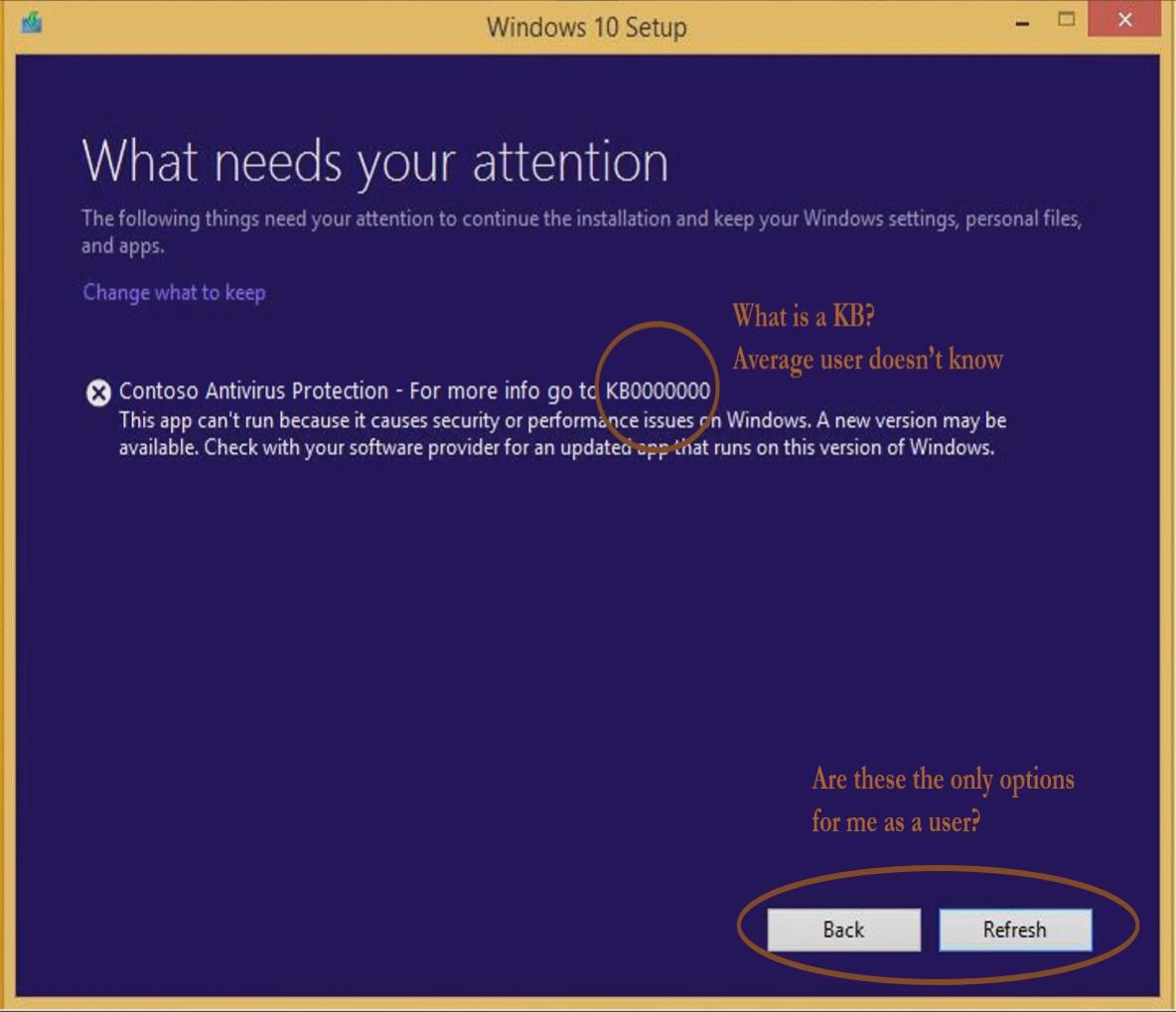
An anonymous reader quotes a report from Ars Technica: The next major Windows release, the Windows 10 April 2019 Update (codenamed 19H1), is going to offer some significant improvements [to error messages]. Microsoft described them on its Windows Insider webcast, and they were spotted initially by WinFuture. Currently, the best case during installation is something like this screen.

The message says that an incompatible application is detected, and a Knowledge Base article is referenced. It turns out that most Windows users don't know what "KBxxxxxxx" actually means, and the article isn't hyperlinked to make accessing it any easier. Issues detected through the other setup experience aren't much better. Windows will offer to uninstall problem applications, but often the better solution is to upgrade the application in question. The new setup process aims to be both more informative and more useful. The general approach is to allow decisions to be made within the setup program where possible and to put meaningful descriptions in the error messages, rather than leaving people with just a KB number to go on. Further, the "learn more" links will take you directly to the relevant Knowledge Base article, rather than hoping that end users know what "KBxxxxxxxx" means. Third-party developers will also be able to provide information about upgrades and updates when applicable to resolving compatibility issues.

Slashdot Top Deals