Submission + - Fifteen Years Later, Citizens United Defined the 2024 Election (brennancenter.org)
Comment Re:Could he be retried for one of the hit attempts (Score 1) 339
Submission + - Anti-Trump Searches Appear Hidden on TikTok (ibtimes.com)
Silk Road Creator Ross Ulbricht Pardoned (bbc.com) 339
"The scum that worked to convict him were some of the same lunatics who were involved in the modern day weaponization of government against me," Trump said in his post online on Tuesday evening. "He was given two life sentences, plus 40 years. Ridiculous!" Ulbricht was found guilty of charges including conspiracy to commit drug trafficking, money laundering and computer hacking. During his trial, prosecutors said Ulbricht's website, hosted on the hidden "dark web", sold more than $200 million worth of drugs anonymously.
Submission + - Trump Pardons Silk Road Founder (nypost.com)
Submission + - Decentralized Social Media Is the Only Alternative to the Tech Oligarchy (404media.co)
The problem with decentralized social media platforms thus far is that their user base is minuscule compared to platforms like TikTok, Facebook, and Instagram, meaning the cultural and political influence has lagged behind them. You also cannot directly monetize an audience on Bluesky or Mastodon—which, to be clear, is a feature, not a bug—but also means that the value proposition for an influencer who makes money through the TikTok creator program or a small business that makes money selling chewing gum on TikTok shop or a clothes brand that has figured out how to arbitrage Instagram ads to sell flannel shirts is not exactly clear. I am not advocating for decentralized social media to implement ads and creator payment programs. I’m just saying that many TikTok influencers were directing their collective hundreds of millions of fans to follow them to Instagram or YouTube, not a decentralized alternative.
This doesn’t mean that the fediverse or that a decentralized Instagram or TikTok competitor that runs on the AT.Protocol is doomed. But there is a lot of work to do. There is development work that needs to be done (and is being done) to make decentralized protocols easier to join and use and more interoperable with each other. And there is a massive education and recruitment challenge required to get the masses to not just try out decentralized platforms but to earnestly use them. Bluesky’s growing user base and rise as a legitimately impressive platform that one can post to without feeling like it’s going into the void is a massive step forward, and proof that it is possible to build thriving alternative platforms. The fact that Meta recently blocked links to a decentralized Instagram alternative shows that big tech sees these platforms, potentially, as a real threat.
Submission + - TikTok is censoring anti-Trump content (newsweek.com)
A post on X, formerly Twitter, which has received 4.5 million views at the time of reporting, claims that "TikTok is now region locking Americans from looking up things like "fascism" and "Donald Trump rigged election"."
The post includes two screenshots of the TikTok app. The screenshot is of the search page, and in both the search term is "Donald Trump rigged election." The post states that: "On the left are results from a device in America, and on the right are results from one in the UK."
The post on the left shows a results page stating "No results found," while on the left it shows two videos of the President.
Another post from the account Dustin Genereux said that, "Censorship on TikTok is at an all time high with accounts being deleted, posts going back years being flagged, people losing access to the creator fund for saying anything Anti-Trump, MAGA, Elon, etc. But free speech and all that right?"
Great Barrier Reef Hit By Its Most Widespread Coral Bleaching, Study Finds (theguardian.com) 15
Only 92 coral colonies escaped bleaching entirely and by July, when the analysis for the study ended, 193 were dead and a further 113 were still showing signs of bleaching. Prof Maria Byrne, a marine biologist at the University of Sydney and lead author of the study, has been researching and visiting the island for 35 years.
Brendan Carr is Officially in Charge of the FCC (theverge.com) 71
Carr's priorities might also be gleaned from a document you might have already heard about: Project 2025. That's because he authored the FCC chapter of the Heritage Foundation's wishlist for a Donald Trump presidency. In that chapter, Carr proposes actions including: limiting immunity for tech companies under Section 230 of the Communications Decency Act, requiring disclosures about how platforms prioritize content, requiring tech companies to pay into a program that funds broadband access in rural areas, and more, quickly approving applications to launch satellites from companies like Elon Musk's Starlink.
Authors Seek Meta's Torrent Client Logs and Seeding Data In AI Piracy Probe (torrentfreak.com) 15
"By downloading through the bit torrent protocol, Meta knew it was facilitating further copyright infringement by acting as a distribution point for other users of pirated books," the amended complaint notes. "Put another way, by opting to use a bit torrent system to download LibGen's voluminous collection of pirated books, Meta 'seeded' pirated books to other users worldwide." Meta believed that the allegations weren't sufficiently new to warrant an update to the complaint. The company argued that it was already a well-known fact that it used books from these third-party sources, including LibGen. However, the authors maintained that the 'torrent' angle is novel and important enough to warrant an update. Last week, United States District Judge Vince Chhabria agreed, allowing the introduction of these new allegations. In addition to greenlighting the amended complaint, the Judge also allowed the authors to conduct further testimony on the "seeding" angle. "[E]vidence about seeding is relevant to the existing claim because it is potentially relevant to the plaintiffs' assertion of willful infringement or to Meta's fair use defense," Judge Chhabria wrote last week.
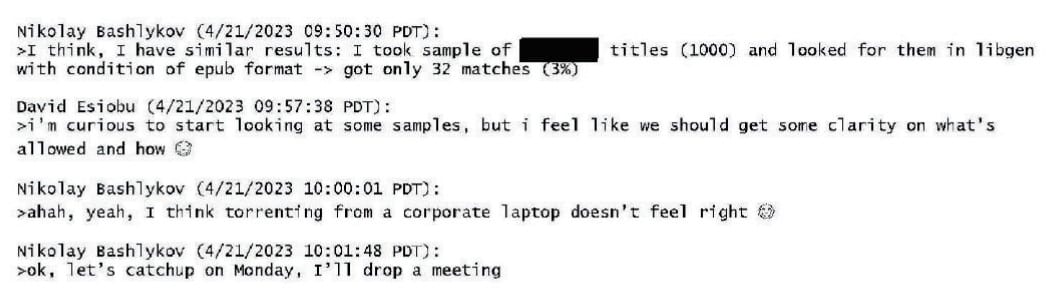
With the court recognizing the relevance of Meta's torrenting activity, the plaintiffs requested reconsideration of an earlier order, where discovery on BitTorrent-related matters was denied. Through a filing submitted last Wednesday, the plaintiffs hope to compel Meta to produce its BitTorrent logs and settings, including peer lists and seeding data. "The Order denied Plaintiffs' motion to compel production of torrenting data, including Meta's BitTorrent client, application logs, and peer lists. This data will evidence how much content Meta torrented from shadow libraries and how much it seeded to third parties as a host of this stolen IP," they write. While archiving lists of seeders is not a typical feature for a torrent client, the authors are requesting Meta to disclose any relevant data. In addition, they also want the court to reconsider its ruling regarding the crime-fraud exception. That's important, they suggest, as Meta's legal counsel was allegedly involved in matters related to torrenting. "Meta, with the involvement of in-house counsel, decided to obtain copyrighted works without permission from online databases of copyrighted works that 'we know to be pirated, such as LibGen," they write. The authors allege that this involved "seeding" files and that Meta attempted to "conceal its actions" by limiting the amount of data shared with the public. One Meta employee also asked for guidance, as "torrenting from a corporate laptop doesn't feel right."
Comment Daszak (Score 1) 303
We have very good reasons to distrust the virology community: Peter Daszak and the fact that he enjoys the support of that community.
-- He organized and signed the Lancet statement against the lab-leak theory, without disclosing his conflict of interest as a collaborator with the WIV.
-- He kept his EcoHealth Alliance 2018 proposal to insert furin cleavage sites into bat coronaviruses at the WIV secret, until it was leaked in 2021. A normal person would think it was obviously their moral duty to release any information potentially relevant to the origin of COVID. This alone made it clear Daszak cannot be trusted.
-- He has claimed that since the proposal was not funded, the work must not have been done. Every scientist knows that if you don't get funding from one source, you often pursue the work regardless.
-- A recent Senate hearing asked him whether he ever asked his collaborator Shi Zengli whether the work went ahead. He said he has never asked her. That's unbelievable unless he deliberately didn't want to know, in which case it's totally irresponsible.
The virology community and the NIH have closed ranks around this guy, so I don't trust them either.
Comment describing this as a "bug" isn't really accurate (Score 3, Informative) 61
The behavior that's being removed here isn't really a "bug". Back in CSS1 and/or CSS2, the spec for floating
In particular, Gecko's behavior was to actually use the bounds of the glyph (rather than the font metrics for the whole font) to do layout for a floating first-letter, so that there wouldn't be extra space around it and it would align better. This was a better default behavior, but it was also somewhat less controllable since some of the standard inline layout properties (like line-height) didn't apply.
It also turned out that this better behavior wasn't good enough to really do good typographic first-letter effects. Maybe about a decade after Gecko implemented the glyph-wrapping behavior for floating first-letter, some folks (primarily Dave Cramer) who were interested in doing better initial letters came to the CSS WG and developed (over a period of years, with quite a bit of interaction and discussion in the working group) a new set of CSS properties with a substantial spec (at https://w3c.github.io/csswg-drafts/css-inline/#initial-letter-styling ) to address first-letter typography.
At some point during the progres of that work, one question that came up was whether the spec should continue to have this vague allowance that implementations could try to do something better (as Gecko, and no other browsers, were doing). Given that we knew at this point that the Gecko behavior, while better, wasn't sufficient to do good typography, this seemed like the right thing to do. As one of the Gecko representatives on the CSS WG, I absolutely could have objected on the basis that we *were* doing something better and would like to continue to do so, and such an objection probably would have led to the WG not removing that allowance from the spec. But removing the allowance, and moving towards better interoperability, was the right thing to do, so I supported removing it. (That's also when I commented on and reopened the bug being discussed here.)
That said, it also didn't seem like removing the better behavior from Gecko was the right thing to do until we had implemented the *even better* new spec with the initial-letter-* properties, which would allow Gecko users to see better-quality typographic first-letters in the new way. (Though there's an obvious trade-off there between quality and interoperability. The opinions of standards bodies and implementers for the Web platform have changed a good bit over the past 20 years on how to make such tradeoffs -- generally towards stricter interoperability at the expense of allowing implementations to do "better" things.) So, back when I was working on Gecko, I thought that we should keep it until we'd implemented the new initial-letter-* properties. It seems like the folks currently working on Gecko made the opposite call. But I think both decisions are reasonable -- there's a real tradeoff there (though the inputs into that tradeoff are likely changing over time as well).
So, really, just saying "hey, they fixed a really old bug" isn't that useful a point to make. There's much more history there. (Also, see https://dbaron.org/log/20080515-age-of-bugs which I wrote 14.5 years ago in response to general criticism about the age of bug reports.)
Comment only a little bit (Score 5, Informative) 104
(Former Mozilla Distinguished Engineer here FWIW.)
Parsing WebAssembly modules does represent a small increase in attack surface, and there is additional attack surface if the browser has a dedicated WASM interpreter or JIT compiler. But in Firefox, for example, the WASM optimizing compiler uses the same Ionmonkey infrastructure as the JS engine so there isn't much new attack surface in that JIT compiler. That is very different from say Flash which had its own entirely different compiler.
WASM applications use the same browser APIs as JS does, so there is no new attack surface there. That's a big deal and one of the benefits of WASM's design over say (P)NaCl.
Overall, yeah, WASM adds some attack surface, but not much compared to the rest of the browser. And it's all contained in the sandboxed renderer process(es).
Comment Re:Stallman is an idiot.... (Score 3, Interesting) 640
Stallman is 68 years old. He's had plenty of time to learn social graces with or without assistance.
If he is unable to interact appropriately with other people and unable to learn how, then we can have compassion on him, but he is poorly qualified to be on the board of a public-facing organisation.