Forgot your password?
typodupeerror

Submission + - LLM-inspired study sheds light on how brain cells encode the meaning of words (medicalxpress.com)

alternative_right writes: To investigate how the brain encodes the meaning of words, the researchers first recorded the activity of individual neurons in the hippocampus of 10 people who were listening to stories. Their recordings were collected using tiny wire electrodes that were implanted in the participants' brains as part of clinical monitoring procedures for epilepsy.

The team then used mathematical models to analyze the language used in the stories and the brain recordings. This allowed them to examine whether information about the meaning of words could predict the recorded neuronal activity.

"We recorded responses of hippocampal neurons while individuals listened to narrative speech," wrote Melissa Franch and her colleagues in their paper. "Using an encoding model approach, we find robust encoding of semantics, even after controlling for phonemics and grammar. Individual words had complex selectivities that included multiple words in multiple semantic categories."

Submission + - Amid K-12 AI Pushback, OpenAI Named Lead Partner of 'Hour of AI' for Kids

theodp writes: On the heels of announced AI moratoriums by the nation's two largest K-12 school districts (NYC, LA), tech-backed nonprofit CodeAI (aka Code.org) this week named OpenAI 'Lead Partner' for the 2026 Hour of AI, which has replaced the Hour of Code (RIP, 2013-2024) as the premier event for the nation's K-12 schoolchildren during December's CS Education Week. OpenAI investor and partner Microsoft was named as one of two 'Supporters' for the event/infomercial (the other being U.S. defense contractor Northrop Grumman).

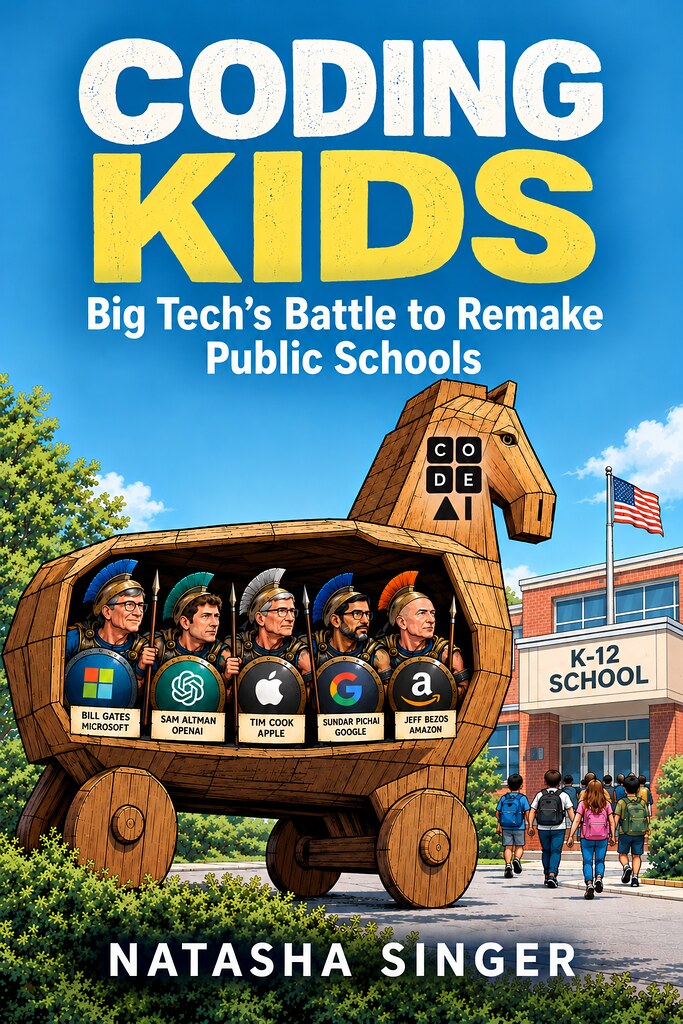
In August, as it launched ChatGPT for Teens, OpenAI announced a new signature partnership with Code.org to 'prepare the first AI generation', explaining that 'through the Hour of AI, OpenAI and CodeAI will introduce millions of students to the basics of using AI thoughtfully and responsibly.' OpenAI and Microsoft last year teamed up with the American Federation of Teachers to 'bring AI into the classroom', but that honeymoon is over. For more on the inside story of how Big Tech is applying the same playbook it used to scale coding lessons nationwide to now mainstream their AI tools in schools, check out Coding Kids: Big Tech's Battle to Remake Public Schools.

So, much like the Hour of Code that preceded it, will the Hour of AI serve as tech's 'Trojan Horse' (ChatGPT-generated parody cover) in its 'Odyssey' to push its agenda and curriculum into schools?

Submission + - First Nuclear Clocks Start Ticking in Vienna and Beijing (phys.org)

necro81 writes: Two groups, one in Vienna and one in Beijing, have successfully demonstrated the world's first nuclear clocks. Standard atomic clocks, like the caesium clocks that define the second, operate by observing the transition of electrons between different orbits about the nucleus. The resulting radiation is usually in the microwave range, and can produce clocks accurate to one second in 100 billion years.

Nuclear clocks go a step further, and probe energy transitions within the nucleus itself. Nuclei can arrange their protons and neutrons into different configurations, called isomers. The isomer with the lowest energy is the one usually found; higher-energy ones are only metastable and decay quickly. Usually it takes serious energy — x-rays and gamma rays — to excite a nucleus into a higher-energy arrangement. It so happens that thorium-229 can be excited using UV light with a wavelength of 148 nm — just within the capabilities of some exotic lasers.

It's still been quite a challenge. For one thing, Th-229 is not found in nature; it must be extracted from the decay chain of uranium-235. The Beijing team used just a microgram mixed in a crystal of calcium fluoride.

Although these prototype nuclear clocks are not yet more accurate than existing atomic clocks (one second in millions, rather than billions, of years), they show the way towards what may be possible. Because the energy transition is in the nucleus, rather than the electron cloud, it is less susceptible to outside disturbances like magnetic fields. And the fundamental frequency is much higher (five orders of magnitude), which should yield more precise timing. This development could lead to smaller and more reliable time standards across the world (and solar system).

Comment Re:What is left to change besides oven and microwa (Score 2, Insightful) 281

What is left to change besides oven and microwave times?

One...the most IMPORTANT one....my internal clock....

That really takes close to a week to get fixed every time.....it throws all of us humans off to some degree.

Oh...and my dog....I have to adjust her schedule twice a year too....

Submission + - Wisconsin U–Madison Prof Francis Halzen named 2026 Nobel laureate in physi (wisc.edu)

schwit1 writes: Halzen is the principal investigator of the NSF IceCube Neutrino Observatory, the world’s largest — and perhaps strangest — telescope. The U.S. National Science Foundation-funded observatory is operated by an international collaboration of scientists led by the Wisconsin IceCube Particle Astrophysics Center based at UW–Madison.

Embedded in a cubic kilometer of Antarctic ice, IceCube uses thousands of light sensors to survey the universe for neutrinos, nearly massless particles that rarely interact with other matter. Neutrinos provide information about the workings of black holes, galaxies and other objects in the cosmos.

“IceCube is like no other telescope in the world,” says UW–Madison interim Chancellor Eric M. Wilcots. “And there is no other scientist quite like Francis Halzen, whose idea to create a neutrino detector under almost a mile of ice has led to a remarkable multinational and multi-institutional scientific collaboration and a fundamental shift in how we think about the universe.”

Slashdot Top Deals

You are always doing something marginal when the boss drops by your desk.

Working...