Comment Re:Idiot (Score 2) 179
I hate Slashdot sometimes.
Comment Re:Idiot (Score 1) 179
Comment Re:Idiot (Score 5, Interesting) 179
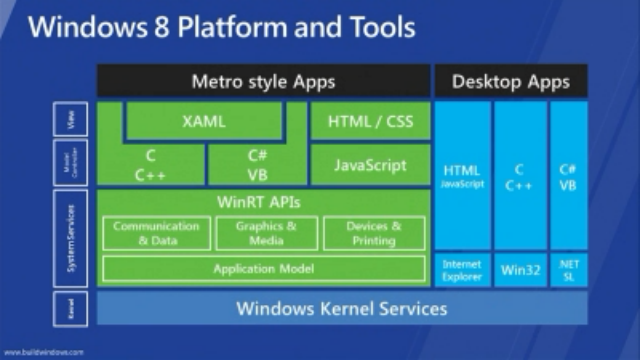
This guy is a complete moron. First, it's called the CLI, not the CIL. Second, it's called the Windows Runtime or WinRT and it runs
Hi, I'm the "complete moron" who wrote the article. I most definitely meant CIL and not CLI, as I was referring to the Common Intermediate Language, and not the Command Line Interface. One is used to interact with an operating system through mostly text (curses and cursor-based terminal graphics being a stark exception), and the other allows multiple human-written programming languages to be compiled to a common bytecode form for interpretation by a
Submission + - Windows 8: .NET versus HTML5 Metro app development (silicon-news.com)
Comment Re:It isn't just licensing costs... (Score 4, Informative) 863
Successful exploitation requires that a threaded Multi-Processing Module is used and that the mod_proxy_ftp module is enabled. (...) An error in the included APR-util library can be exploited to trigger hangs in the prefork and event MPMs on Solaris.
And the second (first in order on the site) unpatched vulnerability deals strictly with a mod_ftp input validation issue. Again, I rarely even see mod_ftp even used as opposed to an entirely seperate FTP server daemon but disabling the faulty module is simple enough in environments requiring absolute security.
And input validation issues are usually patched fairly quickly anyways, I mean come on, this is 2009 and there are too many developers for the project that wouldn't let this sort of thing continue for this amount of time. Not to mention the fact that these unpatched vulnerabilities are nothing compared to the olde IIS Webdav exploit of a few years ago - too bad there wasn't a community aware of it sooner other than the underground black hats already using it to their advantage by the time it was brought to the attention of MS.
Comment Re:Not really... (Score 1) 267
Users don't read dialog boxes. It could've had red flashing lights around it, and it wouldn't have mattered.
Yeah I get those at the bottom of websites all the time, usually because I'm the Xth visitor etc. For some reason, the prize is always a bunch of forms to fill out promising more prizes. (this is a joke, by the way)
Submission + - Dell says Windows 7 pricing may be a 'problem'
The director of product management for Dell's business client product group, Darrel Ward, thinks that the price for the upcoming Windows 7 operating system may potentially be an obstacle for early adopters.
Considering Dell sells Ubuntu-equipped Inspiron 15n for ~$350, and Vista Equipped Inspiron 15 for ~$399, and "If there's one thing that may influence adoption, make things slower or cause customers to pause, it's that generally the ASPs (average selling price) of the operating systems are higher than they were for Vista and XP", it makes you wonder exactly what they hidden "Windows 7 fee" will be on machines later.
Let the flames begin.
Comment inodes (Score 1) 2
That'd be my guess, in addition to just plain common sense: why/how on earth would you need 50,000+ files anyways? Something a database couldn't satisfy?
Submission + - Unix New Hampshire license plate turns 20 (nashuatelegraph.com)
Comment Re:The slashdot effect strikes again (Score 5, Informative) 143
Netbooks are making huge waves within the hardware and software industries today, but not many would believe that the whole Netbook craze actually started back around 1996 with the Toshiba Libretto 70CT. Termed technically as a subnotebook because of its small dimensions (given below), the computer is the first that fits all of the qualifications of being what we would call a Netbook today, due in part to its built-in Infrared and PCMCIA hardware, and itâ(TM)s (albeit early) web browsing software. The First Netbook Computer
The First Netbook Computer
The hardware includes the two (potentially) wireless PCMCIA and Infrared network connections, Windows 95 OSR 2 with Internet Explorer 2.0, a whole 16MB of RAM and a 120Mhz Intel Pentium processor (weâ(TM)re flying now!).
A further look at the hardware reveals even more Netbook-ish hardware/software trends (and pictures below), given todayâ(TM)s standards for Netbook qualifications.
The Libretto (70CT) was certainly not the first small (8â) form factor laptop produced in the early 90â(TM)s, but it was the first to be considered a Netbook given todayâ(TM)s standards because of itâ(TM)s PCMCIA and Infrared connections, used for wireless network connectivity and possibly even via a phone card. The inclusion of Internet Explorer 2.0 within the software also contributes to its ability to be officially termed a âoeNetbookâ (more on this below).
The hardware includes an 8â wide, 5â deep and almost 1.5â form factor containing a whopping 16MB of RAM, a 120Mhz Intel Pentium processor (with added MMX technology!) and a whole 30-45 minutes of battery life.
The software running on the âoeNetbookâ is Windows 95 OSR2, with Included Internet Explorer 2.0 and the Windows 95 Plus! pack of software. The mouse is the nub/nipple/clit mouse, given the lack of trackpad hardware and the only alternative being the bulky ball-based mice of the time, and the actual mouse buttons are mounted on the back.
I donâ(TM)t consider Internet Explorer 2.0 being the most supported browser for web-based applications (hell, I donâ(TM)t even support 6 or 7), and 16MB doesnâ(TM)t sound like a whole lot of RAM for storing a large web page and JavaScript into memory along with the operating system, but around the year 1996 this laptop/subnotebook/netbook would meet all the requirements given its environment to be called a Netbook as we would today.
Other hardware besides what was listed above includes a (HiFi?) 1/4â sound port on the back, a mono speaker on the front above the mouse, and a proprietary docking port on the bottom.
The Pentium MMX and bulky battery connector doesnâ(TM)t exactly make this ACPI-lacking portable the most environmentally-friendly book of all time, but it is certain that it must have gotten the job done in its time.
The screen was a very low-resolution (640Ã--480) 5â LCD screen, leaving enough room on the front for the mouse, speaker, power button, and all-too-important logos of Intel and Toshiba.
While I write this largely with humorous intent, it is worth noting the satire I intend to make of the industryâ(TM)s buzzwords for modern products that sometimes have been out for quite a while, e.g. cloud computing versus clustering/distributed applications and âoehigh-speed Internetâ versus what a T1/ATM connection was over decade ago.
Also, something patent trolls working for Toshiba might wish to investigate are the 22 patents listed on the bottom of the Libretto model (pictured below). What these patents cover and how many modern netbooks/subnotebooks violate these are unknown to me, although Iâ(TM)m sure you could find a few with the right research as these patents were approved less than 25 years ago.
Picture Gallery
These (possibly slow-loading) pictures display several features of the computer, displaying as many of its features as possible (and probably killing our bandwidth): (and indeed they did)
A Look Back At the World's First Netbook 143
Submission + - The World's (very) First Netbook (thecoffeedesk.com) 5
The hardware includes the two (potentially) wireless PCMCIA and Infrared network connections, Windows 95 OSR 2 with Internet Explorer 2.0, a whole 16MB of RAM and a 120Mhz Intel Pentium processor (we're flying now!).
Submission + - NASA Researchers Worried About Huge Sun Flares (wired.com) 1
The report was largely ignored at first because of the unfortunate overlap with an ancient Mayan prediction of a major "turning point" in the year 2012 (by the Western calendar).
Comment Re:Dell e 6400 (Score 1) 291
and the height of my zeppelin (how else would it be portable?) is 7700m
As if the MSPaint diagram you displayed earlier wasn't enough, I can't stop laughing at the thought of a giant hamster-filled zeppelin flying through the air, and the god-awful grinding the turbines make as it flies (not to mention the discarded entrails after they pass through the motor). Then there's the Slashdot user at the very back, with a laptop connected to the contraption, laughing all the way.
Also, you must have an automated forklift system to actually deposit the hamsters into the meat grinders (they can't just pile in, since you're in the confined space of a zeppelin), and even at that where does the power supply of the forklifts themselves rely? Surely they can't power themselves just off of the hamsters since over 2,000 are needed to power the laptop.
And if you don't have an array of forklifts, what you have? Oompa-loompas? Is this the evil Willie-Wonka zeppelin flying through the air? I guess reading Slashdot can pervert even the most good of people...