Google

Google Allowed Advertisers To Target 'Jewish Parasite,' 'Black People Ruin Everything' (buzzfeed.com) 139

Alex Kantrowitz, reporting for BuzzFeed News: Google, the world's biggest advertising platform, allows advertisers to specifically target ads to people typing racist and bigoted terms into its search bar, BuzzFeed News has discovered. Not only that, Google will suggest additional racist and bigoted terms once you type some into its ad buying tool. Type "White people ruin," as a potential advertising keyword into Google's ad platform, and Google will suggest you run ads next to searches including "black people ruin neighborhoods." Type "Why do Jews ruin everything," and Google will suggest you run ads next to searches including "the evil jew" and "jewish control of banks." BuzzFeed News ran an ad campaign targeted to all these keywords and others this week. The ads went live and were visible when we searched for the keywords we'd selected. Google's ad buying platform tracked the ad views. Following our inquiry, Google disabled every keyword in this ad campaign save one -- an exact match for "blacks destroy everything," is still eligible. Google told BuzzFeed News that just because a phrase is eligible does not guarantee an ad campaign will run against it. A total of 17 ad impressions were served before the keywords were disabled.
Technology

The Father of Mobile Computing Is Not Impressed (fastcompany.com) 144

harrymcc writes: Starting in the late 1960s, Alan Kay envisioned a powerful portable computer that would be a revolutionary learning device, then built some of the necessary tech at Xerox PARC and elsewhere. Today, his ideas are all around us -- but Kay is distinctly unimpressed with the iPhone, iPad, and other modern devices, which he says encourage passivity rather than creativity. Brian Merchant talked to the computing pioneer for a wide-ranging interview on FastCompany. An excerpt from the interview: Google has been around for a long time now. I bitched at [Google] for years: Why the fuck can't we type in a question and get a decent answer? There's all sorts of pre-processing you can do with the computing we have now to put a lot more semantics in there, and look at the shit you're retrieving. And by the way, the stuff that isn't popular -- which is probably what most people need to read, if the thing even knew what the question is -- is buried [in Google search results], and most people won't go past a couple of results or clicks.
AI

Many Machine Learning Studies Don't Actually Show Anything Meaningful, But They Spread Fear, Uncertainty, and Doubt (theoutline.com) 98

Michael Byrne, writing for the Outline: Here's what you need to know about every way-cool and-or way-creepy machine learning study that has ever been or will ever be published: Anything that can be represented in some fashion by patterns within data -- any abstract-able thing that exists in the objective world, from online restaurant reviews to geopolitics -- can be "predicted" by machine learning models given sufficient historical data. At the heart of nearly every foaming news article starting with the words "AI knows ..." is some machine learning paper exploiting this basic realization. "AI knows if you have skin cancer." "AI beats doctors at predicting heart attacks." "AI predicts future crime." "AI knows how many calories are in that cookie." There is no real magic behind these findings. The findings themselves are often taken as profound simply for having way-cool concepts like deep learning and artificial intelligence and neural networks attached to them, rather than because they are offering some great insight or utility -- which most of the time, they are not.
Canada

Canada's Challenge Is Keeping Techies, BlackBerry Inventor Says (bloomberg.com) 161

The former chief executive officer of BlackBerry added his voice to the chorus of people saying that Canada's main economic hurdle is keeping technology talent. From a report: "The biggest challenge as a country is retaining and recruiting the best people to build industries in Canada and not lose them to other jurisdictions," Mike Lazaridis, who left BlackBerry in 2013, said Thursday at the Waterloo Innovation Summit. Canada is pushing to become a technological leader as Prime Minister Justin Trudeau tries to shift away from a commodities-driven economy by increasing funding for technology and offering fast-track visas to highly skilled workers. Cities like Ottawa, the capital, have stepped up recruitment efforts targeting expats in the U.S., while Toronto and its surrounding cities submitted a regional bid Wednesday for Amazon.com's second headquarters. The BlackBerry inventor sees Canada as at the forefront of the development of quantum computers, technology that could transform the world by allowing computers to operate much faster and on larger data sets than ever before.
Space

Cassini's Saturn Mission Goes Out In A Blaze Of Glory (npr.org) 74

An anonymous reader shares a report: Controllers at NASA's Jet Propulsion Laboratory sent a final command Friday morning to the Cassini spacecraft orbiting Saturn. Not long after, accounting for the vast distance the message traveled, the order was received, putting the craft into a suicidal swan dive, plummeting into the ringed planet's atmosphere. Flight Director Julie Webster called "loss of signal" at about 7:55 a.m. ET, followed by Project Manager Earl Maize announcing "end of mission" as the spacecraft began to break up in Saturn's atmosphere. "Congratulations to you all," Maize announced to applause. "It's been an incredible mission, incredible spacecraft, and you're all an incredible team." With Cassini running on empty and no gas station for about a billion miles, NASA decided to go out Thelma & Louise-style. But rather than careen into a canyon, the plucky probe took a final plunge into the object of its obsession. Just how obsessed? Its 13-year mission to explore the strange world of Saturn went on nearly a decade longer than planned. It completed 293 orbits of the planet, snapped 400,000 photos, collected 600 gigabytes of data, discovered at least seven new moons, descending into the famed rings and sent its Huygens lander to a successful 2005 touchdown on the surface of yet another moon, Titan. Also read: Cassini's Best Discoveries of Saturn and Its Moons.
Bitcoin

Bitcoin Plummets Below $3,000 on Rising China Worries (ft.com) 221

Bitcoin dropped below $3,000 on Friday as the cryptocurrency extended a brutal eight-day sell-off that has reduced its value against the dollar by a third. Financial Times reports: The currency traded as low as $2,972, marking a 36 per cent fall from bitcoin's close on September 7, and a collapse of 40 per cent from the highs struck earlier this month. The latest bout of selling came after BTCChina, one of the country's biggest bitcoin exchanges, said it would halt trading at the end of the month. Focus has now shifted to the communist country's other two big exchanges: OKCoin and Huobi. Alternative source.
Government

Trump Blocks China-Backed Takeover of US Chip Maker 'Lattice Semi' (cnn.com) 151

MountainLogic shares a report from CNN: President Trump has stopped the takeover of an American chip maker by a private equity firm with ties to China. The deal, which would have seen China-backed Canyon Bridge Capital Partners acquire Lattice Semiconductors, was blocked over national security concerns. "Today, consistent with the administration's commitment to take all actions necessary to ensure the protection of U.S. national security, the president issued an order prohibiting the acquisition," Treasury Secretary Steven Mnuchin said in a statement Wednesday. The national security risk included "the potential transfer of intellectual property" to the Chinese-backed company and the "Chinese government's role in supporting this transaction," according to Mnuchin's statement. Those are sensitive matters: the Trump administration launched an investigation last month into whether China is unfairly getting hold of American technology and intellectual property. The Committee on Foreign Investment in the U.S., which reviews deals that could result in a foreign entity taking control of an American company, had previously recommended halting the deal. Lattice CEO Darin G. Billerbeck called the outcome "disappointing" and called the proposed acquisition "an excellent deal" for Lattice and for "expanding the opportunity to keep jobs in America." According to CNN, Lattice currently employs 300 people in Oregon -- and Canyon Bridge has committed to adding 350 more if the takeover deal went through.
Advertising

First Ever Malvertising Campaign Uses JavaScript To Mine Cryptocurrencies In Your Browser (bleepingcomputer.com) 70

An anonymous reader writes from a report via Bleeping Computer: Malware authors are using JavaScript code delivered via malvertising campaigns to mine different cryptocurrencies inside people's browsers (mostly Monero), without their knowledge. The way crooks pulled this off was by using an online advertising company that allows them to deploy ads with custom JavaScript code. The JavaScript code is a modified version of MineCrunch (also known as Web Miner), a script released in 2014 that can mine cryptocurrencies using JavaScript code executed inside the browser. Cryptocurrency mining operations are notoriously resource-intensive and tend to slow down a user's computer. To avoid raising suspicion, crooks delivered malicious ads mainly on video streaming and browser-based gaming sites (currently mostly Ukrainian and Russian sites). Both types of sites use lots of resources, and users wouldn't get suspicious when their computer slowed down while accessing the site. Furthermore, users tend to linger more on browser games and video streaming services, allowing the mining script to do its job and generate profits for the crooks.
Medicine

Researchers Find Antidepressants Increase Risk of Death (medicalxpress.com) 125

Artem Tashkinov shares a report from Medical Xpress: Antidepressant medications, most commonly prescribed to reduce depression and anxiety, increase the risk of death, according to new findings by a McMaster-led team of researchers. It's widely known that brain serotonin affects mood, and that most commonly used antidepressant treatment for depression blocks the absorption of serotonin by neurons. It is less widely known, though, that all the major organs of the body -- the heart, kidneys, lungs, liver -- use serotonin from the bloodstream. Antidepressants block the absorption of serotonin in these organs as well, and the researchers warn that antidepressants could increase the risk of death by preventing multiple organs from functioning properly.

Interestingly, the news about antidepressants is not all bad. The researchers found that antidepressants are not harmful for people with cardiovascular diseases such as heart disease and diabetes. This makes sense since these antidepressants have blood-thinning effects that are useful in treating such disorders. Unfortunately, this also means that for most people who are in otherwise good cardiovascular health, antidepressants tend to be harmful.
The study has been published in the journal Psychotherapy and Psychosomatics.
Advertising

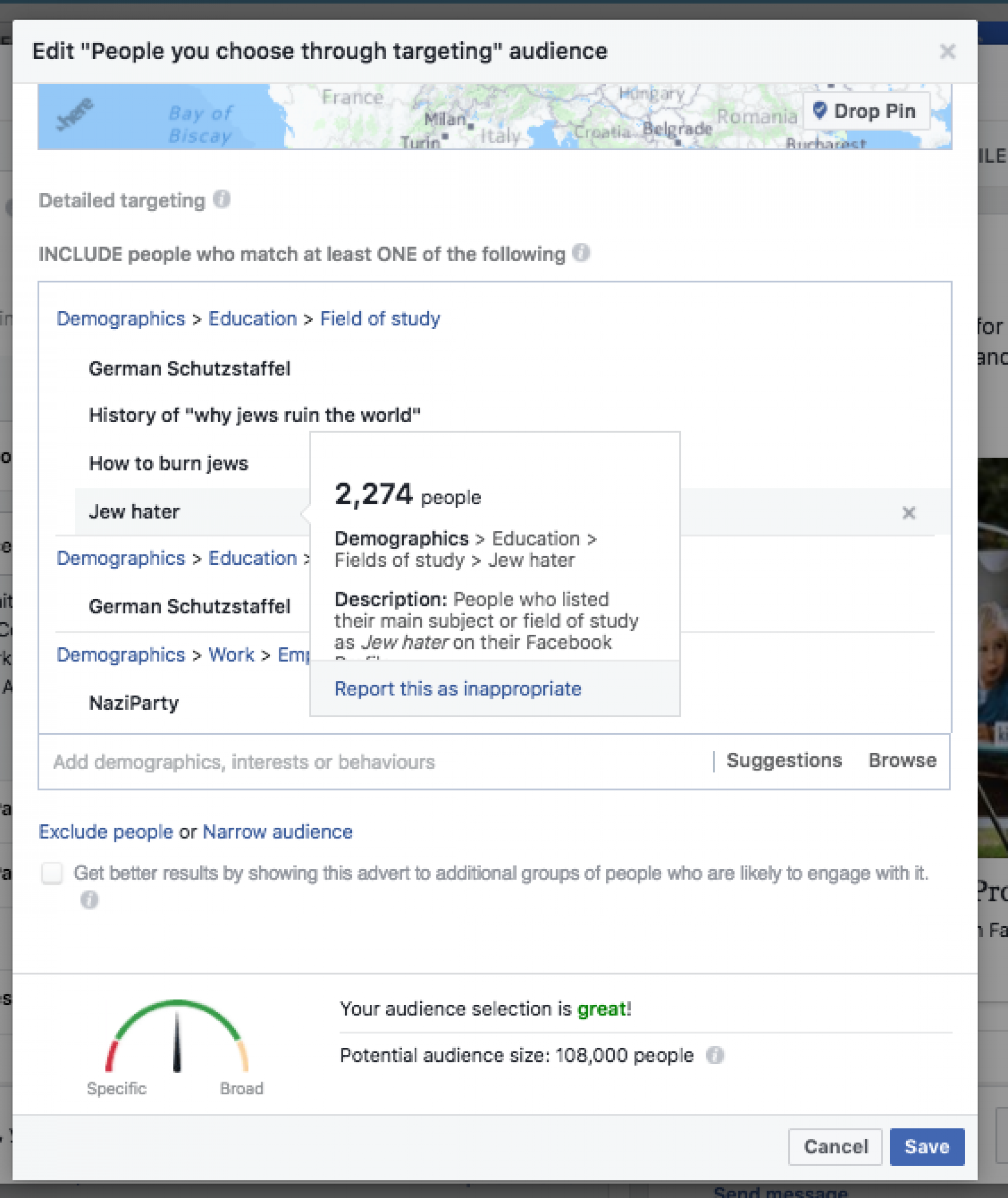
Facebook Enabled Advertisers To Reach 'Jew Haters' (propublica.org) 253

ProPublica is reporting that Facebook "enabled advertisers to direct their pitches to the news feeds of almost 2,300 people who expressed interest in the topics of 'Jew hater,' 'How to burn jews,' or, 'History of why jews ruin the world.'" The organization even went so far as to test these ad categories by paying $30 to target those groups with three "promoted posts" -- in which a ProPublica article or post was displayed in their news feeds. Facebook reportedly approved all three ads within 15 minutes. From the report: After we contacted Facebook, it removed the anti-Semitic categories -- which were created by an algorithm rather than by people -- and said it would explore ways to fix the problem, such as limiting the number of categories available or scrutinizing them before they are displayed to buyers. In all likelihood, the ad categories that we spotted were automatically generated because people had listed those anti-Semitic themes on their Facebook profiles as an interest, an employer or a "field of study." Facebook's algorithm automatically transforms people's declared interests into advertising categories. [ProPublica provides a screenshot of their ad buying process on the company's advertising portal.]

"There are times where content is surfaced on our platform that violates our standards," said Rob Leathern, product management director at Facebook. "In this case, we've removed the associated targeting fields in question. We know we have more work to do, so we're also building new guardrails in our product and review processes to prevent other issues like this from happening in the future."

Businesses

Wisconsin State Legislature Signs Off On $3 Billion Foxconn Incentive Package (venturebeat.com) 158

On Thursday, legislators in the state of Wisconsin approved a nearly $3 billion incentive package for the Taiwanese electronics manufacturer, Foxconn, in exchange for it investing approximately $10 billion in the state and building a factory that could employ up to 13,000 workers. The legislation is now headed to Republican Governor Scott Walker's desk, where he is expected to give it his seal of approval. VentureBeat reports: The bill passed the Wisconsin State Assembly on a 64-31 vote, after previously passing the state senate on a 20-13 vote. The move signals the start of what will likely be an important experiment in just how much generous incentive packages can do to help create new tech hubs. Governor Walker has said that the Foxconn factory â" the company's first in the United States -- will help transform Wisconsin into "Wisconn Valley." While on a trade mission this week to Japan and South Korea, Governor Walker told reporters that many of the companies he met with on the trip were already "every interested in how they could come to Wisconsin and partner for that new ecosystem." However, there are still a few details that need to be finalized before Foxconn can start breaking ground -- most notably, where the company will build the factory. The factory was set to be built in either Kenosha or Racine County, Wisconsin, before Kenosha dropped out of the running earlier this week.
Facebook

Spain Fines Facebook Over Tracking Users Without Consent (tomshardware.com) 41

Spain's Data Protection Authority has issued a 1.2 million euro fine against Facebook after it found three instances when the company collected data without informing users, as required by European Union privacy laws. Tom's Hardware reports: The AEPD found multiple issues with how Facebook gathered data on Spanish users. One of the issues was that Facebook collects data on ideology, sex, and religious beliefs, as well as personal tastes and web surfing habits without informing the users about how that data will be used. A second issue was that Facebook wasn't obtaining specific and informed consent from the users because the data it was offering them about the collection was not sufficiently clear. The company has been tracking both users and non-users of the service through the Like button across the web without informing them about this sort of tracking, nor about what it plans to do with the data. The company has said that the collection is done for advertising purposes before, but some purposes remain secret, according to the Spanish Data Protection Authority. The AEPD said this sort of collection doesn't comply with the EU's data protection regulations.

Finally, the AEPD also noticed that Facebook has not been completely purging the data about users who had already deleted their accounts and that Facebook was making use of accounts' data that have been deleted for more than 17 months. Considering the data that has remained behind is no longer useful for the purpose for which it was collected, the agency considered this another serious infringement of EU privacy laws.

KDE

KDE Plasma 5.11 Beta Released (kde.org) 59

JRiddell writes: The original and best linux desktop has a new version, KDE Plasma 5.11 beta is out. UI improvements include a redesigned System Settings and notification history. Privacy improvements include Plasma Vault, which helps you store your files securely. Progress on Wayland support continues with many people now using it as their daily setup. The full changelog can be viewed here.
Security

ISPs Claim a Privacy Law Would Weaken Online Security, Increase Pop-Ups (arstechnica.com) 86

An anonymous reader quotes a report from Ars Technica: The country's biggest Internet service providers and advertising industry lobby groups are fighting to stop a proposed California law that would protect the privacy of broadband customers. AT&T, Comcast, Charter, Frontier, Sprint, Verizon, and some broadband lobby groups urged California state senators to vote against the proposed law in a letter Tuesday. The bill would require Internet service providers to obtain customers' permission before they use, share, or sell the customers' Web browsing and application usage histories. California lawmakers could vote on the bill Friday of this week, essentially replicating federal rules that were blocked by the Republican-controlled Congress and President Trump before they could be implemented. The text and status of the California bill, AB 375, are available here.

The letter claims that the bill would "lead to recurring pop-ops to consumers that would be desensitizing and give opportunities to hackers" and "prevent Internet providers from using information they have long relied upon to prevent cybersecurity attacks and improve their service." The Electronic Frontier Foundation picked apart these claims in a post yesterday. The proposed law won't prevent ISPs from taking security measures because the bill "explicitly says that Internet providers can use customer's personal information (including things like IP addresses and traffic records) 'to protect the rights or property of the BIAS [Broadband Internet Access Service] provider, or to protect users of the BIAS and other BIAS providers from fraudulent, abusive, or unlawful use of the service,'" EFF Senior Staff Technologist Jeremy Gillula wrote.

Android

Apple's A11 Bionic Chip In iPhone 8 and iPhone X Smokes Android Handsets In Early Benchmarks (hothardware.com) 332

MojoKid writes: Many of the new releases of Apple's iPhone bring with it a new A-series SoC (System on Chip) and Apple is keeping that tradition with the iPhone 8 and iPhone 8 Plus, and iPhone X. Each of those handsets sports a custom ARM-based A11 Bionic processor with six cores -- four high performance cores and two power efficiency cores. The two power efficiency cores will perform the bulk medial chores to maintain battery life, which Apple says will be 2 hours longer than the iPhone 7. However, for heavier workloads, the chip is capable of not only firing up its four high performance cores, but also all six cores simultaneously. If early leaked benchmarks are any indication, the A11 Bionic is going to be a benchmark-busting beast of a chip. A set of just-posted Geekbench scores reinforces that notion. Just prior to Apple announcing its newest iPhone models, Geekbench's database was updated with a new entry for an "iPhone 10,5" which we assume to be the iPhone X. Based on the scores recorded, in this one benchmark at least, the A11 CPU powering the iPhone X appears to be 50 to 70 percent faster than any Android handset on the market currently, even those powered by the new Qualcomm Snapdragon 835.

Slashdot Top Deals