The Internet

How Many .com Domain Names Are Unused? (singaporedatacompany.com) 158

Christopher Forno, CTO at Singapore Data Company writes: When looking for .com names, I've been frustrated by how many are already taken but appear to be unused. It can feel like people are registering every pronounceable combination of letters in every major language, and even the unpronounceable short ones. Is there rampant domain speculation, or do I just think of the same names as everyone else? Let's look at the data.

There are currently 137 million .com domain names registered. Of these, roughly 1/3 are in use (businesses, personal websites, email, etc.), another 1/3 appear to be unused, and the last 1/3 are used for a variety of speculative purposes. I started by crawling a random sample of the domains from the top-level .com DNS zone file, until reaching 100,000 valid domains. [...] For most categories I've included a random sample of screenshots from that category, excluding redundant ones: Content (31% or ~43 million), Ads (23% or ~31 million), No Web Server (11% or ~16 million), Empty (9.2% or ~13 million), For Sale (7.1% or ~9.8 million), Error (5.7% or ~7.9 million), Parked (4.8% or ~6.5 million), Gambling (3.0% or ~4 million), Mail (2.6% or ~3.5 million), Redirect (1.1% or ~1.6 million), Private (0.64% or ~0.9 million), and Porn (0.59% or ~0.8 million).

Businesses

In France, Comic Books Are Serious Business (nytimes.com) 71

It's a big year for comic book anniversaries. Batman's 80th is this year, and Asterix is turning 60. But at the Angouleme International Comics Festival in France, which finished on Sunday, there was a sense that the form's best days may be yet to come -- in the French-speaking world, at least. From a report: "It's a kind of golden age," said Jean-Luc Fromental, a comic book author who also runs a graphic-novel imprint for the publisher Denoel. "There has never been so much talent. There have never been so many interesting books published."

There are now more comic books published annually in France and Belgium than ever before, according to the festival's artistic director, Stephane Beaujean. "The market has risen from 700 books per year in the 1990s to 5,000 this year," he said in an interview. "I don't know any cultural industry which has had that kind of increase." Research by the market research company GfK, released to coincide with the festival, showed that turnover in the comic book industry in those two countries alone reached 510 million euros, or around $580 million, in 2018.

The bumper year in France and Belgium contrasts with a mixed situation worldwide. Comichron, a website that reports on comic book sales in the United States, where the market is worth around $1 billion, says that sales there are declining. But in terms of respect and recognition, comics are on the way up.

Science

Plants and Animals Sometimes Take Genes From Bacteria, Study Suggests (sciencemag.org) 44

An anonymous reader quotes a report from Science Magazine: Many genome studies have shown that prokaryotes—bacteria and archaea -- liberally swap genes among species, which influences their evolution. The initial sequencing of the human genome suggested our species, too, has picked up microbial genes. But further work demonstrated that such genes found in vertebrate genomes were often contaminants introduced during sequencing. [...] Debashish Bhattacharya, an evolutionary genomicist at Rutgers University in New Brunswick, New Jersey, and UD plant biochemist Andreas Weber took a closer look at a possible case of bacteria-to-eukaryote gene transfer that [William Martin, a biologist that concluded that there is no significant ongoing transfer of prokaryotic genes into eukaryotes, has challenged in 2015]. The initial sequencing of genomes from two species of red algae called Cyanidiophyceae had indicated that up to 6% of their DNA had a prokaryotic origin. These so-called extremophiles, which live in acidic hot springs and even inside rock, can't afford to maintain superfluous DNA. They appear to contain only genes needed for survival. "When we find a bacterial gene, we know it has an important function or it wouldn't last" in the genome, Bhattacharya says.

He and Weber turned to a newer technology that deciphers long pieces of DNA. The 13 red algal genomes they studied contain 96 foreign genes, nearly all of them sandwiched between typical algal genes in the DNA sequenced, which makes it unlikely they were accidentally introduced in the lab. "At the very least, this argument that [putative transferred genes are] all contamination should finally be obsolete," says Gerald Schoenknecht, a plant physiologist at Oklahoma State University in Stillwater. The transferred genes seem to transport or detoxify heavy metals, or they help the algae extract nourishment from the environment or cope with high temperature and other stressful conditions. "By acquiring genes from extremophile prokaryotes, these red algae have adapted to more and more extreme environments," Schoenknecht says.
While Martin says the new evidence doesn't persuade him, several insect researchers say they see evidence of such gene transfer. "I've moved beyond asking 'if [the bacterial genes] are there,' to how they work," says John McCutcheon, a biologist at Montana State University in Missoula who studies mealy bugs. The red algae, he adds, "is a very clear case."
Nintendo

Nintendo Reportedly Plans Smaller and Cheaper Switch For This Year (engadget.com) 96

According to a report from Nikkei, Nintendo is developing a smaller and cheaper version of the Switch focused on portability, and without some of the features in the original console. "A rumor in October suggested Nintendo was developing a new Switch, but instead of improving on the existing model, it's just as likely the company is looking for ways to streamline the system," notes Engadget. From the report: As Ars Technica speculates, the console's plastic dock could be the first thing to go. It's available separately for $90, and there are also cheaper ways to get your Switch to output to a TV (it's relying on a USB-C connection, after all). Nintendo could conceivably move towards a smaller and cheaper screen, and potentially even make the controller a physical part of the console, instead of the removable Joy-Cons. It also wouldn't be out of character for Nintendo to break existing functionality with a console revamp -- the 2DS was a cheaper spin on the 3DS that was still very playable without 3D.
Medicine

University of Columbia Researchers Translate Brain Signals Directly Into Speech (columbia.edu) 84

dryriver writes: There is good news for people who have limited or no ability to speak, due to having suffered a stroke for example. Researchers at Columbia University have managed to turn brain signals in the auditory cortex of test subjects into somewhat intelligible speech using a vocoder-like system with audio output cleaned up by neural networks. The findings have been published in the journal Nature. Here's an excerpt from the Zuckerman Institute's press release, which contains example audio of a number sequence being turned into robotic speech: "In a scientific first, Columbia neuroengineers have created a system that translates thought into intelligible, recognizable speech. By monitoring someone's brain activity, the technology can reconstruct the words a person hears with unprecedented clarity. This breakthrough, which harnesses the power of speech synthesizers and artificial intelligence, could lead to new ways for computers to communicate directly with the brain. It also lays the groundwork for helping people who cannot speak, such as those living with amyotrophic lateral sclerosis (ALS) or recovering from stroke, regain their ability to communicate with the outside world."
Power

Scientists Create Super-Thin 'Sheet' That Could Charge Our Phones (theguardian.com) 116

An anonymous reader quotes a report from The Guardian: Scientists at Massachusetts Institute of Technology (MIT) have created super-thin, bendy materials that absorb wireless internet and other electromagnetic waves in the air and turn them into electricity. The lead researcher, Tomas Palacios, said the breakthrough paved the way for energy-harvesting covers ranging from tablecloths to giant wrappers for buildings that extract energy from the environment to power sensors and other electronics. Details have been published in the journal Nature. Palacios and his colleagues connected a bendy antenna to a flexible semiconductor layer only three atoms thick. The antenna picks up wifi and other radio-frequency signals and turns them into an alternating current. This flows into the molybdenum disulphide semiconductor, where it is converted into a direct electrical current. [M]olybdenum disulphide film can be produced in sheets on industrial roll-to-roll machines, meaning they can be made large enough to capture useful amounts of energy.

Ambient wifi signals can fill an office with more than 100 microwatts of power that is ripe to be scavenged by energy-harvesting devices. The MIT system has an efficiency of between 30% and 40%, producing about 40 microwatts when exposed to signals bearing 150 microwatts of power in laboratory tests. "It doesn't sound like much compared with the 60 watts that a computer needs, but you can still do a lot with it," Palacios said. "You can design a wide range of sensors, for environmental monitoring or chemical and biological sensing, which operate at the single microwatt level. Or you could store the electricity in a battery to use later."

Medicine

Giving the Humble Stethoscope an AI Upgrade Could Save Millions of Kids (ieee.org) 82

the_newsbeagle writes: The stethoscope is a ubiquitous medical tool that has barely changed since it was invented in the early 1800s. But now a team of engineers, doctors, and public health researchers have come together to reinvent the tool using adaptive acoustics and AI. Their motivation is this statistic: Every year, nearly 1 million kids die of pneumonia around the world, with most deaths in sub-Saharan Africa and South Asia. The death toll is highest among children under the age of 5. The researchers, from Johns Hopkins University, designed a smart stethoscope for use by unskilled workers in noisy medical clinics. It uses a dynamic audio filtering system to remove ambient noise and distracting body sounds while not interfering with the subtle sounds from the lungs. And it uses AI to analyze the cleaned-up signal and provide a diagnosis.
Crime

Second China-Bound Apple Car Worker Charged With Data Theft (bloomberg.com) 75

schwit1 shares a report from Bloomberg: An Apple hardware engineer was charged by the U.S. with stealing the iPhone maker's driverless car secrets for a China-based company, the second such case since July amid an unprecedented crackdown by the Trump administration on Chinese corporate espionage. Jizhong Chen was seen by a fellow Apple employee taking photographs Jan. 11 with a wide-angle lens inside a secure work space that houses the company's autonomous car project, about six months after he signed a strict confidentiality oath when he was hired, according to a criminal complaint in federal court in San Jose, California. Prosecutors said Chen admitted to taking the photos and backing up some 2,000 files to his personal hard drive, including manuals and schematics for the project, but didn't tell Apple he had applied for a job with a China-based autonomous vehicle company.
Businesses

Tesla Reports Second-Consecutive Profit; CFO Retires Again 102

Rei writes: Yesterday, Tesla reported their 4th quarter earnings, representing their second consecutive profit. While earnings per share missed analyst expectations ($1.93 vs. $2.20), revenue beat expectations by around $100 million and free cash flow ($910 million) was more than double the First Call consensus of $395 million. Model 3 margins were maintained at an impressive 20% level despite significant reductions in the average sale price in Q4; labor hours fell by 20% in Q4 and 65% in the second half of 2018 alone. With $3.7 billion in the bank, Tesla is now well positioned to repay its $920 million March convertible bond obligations in cash. Severance costs and an increase in inventory in transit due to shipments to Europe and China are expected to hurt Tesla's profits in Q1, but guidance for Q2 onward in 2019 is strong. Highlights planned for 2019 include introduction of faster V3 Supercharging early in the year, Model Y and pickup unveiling in the middle of the year, base Model 3 unveiling in the middle of the year, and full-vehicle production in the under-construction Shanghai Gigafactory by the end of the year -- the first wholly foreign-owned auto plant in China, which has seen extensive governmental support.

Despite a generally positive earnings report and conference call, the atmosphere was soured by the news that Tesla's 11-year Tesla veteran CFO Deepak Ahuja was re-retiring. Having previously retired in 2015, Deepak returned to Tesla in 2017 to replace outgoing CFO Jason Wheeler. Ahuja will remain with the company for several months as CFO and then become a senior advisor, while his protege Zach Kirkhorn fills his role. The market reacted negatively to the news, with Tesla trading down 4.5% premarket.
Microsoft

Windows Setup Error Messages Will Soon Actually Help Fix Problems (arstechnica.com) 69

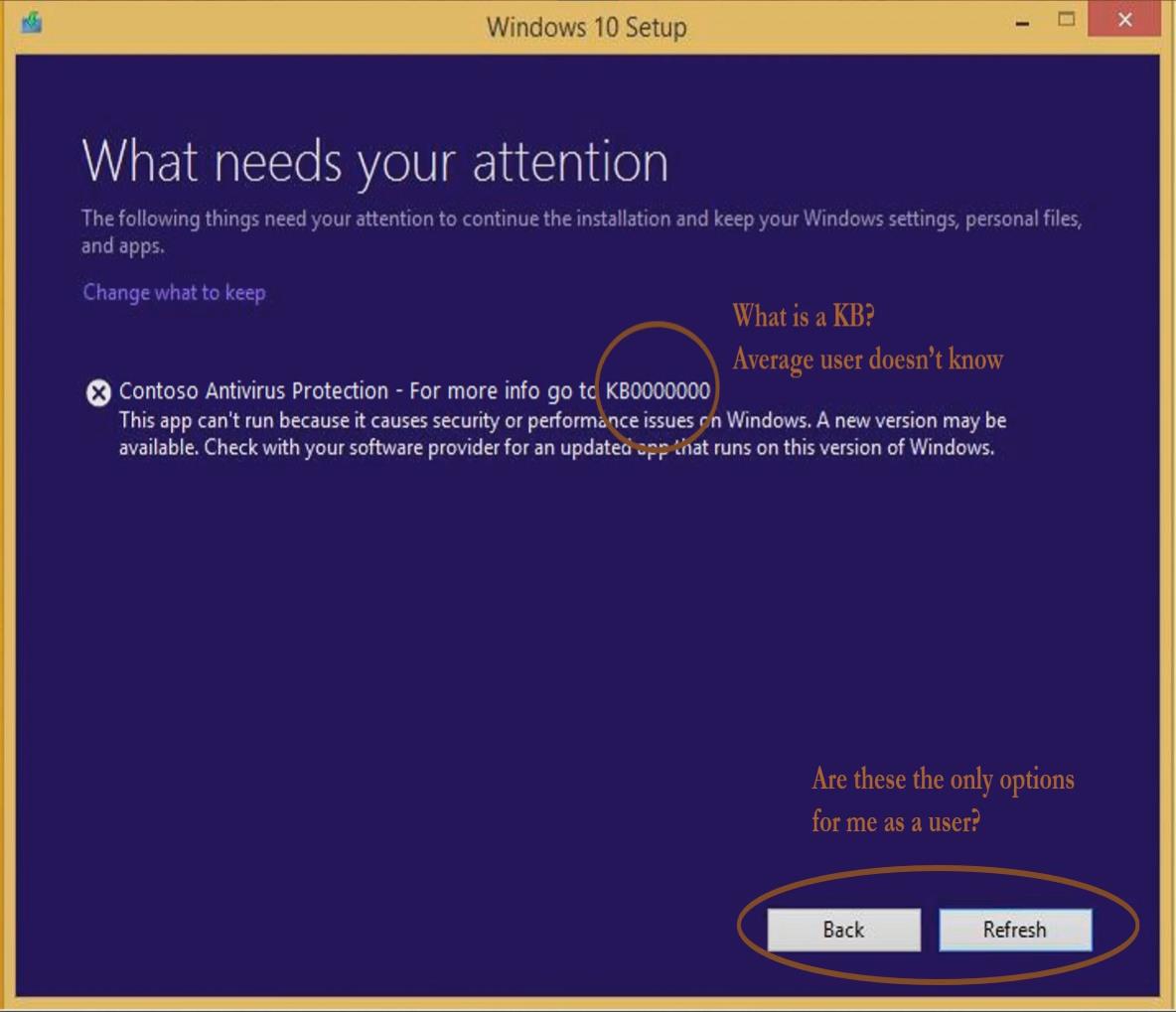
An anonymous reader quotes a report from Ars Technica: The next major Windows release, the Windows 10 April 2019 Update (codenamed 19H1), is going to offer some significant improvements [to error messages]. Microsoft described them on its Windows Insider webcast, and they were spotted initially by WinFuture. Currently, the best case during installation is something like this screen.

The message says that an incompatible application is detected, and a Knowledge Base article is referenced. It turns out that most Windows users don't know what "KBxxxxxxx" actually means, and the article isn't hyperlinked to make accessing it any easier. Issues detected through the other setup experience aren't much better. Windows will offer to uninstall problem applications, but often the better solution is to upgrade the application in question. The new setup process aims to be both more informative and more useful. The general approach is to allow decisions to be made within the setup program where possible and to put meaningful descriptions in the error messages, rather than leaving people with just a KB number to go on. Further, the "learn more" links will take you directly to the relevant Knowledge Base article, rather than hoping that end users know what "KBxxxxxxxx" means. Third-party developers will also be able to provide information about upgrades and updates when applicable to resolving compatibility issues.

Education

H-1B Visa Lottery Will Now Favor Masters, Doctorate Degree Holders (sfchronicle.com) 269

McGruber shares a report from The San Francisco Chronicle: The Department of Homeland Security announced a rule change Wednesday that will transform the lottery that decides who gets the 85,000 H-1B visas granted to for-profit companies every year. Previously, an initial lottery granted 20,000 visas only to those holding advanced degrees granted by U.S. institutions -- master's degrees or doctorates -- and then a general lottery granted 65,000 visas to all qualified applicants. The Department of Homeland Security switched the order of these lotteries, it said in a notice of the final rule change, which will bolster the odds for highly educated foreign nationals. The change reduces the likelihood that people with just a bachelor's degree will win in the general lottery, said Lisa Spiegel, an attorney at Duane Morris in San Francisco and head of the firm's immigration group. The program shift could hurt technology staffing companies, also known as outsourcers, who have a reputation for flooding the lottery with applications. Three Indian firms -- Tata Consultancy Services, Infosys and Wipro -- often account for a majority of the H-1B applications, an analysis of government data shows.
Security

Hacker Spoke To Baby and Hurled Obscenities At Couple Using Nest Camera, Dad Says (cbsnews.com) 106

pgmrdlm shares a report from CBS News: An Illinois couple said a hacker spoke to their baby through one of their Nest security cameras and then later hurled obscenities at them, CBS station WBBM-TV reports. Arjun Sud told the station he was outside his 7-month-old son's room Sunday outside Chicago and he heard someone talking. "I was shocked to hear a deep, manly voice talking," Sud said. "My blood ran cold." Sud told WBBM-TV he thought the voice was coming over the baby monitor by accident. But it returned when he and his wife were downstairs. The voice was coming from another of the many Nest cameras throughout the couple's Lake Barrington house. "Asking me, you know, why I'm looking at him -- because he saw obviously that I was looking back -- and continuing to taunt me," Sud said. Later that night, Arjun Sud noticed the Nest thermostat they have upstairs had been raised to 90 degrees. He suspected the hacker was behind that too. Nest's parent company, Google, said in a statement that Nest's system was not breached. Google said the recent incidents stem from customers "using compromised passwords exposed through breaches on other websites."
Facebook

Fake News Sites Are Changing Their Domain Name To Get Around Facebook Fact-Checkers (mashable.com) 197

An anonymous reader quotes a report from Mashable: In order to avoid Facebook's fact checking system, the site formerly known as YourNewsWire, one of the most well-known purveyors of fake news online, has simply rebranded. The site now goes by News Punch and posts fake news content similar to what it published under their former name, according to a report by Poynter. YourNewsWire co-founders Sinclair Treadway and Sean Adl-Tabatabai, who reside in California, founded the site in 2014. The two completely migrated the website from the "yournewswire.com" domain name to "newspunch.com" in November 2018. Treadway told Bloomberg at the time that they move was made due to declining revenue thanks to Facebook's fact-checking system. Under this program, fact-checking outlets like Snopes are able to mark content posted on Facebook as false, which in turn decreases the site's reach on Facebook. According to the investigation, the workaround has been a success. Content that Poynter itself had found to be previously marked false on "yournewswire.com" was ported over to the "newspunch.com" domain. When shared on Facebook, that same fake news content that now lived on "newspunch.com" was not marked as false under the fact-checking program. Facebook is reportedly rolling out features to thwart the site's workaround.
Data Storage

UltraViolet Digital Movie Locker is Shutting Down (theverge.com) 66

UltraViolet, one of the entertainment industry's first attempts at creating a comprehensive digital locker service, is shutting down on July 31st. Users should link their libraries to the service of at least one retailer which can then be used to access their films and TV shows after the shutdown. From a report: UltraViolet's days were numbered ever since Disney, the only major Hollywood studio not to join, launched its expanded Movies Anywhere locker service in 2017. Not only did it offer broad studio support, but it could also be connected to major digital retailers like iTunes, Amazon, and Google Play, unlike UltraViolet. Additional resources: How to safeguard your UltraViolet library.
Businesses

Apple Blocks Google From Running Its Internal iOS Apps (theverge.com) 175

Apple has now shut down Google's ability to distribute its internal iOS apps, following a similar shutdown that was issued to Facebook earlier this week. From a report: A person familiar with the situation tells The Verge that early versions of Google Maps, Hangouts, Gmail, and other pre-release beta apps have stopped working today, alongside employee-only apps like a Gbus app for transportation and Google's internal cafe app. UPDATE: Apple has restored Google's Enterprise Certificate so its internal apps will now function.

Slashdot Top Deals