Moon

India's Moon Lander Has Not Replied to Its First Wake-Up Call (nytimes.com) 34

"As the sun rose on Friday over the lunar plateau where India's Vikram lander and Pragyan rover sit, the robotic explorers remained silent," writes the New York Times: The Indian Space Research Organization, India's equivalent of NASA, said on Friday that mission controllers on the ground had sent a wake-up message to Vikram. The lander, as expected, did not reply. Efforts will continue over the next few days, but this could well be the conclusion of Chandrayaan-3, India's first successful space mission to the surface of another world...

The hope was that when sunlight again warmed the solar panels, the spacecraft would recharge and revive. But that was wishful thinking. Neither Vikram nor Pragyan were designed to survive a long, frigid lunar night when temperatures plunge to more than a hundred degrees below zero, far colder than the electronic components were designed for. The spacecraft designers could have added heaters or used more resilient components, but that would have added cost, weight and complexity...

The mission's science observations included a temperature probe deployed from Vikram that pushed into the lunar soil. The probe recorded a sharp drop, from about 120 degrees Fahrenheit at the surface to 10 degrees just three inches down. Lunar soil is a poor conductor of heat. The poor heat conduction could be a boon for future astronauts; an underground outpost would be well-insulated from the enormous temperature swings at the surface. Another instrument on Vikram, a seismometer, detected on Aug. 26 what appeared to be a moonquake... The Pragyan measurement suggests that concentrations of sulfur might be higher in the polar regions. Sulfur is a useful element in technologies like solar cells and batteries, as well as in fertilizer and concrete.

Before it went to sleep earlier this month, Vikram made a small final move, firing its engines to rise about 16 inches above the surface before softly landing again. The hop shifted Vikram's position by 12 to 16 inches, ISRO said. "Hoping for a successful awakening for another set of assignments!" ISRO posted on X, the social network formerly known as Twitter, on Sept. 2. "Else, it will forever stay there as India's lunar ambassador."

"Efforts to establish contact will continue," ISRO tweeted yesterday...
Moon

Abandoned Apollo 17 Lunar Module Is Causing Tremors On the Moon (cnn.com) 28

A spacecraft left behind by U.S. astronauts on the lunar surface could be causing small tremors known as moonquakes, according to a new study. CNN reports: Researchers revealed the previously unknown form of seismic activity on the moon for the first time through an analysis of Apollo-era data using modern algorithms. Massive temperature swings that occur on the moon can cause human-made structures to expand and contract in a way that produces these vibrations, the report suggests. The lunar surface is an extreme environment, oscillating between minus 208 degrees Fahrenheit (minus 133 degrees Celsius) in the dark and 250 degrees Fahrenheit (121 degrees Celsius) in direct sun, according to a news release about the study.

In fact, the entire surface of the moon expands and contracts in the cold and heat, noted the study published September 5 in the Journal of Geophysical Research: Planets. Yet scientists were able to use a form of artificial intelligence to gain such an intimate understanding of the Apollo-era data that they could pinpoint gentle tremors that emitted from an Apollo 17 lunar lander module sitting a few hundred yards away from instruments recording the moonquakes, according to a synopsis of the study, which was led by Francesco Civilini, a recent California Institute of Technology postdoctoral researcher and a research space scientist at NASA Goddard Space Flight Center. (NASA provided funding for the study.)

The analysis offers new insights into how the moon responds to its surroundings and what can affect its seismic activities. The rumbles were not dangerous and likely would be imperceptible to humans standing on the moon's surface.

Earth

Tropical Rainforests Could Get Too Hot For Photosynthesis, Scientists Warn 249

Using data collected from the International Space Station (ISS), scientists found that a small yet growing percentage of tree leaves in tropical forests are approaching the maximum temperature threshold for leaves to photosynthesize," reports Live Science. If this trend continues, it could spell disaster for Earth's climate systems and biodiversity. The findings have been published in the journal Nature. From the report: The average critical temperature beyond which photosynthetic machinery in tropical trees begins to fail is 116 degrees Fahrenheit (46.7 degrees Celsius). Currently, only 0.01 % of all leaves surpass this critical temperature every year. But scientists warn that air temperature rises of 7.2 F (4 C) could push trees in tropical forests beyond a tipping point and into mass death. "It's concerning from our perspective that you see nonlinear trends. So you heat the air by, let's say, 2, 3 degrees Celsius [3.6 to 5.4 F], and the actual upper temperature of these leaves goes up by 8 degrees [Celsius; 14.4 F]," Christopher Doughty, an associate professor of ecoinformatics at Northern Arizona University, said during a press conference on Monday (Aug. 21). "Even though a small percentage of leaves are currently doing this, our best guess is that a 4 degrees Celsius increase in temperature could cause some serious issues for certain tropical forests." [...]

Plugging these peak temperatures into a mathematical model, the scientists found that an average 7 F (3.9 C) increase in the air temperature surrounding the leaves caused those most exposed to the heat to have their water-carrying stomata closed off by the tree, leading to their deaths. This triggered a cascade effect, increasing the temperature around the remaining leaves and potentially killing them, their branches and the trees in turn. "If you have 10% of the leaves dying, the whole branch is going to be warmer because a critical part of that branch can no longer cool the broader branch. Likewise you can make that assumption across the whole forest when a tree dies," Doughty said.
Space

How to Turn an Asteroid into a Space Habitat (Using Self-Replicating Spider Robots) (sciencealert.com) 65

A retired Technical Fellow from Rockwell Collins "released a 65-page paper that details an easy-to-understand, relatively inexpensive, and feasible plan to turn an asteroid into a space habitat," reports Universe Today (in an article republished at Science Alert): Dr. David W. Jensen breaks the discussion into three main categories — asteroid selection, habitat style selection, and mission strategy to get there (i.e., what robots to use)... He eventually settled on a torus as the ideal habitat type and then dives into calculations about the overall station mass, how to support the inner wall with massive columns, and how to allocate floor space.

All important, but how exactly would we build such a massive behemoth? Self-replicating robots are Dr. Jensen's answer. The report's third section details a plan to utilize spider robots and a base station that can replicate themselves. He stresses the importance of only sending the most advanced technical components from Earth and using materials on the asteroid itself to build everything else, from rock grinders to solar panels...

With admittedly "back-of-the-envelope" calculations, Dr. Jensen estimates that the program would cost only $4.1 billion. That is far less than the $93 billion NASA plans to spend on the Apollo program. And the result would be a space habitat that provides 1 billion square meters of land that didn't exist before. That's a total cost of $4.10 per square meter to build land — in space. Possibly even more impressive is the timeline — Dr. Jensen estimates that the entire construction project could be done in as little as 12 years. However, it will still take longer to fill the habitat with air and water and start regulating its temperature.

Moon

Scientists Have Found a Hot Spot on the Moon's Far Side (universetoday.com) 46

Wikipedia notes that "Today, the Moon has no active volcanoes even though a significant amount of magma may persist under the lunar surface."

But this week the New York Times reports that "The rocks beneath an ancient volcano on the moon's far side remain surprisingly warm, scientists have revealed using data from orbiting Chinese spacecraft." The findings, which appeared last week in the journal Nature, help explain what happened long ago beneath an odd part of the moon. The study also highlights the scientific potential of data gathered by China's space program, and how researchers in the United States have to circumvent obstacles to use that data...

The Chinese orbiters both had microwave instruments, common on many Earth-orbiting weather satellites but rare on interplanetary spacecraft. The data from Chang'e-1 and Chang'e-2 thus provided a different view of the moon, measuring the flow of heat up to 15 feet below the surface — and proved ideal for investigating the oddity... At Compton-Belkovich, the heat flow was as high as 180 milliwatts per square meter, or about 20 times the average for the highlands of the moon's far side. That measure corresponds to a temperature of minus 10 degrees Fahrenheit about six feet below the surface, or about 90 degrees warmer than elsewhere. "This one stuck out, as it was just glowing hot compared to anywhere else on the moon," said Matthew Siegler, a scientist at the Planetary Science Institute, headquartered in Tucson, Ariz., and who led the research...

"Now we need the geologists to figure out how you can produce that kind of feature on the moon without water, without plate tectonics," Dr. Siegler said.

Universe Today believes this could help scientists better understand the moon's past. "What makes this finding unique is the source of the hotspot isn't active volcanism, such as molten lava, but from radioactive elements within the now-solidified rock that was once molten lava billions of years ago."

Thanks to Slashdot reader rolodexter for sharing the news.
Music

The Technology Behind the New Las Vegas Sphere (cnn.com) 71

The world's largest spherical structure "squats on the Las Vegas skyline like an enormous spaceship, black and mysterious," reports CNN, "until night falls, when it will glow like the Earth from space."

The $2 billion arena — called "The Sphere" — was built just east of the Venetian hotel/casino. It's 366 feet tall and 516 feet wide (or 111 meters tall and 157 meters wide) — and it boasts the world's highest-resolution wraparound LED screen: Its exterior is fitted with 1.2 million hockey puck-sized LEDs that can be programmed to flash dynamic imagery on a massive scale — again, reportedly the world's largest... The acts onstage will be dwarfed by the towering 16K LED screen, which wraps over and around much of the audience.
It was fully illuminated for the first time on Tuesday to celebrate the Fourth of July, CNN points out (offering some video footage). When it opens in September, the plan is to light up its exterior with animations every day and night.

Slashdot reader Tony Isaac says the news "got me wondering how they got such great video on the curved surface of the sphere." It turns out there's a whole lot more than just the exterior that breaks new ground in audio and video technology. An older IBC article goes into detail about how they accomplished both the exterior and interior screens, and the high-resolution audio inside.
CNN reports: Rich Claffey, Sphere's chief operations officer, says that more than 160,000 speakers spread around the bowl will deliver the same pristine sound to every seat, whether someone is in the top row or down on the floor. The venue also is equipped with haptic seats that can vibrate to match whatever is happening onscreen — an earthquake, for example — and 4D machines that can create wind, temperature and even scent effects.

"The way I describe it to my friends and family is, it's the entertainment venue of the future," Claffey says. If it all sounds a little over the top, well — this is Vegas.

The arena's first act will be 25 concerts by U2 (with tickets starting at $140). "There's nothing like it. It's light years ahead of everything that's out there," says U2's The Edge during a tour of the venue in a recent Apple Music video...

And U2's Bono adds that "Most music venues are sports venues. They're built for sports — they're not built for music. They're not built for art. This building was built for immersive experiences in cinema and performance... "
Space

Artificial Photosynthesis Could Be The Secret to Colonizing Space (sciencealert.com) 23

Artificial photosynthesis, inspired by the natural process that enables plants to convert sunlight, water, and carbon dioxide into oxygen and energy, could be crucial for space exploration and colonization. By using semiconductor materials and metallic catalysts, these devices could efficiently produce oxygen and recycle carbon dioxide, reducing reliance on heavy and unreliable systems currently used on the International Space Station. ScienceAlert reports: As my colleagues and I have investigated in a new paper, published in Nature Communications, recent advances in making artificial photosynthesis may well be key to surviving and thriving away from Earth. [...] We produced a theoretical framework to analyze and predict the performance of such integrated "artificial photosynthesis" devices for applications on Moon and Mars. Instead of chlorophyll, which is responsible for light absorption in plants and algae, these devices use semiconductor materials which can be coated directly with simple metallic catalysts supporting the desired chemical reaction. Our analysis shows that these devices would indeed be viable to complement existing life support technologies, such as the oxygen generator assembly employed on the ISS. This is particularly the case when combined with devices which concentrate solar energy in order to power the reactions (essentially large mirrors which focus the incoming sunlight).

There are other approaches too. For example, we can produce oxygen directly from lunar soil (regolith). But this requires high temperatures to work. Artificial photosynthesis devices, on the other hand, could operate at room temperature at pressures found on Mars and the Moon. That means they could be used directly in habitats and using water as the main resource. This is particularly interesting given the stipulated presence of ice water in the lunar Shackleton crater, which is an anticipated landing site in future lunar missions.

On Mars, the atmosphere composes of nearly 96% carbon dioxide - seemingly ideal for an artificial photosynthesis device. But the light intensity on the red planet is weaker than on Earth due to the larger distance from the Sun. So would this pose a problem? We actually calculated the sunlight intensity available on Mars. We showed that we can indeed use these devices there, although solar mirrors become even more important. [...] The returns would be huge. For example, we could actually create artificial atmospheres in space and produce chemicals we require on long-term missions, such as fertilizers, polymers, or pharmaceuticals. Additionally, the insights we gain from designing and fabricating these devices could help us meet the green energy challenge on Earth.

Communications

Japan To Launch Satellite Made of Wood In 2024 (independent.co.uk) 55

The Japanese space agency (JAXA) and NASA plan to launch a satellite made of wood in 2024. The Independent reports: The high durability of wood in space was recently tested and confirmed at the International Space Station (ISS) by an international group of scientists led by those from Kyoto University. Their experiments showed wood samples tested at the ISS for durability underwent minimal deterioration and maintained good stability. Preliminary inspection, including strength tests and crystal structural analyses, of the wood samples was also done once they were brought back to Earth from the ISS by Japanese astronaut Koichi Wakata.

Despite extreme conditions in space, including temperature changes and exposure to intense cosmic rays and dangerous solar particles for 10 months, tests found no changes in the samples, such as cracking, warping, peeling or surface damage, according to a recent Kyoto University statement. The retrieved wood specimens were tested and showed no deformation after space exposure and also did not undergo any mass change before and after space exposure, scientists said.

The international research group has determined that the satellite LignoSat, slated to be jointly launched in 2024 by Nasa and Japan's space agency Jaxa, will likely use Magnolia wood -- "Hoonoki" in Japanese. Magnolia, researchers said, has relatively high workability, dimensional stability and overall strength, making its properties ideal for the mission. Wood also has some benefits compared to complex alloys used in space vehicles, as it is environmentally friendly, easier to produce and can be disposed off better at the end of a satellite's life. Such wooden satellites may also be designed to completely burn up on re-entry into the atmosphere and even if small fragments did survive, they may decompose easily.

AI

Meta Open-Sources Multisensory AI Model That Combines Six Types of Data (theverge.com) 10

Meta has announced a new open-source AI model that links together multiple streams of data, including text, audio, visual data, temperature, and movement readings. From a report: The model is only a research project at this point, with no immediate consumer or practical applications, but it points to a future of generative AI systems that can create immersive, multisensory experiences and shows that Meta continues to share AI research at a time when rivals like OpenAI and Google have become increasingly secretive. The core concept of the research is linking together multiple types of data into a single multidimensional index (or "embedding space," to use AI parlance). This idea may seem a little abstract, but it's this same concept that underpins the recent boom in generative AI.
Mars

China's Mars Rover Discovers Signs of Recent Water in Martian Sand Dunes (go.com) 22

The Associated Press reports that "water may be more widespread and recent on Mars than previously thought, based on observations of Martian sand dunes by China's rover." A paper published in Science suggests thin films of water appeared on sand dunes sometime between 1.4 million years ago and as recently as 400,000 years ago — or perhaps even sooner: The finding highlights new, potentially fertile areas in the warmer regions of Mars where conditions might be suitable for life to exist, though more study is needed...

Before the Zhurong rover fell silent, it observed salt-rich dunes with cracks and crusts, which researchers said likely were mixed with melting morning frost or snow as recently as a few hundred thousand years ago... Conditions during that period were similar to now on Mars, with rivers and lakes dried up and no longer flowing as they did billions of years earlier...

The rover did not directly detect any water in the form of frost or ice. But Qin said computer simulations and observations by other spacecraft at Mars indicate that even nowadays at certain times of year, conditions could be suitable for water to appear... Small pockets of water from thawing frost or snow, mixed with salt, likely resulted in the small cracks, hard crusty surfaces, loose particles and other dune features like depressions and ridges, the Chinese scientists said.

Space.com explains exactly how the discovery was confirmed: The laser-induced breakdown spectrometer (MarSCoDe) instrument onboard the rover zapped sand grains into millimeter-sized particles. Their chemical makeup revealed hydrated minerals like sulfates, silica, iron oxide and chlorides... Researchers say water vapor traveled from Martian poles to lower latitudes like Zhurong's spot a few million years ago, when the planet's polar ice caps released high amounts of water vapor, thanks to a different tilt that had Mars' poles pointed more directly toward the sun. Frigid temperatures on the wobbling planet condensed the drifting vapor and dropped it as snow far from the poles, according to the latest study.

Mars' tilt changes over a 124,000-year cycle, so "this offers a replenishing mechanism for vapor in the atmosphere to form frost or snow at low latitudes where the Zhurong rover has landed," Qin told Space.com. But "no water ice was detected by any instrument on the Zhurong rover." Instead, in the same way that salting roads on Earth melts icy patches during storms, salts in Martian sand dunes warmed the fallen snow and thawed it enough to form saltwater. The process also formed minerals such as silica and ferric oxides, which Zhurong spotted, researchers say. The saltwater, however, didn't stay around for long. Temperatures on Mars swing wildly and spike in the mornings between 5 a.m. and 6 a.m., so the saltwater evaporated and left behind salt and other newly formed minerals that later seeped between the dune's sand grains, cementing them to form a crust, according to the study...

"The phenomenon was documented at one site, but it should be applicable to a fairly large fraction of Mars' surface at similar latitudes," Manasvi Lingam, an assistant professor of astrobiology at the Florida Institute of Technology who wasn't involved in the new research, told Space.com.

Since the rover found water activity on (and in) salty Martian dunes, the researchers now suggest future missions search for salt-tolerant microbes , and are raising the possibility of "extant life on Mars."
Space

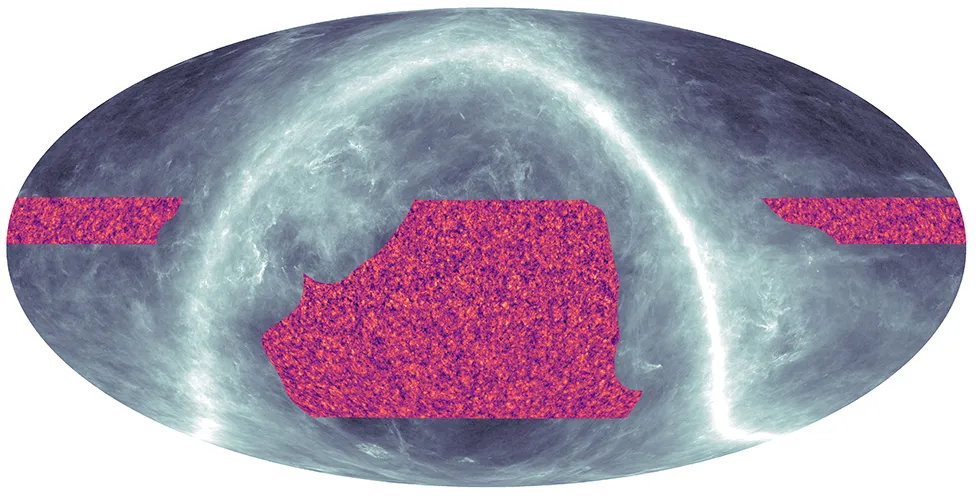
Mysterious Dark Matter Mapped In Finest Detail Yet (bbc.com) 34

According to the BBC, the Atacama Cosmology Telescope (ACT) in Chile has traced the distribution of dark matter "on a quarter of the sky and across almost 14 billion years of time." From the report: In the image [here], the colored areas are the portions of the sky studied by the telescope. Orange regions show where there is more mass, or matter, along the line of sight; purple where there is less. Typical features are hundreds of millions of light-years across. The grey/white areas show where contaminating light from dust in our Milky Way galaxy has obscured a deeper view. The distribution of matter agrees very well with scientific predictions.

ACT observations indicate that the "lumpiness" of the Universe and the rate at which it has been expanding after 14 billion years of evolution are just what you'd expect from the standard model of cosmology, which has Einstein's theory of gravity (general relativity) at its foundation. Recent measurements that used an alternative background light, one emitted from stars in galaxies rather than the CMB, had suggested the Universe lacked sufficient lumpiness.

Another tension concerns the rate at which the Universe is expanding - a number called the Hubble constant. When [the European Space Agency's Planck observatory] looked at temperature fluctuations across the CMB, it determined the rate to be about 67 kilometres per second per megaparsec (A megaparsec is 3.26 million light-years). Or put another way - the expansion increases by 67km per second for every 3.26 million light-years we look further out into space. A tension arises because measurements of the expansion in the nearby Universe, made using the recession from us of variable stars, clocks in at about 73km/s per megaparsec. It's a difference that can't easily be explained. ACT, employing its lensing technique to nail down the expansion rate, outputs a number similar to Planck's. "It's very close - about 68km/s per megaparsec," said Dr Mathew Madhavacheril from the the University of Pennsylvania.
ACT team-member Prof Blake Sherwin from Cambridge University, UK, added: "We and Planck and several other probes are coming in on the lower side. Obviously, you could have a scenario where both the measurements are right and there's some new physics that explains the discrepancy. But we're using independent techniques, and I think we're now starting to close the loophole where we could all be riding this new physics and one of the measurements has to be wrong."

Papers describing the new results have been submitted to The Astrophysical Journal and posted on the ACT website.
Moon

Glass Beads On Moon's Surface May Hold Billions of Tons of Water, Scientists Say (theguardian.com) 28

Slashdot reader votsalo shares a report from the Guardian: Tiny glass beads strewn across the moon's surface contain potentially billions of tons of water that could be extracted and used by astronauts on future lunar missions, researchers say. The discovery is thought to be one of the most important breakthroughs yet for space agencies that have set their sights on building bases on the moon, as it means there could be a highly accessible source of not only water but also hydrogen and oxygen. "This is one of the most exciting discoveries we've made," said Mahesh Anand, a professor of planetary science and exploration at the Open University. "With this finding, the potential for exploring the moon in a sustainable manner is higher than it's ever been."

Anand and a team of Chinese scientists analyzed fine glass beads from lunar soil samples returned to Earth in December 2020 by the Chinese Chang'e-5 mission. The beads, which measure less than a millimeter across, form when meteoroids slam into the moon and send up showers of molten droplets. These then solidify and become mixed into the moon dust. Tests on the glass particles revealed that together they contain substantial quantities of water, amounting to between 300m and 270 billion tons across the entire moon's surface. "This is going to open up new avenues which many of us have been thinking about," said Anand. "If you can extract the water and concentrate it in significant quantities, it's up to you how you utilize it."

The latest research, published in Nature Geoscience, points to fine glass beads as the source of that surface water. Unlike frozen water lurking in permanently shaded craters, this should be far easier to extract by humans or robots working on the moon. "It's not that you can shake the material and water starts dripping out, but there's evidence that when the temperature of this material goes above 100C, it will start to come out and can be harvested," Anand said. The water appears to form when high-energy particles streaming from the sun -- the so-called solar wind -- strike the molten droplets. The solar wind contains hydrogen nuclei, which combine with oxygen in the droplets to produce water or hydroxyl ions. The water then becomes locked in the beads, but it can be released by heating the material. Further tests on the material showed the water diffuses in and out of the beads on the timeframe of a few years, confirming an active water cycle on the moon. According to Prof Sen Hu, a senior co-author of the study at the Chinese Academy of Sciences in Beijing, such impact glasses could store and release water on other airless rocks in the solar system.

Space

RNA Molecule Uracil Found In Asteroid Ryugu Samples (phys.org) 34

Researchers have analyzed samples of the asteroid Ryugu collected by the Japanese Space Agency's Hayabusa2 spacecraft and found uracil, one of the informational units that make up RNA, the molecules that contain the instructions for how to build and operate living organisms. Nicotinic acid, also known as Vitamin B3 or niacin, which is an important cofactor for metabolism in living organisms, was also detected in the same samples. Phys.Org reports: This discovery by an international team, led by Associate Professor Yasuhiro Oba at Hokkaido University, adds to the evidence that important building blocks for life are created in space and could have been delivered to Earth by meteorites. The findings were published in the journal Nature Communications. The researchers extracted these molecules by soaking the Ryugu particles in hot water, followed by analyses using liquid chromatography coupled with high-resolution mass spectrometry. This revealed the presence of uracil and nicotinic acid, as well as other nitrogen-containing organic compounds. "We found uracil in the samples in small amounts, in the range of 6-32 parts per billion (ppb), while vitamin B3 was more abundant, in the range of 49-99 ppb," Oba elaborated. "Other biological molecules were found in the sample as well, including a selection of amino acids, amines and carboxylic acids, which are found in proteins and metabolism, respectively." The compounds detected are similar but not identical to those previously discovered in carbon-rich meteorites.

The team hypothesizes that the difference in concentrations in the two samples, collected from different locations on Ryugu, is likely due to the exposure to the extreme environments of space. They also hypothesized that the nitrogen-containing compounds were, at least in part, formed from the simpler molecules such as ammonia, formaldehyde and hydrogen cyanide. While these were not detected in the Ryugu samples, they are known to be present in cometary ice -- and Ryugu could have originated as a comet or another parent body that had been present in low temperature environments.

Science

A Trillionth-of-a-Second Shutter Speed Camera Catches Chaos in Action (sciencealert.com) 21

Long-time Slashdot reader turp182 shares two stories about the new state-of-the-art in very-high-speed imaging. "The techniques don't image captured photons, but instead 'touch' the target to perform imaging/read structures using either lasers or neutrons."

First, Science Daily reports that physicists from the University of Gothenburg (with colleagues from the U.S. and Germany) have developed an ultrafast laser camera that can create videos at 12.5 billion images per second, "which is at least a thousand times faster than today's best laser equipment." [R]esearchers use a laser camera that photographs the material in [an ultrathin, one-atom-thick] two-dimensional layer.... By observing the sample from the side, it is possible to see what reactions and emissions occur over time and space. Researchers have used single-shot laser sheet compressed ultrafast photography to study the combustion of various hydrocarbons.... This has enabled researchers to illustrate combustion with a time resolution that has never been achieved before. "The more pictures taken, the more precisely we can follow the course of events...." says Yogeshwar Nath Mishra, who was one of the researchers at the University of Gothenburg and who is now presenting the results in a scientific article in the journal Light: Science & Applications.... The new laser camera takes a unique picture with a single laser pulse.
Meanwhile, ScienceAlert reports on a camera with a trillionth-of-a-second shutter speed — that is, 250 million times faster than digital cameras — that's actually able to photograph atomic activity, including "dynamic disorder." Simply put, dynamic disorder is when clusters of atoms move and dance around in a material in specific ways over a certain period — triggered by a vibration or a temperature change, for example. It's not a phenomenon that we fully understand yet, but it's crucial to the properties and reactions of materials. The new super-speedy shutter speed system gives us much more insight into what's happening....

The researchers are referring to their invention as variable shutter atomic pair distribution function, or vsPDF for short.... To achieve its astonishingly quick snap, vsPDF uses neutrons to measure the position of atoms, rather than conventional photography techniques. The way that neutrons hit and pass through a material can be tracked to measure the surrounding atoms, with changes in energy levels the equivalent of shutter speed adjustments.

Earth

Solar Geoengineering 'Only Option' To Cool Planet Within Years, UN Says 138

The United Nations Environment Program (UNEP) is investigating the potentials and dangers of solar geoengineering technologies, stating that these controversial interventions are humanity's "only option" to quickly cool the planet within years. An anonymous shares an excerpt from a Motherboard article: In a report published by UNEP in February, an independent panel describes what's currently known about so-called solar radiation modification, also called solar geoengineering, and concludes that, despite its great potential, it's not viable or even safe right now. Nonetheless, amid growing calls from governments to find an emergency brake for climate change -- and ongoing, independent efforts to develop solar geoengineering technology -- the UNEP is calling for a full-scale global review of the tech and eventual multinational framework for how it should be governed. The recommendations have some opponents fearing that this amounts to endorsement of adopting the technology -- a move that could create an even worse environmental crisis by messing with intertwined natural climate systems or pulling the focus away from mitigation measures, as well as further widening the inequalities that already exist as a result of climate change.

Solar radiation modification describes a range of technologies that aim to cool our overheated planet by reflecting incoming sunlight back out into space, or making it easier for heat coming off the earth to escape. Blocking out just two percent of sunlight could, according to some estimates, totally offset the warming that comes from doubling the amount of CO2 in the atmosphere from pre-industrial levels. It's a tantalizing prospect, but comes with a raft of issues. For one, as the report notes, the best large-scale evidence we have that it could even work is from volcanic eruptions, where the smog cooled the globe for a couple of years afterwards. Most of the actual research has involved climate modeling, theoretical analyses or cost estimates. Some groups have conducted small-scale indoor experiments of how the tech might work. No one's taken the trials outdoors yet.

Even if we knew more, it's not a be-all-end-all climate solution, said UNEP's chief scientist, Andrea Hinwood. "SRM technologies, should they be considered at some point in the future, do not solve the climate crisis because they do not reduce greenhouse gas emissions nor reverse the impacts of climate change. The world must be crystal clear on this point," she said in a UN media release. What solar geoengineering might do though, is buy the planet some time. The UNEP report highlights that even if we fully halted CO2 emissions right now, it could take at least until the end of the century to see a drop in temperature. "Make no mistake: there are no quick fixes to the climate crisis," wrote UNEP executive director Inger Andersen in the report. "Increased and urgent action to slash greenhouse gas emissions and invest in adapting to the impacts of climate change is immutable. Yet current efforts remain insufficient."
Despite firm opposition from some, the message from the UNEP report seems to be to proceed with caution. "While UNEP is concerned, it is naive to think research will cease and the issues will disappear. We cannot afford to bury our heads in the sand," said chief scientist Hinwood.
Moon

Blue Origin Makes a Big Lunar Announcement Without Any Fanfare (arstechnica.com) 53

An anonymous reader quotes a report from Ars Technica: On Friday, in a blog post not even promoted by the company's Twitter account or a news release, Blue Origin quietly said its "Blue Alchemist" program has been working on [using the dusty lunar surface to manufacture solar panels] for the last two years. The company, founded by Jeff Bezos, has made both solar cells and electricity transmission wires from simulated lunar soil -- a material that is chemically and mineralogically equivalent to lunar regolith. The engineering work is based on a process known as "molten regolith electrolysis," and Blue Origin has advanced the state of the art for solar cell manufacturing. In this process, a direct electric current is applied to the simulated regolith at a high temperature, above 1,600-degrees Celsius. Through this electrolysis process, iron, silicon, and aluminum can be extracted from the lunar regolith. Blue Origin says it has produced silicon to more than 99.999 percent purity through molten regolith electrolysis.

The key advance made by Blue Alchemist is that its engineers and scientists have taken the byproducts of this reaction -- and these materials alone -- to fabricate solar cells as well as the protective glass cover that would allow them to survive a decade or longer on the lunar surface. Blue Origin will attempt to market the technology to NASA for use by its Artemis program to return humans to the Moon in a "sustainable" way. NASA and its international partners seek to differentiate Artemis from the Apollo program by more extended stays on the Moon and building infrastructure such as power systems.

"Although our vision is technically ambitious, our technology is real now," the company said in its blog post. "Blue Origin's goal of producing solar power using only lunar resources is aligned with NASA's highest priority Moon-to-Mars infrastructure development objective." This is a notable research breakthrough, as the same electrolysis process could also be used to produce metals for building habitats and other structures, as well as oxygen. These are all important for "living off the land" if humans are to avoid the expense of needing to bring everything from Earth to live and work in space. While it is a long way from lab experiments to manufacturing on the Moon, these experiments are a critical first step.

Power

Several US Universities Want to Use Micronuclear Reactors (apnews.com) 69

The University of Illinois plans to apply for a construction permit for a high-temperature, gas-cooled micronuclear reactor, reports the Associated Press, "and aims to start operating it by early 2028."

And they're not the only ones interested in the technology: Last year, Penn State University signed a memorandum of understanding with Westinghouse to collaborate on microreactor technology. Mike Shaqqo, the company's senior vice president for advanced reactor programs, said universities are going to be "one of our key early adopters for this technology." Penn State wants to prove the technology so that Appalachian industries, such as steel and cement manufacturers, may be able to use it, said Professor Jean Paul Allain, head of the nuclear engineering department. Those two industries tend to burn dirty fuels and have very high emissions....

"I do feel that microreactors can be a game-changer and revolutionize the way we think about energy," Allain said. For Allain, microreactors can complement renewable energy by providing a large amount of power without taking up much land. A 10-megawatt microreactor could go on less than an acre, whereas windmills or a solar farm would need far more space to produce 10 megawatts, he added. The goal is to have one at Penn State by the end of the decade....

Nuclear reactors that are used for research are nothing new on campus. About two dozen U.S. universities have them. But using them as an energy source is new.

Other examples from the article:
  • Purdue University in Indiana "is working with Duke Energy on the feasibility of using advanced nuclear energy to meet its long-term energy needs."
  • Abilene Christian University in Texas "is leading a group of three other universities with the company Natura Resources to design and build a research microreactor cooled by molten salt to allow for high temperature operations at low pressure, in part to help train the next generation nuclear workforce."

Earth

Planting More Trees In Cities Could Cut Deaths From Summer Heat, Says Study 111

Planting more trees could mean fewer people die from increasingly high summer temperatures in cities, a study suggests. The Guardian reports: Increasing the level of tree cover from the European average of 14.9% to 30% can lower the temperature in cities by 0.4C, which could reduce heat-related deaths by 39.5%, according to first-of-its-kind modeling of 93 European cities by an international team of researchers. [...] The researchers used mortality data to estimate the potential reduction in deaths from lower temperatures as a result of increased tree coverage. Using data from 2015 they estimated that out of the 6,700 premature deaths that year attributed to higher urban temperatures, 2,644 could have been prevented had tree cover been increased.

The cities most likely to benefit from the increase in tree coverage are in south and eastern Europe, where summer temperatures are highest and tree coverage tends to be lower. In Cluj-Napoca in Romania -- which had the highest number of premature deaths due to heat in 2015, at 32 per 100,000 people -- tree coverage is just 7%. In Lisbon, Portugal it is as low as 3.6% and in Barcelona its 8.4%. That compares with 15.5% in London and 34% in Oslo. Study co-author Mark Nieuwenhuijsen, a researcher at the Barcelona Institute for Global Health, said the team picked 30% as that is a target that many cities are currently working towards.

He said there was no need for buildings to be razed and replaced with parks, since there is enough space to plant more trees in all the cities the team looked at. He praised initiatives such as the EU's 3 billion trees plan, and the UK government's proposal to ensure every home is within a 15-minute walk from green space, though he noted that policymakers must ensure trees are evenly distributed between richer and poor neighborhoods. He added that cities which are "too car-dominated" should consider replacing asphalt roads, which absorb heat, with trees. Planting more trees in cities should be prioritized because it brings a huge range of health benefits beyond reducing heat-related deaths, he added, including reducing cardiovascular disease, dementia and poor mental health.
The study has been published in the journal The Lancet.
Earth

US Government Begins Researching 'Climate Intervention' Geoengineering (ametsoc.org) 78

Federal U.S. agencies (including the White House Office of Science and Technology Policy) have been asked to develop a five-year "scientific assessment of solar and other rapid climate interventions." As the Daily Beast sees it, the U.S. government is signalling that it's looking into "one of the most controversial and consequential climate change-fighting tactics yet," suggesting the report will look at a technique "that essentially involves spraying fine aerosols into the atmosphere to reflect sunlight away from the Earth. The idea is that, once it's reflected, there'll be less heat and temperatures will go down."

It seems like that's a subset of the "solar and other rapid climate interventions" being mentioned in the federal document. But for what it's worth, here's an official statement from the American Meteorological Society on "large-scale efforts to intentionally modify the climate system to counteract the consequences of increasing greenhouse gas concentrations.... now commonly referred to as climate intervention (also called geoengineering)..." Proposals to intervene in the climate system generally fall into two broad categories: 1) actively removing CO2 (and possibly other greenhouse gases) from the atmosphere, known as carbon dioxide removal; 2) exerting a cooling influence on Earth by reflecting sunlight (known as solar radiation management) or altering thermal emissions to space by thinning cirrus clouds. These proposals differ widely in their potential to reduce impacts, create new risks, and redistribute risks among nations.

Techniques that remove CO2 directly from the air would confer global benefits by directly addressing the source of the climate problem. However, it may not be feasible to rapidly remove CO2 at a scale that will significantly limit warming. The effects of CO2 removal approaches are not fully understood and could create adverse local and global impacts. Reflecting sunlight would reduce Earth's average surface temperature but would not offset all aspects of climate change and would produce a different set of risks than those resulting from unmitigated warming.

The American Meteorological Society recommends an accelerated and robust climate intervention research program, and associated governance framework, to inform public policies. This should not include the development of deployment platforms but needs to include study of the feasibility of different deployment scenarios and strategies and how they would affect climate risk.... The desired outcome is for society to have the best possible information in hand to assess different options for reducing the risks of climate change and to decide if actions should include intentional climate intervention. Comprehensive Earth system model simulations will play a critical role in quantifying the regional to global impacts of different climate intervention approaches.... Sustained monitoring of the Earth system and targeted field campaigns will be critical, not only to improve our understanding of key processes but for establishing an observational baseline of the system behavior prior to any intervention. Monitoring and field studies would also be needed for quantifying impacts should an intervention be implemented.

These studies will yield additional benefits in our understanding of atmospheric processes and the climate system, with implications beyond what is needed for decisions related to climate intervention, such as improved weather predictions and climate projections.

The climate crisis must be addressed by ending net emissions of greenhouse gases, and at the same time, adapting to changes already happening. While it is currently premature to either advocate for or rule out climate interventions, these decisions, when they are made, must be based on the best scientific and technical information. With this goal in mind, AMS calls for a robust program of research with a strong governance framework to assess climate interventions. Such a program should be designed to provide the knowledge base to support decisions that may need to be made within the next decade regarding the inclusion of climate intervention among our responses to global warming.

Thanks to long-time Slashdot reader cstacy for submitting the article.
Space

Rocket Launch Thrusts India Deeper Into Space Exploration Race (bloomberg.com) 9

India launched its first rocket developed by a startup into space on Friday, with the aim of testing the company's technology that will be used to design three orbital vehicles. From a report: The Vikram-S rocket, developed by Hyderabad-based Skyroot Aerospace, took off at 11:30 a.m. local time from Sriharikota, an island near Chennai in southeastern India. The rocket reached an altitude of 89.5 kilometers (56 miles) and all systems worked as planned, Pawan Goenka, head of an industry space body said.

"It's a major step forward to India developing its own space ecosystem and emerging as a front-line nation in space," Space Minister Jitendra Singh said. Built in just two years, the sub-orbital validated the pressure, temperature and vibration in Skyroot's orbital vehicles, with the first of the series, Vikram I, scheduled to launch next year. It carried a payload from two Indian aerospace startups and a non-profit space research laboratory in Armenia.

Slashdot Top Deals