Earth

Swarming Bees May Potentially Change the Weather 36

fahrbot-bot shares a report from Live Science: Swarming bees produce so much electricity that they may affect local weather, new research suggests. The finding, which researchers made by measuring the electrical fields around honeybee (apis mellifera) hives, reveals that bees can produce as much atmospheric electricity as a thunderstorm. This can play an important role in steering dust to shape unpredictable weather patterns; and their impact may even need to be included in future climate models.

Insects' tiny bodies can pick up positive charge while they forage -- either from the friction of air molecules against their rapidly beating wings (honeybees can flap their wings more than 230 times a second) or from landing onto electrically charged surfaces. But the effects of these tiny charges were previously assumed to be on a small scale. Now, a new study, published Oct. 24 in the journal iScience, shows that insects can generate a shocking amount of electricity.

To test whether honeybees produce sizable changes in the electric field of our atmosphere, the researchers placed an electric field monitor and a camera near the site of several honeybee colonies. In the 3 minutes that the insects flooded into the air, the researchers found that the potential gradient above the hives increased to 100 volts per meter. In other swarming events, the scientists measured the effect as high as 1,000 volts per meter, making the charge density of a large honeybee swarm roughly six times greater than electrified dust storms and eight times greater than a stormcloud. The scientists also found that denser insect clouds meant bigger electrical fields -- an observation that enabled them to model other swarming insects such as locusts and butterflies.
Education

A Tool That Monitors How Long Kids Are In the Bathroom Is Now In 1,000 American Schools (vice.com) 90

e-HallPass, a digital system that students have to use to request to leave their classroom and which takes note of how long they've been away, including to visit the bathroom, has spread into at least a thousand schools around the United States. Motherboard reports: On Monday, a since deleted tweet went viral in which someone claimed that their school was preparing to introduce e-HallPass, and described it as "the program where we track how long, at what time, and how often each child goes to the restroom and store that information on third party servers run by a private for-profit company." Motherboard then identified multiple schools across the U.S. that appear to use the technology by searching the web for instruction manuals, announcements, and similar documents from schools that mentioned the technology. Those results included K-12 schools such as Franklin Regional Middle School, Fargo Public Schools, River City High School, Loyalsock Township School District, and Cabarrus County Schools. Also schools Motherboard found that appear to use e-HallPass include Mehlville High School, Eagle County School District, Hopatcong Borough Schools, and Pope Francis Preparatory School. These schools are spread across the country, with some in California, New York, Virginia, and North Carolina. Eduspire, the company that makes e-HallPass, told trade publication EdSurge in March that 1,000 schools use the system. Brian Tvenstrup, president of Eduspire, told the outlet that the company's biggest obstacle to selling the product "is when a school isn't culturally ready to make these kinds of changes yet."

The system itself works as a piece of software installed on a computer or mobile device. Students request a pass through the software and the teacher then approves it. The tool promises "hall omniscience" with the ability to "always know who has a pass and who doesn't (without asking the student!)," according to the product's website. Admins can then access data collected through the software, and view a live dashboard showing details on all passes. e-HallPass can also stop meet-ups of certain students and limit the amount of passes going to certain locations, the website adds, explicitly mentioning "vandalism and TikTok challenges." Many of the schools Motherboard identified appear to use e-HallPass specifically on Chromebooks, according to student user guides and similar documents hosted on the schools' websites, though it also advertises that it can be used to track students on their personal cell phones.

Canada

Why Alphabet's 'Smart City' in Toronto Failed (technologyreview.com) 111

Alphabet's "urban innovation" arm Sidewalk Labs planned to build a model "smart city" along a 12-acre patch of Toronto waterfront known as Quayside.

But they abandoned the project in 2020, points out MIT's Technology Review, "at the tail end of years of public controversy over its $900 million vision for a data-rich city within the city."

Sidewalk's big idea was flashy new tech. This unassuming section of Toronto was going to become a hub for an optimized urban experience featuring robo-taxis, heated sidewalks, autonomous garbage collection, and an extensive digital layer to monitor everything from street crossings to park bench usage. Had it succeeded, Quayside could have been a proof of concept, establishing a new development model for cities everywhere. It could have demonstrated that the sensor-Âladen smart city model embraced in China and the Persian Gulf has a place in more democratic societies. Instead, Sidewalk Labs' two-and-a-half-year struggle to build a neighborhood "from the internet up" failed to make the case for why anyone might want to live in it....

The project's tech-first approach antagonized many; its seeming lack of seriousness about the privacy concerns of Torontonians was likely the main cause of its demise. There is far less tolerance in Canada than in the U.S. for private-sector control of public streets and transportation, or for companies' collecting data on the routine activities of people living their lives. "In the U.S. it's life, liberty, and the pursuit of happiness," says Alex Ryan, a senior vice president of partnership solutions for the MaRS Discovery District, a Toronto nonprofit founded by a consortium of public and private funders and billed as North America's largest urban innovation hub. "In Canada it's peace, order, and good government. Canadians don't expect the private sector to come in and save us from government, because we have high trust in government."

With its very top-down approach, Sidewalk failed to comprehend Toronto's civic culture. Almost every person I spoke with about the project used the word "hubris" or "arrogance" to describe the company's attitude. Some people used both.

In February Toronto announced new plans for the area, the article points out, with "800 affordable apartments, a two-acre forest, a rooftop farm, a new arts venue focused on indigenous culture, and a pledge to be zero-carbon.... Indeed, the philosophical shift signaled by the new plan, with its emphasis on wind and rain and birds and bees rather than data and more data, seems like a pragmatic response to the demands of the present moment and the near future."

The article calls it "a conspicuous disavowal not only of the 2017 proposal but of the smart city concept itself."
The Military

Ukraine Alleges Russia Is Planning 'Terrorist' Incident At Chernobyl (cnn.com) 78

According to the latest updates from CNN, Ukraine's defense ministry claims Russia is planning to carry out "some sort of terrorist attack at the Chernobyl nuclear power plant" and blame Ukraine. The plant is currently without power and under Russian control. From the report: The Main Intelligence Directorate of the Ministry of Defence claimed on its Facebook page Friday that "the available intelligence says Putin has ordered that his troops to prepare a terror attack at Chernobyl for which the Russian invaders will try to blame Ukraine." The directorate also repeated that the plant "remains completely disconnected from the monitoring systems run by the International Atomic Energy Agency (IAEA)."

The Ukrainian Ministry of Defence also alleged Friday that Russian forces had denied a Ukrainian repair team access to Chernobyl. It claimed without offering evidence that "Belarusian specialists" went there posing as nuclear power experts and that Russian saboteurs were arriving to set up a terror attack. The ministry claimed that "without receiving the desired result from the ground military operation and direct talks, Putin is ready to resort to nuclear blackmail of the international community."

The IAEA said last week that it had not been able to re-establish communication with systems installed to monitor nuclear material and activities at either the Chernobyl or Zaporizhzhia plants following the loss of remote data transmissions from those systems. IAEA Director General Rafael Grossi said Thursday that the situation at the Chernobyl nuclear power plant, occupied by the Russian forces, was degrading as the IAEA was losing "a significant amount of information" on safeguarding monitoring systems. However, he said he was "quite encouraged [...] on one important thing, is that Ukraine and Russian Federation want to work with us, they agree to work with us."
"Both Russia and Ukraine have repeatedly claimed without substantiation that the other side is planning to provoke an incident involving nuclear, chemical or biological agents," notes CNN.

On Wednesday, Russian's foreign ministry claimed that the U.S. operates a biowarfare lab in Ukraine, "an accusation that has been repeatedly denied by Washington and Kyiv," reports Reuters.
Space

Amazon Joins Lockheed Martin and Cisco to Send Alexa to Space, Offers NASA Tours for SchoolKids (geekwire.com) 25

"Alexa, when are we arriving at the moon?" quips GeekWire.

Long-time Slashdot reader theodp writes: This week brought news that Amazon is teaming up with Lockheed Martin and Cisco to put its Alexa voice assistant on NASA's Orion spacecraft for the (uncrewed) Artemis 1 round-the-moon mission....

On the heels of that announcement came news that Amazon Future Engineer (AFE) has partnered with Mobile CSP and the National Science Teaching Association (NSTA) on the Alexa for Astronauts program, which will provide students in grades 4-and-up with live WebEx by Cisco tours from NASA's Johnson Space Center. This program will also provide curriculum — NSTA's Using AI to Monitor Health and Mobile CSP's Alexa in Space — aimed at teaching high school Science and AP Computer Science Principles students "how to program their own Alexa skills that could help astronauts [and 'inexperienced space travelers, such as tourists'] solve problems in space and communities at home" using MIT's App Inventor.

App Inventor, some may recall, was developed at Google to bring programming to the masses only to be suddenly abandoned. App Inventor was later picked up by MIT and — with support from Google and millions in NSF funding — eventually found its way into curriculum developed for the new AP CSP course aimed at mainstreaming AP Computer Science.

Chrome

EFF Warns Chrome Users: 'Manifest V3 Is Deceitful and Threatening' (eff.org) 46

In a recent blog post from the Electronic Frontier Foundation, the digital rights group warns that Google Chrome's latest specification for building Chrome extensions, known as Manifest V3, "is outright harmful to privacy efforts." EFF technologist Daly Barnett writes: Like FLoC and Privacy Sandbox before it, Manifest V3 is another example of the inherent conflict of interest that comes from Google controlling both the dominant web browser and one of the largest internet advertising networks. [...] It will restrict the capabilities of web extensions -- especially those that are designed to monitor, modify, and compute alongside the conversation your browser has with the websites you visit. Under the new specifications, extensions like these -- like some privacy-protective tracker blockers -- will have greatly reduced capabilities. Google's efforts to limit that access is concerning, especially considering that Google has trackers installed on 75% of the top one million websites.

It's also doubtful Mv3 will do much for security. Firefox maintains the largest extension market that's not based on Chrome, and the company has said it will adopt Mv3 in the interest of cross-browser compatibility. Yet, at the 2020 AdBlocker Dev Summit, Firefox's Add-On Operations Manager said about the extensions security review process: "For malicious add-ons, we feel that for Firefox it has been at a manageable level... since the add-ons are mostly interested in grabbing bad data, they can still do that with the current webRequest API that is not blocking." In plain English, this means that when a malicious extension sneaks through the security review process, it is usually interested in simply observing the conversation between your browser and whatever websites you visit. The malicious activity happens elsewhere, after the data has already been read. A more thorough review process could improve security, but Chrome hasn't said they'll do that. Instead, their solution is to restrict capabilities for all extensions.

As for Chrome's other justification for Mv3 -- performance -- a 2020 study (PDF) by researchers at Princeton and the University of Chicago revealed that privacy extensions, the very ones that will be hindered by Mv3, actually improve browser performance. The development specifications of web browser extensions may seem in the weeds, but the broader implications should matter to all internet citizens: it's another step towards Google defining how we get to live online. Considering that Google has been the world's largest advertising company for years now, these new limitations are paternalistic and downright creepy.

Social Networks

Low-Tech Video Game Streams Are Taking Off On TikTok (polygon.com) 14

Ana Diaz writes via Polygon: Jack Morrison logs on to stream, he doesn't boot up Twitch, Streamlabs OBS, or speak into a fancy microphone. Instead, he grabs a basic circular mirror and sets it in front of his desktop monitor, facing the screen. Then he sits in front of his monitor, as usual, and plays the game, propping up his cell phone to face him and setting his camera live. When he boots up Apex Legends, viewers see the gameplay reflected in the mirror as they watch him play. This makeshift setup might have been surprising just a year ago, in an industry that seems to be more and more concerned with having the latest streaming technology. But it's become a rather common practice on TikTok, where video game streaming has picked up in the past few months. In September, the company said that one billion people in total use the app each month, and jokes and sounds riffing on video games have long proliferated widely across TikTok. Now, Morrison (JackMorrisonTV on TikTok) and other streamers with similarly crude setups have taken over the app's "LIVE" section, capturing as many as 2,400 viewers at a time.

These streamers are using low-key setups, in comparison to the complex (and expensive) setups that dominate Twitch, where a DSLR camera and the capture card to use it can cost over $800. The exact build of each TikToker's setup varies, but nearly all of them capture video via an external camera that's focused on a screen, or in Morrison's case, a reflection of a screen. A brief scroll through the gaming section of TikTok's live content shows these streamers' ingenuity; some will stream videos of tablets or phones as they play mobile games, while others will just put the camera in front of a screen. The games also vary widely, with people playing games like Snake, Minecraft, and Wordscapes in addition to shooters like Valorant.

The number of live streams is much smaller than the wave of short-form videos being pushed out every single day on the app, making them stand out more. It also feels like a more accessible platform, especially for people who are just getting started with streaming. TikTok streamers are using more basic technology, such as mirrors, cell phone stands, and the like. It's also less competitive than Twitch, which has over seven million unique streamers go live each month. [...] TikTok is also testing monetization features that might make it more appealing for streamers to use. [...] For now, streams seem like a quick and easy way to take advantage of TikTok's massive audience. Whether or not bona fide TikTok streaming stars will emerge on the platform or find a sustainable home there remains to be seen.

Government

10 US Government Agencies Plan Expanded Use of Facial Recognition (msn.com) 29

The Washington Post reports that the U.S. government "plans to expand its use of facial recognition to pursue criminals and scan for threats, an internal survey has found, even as concerns grow about the technology's potential for contributing to improper surveillance and false arrests." Ten federal agencies — the departments of Agriculture, Commerce, Defense, Homeland Security, Health and Human Services, Interior, Justice, State, Treasury and Veterans Affairs — told the Government Accountability Office they intend to grow their facial recognition capabilities by 2023, the GAO said in a report posted to its website Tuesday. Most of the agencies use face-scanning technology so employees can unlock their phones and laptops or access buildings, though a growing number said they are using the software to track people and investigate crime. The Department of Agriculture, for instance, said it wants to use it to monitor live surveillance feeds at its facilities and send an alert if it spots any faces also found on a watch list...

The GAO said in June that 20 federal agencies have used either internally developed or privately run facial recognition software, even though 13 of those agencies said they did not "have awareness" of which private systems they used and had therefore "not fully assessed the potential risks ... to privacy and accuracy." In the current report, the GAO said several agencies, including the Justice Department, the Air Force and Immigration and Customs Enforcement, reported that they had used facial recognition software from Clearview AI, a firm that has faced lawsuits from privacy groups and legal demands from Google and Facebook after it copied billions of facial images from social media without their approval... Many federal agencies said they used the software by requesting that officials in state and local governments run searches on their own software and report the results. Many searches were routed through a nationwide network of "fusion centers," which local police and federal investigators use to share information on potential threats or terrorist attacks...

U.S. Customs and Border Protection officials, who have called the technology "the way of the future," said earlier this month that they had run facial recognition scans on more than 88 million travelers at airports, cruise ports and border crossings. The systems, the officials said, have detected 850 impostors since 2018 — or about 1 in every 103,000 faces scanned.

Printer

The World's First 3D-Printed Steel Bridge (popularmechanics.com) 40

An anonymous reader quotes a report from Popular Mechanics, written by Laura Rider: After four long years of planning, the world's first 3D-printed steel bridge debuted in Amsterdam last month. If it stands up to the elements, the bridge could be a blueprint for fixing our own structurally deficient infrastructure in the U.S. -- and we sorely need the help. Dutch Company MX3D built the almost 40-foot-long bridge for pedestrians and cyclists to cross the city's Oudezijds Achterburgwal canal. It relied on four robots, fit with welding torches, to 3D-print the structure. To do it, the machines laid out 10,000 pounds of steel, heated to 2,732 degrees Fahrenheit, in an intricate layering process. The result? An award-winning design, pushing the boundaries of what steel can do.

Designers first came up with the concept for the bridge in 2015, with the goal of making an exceptionally efficient structure. To do so, they had to emphasize two things: simplicity and safety. To monitor the efficiency of their design, scientists at Imperial College London engineered the bridge to be a "living laboratory." A team of structural engineers, computer scientists, and statisticians developed a system of over one dozen embedded sensors for the bridge, which send live data to the university for further analysis of the bridge's performance. They monitor the bridge's movement, vibration, temperature, strain (the change in shape and size of materials under applied forces), and displacement (the amount an object shifts in a specific direction) over time. From that data, scientists built a "digital twin" -- computer science parlance for an identical, virtual rendering -- of the bridge that gets more accurate over time. With machine learning, they can now look for trends that might suggest modifications are in order.

For this bridge, designers utilized two methods of 3D printing -- Direct Energy Deposit (DED) and Powder Bed Fusion (PBF). With DED, the printer feeds material (typically in powder or wire form) through a pen-like nozzle, and an intense heat source (typically a laser, but sometimes an electron beam) melts the metal on contact. PBF works similarly in that a laser or electron beam melts powder down to build each layer. The main advantage of PBF, though, is that it operates with much smaller (and more expensive) parts, resulting in a higher-resolution project than DED could accomplish on its own. This allows designers to take their visions a step further.

Technology

CES 2022 To Require Proof of Vaccination For Attendees, Exhibitors (theverge.com) 35

CES 2022 will be a hybrid event with in-person and digital components. However, in order to attend the event in person, the Consumer Technology Association (CTA) says you'll need to provide proof of vaccination against COVID-19. The Verge reports: As far as those who are not vaccinated, whether by their own choice or because they live somewhere without access to vaccines, the CTA says it's "assessing the acceptance of proof of a positive antibody test as an alternative requirement." It's also unknown how this will apply to events happening beyond the show floor and keynote ballrooms, or outside the CTA's umbrella entirely. We expect to hear more details about all of this long before the CES 2022 media days start on January 3rd, or when the show floor opens on January 5th. Here's an excerpt from the CTA's announcement: The Consumer Technology Association (CTA) today announced that CES 2022, the world's most influential technology event, will require in-person attendees to provide proof of COVID-19 vaccination. CES 2022 will take place in Las Vegas on January 5-8, 2022. For those who may be unable to travel to Las Vegas, CTA will again create a digital event that will run in parallel with the in-person program. Digital audiences will have the opportunity to share the spirit of the in-person event.
[...]
CTA is also assessing the acceptance of proof of a positive antibody test as an alternative requirement and will share more details on this later. Safety, security and health are a priority at CES, and we will follow state and local guidelines and recommendations by the CDC. CTA will continue to monitor and evaluate the situation and will announce additional or modified protocols closer to the show.

Microsoft

Microsoft Also Patented Tech to Score Meetings Using Filmed Body Language, Facial Expressions (geekwire.com) 78

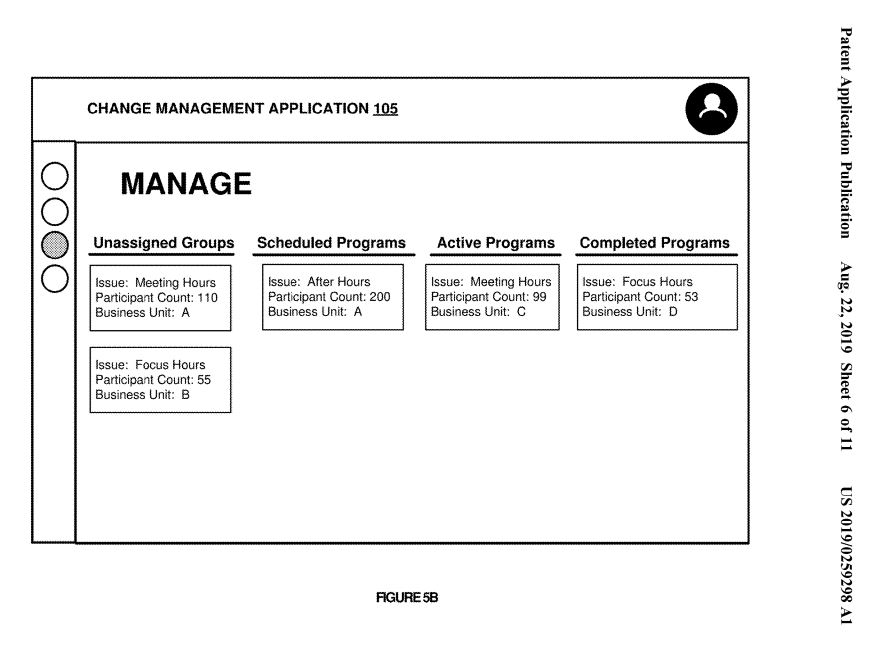
Remember when Microsoft was criticized for enabling "workplace surveillance" over "productivity scores" in its Microsoft 365 office software which gave managers highly detailed profiles of each individual employee's activity. Long-time Slashdot reader theodp writes: The Microsoft 365 Productivity Score apparently has roots in another Microsoft patent application for Systems, Methods, and Software for Implementing a Behavior Change Management Program, which also lays out plans for as yet unimplemented features to automatically schedule hundreds of employees for months of productivity re-education, including preventing employees from scheduling meetings with others if the service deems it counter-productive. So, could the HAL 9000's "I'm sorry Dave, I'm afraid I can't do that" be considered prior art?
But Microsoft "has even bigger ideas for using technology to monitor workers in the interest of maximizing organizational productivity," reports GeekWire: Newly surfaced Microsoft patent filings describe a system for deriving and predicting "overall quality scores" for meetings using data such as body language, facial expressions, room temperature, time of day, and number of people in the meeting. The system uses cameras, sensors, and software tools to determine, for example, "how much a participant contributes to a meeting vs performing other tasks (e.g., texting, checking email, browsing the Internet)."

The "meeting insight computing system" would then predict the likelihood that a group will hold a high-quality meeting. It would flag potential challenges when an organizer is setting the meeting up, and recommend alternative venues, times, or people to include in the meeting, for example... A patent application made public Nov. 12 notes, "many organizations are plagued by overly long, poorly attended, and recurring meetings that could be modified and/or avoided if more information regarding meeting quality was available." The approach would apply to in-person and virtual meetings, and hybrids of the two...

The filings do not detail any potential privacy safeguards. A Microsoft spokesperson declined to comment on the patent filings in response to GeekWire's inquiry. To be sure, patents are not products, and there's no sign yet that Microsoft plans to roll out this hypothetical system. Microsoft has established an internal artificial intelligence ethics office and a companywide committee to ensure that its AI products live by its principles of responsible AI, including transparency and privacy. However, the filings are a window into the ideas floating around inside Microsoft, and they're consistent with the direction the company is already heading.

Facebook

Facebook Will Let People Claim Ownership of Images and Issue Takedown Requests (theverge.com) 26

Facebook is going to let people take more control over the images they own and where they end up. The Verge reports: In an update to its rights management platform, the company is starting to work with certain partners today to give them the power to claim ownership over images and then moderate where those images show up across the Facebook platform, including on Instagram. The goal is to eventually open this feature up to everyone, as it already does with music and video rights. The company didn't give a timeline on when it hopes to open this up more broadly.

Facebook didn't disclose who its partners are, but this could theoretically mean that if a brand like National Geographic uploaded its photos to Facebook's Rights Manager, it could then monitor where they show up, like on other brands' Instagram pages. From there, the company could choose to let the images stay up, issue a takedown, which removes the infringing post entirely, or use a territorial block, meaning the post stays live but isn't viewable in territories where the company's copyright applies. To claim their copyright, the image rights holder uploads a CSV file to Facebook's Rights Manager that contains all the image's metadata. They'll also specify where the copyright applies and can leave certain territories out. Once the manager verifies that the metadata and image match, it'll then process that image and monitor where it shows up. If another person tries to claim ownership of the same image, the two parties can go back and forth a couple times to dispute the claim, and Facebook will eventually yield it to whoever filed first. If they then want to appeal that decision, they can use Facebook's IP reporting forms.

Android

The Galaxy Note 20 Ultra Has Lasers, Plays Xbox Games, And is Just Massive 50

Samsung today unveiled two Galaxy Note 20 models -- the Note 20 (which starts at $999) and Note 20 Ultra (which starts at $1,299) -- arriving later this month on August 21. Both Note 20 smartphones come with an S Pen, but there are some major differences. Notably, the screen and the cameras are a little bit different. From a report: The smaller Note 20 has a 6.7-inch display with flat edges and the larger Note 20 Ultra has a 6.9-inch 120Hz screen with curved sides. Curved glass has long been a signature design on Samsung phones and it looks like the company is at least considering a change. But the one thing I'm most excited for is the Note 20 Ultra's 108-megapixel camera. This is the same image sensor on the S20 Ultra with one important change: a laser sensor that enables faster autofocusing. In other words: Samsung says it has fixed the S20 Ultra's autofocusing issues on the Note 20 Ultra. I'll test that out soon enough to verify the claim, but for now, here's everything else you need to know about the Note 20 phones.

Expand to a TV with DeX: In addition to plugging your Note 20 into a laptop or monitor to turn it into a desktop-like computer experience with DeX mode, Note 20 users can wirelessly connect to a TV with Miracast support. Samsung says all of its 2019 and newer smart TVs support the wireless DeX mode.
Smarter Windows integration: Samsung's growing partnership with Microsoft is yielding even tighter synergy between its devices and Windows 10. Samsung says Windows 10 will let you run multiple Note 20 apps simultaneously later this year and has better drag-and-drop support between devices.
Xbox Game Pass Ultimate: If you're a gamer, you'll be able to stream over 100 Xbox games directly to the Note 20 phones with Xbox Game Pass Ultimate. This feature doesn't go live until September 15.
Ultra-wideband: Like the iPhone 11 and 11 Pro, the Note 20 phones have an ultra-wideband chip inside. Samsung says UWB will allow people to share files to another UWB-supported device by pointing them at each other. UWB can also be used to unlock smart locks (for homes or cars).
First Person Shooters (Games)

'Doom Eternal' Is Using Denuvo's New Kernel-Level Anti-Cheat Driver (arstechnica.com) 68

"Doom Eternal has become the latest game to use a kernel-level driver to aid in detecting cheaters in multiplayer matches," reports Ars Technica: The game's new driver and anti-cheat tool come courtesy of Denuvo parent Irdeto, a company once known for nearly unbeatable piracy protection and now known for somewhat effective but often cracked piracy protection. But the new Denuvo Anti-Cheat protection is completely separate from the company's Denuvo Anti-Tamper technology... The new Denuvo Anti-Cheat tool rolls out to Doom Eternal players after "countless hours and millions of gameplay sessions" during a two-year early access program, Irdeto said in a blog post announcing its introduction. But unlike Valorant's similar Vanguard system, the Denuvo Anti-Cheat driver "doesn't have annoying tray icons or splash screens" letting players monitor its use on their system. "This invisibility could raise some eyebrows," Irdeto concedes.

To assuage any potential fears, Irdeto writes that Denuvo Anti-Cheat only runs when the game is active, and Bethesda's patch notes similarly say that "use of the kernel-mode driver starts when the game launches and stops when the game stops for any reason...."

"No monitoring or data collection happens outside of multiplayer matches," Denuvo Anti-Cheat Product Owner Michail Greshishchev told Ars via email. "Denuvo does not attempt to maintain the integrity of the system. It does not block cheats, game mods, or developer tools. Denuvo Anti-Cheat only detects cheats." Greshishchev added that the company's driver has received "certification from renown[ed] kernel security researchers, completed regular whitebox and blackbox audits, and was penetration-tested by independent cheat developers." He said Irdeto is also setting up a bug bounty program to discover any flaws they might have missed.

And because of Denuvo Anti-Cheat's design, Greshishchev says the driver is more secure than others that might have more exposure to the Internet. "Unlike existing anti-cheats, Denuvo Anti-Cheat does not stream shell code from the Web," Greshishchev told Ars. "This means that, if compromised, attackers can't send down arbitrary malware to gamers' machines...."

If a driver exploit is discovered in the wild, Greshishchev told Ars that revocable certificates and self-expiring network keys can be used as "kill switches" to cut them off.

The Courts

Filmmakers Sue State Department Over Social Media Surveillance Rules (theverge.com) 20

A group of filmmakers have sued the State Department for making visa applicants hand over details about their social media accounts. "The lawsuit argues that the requirement unconstitutionally discourages applicants from speaking online -- and, conversely, discourages people who post political speech from trying to enter the U.S.," reports The Verge. From the report: This lawsuit, filed by the Doc Society and the International Documentary Association, challenges the decision on First Amendment grounds. It calls the registration system "the cornerstone of a far reaching digital surveillance regime" that makes would-be visitors provide "effectively a live database of their personal, creative, and political activities online" -- which the government can monitor at any time, long after the application process has been completed. Applicants must even disclose accounts that they use pseudonymously, and if U.S. authorities fail to keep that information secure, it could potentially endanger people who are trying to avoid censorship from a repressive foreign government.

The plaintiffs in this lawsuit say that some non-U.S. members have begun deleting social media content or stopped expressing themselves online because they're afraid it will complicate their ability to enter the U.S. Others have decided to stop working in the country because they don't want to reveal their social media accounts. "The Registration Requirement enables the government to compile a database of millions of people's speech and associations, which it can cross-reference to glean more information about any given visa applicant," warns the suit. And "the government's indefinite retention of information collected through the Registration Requirement further exacerbates the requirement's chilling effect because it facilitates surveillance into the future."

The Courts

Flaws in Cellphone Evidence Prompt Review of 10,000 Verdicts in Denmark (nytimes.com) 36

The authorities in Denmark say they plan to review over 10,000 court verdicts because of errors in cellphone tracking data offered as evidence. From a report: The country's director of public prosecutions on Monday also ordered a two-month halt in prosecutors' use of cellphone data in criminal cases while the flaws and their potential consequences are investigated. "It's shaking our trust in the legal system," Justice Minister Nick Haekkerup said in a statement. The first error was found in an I.T. system that converts phone companies' raw data into evidence that the police and prosecutors can use to place a person at the scene of a crime. During the conversions, the system omitted some data, creating a less-detailed image of a cellphone's whereabouts. The error was fixed in March after the national police discovered it. In a second problem, some cellphone tracking data linked phones to the wrong cellphone towers, potentially connecting innocent people to crime scenes, said Jan Reckendorff, the director of public prosecutions.

"It's a very, very serious case," Mr. Reckendorff told Denmark's state broadcaster. "We cannot live with incorrect information sending people to prison." The authorities said that the problems stemmed partly from police I.T. systems and partly from the phone companies' systems, although a telecom industry representative said he could not understand how phone companies could have caused the errors. The national police determined that the flaws applied to 10,700 court cases dating to 2012, but it is unclear whether the faulty data was a decisive factor in any verdicts. The justice minister set up a steering group to track the extent of the legal problems they may have caused and to monitor the reviews of cases that may have been affected.

Facebook

Facebook Announces Libra Cryptocurrency (fb.com) 219

Facebook has finally revealed the details of its cryptocurrency Libra. From a blog post: Today we're sharing plans for Calibra, a newly formed Facebook subsidiary whose goal is to provide financial services that will let people access and participate in the Libra network. The first product Calibra will introduce is a digital wallet for Libra, a new global currency powered by blockchain technology. The wallet will be available in Messenger, WhatsApp and as a standalone app -- and we expect to launch in 2020. [...] For many people around the world, even basic financial services are still out of reach: almost half of the adults in the world don't have an active bank account and those numbers are worse in developing countries and even worse for women. The cost of that exclusion is high -- approximately 70% of small businesses in developing countries lack access to credit and $25 billion is lost by migrants every year through remittance fees. This is the challenge we're hoping to address with Calibra, a new digital wallet that you'll be able to use to save, send and spend Libra.

From the beginning, Calibra will let you send Libra to almost anyone with a smartphone, as easily and instantly as you might send a text message and at low to no cost. And, in time, we hope to offer additional services for people and businesses, like paying bills with the push of a button, buying a cup of coffee with the scan of a code or riding your local public transit without needing to carry cash or a metro pass. When it launches, Calibra will have strong protections in place to keep your money and your information safe. We'll be using all the same verification and anti-fraud processes that banks and credit cards use, and we'll have automated systems that will proactively monitor activity to detect and prevent fraudulent behavior. We'll also offer dedicated live support to help if you lose your phone or your password -- and if someone fraudulently gains access to your account and you lose some Libra as a result, we'll offer you a refund.
Facebook's currency is backed by more than two dozen companies ranging from Visa and Mastercard to Lyft and Spotify. Apple, Google, Amazon and Microsoft have not yet signed up. Banks decided not to join the starting roster because of uncertainties about regulation and concerns over logistical issues that could hamper take-up, Financial Times reported citing several industry executives. From the report: If successful, the project could dramatically reshape some corners of the finance industry, disintermediating payments platforms and stealing business from retail banks and fintech groups, particularly those that specialise in sending payments across borders. Jorn Lambert, executive vice-president for digital solutions at Mastercard, said he was not worried that fee-free transactions would threaten the payment card business. "It's an addition to what we do, not instead of what we do. It is not a zero-sum game. Today, 85 per cent of transactions are made in cash." It is unclear whether Libra will clear the steep hurdles needed to get off the ground, win over regulators, such as the US Securities and Exchange Commission, and be embraced, or strongly resisted, by the financial services industry. Central banks have already questioned the impact of company-created cryptocurrencies on financial stability. "We see hurdles to scale, we see hurdles to adoption, we see enough of this to decide that we would not participate in a scheme like this," said a senior payments executive at a large global bank.
Communications

Satellite Airliner Tracking Over Oceans Goes Global (bbc.com) 57

dryriver shares a report from the BBC: Tracking airplanes anywhere in the world just got a lot easier. The U.S. firm Aireon says its new satellite surveillance network is now fully live and being trialled over the North Atlantic. The system employs a constellation of 66 (Iridium) spacecraft, which monitor the situational messages pumped out by aircraft transponders. These report a plane's position, altitude, direction and speed every eight seconds. The two big navigation management companies that marshal plane movements across the North Atlantic -- UK Nats and Nav Canada -- intend to use Aireon to transform their operations. The more detailed information they now have about the behavior of airplanes means more efficient routing can be introduced. This ought to reduce costs for airlines. Passengers should also experience fewer delays. Aireon has receivers riding piggyback on all 66 spacecraft of the Iridium sat-phone service provider. These sensors make it possible now to track planes even out over the ocean, beyond the visibility of radar -- and ocean waters cover 70% of the globe. The rapid-fire nature of the messaging also means aircraft visibility is virtually continuous. Existing data links only report ocean-crossing aircraft positions every 14 minutes. '
Cellphones

Could You Live Without Your Smartphone? (theglobeandmail.com) 157

Three-quarters of Canadians own smartphones-- and 94% of 15- to 34-year-olds. But this week the Globe and Mail profiled "digital refuseniks" who are "deliberately logging off -- and they say it's done wonders for their imaginations and peace of mind." They are hidden among us, neither jobless nor friendless, and living quite happily. Cut off from Uber, yet somehow thriving. For example, Tony North does not live for his smartphone, because he's never had one. "I just didn't want to get into the habit of distraction," he says simply, in an interview conducted over landline from his home in Paris, Ontario. The high-school teacher spends about 20 minutes a day [on his laptop] on his one social-media platform, Facebook, which he uses to keep in touch with family back home in Australia. In fact, you could blame Australia for Mr. North's desire to be digitally unleashed: He remembers leaving home to travel overseas, and the wonderful feeling of being uncontactable that came with it. "It was such a feeling of freedom, and I guess I wanted to keep a bit of that."

As a teacher of English and drama, Mr. North, 53, is worried about the consequences of teenagers' near-constant devotion to their online lives (his own two children, 12 and 13 years old, do not have phones). In drama class, he makes his students put away their phones and engage in face-to-face exercises: "I'm basically forcing them to interact," he says. "When I ask for evaluations at the end of the semester, it's one of the things they most seem to appreciate...." Canadians between the ages of 18 and 34 spend nearly five hours a day online, according to a 2017 survey from Media Technology Monitor... "Have Smartphones Destroyed a Generation?" the Atlantic magazine asked last year in a cover story designed to keep parents up at night, frozen in the blue light of further bad news.

North says in the extra time "he reads many novels and enjoys quiet moments of reflection and watching the world go by." And 18-year-old Bethany March is also severely limiting her phone use. ''I saw the way that people got so invested, not just in their phones, but in social media, and I didn't want to be that person," she says. "So many times people would be zeroed in on their phones. It was just rude, to be honest. I'd think, 'I'm here with you, talk to me.'"

71-year-old John Moir insists that living without a smartphone makes him really experience new locations, "rather than trying to be in two places at once," adding that "Whenever I tell people I don't have a phone, they say, 'Oh, that's so great. I wish I didn't have to have one.'" That's "one thing digital refuseniks never have to worry about," the article concludes: "Who is the servant in their digital relationship, and who is the master."
The Internet

Is The World Shifting To 'Ambient Computing'? (computerworld.com) 147

In the future, "A massive convergence of technologies will enable us to use computers and the internet without really using them," argues Computerworld. At the dawn of the personal computing revolution, people "operated" a computer. They sat down and did computing -- often programming. Later, with the application explosion, operators became "users." People used computers for purposes other than programming or operating a computer -- like balancing their checkbooks or playing video games. All computing uses so far have required a cognitive shift from doing something in the real world to operating or using a computer. Ambient computing changes all that, because it involves using a computer without consciously or deliberately or explicitly "using" a computer....

It's just there, guiding and nudging you along as you accomplish things in life. Ambient computing devices will operate invisibly in the background. They'll identify, monitor and listen to us and respond to our perceived needs and habits. So a good working definition of ambient computing is "computing that happens in the background without the active participation of the user...."

In 20 years, the idea of picking up a device or sitting down at a computer to actively use it will seem quaintly antiquated. All computing will be ambient -- all around us all the time, whispering in our ear, augmenting the real world through our prescription eyeglasses and car windshields, perceiving our emotions and desires and taking action in the background to help us reach our business goals and live a better life. Between now and then we'll all ride together on a very interesting journey from computers we actively use to computing resources increasingly acting in the background for us.

Though the article identifies smart speakers are the first ambient computing devices most people will encounter, it's argues that that's just the beginning of a much larger change.

"We're also going to be flooded and overwhelmed by the 'ambient computing' hype as, I predict, it will become one of the most overused and abused marketing buzzwords ever."

Slashdot Top Deals