Mozilla

Mozilla Outlines Plan For Manifest V3 Extensions API (mozilla.org) 13

New submitter q4Fry writes: When Google released its changes to the Chrome WebExtensions API for comment, many groups criticized them for cutting off ad-blockers at the knees. Now, Mozilla has released its plan for following (and departing from) the APIs that Chrome may adopt.

Will Mozilla follow Google with these changes? In the absence of a true standard for browser extensions, maintaining compatibility with Chrome is important for Firefox developers and users. Firefox is not, however, obligated to implement every part of v3, and our WebExtensions API already departs in several areas under v2 where we think it makes sense.


Government

Trump Administration Is Rolling Back Rules Requiring More Energy-Efficient Bulbs (nytimes.com) 391

An anonymous reader quotes a report from The New York Times: The Trump administration announced new rules on Wednesday to roll back requirements for energy-saving light bulbs, a move that could contribute to the greenhouse gas emissions that cause climate change. The Energy Department's filing in the Federal Register will prevent new efficiency standards from going into effect on Jan. 1 under a law passed in 2007. The changes are likely to be challenged in court. "We will explore all options, including litigation, to stop this completely misguided and unlawful action," said Noah Horowitz, director of the Center for Energy Efficiency Standards at the Natural Resources Defense Council, last week in anticipation of the move. "One part of the new standards would have required the adding of four kinds of incandescent and halogen light bulbs to the energy-efficient group: three-way, the candle-shaped bulbs used in chandeliers; the globe-shaped bulbs found in bathroom lighting; reflector bulbs used in recessed fixtures; and track lighting," the report adds. "A rule that will be published Thursday in the Federal Register will eliminate the requirement for those four categories of bulbs."

"The Department of Energy was also supposed to begin a broader upgrade concerning energy efficiency in pear-shaped bulbs, scheduled to go into effect Jan. 1, 2020. The department is proposing a new rule that would eliminate that requirement, subject to a 60-day comment period."
Facebook

A Huge Database of Facebook Users' Phone Numbers Found Online (techcrunch.com) 36

Hundreds of millions of phone numbers linked to Facebook accounts have been found online. TechCrunch: The exposed server contained over 419 million records over several databases on users across geographies, including 133 million records on U.S.-based Facebook users, 18 million records of users in the U.K., and another with more than 50 million records on users in Vietnam. But because the server wasn't protected with a password, anyone could find and access the database. Each record contained a user's unique Facebook ID and the phone number listed on the account. A user's Facebook ID is typically a long, unique and public number associated with their account, which can be easily used to discern an account's username. But phone numbers have not been public in more than a year since Facebook restricted access to users' phone numbers. TechCrunch verified a number of records in the database by matching a known Facebook user's phone number against their listed Facebook ID. We also checked other records by matching phone numbers against Facebook's own password reset feature, which can be used to partially reveal a user's phone number linked to their account.
Transportation

A Restart For the Aptera Electric Car? (ieee.org) 37

necro81 writes: The Aptera 2e was a head-turning 3-wheeled electric vehicle when it debuted a decade ago. With a body more like an aircraft than a car, it was designed for maximum efficiency. Unfortunately, the company went bankrupt and liquidated before it hit production. Now IEEE Spectrum reports the founders are having another crack at it, taking advantage of a decade of improvement in batteries, computation, and EV component supply chains. By utilizing sandwich composite body panels, lightweight 3D-printed metal components, and speedier fluid dynamics simulations, their aim is a maximum efficiency, low-volume production vehicle that, with its largest battery configuration, could achieve a range of 1000 miles (1600 km).
AI

A Breakthrough for AI Technology: Passing an 8th-Grade Science Test (nytimes.com) 111

The New York Times: Four years ago, more than 700 computer scientists competed in a contest to build artificial intelligence that could pass an eighth-grade science test. There was $80,000 in prize money on the line. They all flunked. Even the most sophisticated system couldn't do better than 60 percent on the test. A.I. couldn't match the language and logic skills that students are expected to have when they enter high school. But on Wednesday, the Allen Institute for Artificial Intelligence, a prominent lab in Seattle, unveiled a new system that passed the test with room to spare. It correctly answered more than 90 percent of the questions on an eighth-grade science test and more than 80 percent on a 12th-grade exam.

The system, called Aristo, is an indication that in just the past several months researchers have made significant progress in developing A.I. that can understand languages and mimic the logic and decision-making of humans. The world's top research labs are rapidly improving a machine's ability to understand and respond to natural language. Machines are getting better at analyzing documents, finding information, answering questions and even generating language of their own. Aristo was built solely for multiple-choice tests. It took standard exams written for students in New York, though the Allen Institute removed all questions that included pictures and diagrams. Answering questions like that would have required additional skills that combine language understanding and logic with so-called computer vision.

Businesses

WeWork CEO Returns $5.9 Million For 'We' Trademark To Company After Criticism (businessinsider.com) 66

When WeWork filed to go public this summer, we learned an incredible detail about its cofounder Adam Neumann: He was paid a whopping $5.9 million by the company he runs for use of the word "we." From a report: The logic was laid out as such: Ahead of its initial-public-offering filing, WeWork reorganized and rebranded as The We Company. To rebrand itself around the word "We," the company paid its own CEO nearly $6 million for trademark rights. The transaction was handled through a private company that Neumann is a managing member of, We Holdings LLC, which owned the trademark rights to the word "we." Moreover, WeWork characterized the nearly $6 million payment as "fair market value." In his analysis of the company following its IPO filing, the New York University marketing professor Scott Galloway characterized the situation as such: "Adam also owned the rights to the 'We' trademark, which the firm decided they must own and paid the founder/CEO $5.9 million for the rights. The rights to a name nearly identical to the name of the firm where he's the founder/CEO and largest shareholder. YOU. CAN'T. MAKE. THIS. S---. UP." On Wednesday, in a newly filed Securities and Exchange Commission document, WeWork walked back that arrangement.
Google

Google Has Secret Webpages That Feed Your Personal Data To Advertisers, Report Says (cnet.com) 43

New evidence submitted for an investigation into Google's collection of personal data in the European Union reportedly accuses the search giant of stealthy sending your personal user data to advertisers. The company allegedly relays this information to advertisers using hidden webpages, allowing it to circumvent EU privacy regulations. From a report: The evidence was submitted to Ireland's Data Protection Commission, the main watchdog over the company in the European Union, by Johnny Ryan, chief policy officer for privacy-focused browser maker Brave, according to a Financial Times report Wednesday. Ryan reportedly said he discovered that Google used a tracker containing web browsing information, location and other data and sent it to ad companies via webpages that "showed no content," according to FT. This could allow companies buying ads to match a user's Google profile and web activity to profiles from other companies, which is against Google's own ad buying rules, according to the FT. In response, Google said Wednesday it doesn't serve "personalized ads or send bid requests to bidders without user consent."
Crime

Google To Pay $170 Million To Settle FTC Claims That YouTube Collected Kids Data Illegally 23

Google and YouTube will pay $170 million to settle allegations by the Federal Trade Commission and the New York Attorney General that YouTube illegally collected personal information from children without their parents' consent, the FTC announced. From a report: The fine is a record in a case related to alleged violations of the Children's Online Privacy Protection Act (COPPA), according to the FTC. "YouTube touted its popularity with children to prospective corporate clients," said FTC Chairman Joe Simons. "Yet when it came to complying with COPPA, the company refused to acknowledge that portions of its platform were clearly directed to kids. There's no excuse for YouTube's violations of the law."

Under the settlement, YouTube is required to develop and maintain a system that lets channel owners to identify "child-directed content" so that YouTube can ensure it is complying with COPPA. In addition, Google and YouTube must notify channel owners that their child-directed content may be subject to COPPA's obligations and provide annual training about complying with COPPA for employees who deal with YouTube channel owners.
Businesses

Google's Paid Search Ads Are 'Shakedown' and 'Ransom', Basecamp CEO says (cnbc.com) 120

An anonymous reader shares a report: Do a Google search for Basecamp, a web-based project management tool company, and you might see one or more ads for competitors show up in results above the actual company. Basecamp CEO and co-founder Jason Fried sounded off against the practice Tuesday, calling it a "shakedown" and saying it's like ransom to have to pay up just to be seen in results.

"When Google puts 4 paid ads ahead of the first organic result for your own brand name, you're forced to pay up if you want to be found," he tweeted Tuesday afternoon. "It's a shakedown. It's ransom. But at least we can have fun with it. Search for Basecamp and you may see this attached ad." The tweet includes the screenshot of an ad for Basecamp, reading "Basecamp.com -- We don't want to run this ad." The copy says "We're the #1 result, but this site lets companies advertise against us using our brand. So here we are. A small, independent co. forced to pay ransom to a giant tech company."

Security

Fraudsters Deepfake CEO's Voice To Trick Manager Into Transferring $243,000 (thenextweb.com) 39

An anonymous reader quotes a report from The Next Web: In March, criminals sought the help of commercially available voice-generating AI software to impersonate the boss of a German parent company that owns a UK-based energy firm. They then tricked the latter's chief executive into urgently wiring said funds to a Hungarian supplier in an hour, with guarantees that the transfer would be reimbursed immediately. The company CEO, hearing the familiar slight German accent and voice patterns of his boss, is said to have suspected nothing, the report said.

But not only was the money not reimbursed, the fraudsters posed as the German CEO to ask for another urgent money transfer. This time, however, the British CEO refused to make the payment. As it turns out, the funds the CEO transferred to Hungary were eventually moved to Mexico and other locations. Authorities are yet to determine the culprits behind the cybercrime operation. The firm was insured by Euler Hermes Group, which covered the entire cost of the payment. The names of the company and the parties involved were not disclosed.
According to The Wall Street Journal, which first reported the news, the voice fraud cost the company $243,000.
Software

Faulty Tesla App Locked Some Owners Out of Their Cars For Hours (gizmodo.com) 144

Some Tesla owners who depended on the app to unlock their cars were left scrambling for their physical keys yesterday when the app went down for maintenance. Several users took to Twitter to pour out their agony. The Next Web first reported the news: Downdetector.com, a website that shows the status of various services, had many people reporting an outage for Tesla over the last couple of hours. According to the website, first outages were reported around 4.30AM ET. While Tesla's app helps you unlock the car, you can still use a key card, an option key fob, or the app without needing to connect to the internet. But some people who didn't have the key card or the fob, and were logged out of the app, had to wait at the time of reporting. A Tesla spokesperson confirmed to Gizmodo that Tesla's app was temporarily unavailable on Monday but full functionality was soon restored. Tweets suggest the app was down for around three hours at least.
Space

SpaceX Satellite Was On 'Collision Course' Until ESA Satellite Was Re-Routed (arstechnica.com) 65

The European Space Agency (ESA) yesterday took action to avoid a collision with a SpaceX broadband satellite after a bug in SpaceX's on-call paging system prevented the company from getting a crucial update. Ars Technica reports: "For the first time ever, ESA has performed a 'collision avoidance maneuver' to protect one of its satellites from colliding with a 'mega constellation,'" the ESA said on Twitter. The "mega constellation" ESA referred to is SpaceX's Starlink broadband system, which is in the early stages of deployment but could eventually include nearly 12,000 satellites. Action had to be taken because the ESA's Aeolus satellite and a Starlink satellite were on a course that carried more than a 1-in-10,000 chance of a collision. According to the ESA, the Earth-observation satellite Aeolus "fired its thrusters, moving it off a collision course with a SpaceX satellite in their Starlink constellation." "SpaceX explained in a statement today that it didn't initially take action because of early estimates that the risk of collision was much lower than it turned out to be," the report adds. "SpaceX said it would have coordinated with ESA to avoid a collision once the estimates got worse, if only the paging-system bug hadn't prevented SpaceX from getting an update on the collision probability. SpaceX said it is trying to fix the bug to prevent such mishaps in the future."
Hardware

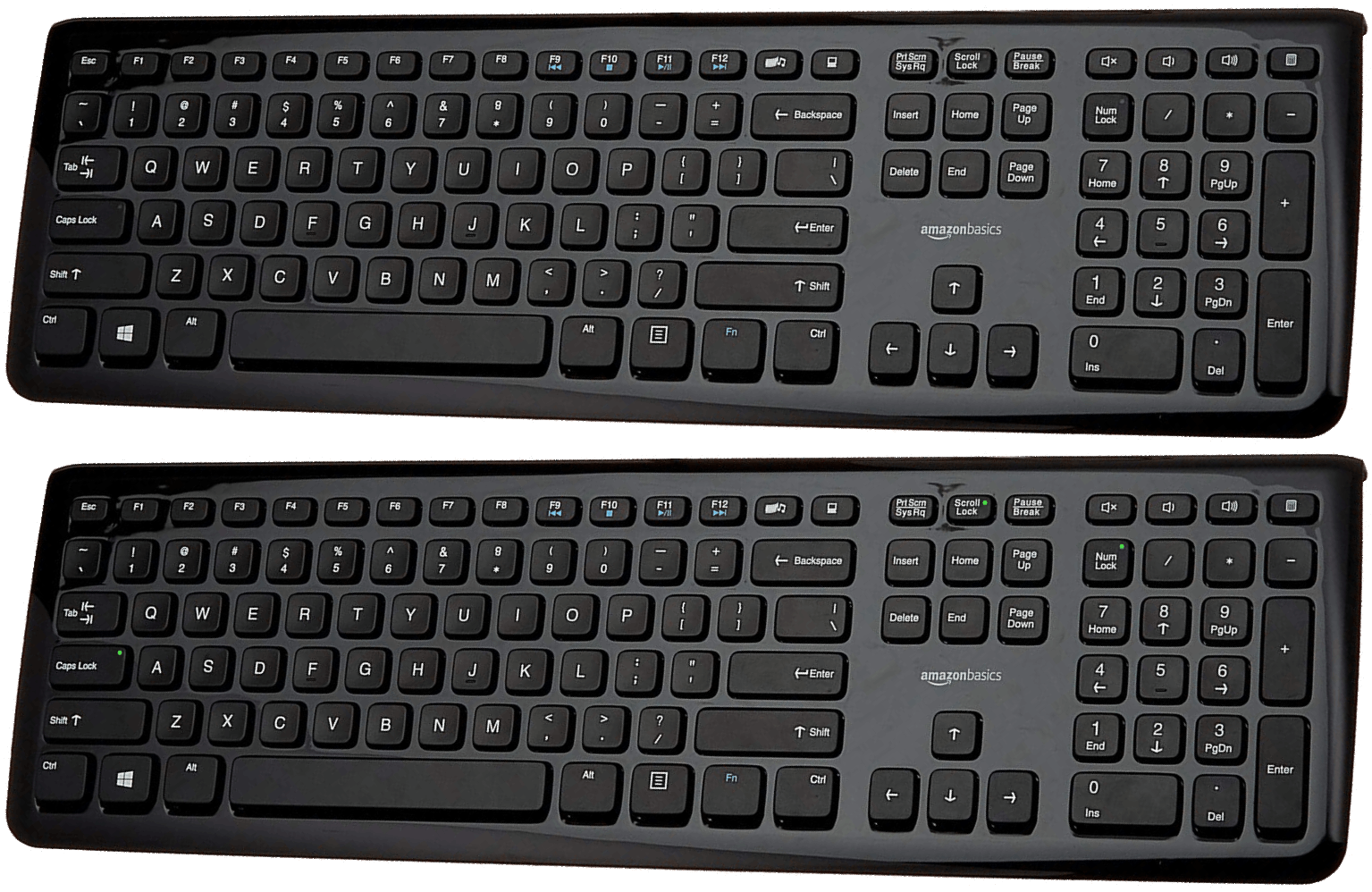
'Why the Amazon Basics Keyboard Is My Favorite Keyboard' (nickjanetakis.com) 183

Full stack developer and teacher, Nick Janetakis, says the Amazon Basics keyboard is one of his favorite general purpose/programming keyboards. "It hits all the major points that make a keyboard good and it also happens to be only $14," he writes. From his blog post: Quiet as Possible: I have one freelance client (ahem Ryan!) who has really loud mechanical key switches. Every time we hop on a screen sharing session that involves typing I can't tell if he's lighting off fireworks in his office or writing code. [...] I tried a bunch of keyboards and [the Amazon Basics keyboard] is really very quiet while having tactile feeling keys. (You can listen to this YouTube video to hear what the keyboard sounds like.)

Tactile Feeling Keys: The Amazon Basics keyboard fits in between with mid-height keys. They have a decent amount of resistance to them so you can definitely feel each key press, but it's not so much that it hurts your forearms after long hours of coding.

Easy to Clean / Avoids Stuck Keys: After a quick wipe down it looks pretty much as good as new -- even years later. The mid-height keys are excellent for avoiding dirt and stuck keys because it's almost impossible to get anything stuck under a key. Only dust particles get caught under there.

Scratch Resistant Key Cap Labels: After ~5 years of extensive use and abuse only 3 keys had minor chips in their label. I lost the upper part of the L's label, a third of the O's label and half of the ,'s label. Not too bad IMO. I've seen a lot worse with less usage. The labels look like very tightly pressed stickers that are flat to the touch. They almost look like maybe they were heat sealed onto the surface of the key. It's hard to say. Even if I take my nail and try to scrape off a label, it doesn't budge.

Useful Media / Extra Keys: Speaking of keys, it's a nice perk to have a keyboard that has extra keys that you can configure without bloating the size of the keyboard. Amazon has done a fantastic job here at maximizing the usable space of their keyboard. That's 9 distinct keys or 13 if you count the media combo keys. That's really useful. You can always remap any of them to other actions if you prefer. It's a dream come true if you plan to use something like i3wm on Linux which is heavily keyboard shortcut driven.

Compact Size but Sticks To Standards For Key Placement: Everything is where you expect it with this Amazon Basics keyboard and you get the full size backspace / backslash keys.

Caps Lock / Num Lock / Scroll Lock Have Lights on Their Key Switch: With this keyboard, each lock key has its own light which I animated below.

Robust Wire / USB Cable: I have to say the Amazon Basics keyboard is solid in this area. Even on my old keyboard from years ago, the wire has zero signs of wear and tear.

Solid Rubber Feet to Avoid Slipping: There's 4 pretty large rubber grips on the edges of each corner so there's really no reasonable chance of it ever slipping from pressure or normal usage.

Amiga

Ask Slashdot: What Would Computing Look Like Today If the Amiga Had Survived? 221

dryriver writes: The Amiga was a remarkable machine at the time it was released -- 1985. It had a multitasking capable GUI-driven OS and a mouse. It had a number of cleverly designed custom chips that gave the Amiga amazing graphics and sound capabilities far beyond the typical IBM/DOS PCs of its time. The Amiga was the multimedia beast of its time -- you could create animated and still 2D or 3D graphics on it, compose sophisticated electronic music, develop 2D or 3D 16-Bit games, edit and process digital video (using Video Toaster), and of course, play some amazing games. And after the Amiga -- as well as the Atari ST, Archimedes and so on -- died, everybody pretty much had to migrate to either the PC or Mac platforms. If Commodore and the Amiga had survived and thrived, there might have been four major desktop platforms in use today: Windows, OSX, AmigaOS and Linux. And who knows what the custom chips (ASICs? FPGAs?) of an Amiga in 2019 might have been capable of -- Amiga could possibly have been the platform that makes nearly life-like games and VR/AR a reality, and given Nvidia and AMD's GPUs a run for their money.

What do you think the computing landscape in 2019 would have looked like if the Amiga and AmigaOS as a platform had survived? Would Macs be as popular with digital content creators as they are today? Would AAA games target Windows 7/8/10 by default or tilt more towards the Amiga? Could there have been an Amiga hardware-based game console? Might AmigaOS and Linux have had a symbiotic existence of sorts, with AmigOS co-existing with Linux on many enthusiast's Amigas, or even becoming compatible with each other over time?
Google

Android 10 Launches Today, and Pixel Phones Get the Day One Update (arstechnica.com) 45

An anonymous reader quotes a report from Ars Technica: Android 10 is finally finished! The next big Android update, which we've been examining for most of the year as the "Android Q Beta," starts rolling out to devices today. As usual, Android 10 is arriving on Pixel phones first (even the three-year-old Pixel 1), and Google says it is "working with a number of partners to launch or upgrade devices to Android 10 this year." Google has introduced a new branding strategy for Android, by the way, so there's no "Q" snack name with this release. In 2019, it's just "Android 10." Android 10 brings a number of changes to the world's most popular mobile operating system.

First up, devices are getting "fully gestural" navigation, which lets you navigate around the phone with swipe gestures. Just like the implementation on the iPhone X, gesture navigation removed the need for a dedicated space for navigation buttons, allowing for more space for app content. There's finally full support for a dark theme, which will turn the entire system UI and any supported apps from the usual black text on a white background to white text on a black background. (That option significantly reduces the amount of light a phone puts out and saves battery life on OLED displays.) Google has also promised dark mode support for "all" of the Google apps in time for Android 10's launch, so we should be seeing updates to Gmail, Google Play, Google Maps, and a million other Google apps sometime soon.
Other features of Android 10 include a faster share sheet, a "bubbles" API for floating apps, 230 new emoji, improved security and privacy options, and smarter notification panel.
Power

E-Bikes Are Now Allowed In US National Parks (engadget.com) 72

The National Park Service has expanded the use of e-bikes to allow pedal assist models on the same roads and trails as conventional bicycles so long as they cut off assistance at 28MPH. Officials contend that the policy shift could make parks more accessible and "mitigate" environmental damage while ensuring uses similar to traditional bikes. Engadget reports: E-bikes make it easier to travel far, the NPS said. It could likewise enable park rides for people with limited mobility, particularly on hilly and otherwise challenging terrain. They might also lower emissions and improve air quality by reducing the use of cars and motorcycles. It's not certain how the service would enforce the rules.

While the NPS' arguments appear to hold up, USA Today also highlighted concerns that e-bikes could cause more harm than good. Safety may be more of an issue than it is for conventional two-wheelers. E-bikes may also wear down trails in a less sustainable way. And then there's the simple matter of noise. People often go to parks for peace and quiet, and that may be harder if they have to contend with the hum of e-bike motors. This isn't to say that e-bikes will prove calamitous -- it's just that the NPS is letting more of them in without evidence that it considered the potential drawbacks.

Patents

Apple Patents Watch Band That Could ID You From Your Wrist Skin (techcrunch.com) 23

PatentlyApple has spotted several patents that suggest Apple is playing with the idea of making the Apple Watch's band identify users via their wrist's skin texture and arm hair. TechCrunch reports: The first patent describes a sensor built into the Watch or the watch's band that could use infrared to build a thermal image of your wrist and its identifying traits (like skin texture/arm hair) to identify who is wearing it -- sort of like a fingerprint, but from your wrist. Unlike most of Apple's other devices, the Apple Watch doesn't currently have any sort of built-in biometrics for unlocking -- there's no thumbprint sensor for Touch ID, or camera for Face ID. Unlocking your Apple Watch means poking at the screen to punch in a PIN (or, if you've configured it to unlock when you unlock your phone, doing that). A sensor setup like this could make the unlocking process automatic without the need to unlock your phone.

The second granted patent describes a Watch band that can adjust itself on the fly -- think Nike's self-tightening shoes, but on your wrist. If the Watch detects that it's sliding while you're running (or if the aforementioned thermal sensors need a closer look at your wrist skin) tensioners in the device could tighten or loosen the band on command. Finally, a third granted patent tinkers with the idea of a Watch band with built-in light-up indicators -- like, say, a notification light for incoming texts, or a meter that fills up to tell you at-a-glance how much distance you've got left on your run, or a stripe that glows yellow when you've got something on your calendar in the next hour. All of this can already be done on the Watch's screen, of course -- this would just allow for it without having to power up the entire display.

Youtube

YouTube Removes 17,000 Channels For Hate Speech (hollywoodreporter.com) 409

An anonymous reader quotes a report from The Hollywood Reporter: YouTube says it has removed more than 17,000 channels for hate speech, representing a spike in takedowns since its new hate speech policy went into effect in June. The Google-owned company calls the June update -- in which YouTube said it would specifically prohibit videos that glorify Nazi ideology or deny documented violent events like the Holocaust -- a "fundamental shift in our policies" that resulted in the takedown of more than 100,000 individual videos during the second quarter of the year. The number of comments removed during the same period doubled to over 500 million, in part due to the new hate speech policy. YouTube said that the 30,000 videos it had removed in the last month represented 3 percent of the views that knitting videos generated during the same period. YouTube says the videos removed represented a five-times increase compared with the previous three months. Still, in early August the ADL's Center on Extremism reported finding "a significant number of channels" that continue to spread anti-Semitic and white supremacist content.
Security

Over 47,000 Supermicro Servers Are Exposing BMC Ports on the Internet (zdnet.com) 57

Catalin Cimpanu, writing for ZDNet: More than 47,000 workstations and servers, possibly more, running on Supermicro motherboards are currently open to attacks because administrators have left an internal component exposed on the internet. These systems are vulnerable to a new set of vulnerabilities named USBAnywhere that affect the baseboard management controller (BMC) firmware of Supermicro motherboards. Patches are available to fix the USBAnywhere vulnerabilities, but Supermicro and security experts recommend restricting access to BMC management interfaces from the internet, as a precaution and industry best practice.
China

China Drone Attack on Crop-Eating 'Monster' Shows 98% Kill Rate (bloomberg.com) 39

An army of drones deployed to fight a crop-devouring pest in a southern area of China has recorded a mortality rate of as high as 98%, according to the manufacturer. From a report: XAG, a Guangzhou-based drone maker, teamed up with Germany's Bayer Crop Science in a drone swarm operation to kill the fall armyworm in China's Guangxi region. The autonomous devices, loaded with low-toxicity insecticide, have also successfully managed the pests in a government-led operation in the southwest province of Yunnan, XAG said. "It is the 'crop-devouring monster' that attacks over 80 crop varieties," XAG said in a statement Monday. Most farmers resort to traditional insecticide sprayers, which not only fail to move fast enough against the "ravenous, fast-moving fall armyworm" that can fly up to 100 kilometers in one night, but also expose them to dangerous chemicals, it said.

The fall army worm, a crop-devouring pest, has spread from the Americas to Africa and Asia, gorging on rice, corn, vegetables, cotton and more. Since arriving in China, it has advanced north, affecting 950,000 hectares of crops in 24 provinces as of mid-August, including parts of Hebei, Shaanxi and Shandong, according to an official report published late last month. Outbreaks at 90% of the affected areas are now under control, the report said.

Slashdot Top Deals