Operating Systems

Older iPads May Soon Be Able To Run Linux (arstechnica.com) 47

Older iPads with the Apple A7- and A8-based chips may soon be able to run Linux. "Developer Konrad Dybcio and a Linux enthusiast going by "quaack723" have collaborated to get Linux kernel version 5.18 booting on an old iPad Air 2, a major feat for a device that was designed to never run any operating system other than Apple's," reports Ars Technica. From the report: The project appears to use an Alpine Linux-based distribution called "postmarketOS," a relatively small but actively developed distribution made primarily for Android devices. Dybcio used a "checkm8" hashtag in his initial tweet about the project, strongly implying that they used the "Checkm8" bootrom exploit published back in 2019 to access the hardware. For now, the developers only have Linux running on some older iPad hardware using A7 and A8-based chips -- this includes the iPad Air, iPad Air 2, and a few generations of iPad mini. But subsequent tweets imply that it will be possible to get Linux up and running on any device with an A7 or A8 in it, including the iPhone 5S and the original HomePod.

Development work on this latest Linux-on-iDevices effort is still in its early days. The photos that the developers shared both show a basic boot process that fails because it can't mount a filesystem, and Dybcio notes that basic things like USB and Bluetooth support aren't working. Getting networking, audio, and graphics acceleration all working properly will also be a tall order. But being able to boot Linux at all could draw the attention of other developers who want to help the project.

Compared to modern hardware with an Apple M1 chip, A7 and A8-powered devices wouldn't be great as general-purpose Linux machines. While impressive at the time, their CPUs and GPUs are considerably slower than modern Apple devices, and they all shipped with either 1GB or 2GB of RAM. But their performance still stacks up well next to the slow processors in devices like the Raspberry Pi 4, and most (though not all) A7 and A8 hardware has stopped getting new iOS and iPadOS updates from Apple at this point; Linux support could give some of these devices a second life as retro game consoles, simple home servers, or other things that low-power Arm hardware is good for.
Further reading: Linux For M1 Macs? First Alpha Release Announced for Asahi Linux
Google

Google To Combine Meet, Duo Into Single App (theverge.com) 19

Google announced today that it's combining two of its video-calling apps, Duo and Meet, into a single platform. The Verge reports: Pretty soon, there will be only Google Meet, and Google's hoping it can be the one calling app users need for just about everything in their lives. By bringing them both together, Google's hoping it can solve some of what ails modern communication tools. [...] Over the last couple of years in particular, Meet has become a powerful platform for meetings and group chats of all kinds, while Duo has stayed more of a messaging app. Google promises it's bringing all of Duo's features to Meet going forward and seems convinced it can offer the best of both worlds.

It's not quite right to say that Duo's being killed, though. The app, which Google originally launched in 2016 as an easy way to make one-to-one video calls, does a number of useful things that Meet doesn't. For one thing, you can call someone directly -- including with their phone number -- rather than relying on sending links or hitting that giant Meet button in your Google Calendar invite. Duo has always been more like FaceTime than Zoom in that sense. (Google also launched an iMessage competitor, Allo, at the same time as Duo. Allo didn't turn out so great.)

As the two services become one, Google is leaning on Duo's mobile app as the default. Pretty soon, the Duo app will get an update that brings an onslaught of Meet features into the platform; later this year, the Duo app will be renamed Google Meet. The current Meet app will be called "Meet Original," and eventually deprecated. This sounds... confusing, but Google claims it's the best way forward.

Hardware

Taiwan Restricts Russia, Belarus To CPUs Under 25 MHz Frequency (tomshardware.com) 194

An anonymous reader quotes a report from Tom's Hardware: From now on, Russian and Belarusian entities can only buy CPUs operating at below 25 MHz and offering performance of up to 5 GFLOPS from Taiwanese companies. This essentially excludes all modern technology, including microcontrollers for more or less sophisticated devices. Due to restrictions imposed on exports to Russia by the United States, United Kingdom, and the European Union, leading Taiwanese companies were among the first to cease working with Russia after the country started full-scale war against Ukraine in late February. This week Taiwan's Ministry of Economic Affairs (MOEA) formally published its list of high-tech products that are banned from exportation to Russia and Belarus, which prevents all kinds of Taiwan-produced high-tech devices as well as tools used to make chips (whether or not they use technologies originated from the U.S., U.K., or E.U., which were already covered by restrictions) to be exported to the aggressive nation. [...]

Starting today, Russian entities cannot buy chips that meet one of the following conditions from Taiwanese companies, reports DigiTimes:

- Has performance of 5 GFLOPS. To put it into context, Sony's PlayStation 2 released in 2000 had peak performance of around 6.2 FP32 GFLOPS.
- Operates at 25 MHz or higher.
- Has an ALU that is wider than 32 bits.
- Has an external interconnection with a data transfer rate of 2.5 MB/s or over.
- Has more than 144 pins.
- Has basic gate propagation delay time of less than 0.4 nanosecond.

In addition to being unable to buy chips from Taiwanese companies, Russian entities will not be able to get any chip production equipment from Taiwan, which includes scanners, scanning electron microscopes, and all other types of semiconductor tools that can be used to make chips locally or perform reverse engineering (something that the country pins a lot of hopes on).

Linux

Lotus 1-2-3 Ported To Linux (techradar.com) 91

Lotus-1-2-3, an ancient spreadsheet program from Lotus Software (and later IBM), has been ported to a new operating system. drewsup writes: As reported by The Register, a Lotus 1-2-3 enthusiast called Tavis Ormandy (who is also a bug-hunter for Google Project Zero), managed to successfully port the program onto Linux, which seems to be quite the feat of reverse engineering. It's important to stress that this isn't an emulated program, but rather the original 1990 Lotus 1-2 -- for x86 Unix running natively on modern x86 Linux.
Amiga

'Turn an Old PC Into a High-End Amiga with AmiKit' (amiga.sk) 76

Mike Bouma (Slashdot reader #85,252) writes: AmiKit is a compilation of pre-installed and pre-configured Amiga programs running emulated on Windows, macOS, and Linux (as well as running on classic 68K Amigas expanded with a Vampire upgrade card).

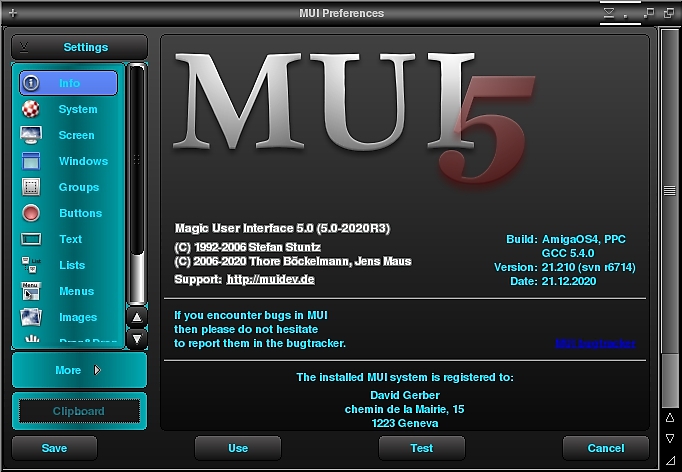
Besides original Workbench (Commodore's desktop environment/graphical filemanager), AmiKit provides Directory Opus Magellan and Scalos as desktop replacements and its "Rabbit Hole" feature allows you to launch Windows, Mac or Linux applications directly from your Amiga desktop! Anti-aliased fonts, Full HD 32-bit screen modes and DualPNG Icons support is included and this package comes with exclusive versions of the Master Control Program (MCP) and MUI 5 (Magic User Interface).

The original AmigaOS (version 3.x) and Kickstart ROM (version 3.1) are required, also the recently released AmigaOS 3.2 is supported. You can also get the needed files from the Amiga Forever package(s). It even supports emulating AmigaOS 4.x (for PowerPC) easily through Flower Pot.

Here's an extensive overview video by Dan Wood. An Amiga Future review of an earlier 2017 version can be read here.

"Everything began in 1994 when my parents bought an Amiga 500 for me and my brother," explains AmiKit's developer.

"I was 14 years old..." Fast forward to 2005, the AmiKit was born — an emulated environment including more than 350 programs. It fully replaced my old Amiga and it became a legend in the community over the years.

Fast forward to 2017, a brand new AmiKit X is released, originally developed for A.L.I.C.E., followed by the XE version released in 2019, Vampire edition in 2020 and Raspberry Pi in 2021. The latest & greatest version was released in 2020.

When someone, who has never heard about Amiga before, asks me why I would want to turn current modern computer into something retro and old fashioned, my short answer is: "Simply because I love Amiga!"

Programming

Should IT Professionals Be Liable for Ransomware Attacks? (acm.org) 250

Denmark-based Poul-Henning Kamp describes himself as the "author of a lot of FreeBSD, most of Varnish and tons of other Open Source Software." And he shares this message in June's Communications of the ACM.

"The software industry is still the problem." If any science fiction author, famous or obscure, had submitted a story where the plot was "modern IT is a bunch of crap that organized crime exploits for extortion," it would have gotten nowhere, because (A) that is just not credible, and (B) yawn!

And yet, here we are.... As I write this, 200-plus corporations, including many retail chains, have inoperative IT because extortionists found a hole in some niche, third-party software product most of us have never heard of.

But he's also proposing a solution. In Denmark, 129 jobs are regulated by law. There are good and obvious reasons why it is illegal for any random Ken, Brian, or Dennis to install toilets or natural-gas furnaces, perform brain surgery, or certify a building is strong enough to be left outside during winter. It may be less obvious why the state cares who runs pet shops, inseminates cattle, or performs zoological taxidermy, but if you read the applicable laws, you will learn that animal welfare and protection of endangered species have many and obscure corner cases.

Notably absent, as in totally absent, on that list are any and all jobs related to IT; IT architecture, computers, computer networks, computer security, or protection of privacy in computer systems. People who have been legally barred and delicensed from every other possible trade — be it for incompetence, fraud, or both — are entirely free to enter the IT profession and become responsible for the IT architecture or cybersecurity of the IT system that controls nearly half the hydrocarbons to the Eastern Seaboard of the U.S....

With respect to gas, water, electricity, sewers, or building stability, the regulations do not care if a company is hundreds of years old or just started this morning, the rules are always the same: Stuff should just work, and only people who are licensed — because they know how to — are allowed to make it work, and they can be sued if they fail to do so.

The time is way overdue for IT engineers to be subject to professional liability, like almost every other engineering profession. Before you tell me that is impossible, please study how the very same thing happened with electricity, planes, cranes, trains, ships, automobiles, lifts, food processing, buildings, and, for that matter, driving a car.

As with software product liability, the astute reader is apt to exclaim, "This will be the end of IT as we know it!" Again, my considered response is, "Yes, please, that is precisely my point!"

Linux

Newest Version of Systemd Includes Experimental Feature for A/B-Style Updating (theregister.com) 182

"Let's popularize image-based OSes," writes Lennart Poettering, "with modernized security properties built around immutability, SecureBoot, TPM2, adaptability, auto-updating, factory reset, uniformity — built from traditional distribution packages, but deployed via images."

Or, as the Register puts it, the Systemd Linux init system "continues to grow and develop, as does Linux itself." They delve into the rationale for the new systemd-sysupdate and kernel-install features, noting "The former is still described as an experimental feature, so relax — for now." No, this does not mean that systemd is becoming a package manager. Like it or not, though, the nature of operating systems is changing. Modern ones are large, complex, and need regular updates, and as The Register has examined in depth recently, this means that the design of Linux distributions is changing radically....

ChromeOS doesn't have a package manager; neither do Fedora's Silverblue and Kinoite versions. You get a tested, known-good image of the OS. Updates are distributed as a complete image, like they are today with Android or iOS. ChromeOS has two root partitions: one live and one spare. The currently running OS updates the spare partition, then you reboot into that one. If everything works, it updates the now-idle second root partition. If it doesn't all work perfectly, then you still have the previous version available to use, and you can just reboot into that again. When a fixed image becomes available, the OS automatically tries again on the spare instance.

The idea is that you always have a known-good OS partition available, which sounds like a benefit to us. Presumably the users are happy too: Chromebook sales may be down, and they only have a fixed lifespan, but there are still well over a hundred million of them out there.

So, no, systemd is not going to become a package manager, because ordinary distros won't have a package manager at all, except maybe Flatpak, or Snap or something similar. The new functionality, including managing installed kernels, is to facilitate A/B type dual-live-system partitions.

For some insight into this vision, Lennart Poettering, lead architect of systemd, has described this in a blog post titled "Bringing Everything Together."

Other updates include "changes to systemd-networkd, such as systemd-resolved starting earlier in the boot sequence, and more cautious allocation of default routes," the article points out, adding that new releases of systemd "ppear roughly twice a year, so the chances are that this will appear in the fall releases of Ubuntu and Fedora...

"If you still prefer to avoid systemd, don't despair. There are still a selection of distros that eschew it altogether, including Devuan GNU+Linux, Alpine Linux, and Void Linux.
Security

Omnipotent BMCs From Quanta Remain Vulnerable To Critical Pantsdown Threat (arstechnica.com) 14

"Quanta not patching vulnerable baseboard management controllers leaves data centers vulnerable," writes long-time Slashdot reader couchslug. "Pantsdown was disclosed in 2019..." Ars Technica reports: In January 2019, a researcher disclosed a devastating vulnerability in one of the most powerful and sensitive devices embedded into modern servers and workstations. With a severity rating of 9.8 out of 10, the vulnerability affected a wide range of baseboard management controllers (BMC) made by multiple manufacturers. These tiny computers soldered into the motherboard of servers allow cloud centers, and sometimes their customers, to streamline the remote management of vast fleets of computers. They enable administrators to remotely reinstall OSes, install and uninstall apps, and control just about every other aspect of the system -- even when it's turned off. Pantsdown, as the researcher dubbed the threat, allowed anyone who already had some access to the server an extraordinary opportunity. Exploiting the arbitrary read/write flaw, the hacker could become a super admin who persistently had the highest level of control for an entire data center.

Over the next few months, multiple BMC vendors issued patches and advisories that told customers why patching the vulnerability was critical. Now, researchers from security firm Eclypsium reported a disturbing finding: for reasons that remain unanswered, a widely used BMC from data center solutions provider Quanta Cloud Technology, better known as QCT, remained unpatched against the vulnerability as recently as last month. As if QCT's inaction wasn't enough, the company's current posture also remains baffling. After Eclypsium privately reported its findings to QCT, the solutions company responded that it had finally fixed the vulnerability. But rather than publish an advisory and make a patch public -- as just about every company does when fixing a critical vulnerability -- it told Eclypsium it was providing updates privately on a customer-by-customer basis. As this post was about to go live, "CVE-2019-6260," the industry's designation to track the vulnerability, didn't appear on QCT's website. [...]
"[T]hese types of attacks have remained possible on BMCs that were using firmware QCT provided as recently as last month," writes Ars' Dan Goodin in closing. "QCT's decision not to publish a patched version of its firmware or even an advisory, coupled with the radio silence with reporters asking legitimate questions, should be a red flag. Data centers or data center customers working with this company's BMCs should verify their firmware's integrity or contact QCT's support team for more information."
Businesses

Broadcom To Acquire VMware in Massive $61 Billion Deal (techcrunch.com) 50

Broadcom has announced it is acquiring VMware in a massive $61 billion deal. From a report: The deal is a combination of cash and stock, with Broadcom assuming $8 billion in VMware debt. With VMware, Broadcom gets more than the core virtualization, which the company was built on. It also gets other pieces it acquired along the way to diversify, like Heptio for containerization, and Pivotal, which helps provide support services for companies transitioning to modern technology. At the same time it bought Pivotal, it also acquired security company Carbon Black. That touches upon a lot of technology, but it begs the question, where does it all fit with Broadcom (which has spent a fair amount of money in recent years buying up a couple of key software pieces prior to today's announcement)?
Power

US Moves Toward Supplying Romania With a Modular, Low-Cost Nuclear Plant (nytimes.com) 139

tomhath shares a report from The New York Times: The United States said on Monday that it would supply Romania with a training simulator in preparation for building a new type of nuclear power generating plant in the country. If an agreement on moving ahead with a power station is reached, Romania could become the first country in Europe, and perhaps in the world, to have such a plant, known as a small modular reactor.

The one in Romania would be built by NuScale Power, a start-up company based in Portland, Ore. The government announced that the plant would be built in Doicesti, at the site of a shuttered coal-fired power plant about 55 miles northwest of Bucharest. [...] NuScale's approach to nuclear energy involves constructing relatively small reactors in factories and then assembling groups of them at the actual site for generating power. The aim is to reduce costs as well as the time required for construction. Conventional modern nuclear plants can cost $10 billion or more.

The plan involves building a power station composed of six of the modular units. The plant would generate 462 megawatts of electricity, making it the size of a medium-size conventional power station. Such a plant might cost around $1.6 billion, according to figures published by the U.S. Embassy in Bucharest. The hope is to have it operating by the end of the decade.

EU

Spain To Invest $13 Billion To Build Microchip Industry (apnews.com) 34

The Spanish government on Tuesday announced plans to invest $13.2 billion to build microchips in the country and "help reduce the dependence of Span and the European Union on other suppliers," reports the Associated Press. From the report: Speaking in Madrid, Deputy Prime Minister and Economy Minister Nadia Calvino said the five-year plan is aimed at enabling Spain to cover every area in the design and production of microchips, which are now considered key to all areas of modern industry. She said the plan was among the most ambitious of the Spanish government's projects to reboot the economy after the COVID-19 pandemic and that it would have an effect on other sectors.

The project was directed at boosting the EU's weak position in microchip production, which Calvino said represented some 10% of the world total. She said this led to a great dependence on a small number of major producers such as Taiwan, the United States, South Korea, Japan and China. Calvino added that "the war in Ukraine makes it a priority to reinforce strategic autonomy in energy, technology, food production as well as cyber security."

Microsoft

Microsoft Launches Power Pages for Designing Business Websites (techcrunch.com) 25

Riding the wave of enthusiasm for no-code/low-code solutions, Microsoft today announced Power Pages, a standalone product within the company's Power Platform portfolio for creating business websites. Power Pages previously existed as a component within Power Apps called Power Apps portals, but it's been broken out and redesigned with a new user experience. From a report: "As a new, standalone product, Power Pages empowers anyone, regardless of their technical background, with an effective platform to create data-powered, modern, and secure websites," Sangya Singh, vice president of power portals at Microsoft, said in a blog post. "In addition to being low-code, Power Pages extends far beyond portals former capabilities to enable organizations of any size to securely build websites with exciting new aesthetic features and advanced capabilities for customization with pro-dev extensibility."

There's no shortage of web design startups on the market. But Microsoft is touting Power Pages' integrations with its existing services as the key differentiator. For example, Power Pages ties in with Visual Studio Code, GitHub, the Power Platform command line interface and Azure DevOps to let more advanced users automate development workflows (e.g. by downloading and uploading projects) and leverage CI/CD practices. Power Pages also allows users to implement role-based access controls and web app firewalls via Azure, and to collect and share business info with site visitors via Microsoft's Dataverse platform.

Space

New Calculations of Solar Spectrum Resolve Decade-Long Controversy About the Sun's Chemical Composition (phys.org) 18

Researchers from the University of Gottingen have published new calculations of the physics of the sun's atmosphere that resolve the apparent contradiction between the modern standard model of solar evolution and the "tried-and-true" method called spectral analysis. "The new calculations of the physics of the sun's atmosphere yield updated results for abundances of different chemical elements, which resolve the conflict," reports Phys.Org. "Notably, the sun contains more oxygen, silicon and neon than previously thought. The methods employed also promise considerably more accurate estimates of the chemical compositions of stars in general." From the report: Highly accurate helioseismic measurements gave results about the sun's interior structure that were at odds with the solar standard models. According to helioseismology, the so-called convective region within our sun where matter rises and sinks down again, like water in a boiling pot, was considerably larger than the standard model predicted. The speed of sound waves near the bottom of that region also deviated from the standard model's predictions, as did the overall amount of helium in the sun. To top it off, certain measurements of solar neutrinos -- fleeting elementary particles, hard to detect, reaching us directly from the sun's core regions -- were slightly off compared to experimental data, as well. Astronomers had what they soon came to call a "solar abundances crisis," and in search of a way out, some proposals ranged from the unusual to the downright exotic. Did the sun maybe accrete some metal-poor gas during its planet-forming phase? Is energy being transported by the notoriously non-interacting dark matter particles?

The newly published study by Ekaterina Magg, Maria Bergemann and colleagues has managed to resolve that crisis, by revisiting the models on which the spectral estimates of the sun's chemical composition are based. [...] In this study they tracked all chemical elements that are relevant to the current models of how stars evolved over time, and applied multiple independent methods to describe the interactions between the sun's atoms and its radiation field in order to make sure their results were consistent. For describing the convective regions of our sun, they used existing simulations that take into account both the motion of the plasma and the physics of radiation ("STAGGER" and "CO5BOLD"). For the comparison with spectral measurements, they chose the data set with the highest available quality: the solar spectrum published by the Institute for Astro- and Geophysics, University of GÃttingen. "We also extensively focused on the analysis of statistical and systematic effects that could limit the accuracy of out results," notes Magg. The new calculations showed that the relationship between the abundances of these crucial chemical elements and the strength of the corresponding spectral lines was significantly different from what previous authors had claimed. Consequently, the chemical abundances that follow from the observed solar spectrum are somewhat different than stated in previous analysis.

"We found, that according to our analysis the sun contains 26% more elements heavier than helium than previous studies had deduced," explains Magg. In astronomy, such elements heavier than helium are called "metals." Only on the order of a thousandth of a percent of all atomic nuclei in the sun are metals; it is this very small number that has now changed by 26% of its previous value. Magg adds: "The value for the oxygen abundance was almost 15% higher than in previous studies." The new values are, however, in good agreement with the chemical composition of primitive meteorites ("CI chondrites") that are thought to represent the chemical make-up of the very early solar system. When those new values are used as the input for current models of solar structure and evolution, the puzzling discrepancy between the results of those models and helioseismic measurements disappears.

Programming

What Made Golang Become Popular? Its Creators Look Back (acm.org) 52

Created at Google in late 2007, the Go programming language was open sourced in late 2009, remember its creators, and "since then, it has operated as a public project, with contributions from thousands of individuals and dozens of companies."

In a joint essay in Communications of the ACM, five of the language's five original creators explore what brought growing popularity to this "garbage-collected, statically compiled language for building systems" (with its self-contained binaries and easy cross-compilation). "The most important decisions made in the language's design...were the ones that made Go better for large-scale software engineering and helped us attract like-minded developers...." Although the design of most languages concentrates on innovations in syntax, semantics, or typing, Go is focused on the software development process itself. Go is efficient, easy to learn, and freely available, but we believe that what made it successful was the approach it took toward writing programs, particularly with multiple programmers working on a shared codebase. The principal unusual property of the language itself — concurrency — addressed problems that arose with the proliferation of multicore CPUs in the 2010s. But more significant was the early work that established fundamentals for packaging, dependencies, build, test, deployment, and other workaday tasks of the software development world, aspects that are not usually foremost in language design.

These ideas attracted like-minded developers who valued the result: easy concurrency, clear dependencies, scalable development and production, secure programs, simple deployment, automatic code formatting, tool-aided development, and more. Those early developers helped popularize Go and seeded the initial Go package ecosystem. They also drove the early growth of the language by, for example, porting the compiler and libraries to Windows and other operating systems (the original release supported only Linux and MacOS X). Not everyone was a fan — for instance, some people objected to the way the language omitted common features such as inheritance and generic types. But Go's development-focused philosophy was intriguing and effective enough that the community thrived while maintaining the core principles that drove Go's existence in the first place. Thanks in large part to that community and the technology it has built, Go is now a significant component of the modern cloud computing environment.

Since Go version 1 was released, the language has been all but frozen. The tooling, however, has expanded dramatically, with better compilers, more powerful build and testing tools, and improved dependency management, not to mention a huge collection of open source tools that support Go. Still, change is coming: Go 1.18, released in March 2022, includes the first version of a true change to the language, one that has been widely requested — the first cut at parametric polymorphism.... We considered a handful of designs during Go's first decade but only recently found one that we feel fits Go well. Making such a large language change while staying true to the principles of consistency, completeness, and community will be a severe test of the approach.

Upgrades

Hollywood Designer 6.0 Released: Now a 'Full-Blown Multimedia Authoring System' (amigans.net) 20

After nearly 20 years, Hollywood Designer 6.0 is "very stable and mature", write its developers — envisioning both hobbyist and professional users (with its support for modern graphics-editing features like filter effects and vector graphics) in its massive new evolution.

Long-time Slashdot reader Mike Bouma explains: Airsoft Softwair has released Hollywood Designer 6.0, "a full-blown multimedia authoring system that runs on top of Hollywood and can be used to create all sorts of multimedia-based applications, for example presentations, slide shows, games, and applications. Thanks to Hollywood, all multimedia applications created using Hollywood Designer can be exported as stand-alone executables for the following systems: AmigaOS3, AmigaOS4, WarpOS, MorphOS, AROS, Windows, macOS, Linux, Android, and iOS."

The current version of Hollywood is v9.1 with various updated add-ons. To see earlier versions of Hollywood 9.0 & Designer 5.0 in action have a look at Kas1e's short demonstration on AmigaOS4 / AmigaOne X5000.

Social Networks

Is Social Media Training Us to Please a Machine? (damagemag.com) 69

A remarkably literary critique of the internet appeared recently in Damage magazine — a project of the nonprofit Society for Psychoanalytic Inquiry funded by the American Psychoanalytic Foundation. "There are ways in which the internet really does seem to work like a possessing demon..." argues writer Sam Kriss.

"We tend to think that the internet is a communications network we use to speak to one another — but in a sense, we're not doing anything of the sort. Instead, we are the ones being spoken through." Teens on TikTok all talk in the exact same tone, identical singsong smugness. Millennials on Twitter use the same shrinking vocabulary. My guy! Having a normal one! Even when you actually meet them in the sunlit world, they'll say valid or based, or say y'all despite being British....

Everything you say online is subject to an instant system of rewards. Every platform comes with metrics; you can precisely quantify how well-received your thoughts are by how many likes or shares or retweets they receive. For almost everyone, the game is difficult to resist: they end up trying to say the things that the machine will like. For all the panic over online censorship, this stuff is far more destructive. You have no free speech — not because someone might ban your account, but because there's a vast incentive structure in place that constantly channels your speech in certain directions. And unlike overt censorship, it's not a policy that could ever be changed, but a pure function of the connectivity of the internet itself. This might be why so much writing that comes out of the internet is so unbearably dull, cycling between outrage and mockery, begging for clicks, speaking the machine back into its own bowels....

The internet is not a communications system. Instead of delivering messages between people, it simulates the experience of being among people, in a way that books or shopping lists or even the telephone do not. And there are things that a simulation will always fail to capture. In the philosophy of Emmanuel Lévinas, your ethical responsibility to other people emerges out of their face, the experience of looking directly into the face of another living subject. "The face is what prohibits us from killing...." But Facebook is a world without faces. Only images of faces; selfies, avatars: dead things. Or the moving image in a FaceTime chat: a haunted puppet. There is always something in the way. You are not talking to a person: the machine is talking, through you, to itself.

As more and more of your social life takes place online, you're training yourself to believe that other people are not really people, and you have no duty towards them whatsoever. These effects don't vanish once you look away from the screen.... many of the big conflicts within institutions in the last few years seem to be rooted in the expectation that the world should work like the internet. If you don't like a person, you should be able to block them: simply push a button, and have them disappear forever.

The article revisits a 2011 meta-analysis that found massive declines in young people's capacity for empathy, which the authors directly associated with the spread of social media. But then Kriss argues that "We are becoming less and less capable of actual intersubjective communication; more unhappy; more alone. Every year, surveys find that people have fewer and fewer friends; among millennials, 22% say they have none at all.

"For the first time in history, we can simply do without each other entirely. The machine supplies an approximation of everything you need for a bare biological existence: strangers come to deliver your food; AI chatbots deliver cognitive-behavioral therapy; social media simulates people to love and people to hate; and hidden inside the microcircuitry, the demons swarm..."

So while recent books look for historical antecedents, "I still think that the internet is a serious break from what we had before," Kriss argues. "And as nice as Wikipedia is, as nice as it is to be able to walk around foreign cities on Google Maps or read early modern grimoires without a library card, I still think the internet is a poison."
Amiga

How to Write Your Own Games - for the Amiga 35

Mike Bouma (Slashdot reader #85,252) writes: With the release of the A500 mini (which also supports A1200 games) and its side loading feature you may be interested to get started with Amiga Retro games development. This is why I collected some recent Amiga games development tutorials and added some additional information.

A popular game programming language on the Amiga is Blitz BASIC or AmiBlitz as the freely available and open source version is called now. The latest version (v 3.9.2) was recently released. The best known game developed with Blitz Basic is Team 17's original Worms game for the Amiga 500 in 1995. Meanwhile the Worms franchise has sold over 75 million game units across many different platforms. Daedalus2097 has just started an AmiBlitz video tutorial series on Twitch.tv: Part 1, Part 2 and Part 3. An example AmiBlitz game currently under development is Super Metal Hero (A1200) and here's a shooter level in the game.

REDPILL is a 2D game creation tool written in AmiBlitz by Carlos Peris and is designed to empower people to create many games for Amiga without programming knowledge. It's still early days but the first games are already being designed using this tool. An example game designed with this tool is Guardian — The legend of flaming sword.

The "Scorpion Engine" developed by Erik 'Earok' Hogan is a closed source game engine with all software developed for it open source. It offers a modern Windows IDE for development. In this video, Erik Hogan guides Micheal Parent from Bitbeam Cannon step by step as they create a legit retro video game from scratch. Various new games have and are being developed using this engine. An already released game is Amigo the Fox and an example game under development is Rick Dangerous (A1200 version).

If you want to dig deeper into Amiga coding then here's a series of Assembly game development tutorials by Phaze101. An example game currently being written in assembler is RESHOOT PROXIMA 3 (A1200).

If you are unexperienced with coding but would like to then here are some Amos (BASIC) tutorials for you: Rob Smith's How to program Wordle in AMOS on the AMIGA and Lets Code Santa's Present Drop Game.
Linux

CentOS Successor Rocky Linux Gets $26M to Fund Push Into Enterprise Space (zdnet.com) 27

"CIQ has landed $26 million in funding to support its plans to expand the use of Rocky Linux in the enterprise space," reports ZDNet. Last year, Red Hat decided to stop supporting CentOS 8 and shifted focus to CentOS Stream. CentOS had some huge enterprise users, among them Disney, GoDaddy, RackSpace, Toyota, and Verizon. In response, Greg Kurtzer, one of CentOS's founders, kicked off Rocky Linux in December 2020.... Kurtzer says Rocky Linux adoption has been "massive", with monthly downloads of OS images typically 250,000, reaching 750,000 in a bumper month. "Within two months we had 10,000 developer and contributors trying to be part of this project...."

The project has gained the support of Greg Kroah-Hartman, the maintainer of the main-line stable Linux kernel, to meet community demands for Rocky Linux to run on a more modern, optimized kernel, Kurtzer said. Kroah-Hartman is leading Rocky Linux special interest group (SIG) for the kernel to create an optional enhanced kernel for Rocky Linux. "He's working closely with us to make sure the kernel we use is blessed by him. He's in the loop as bugs come up and help us manage that kernel in Rocky Linux," says Kurtzer.

"Moreover, today's news follows shortly after CIQ inked a major deal with Google to help support companies looking to deploy Rocky Linux on Google's cloud infrastructure," reports VentureBeat.

Kurtzer tells the site that Rocky Linux "has been a rocket ship in terms of uptake across the enterprise and cloud."
Businesses

'It's 2022, Phones Should Be Built To Last Five Years or More' 215

Robert Triggs, writing for AndroidAuthority: In 2022, there's now a multifaceted argument in favor of a new approach to smartphone manufacturing. One which focuses on long-term support for both hardware and software. Core to this line of thinking is that smartphone hardware has hit a plateau. From the mid-range to flagships, hardware is now more than powerful enough to last several years without going obsolete. The days of rampant year-on-year improvements are long gone, whether you're looking at bleeding-edge performance, cameras, or battery life. This isn't to say we don't yearn for those yearly gains, but they no longer suddenly mark older models for obsolescence even if they materialize. As such, modern smartphones deserve long-term software support above and beyond semi-annual security patches.

Not to mention the increasingly compelling sustainability and right-to-repair arguments regarding raw materials and e-waste. It's increasingly hard to justify the production of throwaway electronics built to last just a handful of years. Simultaneously, sky-high prices and a squeeze in the cost of living have cast new light on the need for easier access to repair programs and spare parts. Not forgetting the popularity of refurbished handsets. Long-term support doesn't have to be an unprofitable venture for smartphone manufacturers either. Official repair channels bring in revenue over time, and it's possible to factor long-term support into the retail price of a handset. Then there's the whole avenue of hardware-as-a-service to explore.
Medicine

Deadly Venom From Spiders and Snakes May Cure What Ails You (nytimes.com) 37

Efforts to tease apart the vast swarm of proteins in venom -- a field called venomics -- have burgeoned in recent years, leading to important drug discoveries. From a report: In a small room in a building at the Arizona-Sonora Desert Museum, the invertebrate keeper, Emma Califf, lifts up a rock in a plastic box. "This is one of our desert hairies," she said, exposing a three-inch-long scorpion, its tail arced over its back. "The largest scorpion in North America." This captive hairy, along with a swarm of inch-long bark scorpions in another box, and two dozen rattlesnakes of varying species and sub- species across the hall, are kept here for the coin of the realm: their venom. Efforts to tease apart the vast swarm of proteins in venom -- a field called venomics -- have burgeoned in recent years, and the growing catalog of compounds has led to a number of drug discoveries. As the components of these natural toxins continue to be assayed by evolving technologies, the number of promising molecules is also growing.

"A century ago we thought venom had three or four components, and now we know just one type of venom can have thousands," said Leslie V. Boyer, a professor emeritus of pathology at the University of Arizona. "Things are accelerating because a small number of very good laboratories have been pumping out information that everyone else can now use to make discoveries." She added, "There's a pharmacopoeia out there waiting to be explored." It is a striking case of modern-day scientific alchemy: The most highly evolved of natural poisons on the planet are creating a number of effective medicines with the potential for many more.

One of the most promising venom-derived drugs to date comes from the deadly Fraser Island funnel web spider of Australia, which halts cell death after a heart attack. Blood flow to the heart is reduced after a heart attack, which makes the cell environment more acidic and leads to cell death. The drug, a protein called Hi1A, is scheduled for clinical trials next year. In the lab, it was tested on the cells of beating human hearts. It was found to block their ability to sense acid, "so the death message is blocked, cell death is reduced, and we see improved heart cell survival," said Nathan Palpant, a researcher at the University of Queensland in Australia who helped make the discovery.

Slashdot Top Deals