Wireless Networking

T-Mobile Says It Will Launch Nationwide 5G Network In Three Years (cnet.com) 59

T-Mobile announced today its plans for launching a "true" nationwide LTE beginning in 2019, with a complete rollout by 2020. From a report: The nation's third-largest carrier on Tuesday unveiled plans to build out its next-generation wireless network using the radio airwaves it just purchased in a government auction. The focus for its 5G network isn't necessarily speed, but instead broader coverage across the country. It's a surprising move given those airwaves operate on a lower band, which is great for covering long distances but won't give you tremendous speeds. The move goes against the conventional thinking about 5G, which has spurred excitement because of its ability to give you a seemingly supersonic connection to the network. Instead, T-Mobile is stressing a better signal everywhere and the ability to manage multiple devices beyond the phone.
Privacy

Virgin Media Starts Turning Customer Routers Into Public Wi-Fi Hotspots (arstechnica.co.uk) 149

UK ISP Virgin Media is expanding its public Wi-Fi network by co-opting customers' home routers as hotspots. Only the most recent router design (the SuperHub v3) will be recruited at first, and customers can opt-out from the program if they wish. Virgin says the change will have "no impact on customers" because affected homes will be allocated extra bandwidth. ArsTechnica offers more context: A little background: a couple of years ago, Virgin Media started trialling a public Wi-Fi service very similar to "BT Wi-Fi with FON," where residential BT customers have their routers turned into hotspots. For some reason the broad rollout of Virgin's service was delayed until now. There are some curious differences between BT and Virgin Media's approach, though. For starters, it seems only Virgin Media customers will have access to this nationwide Wi-Fi network; BT grants free access to BT customers, but non-customers can pay for access ($5 per hour). The owner of that subverted hotspot doesn't get any of the money, of course. Furthermore, while BT customers must share their ADSL or VDSL bandwidth with any public Wi-Fi users, Virgin Media promises that "your home network is completely separate from Virgin Media WiFi traffic, meaning the broadband connection you pay for is exclusively yours, and just as secure."
Communications

Apple Investigating Issue With AirPods Randomly Disconnecting During Calls (macrumors.com) 128

According to MacRumors, Apple is investigating multiple reports from iPhone owners of AirPods randomly disconnecting and reconnecting during calls. While the issue doesn't appear to be widespread, it appears to be a big enough problem to attract Apple's attention. One of the main reasons why the AirPods were so late to the market was because Apple needed more time to ensure the earpieces had reliable connectivity. Specifically, they were delayed to ensure both earpieces receive audio at the same time. MacRumors reports: A MacRumors forum thread and a long thread on Apple's Support Communities website have been generated by AirPods users who are regularly experiencing Bluetooth connection dropouts during phone calls, despite the fact that the wireless earphones almost never lose their connection when used to listen to music or anything else. MacRumors forum member protobiont wrote: "I've had this happen on two phone calls today. I am talking and suddenly the audio switches to the phone, I hear the Airpod connect tones and the audio switches back. This will repeat itself a few times, which is quite distracting during a phone call." At present, the issue appears to be limited to iPhone 6s and iPhone 6s Plus devices, with several users reporting no such problems after upgrading to an iPhone 7. MacRumors was also unable to replicate the problem on Apple's latest handset. Initial reports suggested the dropout issue only occurs if users also have an Apple Watch paired to their iPhone, but MacRumors was able to replicate the problem with a Fitbit Blaze, suggesting a more general conflict when other Bluetooth devices are also connected. Unpairing and then repairing the AirPods does not appear to solve the problem, neither does rebooting nor resetting the iPhone. Until Apple offers a solution, users are advised to use only one AirPod for conducting calls, as the dropouts only seem to occur when both earpieces are in use.
Communications

The Farmer Who Built Her Own Broadband (bbc.com) 157

An anonymous reader writes from a BBC article: "I'm just a farmer's wife," says Christine Conder, modestly. But for 2,300 members of the rural communities of Lancashire she is also a revolutionary internet pioneer. Her DIY solution to a neighbour's internet connectivity problems in 2009 has evolved into B4RN, an internet service provider offering fast one gigabit per second broadband speeds to the parishes which nestle in the picturesque Lune Valley. That is 35 times faster than the 28.9 Mbps average UK speed internet connection according to Ofcom. It all began when the trees which separated Chris's neighbouring farm from its nearest wireless mast -- their only connection to the internet, provided by Lancaster University -- grew too tall. Something more robust was required, and no alternatives were available in the area, so Chris decided to take matters into her own hands. She purchased a kilometre of fibre-optic cable and commandeered her farm tractor to dig a trench. After lighting the cable, the two farms were connected, with hers feeding the one behind the trees. "We dug it ourselves and we lit [the cable] ourselves and we proved that ordinary people could do it," she says. "It wasn't rocket science. It was three days of hard work."
Social Networks

Facebook's Latest Experiment: Helping You Find Free Wi-Fi Hotspots (macworld.com) 32

Users of the social network's iOS app report seeing a new feature in the More section that lets them find nearby public Wi-Fi access points. From a MacWorld story: The feature does not appear to be widely available at the moment, which means this is probably something Facebook is only testing. The social network tests numerous features all the time but this one is particularly notable. Helping users find public Wi-Fi could enable more people to use Facebook Live. If your cellular connection isn't strong, a nearby Wi-Fi location can be a big help -- unless, of course, your Facebook Live broadcast is dependent on your specific location. There could be other uses for finding Wi-Fi beyond live video broadcasts. If you're desperate to upload a photo or recorded video, then locating the closest public Wi-Fi point helps. On top of that it's just one more reason to open the Facebook app, which Facebook obviously wants to encourage as much as possible. Check where the nearest Wi-Fi hotspot is, see that unread notifications indicator at the top of the screen, and before you know it you're engrossed in the news feed.
Communications

T-Mobile Fined $48 Million By FCC For Mischaracterizing 'Unlimited' Plan and Throttling Users' Data (bloomberg.com) 151

T-Mobile will have to pay $48 million in fines after reaching a settlement with the FCC over the way it promoted its unlimited data plans. T-Mobile's unlimited data plans don't charge you for going over a certain data limit, but the carrier can slow down connection speeds after you reach a certain threshold. From a Bloomberg report: The Federal Communications Commission on Wednesday announced the settlement, including a $7.5 million fine and $35.5 million worth of discounted gear or data for customers of third-largest U.S. wireless carrier T-Mobile and its MetroPCS unit. An investigation found that company policy allows T-Mobile to decrease data speeds when customers on plans sold as unlimited exceed a monthly data threshold, the FCC said in a news release. The agency heard from hundreds of "unhappy" customers who complained of slow speeds and said they weren't receiving what they were sold, according to the news release.
Android

Taking the Headphone Jack Off Phones Is User-Hostile and Stupid (theverge.com) 595

A WSJ report on Tuesday claimed that the next iPhone won't have the 3.5mm headphone port. A handful of smartphones such as LeEco's Le 2, Le 2 Pro, and Le Max 2 that have launched this year already don't have a headphone jack. The Verge's Nilay Patel has an opinion piece in which he argues that smartphone companies shouldn't ditch headphone ports as it helps no consumer. He lists six reasons:
1. Digital audio means DRM audio :Restricting audio output to a purely digital connection means that music publishers and streaming companies can start to insist on digital copyright enforcement mechanisms. We moved our video systems to HDMI and got HDCP, remember? Copyright enforcement technology never stops piracy and always hurts the people who most rely on legal fair use, but you can bet the music industry is going to start cracking down on "unauthorized" playback and recording devices anyway.2. Wireless headphones and speakers are fine, not great.
3. Dongles are stupid, especially when they require other dongles.
4. Ditching a deeply established standard will disproportionately impact accessibility.:The headphone jack might be less good on some metrics than Lightning or USB-C audio, but it is spectacularly better than anything else in the world at being accessible, enabling, open, and democratizing. A change that will cost every iPhone user at least $29 extra for a dongle (or more for new headphones) is not a change designed to benefit everyone.5. Making Android and iPhone headphones incompatible is incredibly arrogant and stupid.
6. No one is asking for this.
Software

Ubuntu Phones To Feature Wireless Display Support With OTA-11 Update (softpedia.com) 31

prisoninmate writes from a report via Softpedia: The moment you've all been waiting for is almost here, as you will no longer need a cable to connect your Ubuntu Phone to your TV or a supported LCD monitor. Canonical will soon release the OTA-11 software update to supported Ubuntu Phone devices implementing the Aethercast (also known as Miracast or Display Casting) technology that provides Wireless display support to Ubuntu Phone devices, but only for Meizu PRO 5, which comes with out-of-the-box wireless display functionality. Some other features of the OTA-11 update include: the adoption of the NetworkManager 1.2 network connection manager, an updated VPN feature with username and password authentication support, a pre-loaded Home Scope which will allow for a faster startup, multiple application windows, and subtitles in the header. In addition, the positioning in location service has been greatly improved, Dynamic Grid Unit (DGU) support is now available, and many bugs have been fixed (squashed). You can view a list of the devices that support the OTA-11 update here.

UPDATE 5/31/16: The report has been updated to clarify that the Meizu PRO 5 is the only device that supports wireless display functionality out-of-the-box.
Encryption

Millions Of Waze Users Can Have Their Movements Tracked By Hackers (fusion.net) 55

An anonymous reader quotes a report from Fusion: Researchers at the University of California-Santa Barbara recently discovered a Waze vulnerability that allowed them to create thousands of "ghost drivers" that can monitor the drivers around them -- an exploit that could be used to track Waze users in real-time. Here's how the exploit works. Waze's servers communicate with phones using an SSL encrypted connection, a security precaution meant to ensure that Waze's computers are really talking to a Waze app on someone's smartphone. Zhao and his graduate students discovered they could intercept that communication by getting the phone to accept their own computer as a go-between in the connection. Once in between the phone and the Waze servers, they could reverse-engineer the Waze protocol, learning the language that the Waze app uses to talk to Waze's back-end app servers. With that knowledge in hand, the team was able to write a program that issued commands directly to Waze servers, allowing the researchers to populate the Waze system with thousands of "ghost cars" -- cars that could cause a fake traffic jam or, because Waze is a social app where drivers broadcast their locations, monitor all the drivers around them. You can read the full paper detailing the researchers' findings here. Is there a solution to not being tracked? Yes. If you're a Waze user, you can set the app to invisible mode. However, Waze turns off invisible mode every time you restart the app so beware.
Power

Radio Attack Lets Hackers Steal 24 Different Car Models (wired.com) 228

An anonymous reader writes from a Wired article: A group of German vehicle security researchers has released new findings about the extent of a wireless key hack, and their work ought to convince hundreds of thousands of drivers to keep their car keys next to their Pudding Pops. The Munich-based automobile club ADAC recently made public a study it had performed on dozens of cars to test a radio 'amplification attack' that silently extends the range of unwitting drivers' wireless key fobs to open cars and even start their ignitions (in German). The ADAC researchers say that 24 different vehicles from 19 different manufacturers were all vulnerable, allowing them to not only reliably unlock the target vehicles but also immediately drive them away. "This clear vulnerability in [wireless] keys facilitates the work of thieves immensely," reads the post. "The radio connection between keys and car can easily be extended over several hundred meters, regardless of whether the original key is, for example, at home or in the pocket of the owner." [...] Here's the full list of vulnerable vehicles from their findings, which focused on European models: the Audi A3, A4 and A6, BMW's 730d, Citroen's DS4 CrossBack, Ford's Galaxy and Eco-Sport, Honda's HR-V, Hyundai's Santa Fe CRDi, KIA's Optima, Lexus's RX 450h, Mazda's CX-5, MINI's Clubman, Mitsubishi's Outlander, Nissan's Qashqai and Leaf, Opel's Ampera, Range Rover's Evoque, Renault's Traffic, Ssangyong's Tivoli XDi, Subaru's Levorg, Toyota's RAV4, and Volkswagen's Golf GTD and Touran 5T.
Government

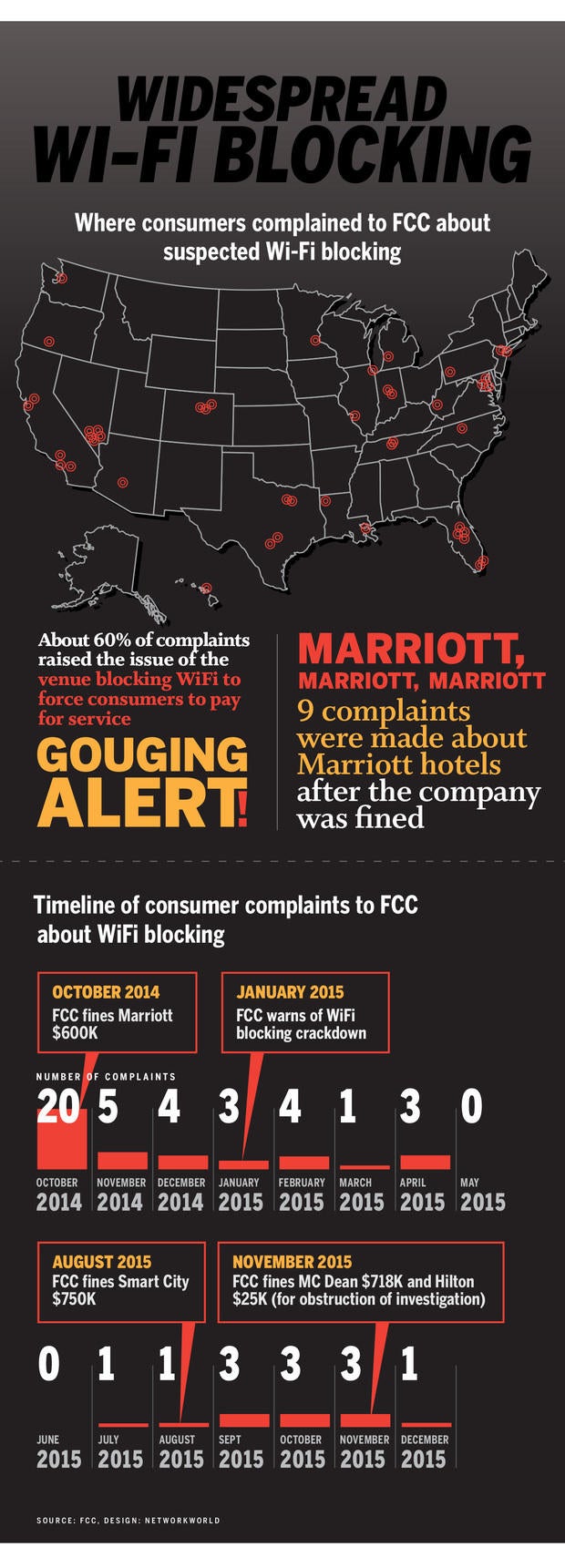
Wi-Fi Hotspot Blocking Persists Despite FCC Crackdown (networkworld.com) 85

An anonymous reader writes: An examination of consumer complaints to the FCC over the past year and a half shows that the practice of Wi-Fi hotspot device blocking continues even though the agency has slapped organizations such as Marriott and Hilton more than $2 million in total for doing this. Venues argue they need to block hotspots for security reasons, but the FCC and consumers say the organizations are doing this to force people to pay for pricey Internet access.
"Consumers who purchase cellular data plans should be able to use them without fear that their personal Internet connection will be blocked by their hotel or conference center," FCC Enforcement Bureau chief Travis LeBlanc said in a statement. "It is unacceptable for any hotel to intentionally disable personal hotspots while also charging consumers and small businesses high fees to use the hotel's own Wi-Fi network. This practice puts consumers in the untenable position of either paying twice for the same service or forgoing Internet access altogether." Consumers have filed many complaints about Wi-Fi hotspot blocking to the FCC.
Hardware Hacking

Microcasting Color TV By Abusing a Wi-Fi Chip (hackaday.com) 63

szczys writes: The NTSC standard has effectively been replaced by newer digital standards, but most televisions still work with these signals. This can be done through a composite video connection, but more fun is to broadcast video directly to your television's analog tuner. This is what cnlohr has been working on, using a lowly ESP8266 module to generate and transmit the color TV signal. This board is a $3 Wi-Fi module. But the chip itself has a number of other powerful peripheral features, including I2S and DMA. This hardware makes it possible to push the TV broadcast out using hardware, taking up only about 10% of processor time. Even more impressive, cnlohr didn't want to recompile and flash (which is a relatively slow process) during prototyping so he used a web worker to implement browser-based development through the chip's Wi-Fi connection. Speaking of chip-abuse in the interest of hyperlocal signal propagation, reader fulldecent writes to point out a project on GitHub that "allows transmission of radio signals from a computer that is otherwise air gapped. Right now this could be useful for playing a quick tune or for pranks. But there are more nefarious uses as this could also be used to exfiltrate information from secure networks."
Networking

Tracking Protection In Wi-Fi Networks Coming Soon To Linux 112

prisoninmate writes: Fedora contributor and NetworkManager developer Lubomir Rintel explains how your devices are being identified on a network by a unique number that most of us know by the name of MAC address. Same goes for mobile networking, as your laptop's or mobile phone's MAC address is, in most cases, broadcasted everywhere you go before you even attempt a connection to a wireless network. And that's a problem for your privacy. The solution? Randomization of the MAC address while scanning for Wi-Fi networks. Apple is already using this method on iOS 8 and later mobile operating systems, and so is Microsoft in Windows 10, so Linux users will ["likely"] get it in the upcoming NetworkManager 1.2 release.
Cellphones

Israeli Firm Creates a Device That Can Hack Any Nearby Phone (softpedia.com) 143

An anonymous reader writes: Israeli startup Rayzone created a device that can hack any smartphone that has its WiFi connection open. The device can steal passwords, files, contact lists, photos, and various others. Called InterApp, the device is dumb-proof (comes with a shiny admin panel), works on hundreds of devices at the same time, and leaves no forensics traces behind after the hack. The company says it will only sell it to law enforcement agencies.
Communications

FCC Fines Another Large Firm For Blocking WiFi 138

AmiMoJo writes: Another company is learning about the fine points of Section 333 of the Communications Act, which prohibits willful interference with any licensed or authorized radio communications. This time, M.C. Dean, who provided the Baltimore Convention Center's in-house WiFi service, were caught by the FCC sending deauthentication frames to prevent hotspot users maintaining a connection. The complainant alleged that M.C. Dean's actions were identical to those that had earned Marriott a $600,000 fine only weeks earlier.
Networking

Worries Mount Over Upcoming LTE-U Deployments Hurting Wi-Fi 173

alphadogg writes: LTE-U is a technology developed by Qualcomm that lets a service provider broadcast and receive signals over unlicensed spectrum, which is usable by anybody – specifically, in this case, the spectrum used by Wi-Fi networks in both businesses and homes. By opening up this new spectrum, major U.S. wireless carriers hope to ease the load on the licensed frequencies they control and help their services keep up with demand. Unsurprisingly, several outside experiments that pitted standard LTE technology or 'simulated LTE-U' technology, in the case of one in-depth Google study, against Wi-Fi transmitters on the same frequencies found that LTE drastically reduced the throughput on the Wi-Fi connection.
IOS

iOS 9 'Wi-Fi Assist' Could Lead To Huge Wireless Bills 182

Dave Knott writes: One of the new features introduced in iOS9 is "Wi-Fi Assist." This enables your phone to automatically switch from Wi-Fi to a cellular connection when the Wi-Fi signal is poor. That's helpful if you're in the middle of watching a video or some other task on the internet that you don't want interrupted by spotty Wi-Fi service. Unfortunately, Wi-Fi Assist is enabled by default, which means that users may exceed their data cap without knowing it because their phone is silently switching their data connection from Wi-Fi to cellular.
The Internet

Why In-Flight Wi-Fi Is Still Slow and Expensive 194

An anonymous reader writes: Let's grant that having access to the internet while on an airplane is pretty amazing. When airlines first began offering it several years ago, it was agonizingly slow and somewhat pricey as well. Unfortunately, it's only gotten more expensive over the years, and the speeds are still frustrating. This is in part because the main provider of in-flight internet, Gogo, knows most of its regular customers will pay for it, regardless of cost. Business travelers with expense accounts don't care if it's $1 or $10 or $50 — they need to stay connected. Data speeds haven't improved because Gogo says the scale isn't big enough to do much infrastructure investment, and most of the hardware is custom-made. A third of Gogo-equipped planes can manage 10 Mbps, while the rest top out at 3 Mbps. There's hope on the horizon — the company says a new satellite service should enable 70 Mbps per plane by the end of the year — but who knows how much they'll charge for an actual useful connection.
Networking

Virgin Media To Base a Public Wi-Fi Net On Paying Customers' Routers 113

An anonymous reader writes with a story that Virgin Media "announced this month its plans to roll out a free public WiFi network this autumn, using subscribers' personal routers and existing infrastructure to distribute the service across UK cities." And while regular customers' routers are to be the basis of the new network, the publicly viewable overlay would operate over "a completely separate connection," and the company claims subscribers' performance will not be hindered. Why, then, would customers bother to pay? For one thing, because the free version is slow: 0.5Mbps, vs. 10Mbps for Virgin's customers.

Slashdot Top Deals