United States

America's EV Registrations Rise 7% in 2025 - Giving EVs a 7.5% Market Share (yahoo.com) 247

EV sales are up 27% for the first seven months of 2025 — for the world. But in America "For the first half of 2025, EV registrations rose 7% to 620,642, with market share inching up just 0.1 percentage point to 7.5 percent," reports Automotive News.

America's new EV registrations were up 4.6% in June (compared to June of 2024), "But EV market share fell for the month and stayed flat for the first half of the year, according to the most recent S&P Global Mobility data." June's 113,460 EV registrations represented 8.6% of U.S. light-vehicle market share, down from 8.8% a year earlier... The data, which serves as a sales proxy since some EV makers don't report U.S. numbers, shows continued flattening of EV market share ahead of the Sept. 30 repeal of the $7,500 federal tax credit.

The S&P Global Mobility numbers include only battery-electric vehicles and not hybrids.

In June Tesla led with 57,260 registrations — more than 6x its next competitor. (Although Tesla's share of the EV segment dropped 6.8% to 43.7 percent in the first half of 2025).

Ranking #2 in June registrations was Chevrolet with 9,517 — a 152% gain over Chevrolet's June 2024 registrations. (Pointing out that the Chevy Equinox EV starts at under $35,000, Electrek writes that "America's most affordable EV with over 315 miles of range, as GM calls it, is quickly winning over buyers.") Automotive News reports Equinox EV registrations surged 722% to 6,239 in June, with Chevy's share of the EV segment more than doubling to 7.7%.

Chevy pulled ahead of Ford (5,759 registrations), Hyundai (5,227 registrations), Rivian (4,613 registrations) and Cadillac (4,121 registrations). Although maybe it's just as interesting that the complete chart shows electric vehicle registrations for 33 different automakers...
Transportation

In Barcelona, Certain Buses Run On Biomethane Produced From Human Waste 33

From the French newspaper Le Monde: Odorless, quiet, sustainable. On the last day of July, passengers boarded Barcelona's V3 bus line with no idea where its fuel came from. Written in large letters on the bus facade, just below its name "Nimbus," a sign clearly stated: "This bus runs on biomethane produced from eco-factory sludge." Still, the explanation was likely too vague for most to grasp its full meaning. The moist matter from wastewater treated at the Baix Llobregat treatment plant was used to produce the biomethane. In other words: the human waste of more than 1.5 million residents of the Catalan city.
Transportation

Volkswagen Wants You To Pay Monthly To Unlock More Horsepower (neowin.net) 143

Slashdot reader darwinmac writes: Volkswagen is offering a subscription model for extra horsepower on its ID.3 electric cars. Want to bump your ride from the standard 201 bhp to the full 228 bhp? That will be about £16.50 per month or £165 per year, or a one-time £649 "lifetime" fee that is tied to the car, not you. If you sell it, you have to pay again.

VW defended this to the BBC by saying you are basically paying for a sportier experience without buying a higher powered model upfront, calling it "nothing new." Nothing changes mechanically. You are just paying VW to essentially flip a boolean somewhere in the car's software.

Wine

Wine 10.13 Released 16

Wine 10.13 has been released after a one-month break, introducing a Windows Gaming Input configuration tab for the Joystick Control Panel, new ECDSA_P521 and ECDH_P521 cryptographic algorithms, OpenGL WoW64 thunk generation, and expanded Windows Runtime metadata support. The update also delivers 32 bug fixes," which is more than normal given the month of time between releases," writes Phoronix's Michael Larabel. "There are fixes for Microsoft Office 365, Microsoft SQL Server Management Studio Express, Doom 3 BFG Edition, and a variety of other game and application fixes."

You can download and learn more about the release at WineHQ.org GitLab.
AI

Google AI Overviews Linked To 25% Drop In Publisher Referral Traffic, New Data Shows (digiday.com) 21

New data from Digital Content Next shows Google's AI Overviews are linked to notable drops in publisher referral traffic, with surveyed sites seeing year-over-year declines between 1% and 25%. From a report: Digital Content Next (DCN), which counts the New York Times, Conde Nast and Vox among its approximately 40 member companies, checked in with 19 of them between May and June to see what was happening to their Google search referral traffic. The upshot: Google AI Overviews is indeed harming publisher traffic. Organic search referral traffic from Google is declining broadly, with the majority of DCN member sites -- spanning both news and entertainment -- experiencing traffic losses from Google search between 1% and 25%. Twelve of the respondent companies were news brands, and seven were non-news.

Over eight weeks in May and June 2025, the median Google Search referral was down almost every week, with losses outpacing gains two-to-one. For the seven non-news brands in the survey, the downward slope was steady and unbroken. Across the eight weeks, the median YoY decline in referred traffic from Google Search was -10% overall, -7% for news brands, and -14% for non-news brands, per the results.

Jason Kint, CEO of DCN, stressed that these losses are a direct consequence of Google AI Overviews, as many publishers claimed in their responses. The latest data offers a "ground truth" of what's actually happening, cutting through Google's vague claims about "quality clicks," made in its latest post, he added. "I think all publishers are ignoring Google's post. But this probably helps ground that," added Kint. The findings come shortly after a recent Pew survey of 900 U.S. consumers found that AI summaries are making users less likely to click through to links.
The U.K.'s Professional Publishers Association (PPA) also found that AI Overviews and AI Mode are steering users toward zero-click results, reducing visits to source sites, and expanding into Google Discover where sources are relegated to citations. Evidence from members shows click-through rates falling 10-25% year-over-year despite stable rankings, with examples including a lifestyle publisher's CTR dropping from 5.1% to 0.6% and an automotive publisher's CTR falling from 2.75% to 1.71% despite increased visibility.
Transportation

Global EV Sales Up 27% In 2025 (cleantechnica.com) 144

An anonymous reader quotes a report from CleanTechnica: In a sharp rebuke to the anti-electrification agenda in the US, global EV sales are up 27% over last year, with some legacy automakers -- but not all -- indicating the potential for a successful transition to electric mobility. CleanTechnica has spilled much ink on the pace of plug-in hybrid and full EV adoption, and the latest report from the UK firm Rho Motion (a branch of the price reporting agency Benchmark Mineral Intelligence) adds some fresh insights.

Covering the first seven months of 2025, earlier today Rho Motion totaled up more than 10.7 million EVs sold for a "robust" 27% increase over the same period last year, with China leading the pack by a wide margin. Europe also contributed to the overall robustness. Germany and the UK racked up impressive gains and Italy also turning in a mentionable performance. "The European EV market has grown by 30% year-to-date, with strong momentum in both battery electric vehicles (BEVs) and plug-in hybrids (PHEVs), up 30% and 32% respectively," Rho Motion summarized.

"In contrast, North America's growth has been muted so far in 2025, with the US facing policy headwinds and Canada seeing a slowdown," Rho Motion Data Manager Charles Lester observed. "We expect a short-term lift in US demand ahead of the IRA consumer tax credit deadline in September, followed by a likely dip," Lester added. That short-term lift won't help North America catch up to Europe [...]
Rho Motion's EV sales snapshot shows the recent gains:

Global: 10.7 million, +27%
China: 6.5 million, +29%
Europe: 2.3 million, +30%
North America: 1.0 million, +2%
Rest of World: 0.9 million, +42%
News

VP.NET Publishes SGX Enclave Code: Zero-Trust Privacy You Can Actually Verify 12

VP.NET has released the source code for its Intel SGX enclave on GitHub, allowing anyone to build the enclave and verify its mrenclave hash matches what's running on the servers. This takes "don't trust, verify" from marketing to reality, making privacy claims testable all the way down to hardware-enforced execution.

A move like this could set a new benchmark for transparency in privacy tech.
Operating Systems

Another Linux Distro Is Shutting Down (neowin.net) 48

An anonymous reader writes: Kaisen Linux, a Debian-based distro packed with tools for sysadmins, system rescue, and network diagnostics, is shutting down. This comes not long after Intel's Clear Linux also reached the end of the road.

Kaisen offered multiple desktop environments like KDE Plasma, LXQt, MATE, and Xfce, plus a "toram" mode that could load the whole OS into RAM so you could free up your USB port. The final release, Rolling 3.0, updates the base to Debian 13, defaults to KDE Plasma 6, replaces LightDM with SDDM, drops some packages like neofetch and hping3, and adds things like faster BTRFS snapshot restores, full ZFS support, and safer partitioning behavior.

Unlike Clear Linux, Kaisen will still get security updates for the next two years, giving current users time to migrate without rushing.

The Military

Pentagon Funded Experiment Develops Robots That Change By 'Consuming' Other Robots (404media.co) 25

alternative_right writes: A team of researchers at Columbia University, funded in part by the Defense Advanced Research Projects Agency, have developed "machines that can grow by consuming other machines." Video of the experiment shows tubular robots that move by extending their shafts to inch along the ground. As the tubes gather, they connect and form into more complex shapes like triangles and tetrahedrons. With each piece consumed, the whole moves faster and with more elegance.

"AI systems need bodies to move beyond current limitations. Physical embodiment brings the AI into the messy, constraint-rich real world -- and that's where true generalization has to happen," Phillipe Martin Wyder, lead researcher on the project, told 404 Media.

Microsoft

Microsoft Kills Volume Rebates in Name of 'Transparency' (theregister.com) 17

Microsoft is updating its pricing approach for Online Services in Enterprise Agreements in the name of consistency and transparency, but could leave some customers paying more. From a report: Many customers, particularly larger ones, enjoy substantial discounts via volume licensing and the change, which will bring the Online Services pricing model into line with those already rolled out for services like Azure, "reflects our ongoing commitment to greater transparency and alignment across all purchasing channels." Online Services include products such as Dynamics 365 and Windows 365.

Exactly how big a discount customers enjoyed depends on the deal they scored. The change will mean that "pricing will align with the pricing published on Microsoft.com." According to Microsoft, "This change reduces licensing complexity, enabling partners to invest less time evaluating Microsoft pricing and programs and more time working with customers on their business needs. With simplified and standardized prices, partners can shift their focus to delivering unique services that will propel their customers' growth."
The changes will take effect on November 1.
AI

Google Releases Pint-Size Gemma Open AI Model (arstechnica.com) 12

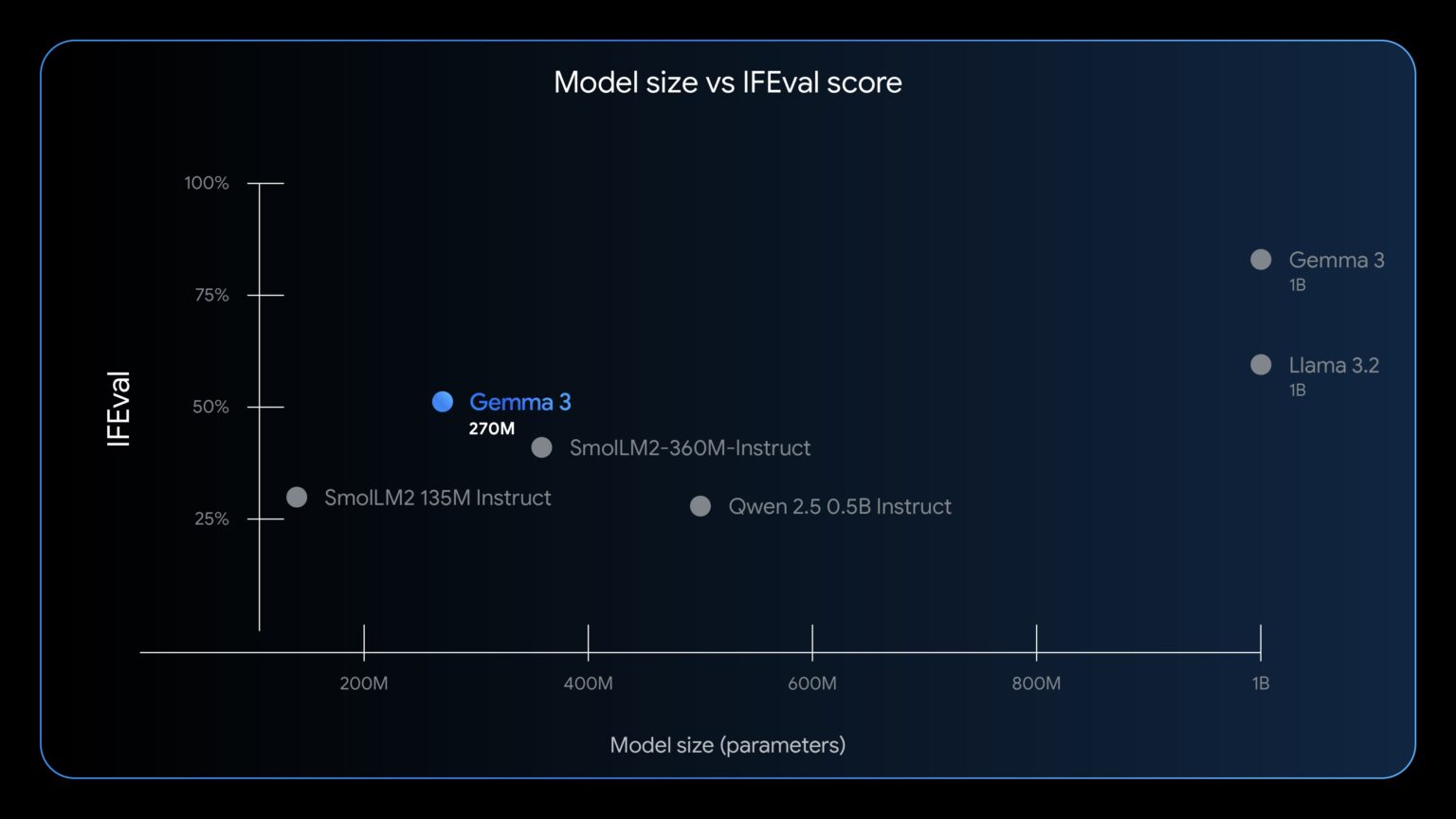
An anonymous reader quotes a report from Ars Technica: Google has announced a tiny version of its Gemma open model designed to run on local devices. Google says the new Gemma 3 270M can be tuned in a snap and maintains robust performance despite its small footprint. [...] Running an AI model locally has numerous benefits, including enhanced privacy and lower latency. Gemma 3 270M was designed with these kinds of use cases in mind. In testing with a Pixel 9 Pro, the new Gemma was able to run 25 conversations on the Tensor G4 chip and use just 0.75 percent of the device's battery. That makes it by far the most efficient Gemma model.

Developers shouldn't expect the same performance level of a multi-billion-parameter model, but Gemma 3 270M has its uses. Google used the IFEval benchmark, which tests a model's ability to follow instructions, to show that its new model punches above its weight. Gemma 3 270M hits a score of 51.2 percent in this test, which is higher than other lightweight models that have more parameters. The new Gemma falls predictably short of 1 billion-plus models like Llama 3.2, but it gets closer than you might think for having just a fraction of the parameters.

Google claims Gemma 3 270M is good at following instructions out of the box, but it expects developers to fine-tune the model for their specific use cases. Due to the small parameter count, that process is fast and low-cost, too. Google sees the new Gemma being used for tasks like text classification and data analysis, which it can accomplish quickly and without heavy computing requirements. You can download the new Gemma for free, and the model weights are available. There's no separate commercial licensing agreement, so developers can modify, publish, and deploy Gemma 3 270M derivatives in their tools.
You can download Gemma 3 270M from Hugging Face and Kaggle in both pre-trained and instruction-tuned versions.
Facebook

Meta's AI Rules Have Let Bots Hold 'Sensual' Chats With Kids, Offer False Medical Info (reuters.com) 23

Meta's internal policy document permitted the company's AI chatbots to engage children in "romantic or sensual" conversations and generate content arguing that "Black people are dumber than white people," according to a Reuters review of the 200-page "GenAI: Content Risk Standards" guide.

The document, approved by Meta's legal, public policy and engineering staff including its chief ethicist, allowed chatbots to describe children as attractive and create false medical information. Meta confirmed the document's authenticity but removed child-related provisions after Reuters inquiries, calling them "erroneous and inconsistent with our policies."
Transportation

Why Cars Still Don't Have Airless Tires, Yet (jalopnik.com) 71

Twenty years after Michelin introduced the Tweel in 2005, airless tires remain absent from passenger vehicles despite their promise to "eliminate nearly 200 million scrap tires a year caused by flats and underinflation," according to Michelin's internal testing cited in a Jalopnik report. Current prototypes "tend to transfer more road noise and vibration into the cabin than traditional radials -- making the ride harsher, especially at highway speeds." Heat dissipation poses additional challenges as "airless designs -- particularly those with internal webbing or solid cores -- have fewer ways to shed thermal load." The added structural mass "can affect fuel economy and increase unsprung weight -- bad news for handling and suspension tuning." Federal regulations compound these technical barriers since vehicle tires are subject to rigorous performance standards, many of which assume air pressure as a baseline.
Windows

Microsoft Says Voice Will Emerge as Primary Input for Next Windows (youtube.com) 138

The next version of Windows will become "more ambient, pervasive, and multi-modal" as AI transforms how users interact with computers, Microsoft's Windows chief Pavan Davuluri said in a company video. Davuluri, Corporate Vice President and head of Windows, said that voice will emerge as a primary input method alongside keyboard and mouse, with the operating system gaining context awareness to understand screen content and user intent through natural language.

Windows interfaces, he said, will appear fundamentally different within five years as the platform becomes increasingly agentic. The transformation will rely on both local processing power and cloud computing capabilities to deliver seamless experiences where users can speak to their computers while simultaneously typing or inking.
Communications

Russia Restricts Calls Via WhatsApp and Telegram (apnews.com) 19

Russian authorities are "partially" restricting calls in messaging apps Telegram and WhatsApp, the latest step in an effort to tighten control over the internet. From a report: In a statement, government media and internet regulator Roskomnadzor justified the measure as necessary for fighting crime, saying that "according to law enforcement agencies and numerous appeals from citizens, foreign messengers Telegram and WhatsApp have become the main voice services used to deceive and extort money, and to involve Russian citizens in sabotage and terrorist activities."
The Military

How the Unraveling of Two Pentagon Projects May Result In a Costly Do-Over (reuters.com) 84

The Pentagon is poised to cancel two nearly finished Navy and Air Force HR software projects worth over $800 million so new contracts can be awarded to other vendors, including Salesforce, Palantir, and Workday. "The reason for the unusual move: officials at those departments, who have so far put the existing projects on hold, want other firms, including Salesforce and billionaire Peter Thiel's Palantir, to have a chance to win similar projects, which could amount to a costly do-over," reports Reuters. From the report: In 2019, Accenture said it had won a contract to expand an HR platform to modernize the payroll, absence management, and other HR functions for the Air Force with Oracle software. The project, which includes other vendors and was later expanded to include Space Force, grew to cost $368 million and was scheduled for its first deployment this summer at the Air Force Academy. An April "status update" on the project conducted by the Air Force and obtained by Reuters described the project as "on track," with initial deployment scheduled for June, noting that it would end up saving the Air Force $39 million annually by allowing it to stop using an older system. But on May 30, Darlene Costello, then-Acting assistant Secretary of the Air Force, sent out a memo placing a "strategic pause" on the project for ninety days and calling for the study of alternate technical solutions, according to a copy of the memo seen by Reuters that was previously unreported. Costello, who has since retired, was reacting to pressure from other Air Force officials who wanted to steer a new HR project to SalesForce and Palantir, three sources said. [...] The Air Force said in a statement that it "is committed to reforming acquisition practices, assessing the acquisition workforce, and identifying opportunities to improve major defense acquisition programs."

Space Force, which operates within the Air Force, was set to receive the Air Force's new payroll system in the coming months. But it is also pulling out of the project because officials there want to launch yet another HR platform project to be led by Workday, according to three people familiar with the matter. The service put out a small business tender on May 7 for firms to research HR platform alternatives, with the goal of selecting a company that will recommend Workday as the best option, the people said. Now the Air Force and Space Force "want to start over with vendors that do not meet their requirements, leading to significant duplication and massive costs," said John Weiler, director of the Information Technology Acquisition Advisory Council, a government-chartered nonprofit group that makes recommendations to improve federal IT contracting.

In 2022, the Honolulu-based Nakupuna Companies took over a 2019 project with other firms to integrate the Navy's payroll and personnel systems into one platform using Oracle software and known as "NP2". The project, which has cost about $425 million since 2023, according to the Government Accountability Office, was set to be rolled out earlier this year after receiving a positive review by independent reviewer and consulting firm Guidehouse in January, according to a copy obtained by Reuters. But the head of Navy's human resources, now retired Admiral Rick Cheeseman, sought to cancel the project according to a June 5 memo seen by Reuters, directing another official to "take appropriate contractual actions" to cancel the project. Navy leaders instead mandated yet another assessment of project, according to a memo seen by Reuters, leaving it in limbo, two sources said.

Cheeseman's reason for trying to kill the project was his anger over a decision by DOGE earlier this year to cancel a $171 million contract for data services provider Pantheon Data that essentially duplicated parts of the HR project. In an email obtained by Reuters, he threatened to withhold funding from the Nakupuna-led project unless the Pantheon contract was restored. "I am beyond exasperated with how this happened," Cheeseman wrote in a May 7 email to Chief Information Officer Jane Rathbun about the contract cancellation, arguing the Pantheon contract was not "duplicative of any effort." "From where I sit, I'm content taking every dime away from NP2 in order to continue this effort," he added in the email. The pausing of NP2 was "unexpected, especially given that multiple comprehensive reviews validated the technical solution as the fastest and most affordable approach," Nakupuna said in a statement, adding it was disappointed by the change because the project was ready to deploy. The Navy said it "continues to prioritize essential personnel resources in support of efforts to strengthen military readiness through fiscal responsibility and departmental efficiency."

AI

Google's Gemini AI Will Get More Personalized By Remembering Details Automatically 38

An anonymous reader quotes a report from The Verge: Google is rolling out an update for Gemini that will allow the AI chatbot to "remember" your past conversations without prompting. With the setting turned on, Gemini will automatically recall your "key details and preferences" and use them to personalize its output.

This expands upon an update that Google introduced last year, which lets you ask Gemini to "remember" your personal preferences and interests. Now, Gemini won't need prompting to recall this information. As an example, Google says if you've used Gemini to get ideas for a YouTube channel surrounding Japanese culture in the past, then AI chatbot might suggest creating content about trying Japanese food if you ask it to suggest new video ideas in the future. [...]

Google will turn on this feature by default, but you can disable it by heading to your settings in the Gemini app and selecting Personal Context. From there, toggle off the Your past chats with Gemini option. Google will roll out this feature to its Gemini 2.5 Pro model in "select countries" starting today, before eventually bringing it to more locations and its Gemini 2.5 Flash model.
Google will also rename its "Gemini Apps Activity" setting to "Keep Activity," which will use "a sample" of your file and photo uploads to Gemini to "help improve Google services for everyone" starting on September 2nd. If you've disabled the previous setting, the new "Keep Activity" setting will be disabled too.

There's also a new "temporary chats" feature in Gemini to preserve privacy. "Temporary chats won't appear in your recent chats or your Keep Activity setting," notes The Verge. "Gemini also won't use these chats to personalize future conversations, nor will Google use them to train its AI models. Google will only save these conversations for 72 hours."
Technology

Pebble Time 2 Reboot Gets a Redesign (9to5google.com) 20

Pebble has unveiled the final design of its rebooted Pebble Time 2 smartwatch, featuring a stainless steel body, color accents, knurled buttons, a flat glass display, customizable RGB backlight, and a built-in compass. 9to5Google reports: In a new episode of his podcast "Tick Talk," original Pebble founder Eric Migicovsky discusses the progress being made on the revival. This time around, the main topic is Pebble Time 2 and its "final design," which sees a considerable redesign compared to what was shown off earlier this year. The new look has some added curves, color accents, knurled buttons, and a stunning overall look.

It'll be available in black and silver colors, as opposed to the black and white previously shown off. In between the metal portions of the build, a polycarbonate layer will allow the radios to work properly, while also adding a blue or red accent to the design. Apparently, there are four total color options on the table, but they're not final just yet. Anyone who has placed a pre-order will get the choice of what color they want.

The new Pebble Time 2 will be made from stainless steel, in particular the same steel material that the original Pebble Steel was built from. It also has transitioned to a flat glass panel versus the curved finish that was used on prior Pebble watches, lessening reflections. The backlight on this model is also more advanced, with an RGB LED that allows the user to control the backlight color so it's not always "blue-ish." Migicovsky says that this will allow the color temperature to change through the day.
The Pebble Time 2 is available to pre-order for $225.
Transportation

Polestar Sets Production Car Record For Longest Drive On a Single Charge (arstechnica.com) 105

An anonymous reader quotes a report from Ars Technica: [O]ver in the UK, a single-motor version of the Polestar 3 just set a world record for the farthest drive in an electric car on a single charge. Three "professional efficiency drivers," Sam Clarke, Kevin Booker, and Richard Parker, drove 581.3 miles (935.4 km), taking 22 hours and 57 minutes to complete the task. That's an efficiency of 5.1 miles/kWh (12.1 kWh/100 km) -- more than 40 percent better than I saw in day-to-day driving in the twin-motor version.

"We are very proud to say we have a world record holder in the Polestar family! This official Guinness World Record for range is another proof point that Polestar 3 is setting new standards. We will continue to push the boundaries of technology and electric performance," said Michael Lohscheller, Polestar CEO.
The report notes that the Polestar 3 was "entirely standard, on stock tires," and averaged a speed of less than 25 mph (40 km/h).
Music

Young Americans Push Playback Beyond 1x as Platforms Widen Speed Controls (economist.com) 88

Young listeners are accelerating audio and video consumption, with an Economist/YouGov poll finding 31% of Americans aged 18-29 using faster-than-1x playback versus 8% among those 45 and older, as Apple, Spotify, newspapers' audio, Netflix, and YouTube expand speed controls, including YouTube's 4x for premium users.

YouTube reports more than 900 years saved per day from fast playback; a meta-analysis led by University of Waterloo researchers finds minimal test-score change up to 1.5x and declines near or past 2x.

Slashdot Top Deals