Nintendo

Nintendo Banned Switch 2 Owner For Playing a Used Switch 1 Game They Bought Online (tomshardware.com) 84

"A Nintendo Switch 2 user reportedly got his brand-new console banned by Nintendo after buying used Switch 1 games and patching them on his console," reports Tom's Hardware: According to Reddit user dmanthey, they purchased four used titles off the Facebook marketplace, inserted them into the Switch 2, and had them all updated. When they turned on their handhelds the following day, they received a message saying that they were restricted from Nintendo's online services and that they couldn't even download the games they had already bought...

[T]hey were able to prove their innocence by pulling up the Facebook Marketplace listing for their games and sending the photos of their purchased cartridges. According to the Redditor, the process was painless and fast, and it was "so much easier than getting support from Microsoft or Sony...." Other users warned, though, that this isn't always a guaranteed resolution.

Nintendo is known for being protective of its intellectual property and delivers harsh penalties to anyone caught violating it. We've already had several reports of users getting banned for using Mig Flash, even on their own ROMs. And while it's not true that getting banned turns your Switch 2 into a brick, it will still prevent you from accessing the company's online services, which severely restricts its features and usability.

"Nintendo attaches unique codes to its Switch game cartridges to prevent piracy," notes Engadget. "However, bad actors can copy games onto a third-party device, like the MIG Flash, and then resell the physical game card. Once Nintendo detects two instances of its unique code being online at the same time, it will ban any accounts using it..." This anti-piracy policy isn't new — Nintendo has long had a reputation for fiercely combating any type of piracy — but it has become relevant again thanks to the recently released Switch 2, which offers backwards compatibility with original Switch titles. The company even recently amended its user agreement to allow itself the power to brick a Nintendo Switch that's caught running pirated games or mods.
Firefox

'Firefox is Fine. The People Running It are Not' (theregister.com) 150

"Firefox is dead to me," wrote Steven J. Vaughan-Nichols last month for The Register, complaining about everything from layoffs at Mozilla to Firefox's discontinuation of Pocket and Fakespot, its small market share, and some user complaints that the browser might be becoming slower. But a new rebuttal (also published by The Register) argues instead that Mozilla just has "a management layer that doesn't appear to understand what works for its product nor which parts of it matter most to users..."

"Steven's core point is correct. Firefox is in a bit of a mess — but, seriously, not such a bad mess. You're still better off with it — or one of its forks, because this is FOSS — than pretty much any of the alternatives." Like many things, unfortunately, much of computing is run on feelings, tradition, and group loyalties, when it should use facts, evidence, and hard numbers. Don't bother saying Firefox is getting slower. It's not. It's faster than it has been in years. Phoronix, the go-to site for benchmarks on FOSS stuff, just benchmarked 21 versions, and from late 2023 to now, Firefox has steadily got faster and faster...

Ever since Firefox 1.0 in 2004, Firefox has never had to compete. It's been attached like a mosquito to an artery to the Google cash firehose... Mozilla's leadership is directionless and flailing because it's never had to do, or be, anything else. It's never needed to know how to make a profit, because it never had to make a profit. It's no wonder it has no real direction or vision or clue: it never needed them. It's role-playing being a business. Like we said, don't blame the app. You're still better off with Firefox or a fork such as Waterfox. Chrome even snoops on you when in incognito mode...

One observer has been spectating and commentating on Mozilla since before it was a foundation — one of its original co-developers, Jamie Zawinksi... Zawinski has repeatedly said: "Now hear me out, but What If...? browser development was in the hands of some kind of nonprofit organization?"

"In my humble but correct opinion, Mozilla should be doing two things and two things only:

— Building THE reference implementation web browser, and
— Being a jugular-snapping attack dog on standards committees.
— There is no 3."


Perhaps this is the only viable resolution. Mozilla, for all its many failings, has invented a lot of amazing tech, from Rust to Servo to the leading budget phone OS. It shouldn't be trying to capitalize on this stuff. Maybe encourage it to have semi-independent spinoffs, such as Thunderbird, and as KaiOS ought to be, and as Rust could have been. But Zawinski has the only clear vision and solution we've seen yet. Perhaps he's right, and Mozilla should be a nonprofit, working to fund the one independent, non-vendor-driven, standards-compliant browser engine.

Science

Hybrid Model Reveals People Act Less Rationally In Complex Games, More Predictably In Simple Ones (phys.org) 77

alternative_right shares a report from Phys.org: Researchers at Princeton University, Boston University and other institutes used machine learning to predict the strategic decisions of humans in various games. Their paper, published in Nature Human Behavior, shows that a deep neural network trained on human decisions could predict the strategic choices of players with high levels of accuracy. [...] Essentially, the team suggests that people behave more rationally while playing games that they perceive as easier. In contrast, when they are playing more complex games, people's choices could be influenced by various other factors, thus the "noise" affecting their behavior would increase.

As part of their future studies, the researchers would also like to shed more light on what makes a game "complex" or "easy." This could be achieved using the context-dependent noise parameter that they integrated into their model as a signature of "perceived difficulty." "Our analysis provides a robust model comparison across a wide range of candidate models of decision-making," said [Jian-Qiao Zhu, first author of the paper]. "We now have strong evidence that introducing context-dependence into the quantal response model significantly improves its ability to capture human strategic behavior. More specifically, we identified key factors in the game matrix that shape game complexity: considerations of efficiency, the arithmetic difficulty of computing payoff differences, and the depth of reasoning required to arrive at a rational solution."

The findings gathered as part of this recent study also highlight the "lightness" with which many people approach strategic decisions, which could make them vulnerable to parties looking to sway them towards making irrational decisions. Once they gather more insight into what factors make games and decision-making scenarios more challenging for people, Zhu and his colleagues hope to start devising new behavioral science interventions aimed at prompting people to make more rational decisions.

Security

Activision Took Down Call of Duty Game After PC Players Hacked (techcrunch.com) 23

Activision removed "Call of Duty: WWII" from Microsoft Store and Game Pass after hackers exploited a security vulnerability that allowed them to compromise players' computers, TechCrunch reported Tuesday, citing a source. The gaming giant took the 2017 first-person shooter offline last week while investigating what it initially described only as "reports of an issue."

Players posted on social media claiming their systems had been hacked while playing the game. The vulnerability was a remote code execution exploit that enables attackers to install malware and take control of victims' devices. The Microsoft Store and Game Pass versions contained an unpatched security flaw that had been fixed in other versions of the game.
Programming

Microsoft Open Sources Copilot Chat for VS Code on GitHub (nerds.xyz) 18

"Microsoft has released the source code for the GitHub Copilot Chat extension for VS Code under the MIT license," reports BleepingComputer. This provides the community access to the full implementation of the chat-based coding assistant, including the implementation of "agent mode," what contextual data is sent to large language models (LLMs), and the design of system prompts. The GitHub repository hosting the code also details telemetry collection mechanisms, addressing long-standing questions about data transparency in AI-assisted coding tools...

As the VS Code team explained previously, shifts in AI tooling landscape like the rapid growth of the open-source AI ecosystem and a more level playing field for all have reduced the need for secrecy around prompt engineering and UI design. At the same time, increased targeting of development tools by malicious actors has increased the need for crowdsourcing contributions to rapidly pinpoint problems and develop effective fixes. Essentially, openness is now considered superior from a security perspective.

"If you've been hesitant to adopt AI tools because you don't trust the black box behind them, this move opensources-github-copilot-chat-vscode/offers something rare these days: transparency," writes Slashdot reader BrianFagioli" Now that the extension is open source, developers can audit how agent mode actually works. You can also dig into how it manages your data, customize its behavior, or build entirely new tools on top of it. This could be especially useful in enterprise environments where compliance and control are non negotiable.

It is worth pointing out that the backend models powering Copilot remain closed source. So no, you won't be able to self host the whole experience or train your own Copilot. But everything running locally in VS Code is now fair game. Microsoft says it is planning to eventually merge inline code completions into the same open source package too, which would make Copilot Chat the new hub for both chat and suggestions.

Biotech

You Can Now Rent a Flesh Computer Grown In a British Lab (sciencealert.com) 34

alternative_right shares a report from ScienceAlert: The world's first commercial hybrid of silicon circuitry and human brain cells will soon be available for rent. Marketed for its vast potential in medical research, the biological machine, grown inside a British laboratory, builds on the Pong-playing prototype, DishBrain. Each CL1 computer is formed of 800,000 neurons grown across a silicon chip, and their life-support system. While it can't yet match the mind-blowing capabilities of today's most powerful computers, the system has one very significant advantage: it only consumes a fraction of the energy of comparable technologies.

AI centers now consume countries' worth of energy, whereas a rack of CL1 machines only uses 1,000 watts and is naturally capable of adapting and learning in real time. [...] When neuroscientist Brett Kagan and colleagues pitted their creation against equivalent levels of machine learning algorithms, the cell culture systems outperformed them. Users can send code directly into the synthetically supported system of neurons, which is capable of responding to electrical signals almost instantly. These signals act as bits of information that can be read and acted on by the cells. But perhaps the greatest potential for this biological and synthetic hybrid is as an experimental tool for learning more about our own brains and their abilities, from neuroscience to creativity.
The first CL1 units will reportedly ship soon for $35,000 each. Remote access can apparently be rented for $300 per week.
Windows

Games Run Faster On SteamOS Than Windows 11, Ars Testing Finds (arstechnica.com) 102

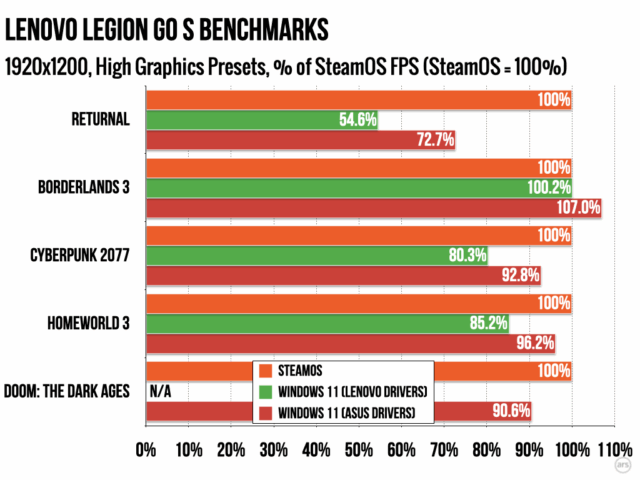
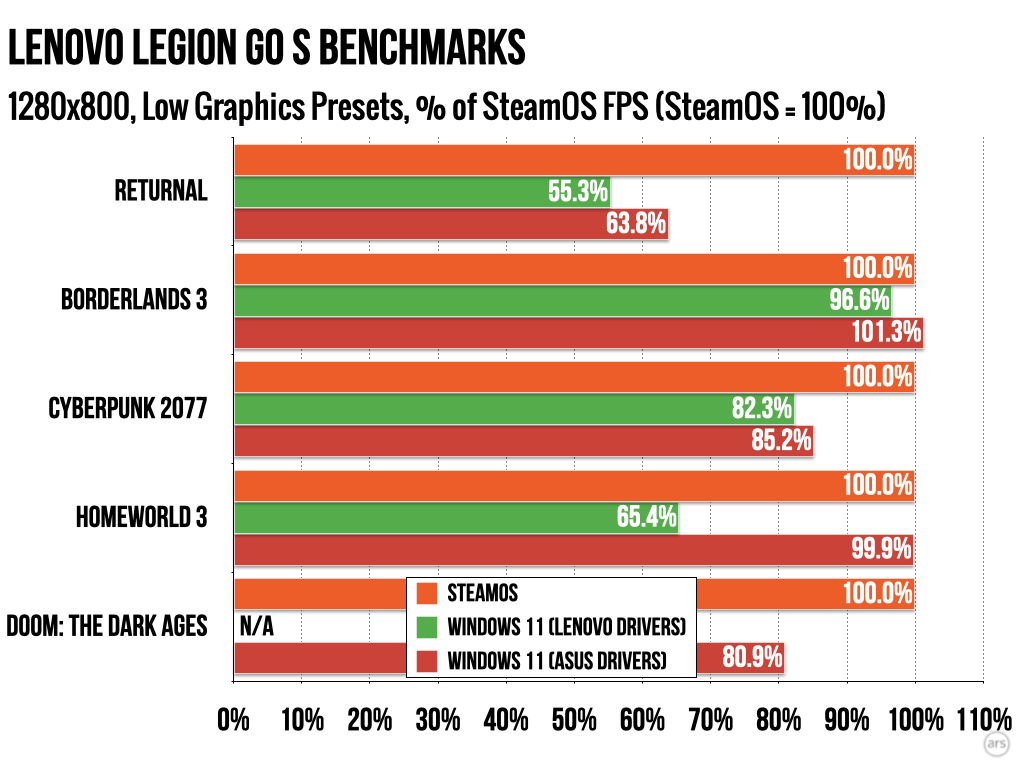
An anonymous reader quotes a report from Ars Technica: Nearly a decade ago, Ars testing found that Valve's "Steam Machines"-era version of SteamOS performed significantly worse than Windows when SteamOS's Linux game ports were tested on the same hardware as their Windows counterparts. Today, though, Ars testing on the Lenovo Legion Go S finds recent games generally run at higher frame rates on SteamOS 3.7 than on Windows 11. [...]

As you can see in the included charts, SteamOS showed noticeable frame rate improvements in four of the five games tested. Only Borderlands 3 showed comparable performance across both operating systems, with Windows eking out ever-so-slightly higher frame rates in that game's benchmarks. For the other four tested games, the stock Lenovo Windows drivers were sometimes significantly worse than those included with SteamOS. When playing Returnal at "High" graphics presets and 1920x1200 resolution, for instance, changing from Lenovo's Windows drivers to SteamOS meant the difference between a hard-to-take 18 FPS average and a downright decent 33 FPS average. Sideloading the updated Asus drivers showed a noticeable improvement in Windows performance across all tested games and even brought Homeworld 3's "Low" graphics benchmark test to practical parity with SteamOS. In all other cases, though, even these updated drivers resulted in benchmark frame rates anywhere from 8 percent to 36 percent lower than those same benchmarks on SteamOS.

These results might seem a bit counterintuitive, considering that games running on SteamOS must go through a Proton translation layer for every native Windows instruction in a game's code. But Valve has put in consistent work over the years to make Proton as efficient and cross-compatible as possible; not to mention its continued work on Linux's Mesa graphics drivers seems to be paying dividends for SteamOS graphics performance. Running SteamOS also means eliminating a lot of operating system overhead that the more generalist Windows uses by default. Microsoft seems aware of this issue for gamers and has recently announced that the upcoming "Xbox Experience for Handheld" will "minimize background activity and defer non-essential tasks" to allow for "more [and] higher framerates" in games.

AI

What if Customers Started Saying No to AI? (msn.com) 213

An artist cancelled their Duolingo and Audible subscriptions to protest the companies' decisions to use more AI. "If enough people leave, hopefully they kind of rethink this," the artist tells the Washington Post.

And apparently, many more people feel the same way... In thousands of comments and posts about Audible and Duolingo that The Post reviewed across social media — including on Reddit, YouTube, Threads and TikTok — people threatened to cancel subscriptions, voiced concern for human translators and narrators, and said AI creates inferior experiences. "It destroys the purpose of humanity. We have so many amazing abilities to create art and music and just appreciate what's around us," said Kayla Ellsworth, a 21-year-old college student. "Some of the things that are the most important to us are being replaced by things that are not real...."

People in creative jobs are already on edge about the role AI is playing in their fields. On sites such as Etsy, clearly AI-generated art and other products are pushing out some original crafters who make a living on their creations. AI is being used to write romance novels and coloring books, design logos and make presentations... "I was promised tech would make everything easier so I could enjoy life," author Brittany Moone said. "Now it's leaving me all the dishes and the laundry so AI can make the art."

But will this turn into a consumer movement? The article also cites an assistant marketing professor at Washington State University, who found customers are now reacting negatively to the term "AI" in product descriptions — out of fear for losing their jobs (as well as concerns about quality and privacy). And he does predict this can change the way companies use AI.

"There will be some companies that are going to differentiate themselves by saying no to AI." And while it could be a niche market, "The people will be willing to pay more for things just made by humans."
Science

Casino Lights Could Be Warping Your Brain To Take Risks, Scientists Warn (sciencealert.com) 28

ScienceAlert reports: Casino lighting could be nudging gamblers to be more reckless with their money, according to a new study, which found a link between blue-enriched light and riskier gambling behavior. The extra blue light emitted by casino decor and LED screens seems to trigger certain switches in our brains, making us less sensitive to financial losses compared to gains of equal magnitude, researchers from Flinders University and Monash University in Australia found...

The researchers think circadian photoreception, which is our non-visual response to light, is playing a part here. The level of blue spectrum light may be activating specific eye cells connected to brain regions in charge of decision-making, emotional regulation, and processing risk versus reward scenarios.

"Under conditions where the lighting emitted less blue, people tended to feel a $100 loss much more strongly than a $100 gain — the loss just feels worse," [says the study's lead author, a psychologist at the Flinders Health and Medical Research Institute]. "But under bright, blue-heavy light such as that seen in casino machines, the $100 loss didn't appear to feel as bad, so people were more willing to take the risk...." That raises some questions around ethics and responsibility, according to the researchers. While encouraging risk taking might be good for the gambling business, it's not good for the patrons spending their cash.

One professor involved in the study reached this conclusion. "It is possible that simply dimming the blue in casino lights could help promote safer gambling behaviors."

The research has been published in Scientific Reports.

Thanks to Slashdot reader alternative_right for sharing the news.
Robotics

Scientists Built a Badminton-Playing Robot With AI-Powered Skills (arstechnica.com) 10

An anonymous reader quotes a report from Ars Technica: The robot built by [Yuntao Ma and his team at ETH Zurich] was called ANYmal and resembled a miniature giraffe that plays badminton by holding a racket in its teeth. It was a quadruped platform developed by ANYbotics, an ETH Zurich spinoff company that mainly builds robots for the oil and gas industries. "It was an industry-grade robot," Ma said. The robot had elastic actuators in its legs, weighed roughly 50 kilograms, and was half a meter wide and under a meter long. On top of the robot, Ma's team fitted an arm with several degrees of freedom produced by another ETH Zurich spinoff called Duatic. This is what would hold and swing a badminton racket. Shuttlecock tracking and sensing the environment were done with a stereoscopic camera. "We've been working to integrate the hardware for five years," Ma said.

Along with the hardware, his team was also working on the robot's brain. State-of-the-art robots usually use model-based control optimization, a time-consuming, sophisticated approach that relies on a mathematical model of the robot's dynamics and environment. "In recent years, though, the approach based on reinforcement learning algorithms became more popular," Ma told Ars. "Instead of building advanced models, we simulated the robot in a simulated world and let it learn to move on its own." In ANYmal's case, this simulated world was a badminton court where its digital alter ego was chasing after shuttlecocks with a racket. The training was divided into repeatable units, each of which required that the robot predict the shuttlecock's trajectory and hit it with a racket six times in a row. During this training, like a true sportsman, the robot also got to know its physical limits and to work around them.

The idea behind training the control algorithms was to develop visuo-motor skills similar to human badminton players. The robot was supposed to move around the court, anticipating where the shuttlecock might go next and position its whole body, using all available degrees of freedom, for a swing that would mean a good return. This is why balancing perception and movement played such an important role. The training procedure included a perception model based on real camera data, which taught the robot to keep the shuttlecock in its field of view while accounting for the noise and resulting object-tracking errors.

Once the training was done, the robot learned to position itself on the court. It figured out that the best strategy after a successful return is to move back to the center and toward the backline, which is something human players do. It even came with a trick where it stood on its hind legs to see the incoming shuttlecock better. It also learned fall avoidance and determined how much risk was reasonable to take given its limited speed. The robot did not attempt impossible plays that would create the potential for serious damage -- it was committed, but not suicidal. But when it finally played humans, it turned out ANYmal, as a badminton player, was amateur at best.
The findings have been published in the journal Science Robotics.

You can watch a video of the four-legged robot playing badminton on YouTube.
IOS

Apple Unveils a Dedicated Games App (engadget.com) 12

At WWDC 2025, Apple announced a new dedicated Games app coming to Mac, iPhone, and iPad with features like leaderboards, matchmaking, and integration with Apple Arcade. Engadget's Jessica Conditt describes it as "a revamp of Game Center" that behaves "more like a modern gaming hub, a la Xbox or GOG Galaxy." From the report: You can see what your friends are playing and challenge them to specific feats in certain titles. The library tab will include every game you've ever downloaded from the App Store, allowing you to booth them up right there. On Mac, a Games app overlay makes communication tools, audio controls, Bluetooth connections and live battery levels accessible at any time.
XBox (Games)

Microsoft Announces Upcoming Windows-Powered Handheld Xbox Device: the 'ROG Xbox Ally' (engadget.com) 44

Nintendo's new Switch 2 console sold a record 3 million units after its launch Thursday. But then today Microsoft announced their own upcoming handheld gaming device that's Xbox-branded (and Windows-powered).

Working with ASUS' ROG division, they build a device that weighs more than the Nintendo Switch 2, and "is marginally heavier than the Steam Deck," reports Engadget. But "at least those grips look more ergonomic than those on the Nintendo Switch 2 (which is already cramping my hands) or even the Steam Deck." There are two variants of the handheld: the ROG Xbox Ally and ROG Xbox Ally X. Microsoft didn't reveal pricing, but the handhelds are coming this holiday... Critically, Microsoft and ROG aren't locking the devices to only playing Xbox games (though you can do that natively, via the cloud or by accessing an Xbox console remotely). You'll be able to play games from Battle.net and "other leading PC storefronts" too. Obviously, there's Game Pass integration here, as well as support for the Xbox Play Anywhere initiative, which enables you to play games with synced progress across a swathe of devices after buying them once...

There's a dedicated physical Xbox button that can bring up a Game Bar overlay, which seemingly makes it easy to switch between apps and games, tweak settings, start chatting with friends and more... You'll be able to mod games on either system as well.

The Xbox Ally is powered by the AMD Ryzen Z2 A Processor, and has 16GB of RAM and 512GB of SSD storage. The Xbox Ally X is the more powerful model. It has a AMD Ryzen AI Z2 Extreme processor, 24GB of RAM and 1TB of storage. They each have a microSD card reader, so you won't need to worry about shelling out for proprietary storage options to have extra space for your games... Both systems boast "HD haptics..." Both systems should be capable of outputting video to a TV or monitor, as they have two USB-C ports with support for DisplayPort 2.1 and Power Delivery 3.0.

"Microsoft has needed to respond to SteamOS ever since the Steam Deck launched three years ago," argues The Verge, "and it has steadily been tweaking its Xbox app and the Xbox Game Bar on Windows to make both more handheld-friendly..." But there was always a bigger overhaul of Windows required, and we're starting to see parts of that today. "The reality is that we've made tremendous progress on this over the last couple of years, and this is really the device that galvanized those teams and got everybody marching and working towards a moment that we're just really excited to put into the hands of players," says Roanne Sones, corporate vice president of gaming Devices and ecosystem at Xbox, in a briefing with The Verge...

I'll need to try this new interface fully to really get a feel for the Windows changes here, but Microsoft is promising that this isn't just lipstick on top of Windows. "This isn't surface-level changes, we've made significant improvements," says Potvin. "Some of our early testing with the components we've turned off in Windows, we get about 2GB of memory going back to the games while running in the full-screen experience."

United States

California Court Says Holding Phone For Maps While Driving is Illegal (sfchronicle.com) 163

California law prohibits "operating" a mobile phone while driving. And that makes it illegal for a driver to hold a cellphone in order to look at a map, a state appeals court ruled this week. From a report: In a 2016 law intended to strengthen previous restrictions, "the Legislature intended to prohibit all handheld functions of wireless telephones while driving" and "to encourage drivers to keep their eyes on the road," said the 6th District Court of Appeal.

A Superior Court panel had reversed a driver's conviction for a traffic infraction and $158 fine in San Jose, ruling that the law prohibited only "actively using or manipulating" a hand-held phone for actions such as talking or listening, browsing the internet or playing video games while driving. The appeals court reinstated the conviction and the fine, in a ruling that could set a statewide standard unless it is narrowed or overturned on appeal.

Star Wars Prequels

'Star Wars'-Inspired Tabletop Games Bring Rebellion and Glory (without Disney) (aftermath.site) 40

"I am a huge fan of Star Wars," opines an article from the gaming Aftermath. "As every Star Wars fan knows, being a Star Wars fan means you hate Star Wars as much as you love it."

But fortunately there's Going Rogue and Galactic — two tabletop games "inspired" by the Star Wars universe (which just successfully crowdfunded a printed illustrated hardcover edition). They're described as "war among the stars" role-playing games, where members of The Liberation dedicate their lives to the war against The Mandate — "rebels, soldiers, spies, and criminals, or perhaps someone who simply picked up and blaster and said 'enough is enough.'"

The article notes that Going Rogue was a way for the game's designer to work out their issues with Star Wars: "You can re-skin Going Rogue to be all the original stuff [from Star Wars]. I prefer, at this point, to play it not in canon Star Wars," Levine said. "And also, there are things I hate about canon Star Wars. I think it sucks that the Jedi are child kidnapping, sexless acetics!" In particular Going Rogue is a remix of Rogue One: A Star Wars Story, which depicts the lives of a group of rebel agents who give their lives for the rebellion before the original trilogy. "I love Rogue One and I hate Rogue One," Levine said...

But Going Rogue aims to do more than just allow players to "fix" Star Wars's narrative problems. It also allows players to explore this narrative of rebellion without having to interface with an evil entertainment empire: Disney... Going Rogue is an opportunity for Star Wars fans to make the story of Star Wars their own, including making it more in league with their own politics by taking Disney out of it. "Something I like about tabletop role playing and adaptational tabletop role playing is it says, 'Actually, fuck them. They don't get to own this thing,'" Levine said. "We can't fully divest from the connection to Star Wars. Obviously, we are downstream of it in certain ways. But we are also trying to say, fuck [Disney's] ownership of this thing that you love."

Aftermath adds that the game Going Rogue "intrigued me specifically because it was inspired by Rogue One: A Star Wars Story and Andor — in particular, Going Rogue has a mechanic baked into the game where your character is more or less guaranteed to go out in a blaze of glory for the cause." [The game's designer says] "I wanted to design the game in a way that, as your character realized that they were willing to voluntarily sacrifice their life for this, you were narratively guaranteed by the mechanics that that sacrifice was worth it. You get to see, after they die, how it transforms the galaxy. I wanted you to get that feeling because you don't get that certainty in real life." They didn't make this game to convince anyone to become a socialist, but instead to create an emotional tool that serves as a mirror for the players' own feelings about what it means to devote your life to a political cause.
First Person Shooters (Games)

New 'Doom: The Dark Ages' Already Adjusted to Add Even More Dangerous Demons (windowscentral.com) 23

Doom: The Dark Ages just launched on May 15. But it's already received "difficulty" balance changes "that have made the demons of Hell even more dangerous than ever," writes Windows Central: According to DOOM's official website Slayer's Club, these balance adjustments are focused on making the game harder, as players have been leaving feedback saying it felt too easy even on Nightmare Mode. As a result, enemies now hit harder, health and armor item pick-ups drop less often, and certain enemies punish you more severely for mistiming the parry mechanic.
It reached three million players in just five days, which was seven times faster than 2020's Doom: Eternal," reports Wccftech (though according to analytics firm Ampere Analysis (via The Game Business), more than two million of those three million launch players were playing on Xbox, while only 500K were playing on PS5.") "id Software proves it can still reinvent the wheel," according to one reviewer, "shaking up numerous aspects of gameplay, exchanging elaborate platforming for brutal on-the-ground action, as well as the ability to soar on a dragon's back or stomp around in a giant mech."

And the New York Times says the game "effectively reinvents the hellish shooter with a revamped movement system and deepened lore" in the medieval goth-themed game... Double jumping and dashing are ditched and replaced with an emphasis on raw power and slow, strategic melee combat. Doom Slayer's arsenal features a brand-new tool, the powerful Shield Saw, which Id Software made a point to showcase across its "Stand and Fight" trailers and advertisements. Used for absorbing damage at the expense of speed, the saw also allows players to bash enemies from afar and close the gap on chasms too wide to jump across. While previous titles allowed players to quickly worm their way through bullet hell, The Dark Ages expects you to meet foes head on. "If you were an F-22 fighter jet in Doom Eternal, this time around we wanted you to feel like an Abrams tank," Hugo Martin, the game's creative director, has told journalists.

And Doom Slayer's beefy durability and unstoppable nature does make the gameplay a refreshing experience. The badassery is somehow ratcheted to new heights with the inclusion of a fully controllable mech, which has only a handful of attacks at its disposal, and actual dragons. Flight in a Doom game is entirely surprising and fluid, and the dragons feel relatively easy to maneuver through tight spots. They can also engage in combat more deliberately with the use of dodges and mounted cannons...

One of my favorite additions is the skullcrusher pulverizer. Equal parts heinous nutcracker and demonic woodchipper, the gun lodges skulls into a grinder and sends shards of bones flying at enemies. The animation is both goofy and satisfying.

Another special Times article notes that Doom's fans "resurrect the original game over and over again on progressively stranger pieces of hardware: a Mazda Miata, a NordicTrack treadmill, a French pharmacy sign." But what many hard-core tech hobbyists want to know is whether you can play it on a pregnancy test. The answer: positively yes. And for the first time, even New York Times readers can play Doom within The Times's site [after creating a free account]...

None of this happened by accident, of course. Ports were not incidental to Doom's development. They were a core consideration. "Doom was developed in a really unique way that lent a high degree of portability to its code base," said John Romero, who programmed the game with John Carmack. (In our interview, he then reminisced about operating systems for the next 14 minutes.) Id had developed Wolfenstein 3D, the Nazi-killing predecessor to Doom, on PCs. To build Doom, Carmack and Romero used NeXT, the hardware and software company founded by Steve Jobs after his ouster from Apple in 1985. NeXT computers were powerful, selling for about $25,000 apiece in today's dollars. And any game designed on that system would require porting to the more humdrum PCs encountered by consumers at computer labs or office jobs.

This turned out to be advantageous because Carmack had a special aptitude for ports. All of Id's founders met as colleagues at Softdisk, which had hired Carmack because of his ability to spin off multiple versions of a single game. The group decided to strike out on its own after Carmack created a near-perfect replica of the first level of Super Mario Bros. 3 — Nintendo's best-selling platformer — on a PC. It was a wonder of software engineering that compensated for limited processing power with clever workarounds. "This is the thing that everyone has," Romero said of PCs. "The fact that we could figure out how to make it become a game console was world changing...."

Romero founded a series of game studios after leaving Id in 1996 and is working on a new first-person shooter, the genre he and Carmack practically invented. He has no illusions about how it may stack up. "I absolutely accept that Doom is the best game I'll ever make that has that kind of a reach," he said. "At some point you make the best thing." Thirty years on, people are still making it.

And in related news, PC Gamer reports... As part of a new "FPS Fridays" series on Twitch, legendary shooter designer John Romero streamed New Blood's 2018 hit, Dusk, one of the first and most influential indie "boomer shooters" in the genre's recent revitalization. The short of it? Romero seems to have had a blast.
Windows

Windows 11 To Get Apple-Style App Continuity (windowscentral.com) 27

Microsoft is introducing a new "Cross Device Resume" feature for Windows 11, enabling app developers to let users seamlessly continue activity between devices in a manner closely mirroring Apple's Handoff for Macs and iPhones. Unveiled at Build 2025 during a session titled "Create Seamless Cross-Device Experiences with Windows for your app," the feature was demonstrated -- before the session was quietly edited to remove this segment -- by showing Spotify playing a song on an Android phone, then surfacing the Spotify app in the Windows taskbar with a phone icon; clicking this launches Spotify on the PC at precisely the same point in the app as on the phone, preserving playback position for uninterrupted use.
Iphone

iPhone Shipments Crash 50% In China As Local Brands Dominate (macrumors.com) 56

Apple's smartphone shipments in China plunged nearly 50% year-over-year in March 2025, as domestic brands like Huawei and Vivo surged ahead -- now controlling 92% of the market. MacRumors reports: The steep decline saw shipments fall to just 1.89 million units, down from 3.75 million during the same period last year. That shrinks Apple's share of the Chinese market to approximately 8%, while domestic brands now control 92% of smartphone shipments. For the entire first quarter, non-Chinese brand shipments declined over 25%, while total smartphone shipments in China actually increased by 3.3%.

Apple's struggles come as domestic competitors have gained ground. Counterpoint Research reports Huawei now leads with a 19.4% share, followed by Vivo (17%), Xiaomi (16.6%), and Oppo (14.6%). Apple has slipped to fifth place with 14.1%. Several factors are driving Apple's declining fortunes. The company faces competition from rejuvenated local brands like Huawei, which has rebounded with proprietary chips and its HarmonyOS Next software. Chinese government policies appear to be playing a role too. Under government subsidies, consumers of electronics get a 15% refund of products that are priced under 6,000 yuan ($820). Apple's standard iPhone 16 starts at 5,999 yuan.

The Military

Nations Meet At UN For 'Killer Robot' Talks (reuters.com) 35

An anonymous reader quotes a report from Reuters: Countries are meeting at the United Nations on Monday to revive efforts to regulate the kinds of AI-controlled autonomous weapons increasingly used in modern warfare, as experts warn time is running out to put guardrails on new lethal technology. Autonomous and artificial intelligence-assisted weapons systems are already playing a greater role in conflicts from Ukraine to Gaza. And rising defence spending worldwide promises to provide a further boost for burgeoning AI-assisted military technology.

Progress towards establishing global rules governing their development and use, however, has not kept pace. And internationally binding standards remain virtually non-existent. Since 2014, countries that are part of the Convention on Conventional Weapons (CCW) have been meeting in Geneva to discuss a potential ban fully autonomous systems that operate without meaningful human control and regulate others. U.N. Secretary-General Antonio Guterres has set a 2026 deadline for states to establish clear rules on AI weapon use. But human rights groups warn that consensus among governments is lacking. Alexander Kmentt, head of arms control at Austria's foreign ministry, said that must quickly change.

"Time is really running out to put in some guardrails so that the nightmare scenarios that some of the most noted experts are warning of don't come to pass," he told Reuters. Monday's gathering of the U.N. General Assembly in New York will be the body's first meeting dedicated to autonomous weapons. Though not legally binding, diplomatic officials want the consultations to ramp up pressure on military powers that are resisting regulation due to concerns the rules could dull the technology's battlefield advantages. Campaign groups hope the meeting, which will also address critical issues not covered by the CCW, including ethical and human rights concerns and the use of autonomous weapons by non-state actors, will push states to agree on a legal instrument. They view it as a crucial litmus test on whether countries are able to bridge divisions ahead of the next round of CCW talks in September.
"This issue needs clarification through a legally binding treaty. The technology is moving so fast," said Patrick Wilcken, Amnesty International's Researcher on Military, Security and Policing. "The idea that you wouldn't want to rule out the delegation of life or death decisions ... to a machine seems extraordinary."

In 2023, 164 states signed a 2023 U.N. General Assembly resolution calling for the international community to urgently address the risks posed by autonomous weapons.
Security

Microsoft Appoints Deputy CISO For Europe To Reassure European IT leaders (csoonline.com) 19

Microsoft has appointed a Deputy CISO for Europe to address growing regulatory pressure and reassure EU leaders about its cybersecurity commitment. "The move also highlights strong fears from European IT execs and government officials that the Trump administration may exert significant influence on cybersecurity companies," reports CSO Online. From the report: Who that Deputy CISO will ultimately be is unclear. Wednesday's statement simply said that Microsoft CISO Igor Tsyganskiy is "appointing a new Deputy CISO for Europe as part of the Microsoft Cybersecurity Governance Council," but the phrasing made it unclear when that would happen. However, Tsyganskiy made a separate announcement on LinkedIn that he has given the role to current Deputy CISO Ann Johnson. But he then said that Johnson, who is based at Microsoft's head office in Redmond, Washington, will hold that post "temporarily."

In his LinkedIn post, Tsyganskiy explained that the Cybersecurity Governance Council, which was created in 2024, consists of "our Global CISO and Deputy Chief Information Security Officers (Deputy CISOs) representing each of our technology services. This Council oversees the company's cyber risks, defenses, and compliance across regions and domains." "The Deputy CISO for Europe will be accountable for compliance with current and emerging cybersecurity regulations in Europe, including the Digital Operational Resilience Act (DORA), the NIS 2 Directive, and the Cyber Resilience Act (CRA)," Tsyganskiy wrote. "These laws will prove transformative not only in EU markets, but worldwide, and Microsoft is actively engaged in preparing for what lies ahead."
Microsoft said in Wednesday's statement: "the appointment of a Deputy CISO for Europe reflects the importance and global influence of EU cybersecurity regulations and the company's commitment to meeting and exceeding those expectations to prioritize cybersecurity across the region. This new position will report directly to Microsoft's CISO."

Michela Menting, France-based digital security research director at ABI Research, said when she heard on Wednesday that Microsoft was creating such a role, "I was mostly surprised that they don't already have one."

"GDPR has been in place for quite some time now and the fact they are only now putting in a European deputy CISO is concerning," Menting added. "They are playing catch up."
Portables

Lenovo May Be Avoiding the 'Windows Tax' By Offering Cheaper Laptops With Pre-Installed Linux (itsfoss.com) 55

"The U.S. and Canadian websites for Lenovo offered U.S. $140 and CAD $211 off on the same ThinkPad X1 Carbon model when choosing any one of the Linux-based alternatives," reports It's FOSS News: This was brought to my attention thanks to a Reddit post... Others then chimed in, saying that Lenovo has been doing this since at least 2020 and that the big price difference shows how ridiculous Windows' pricing is...

Not all models from their laptop lineup, like ThinkPad, Yoga, Legion, LOQ, etc., feature an option to get Linux pre-installed during the checkout process. Luckily, there is an easy way to filter through the numerous laptops. Just go to the laptops section (U.S.) on the Lenovo website and turn on the "Operating System" filter under the Filter by specs sidebar menu.

The article end with an embedded YouTube video showing a VCR playing a videotape of a 1999 local TV news report... about the legendary "Windows Refund Day" protests.

Slashdot ran numerous stories about the event — including one by Jon Katz...

Slashdot Top Deals