Cloud

Ask Slashdot: Budget-Friendly Webcam Without a Cloud Service? 118

simpz writes: Does anyone know of a fairly inexpensive webcam that doesn't depend on a cloud service? A few years ago, you could buy a cheap webcam (with the usual pan/tilt and IR) for about $50 that was fully manageable from a web browser. Nowadays the web interfaces are limited in functionality (or non-existent), or you need a phone app that doesn't work well (maybe only working through a cloud service). I've even seen a few cheap ones that still need ActiveX to view the video in a web browser, really people!

I'd like to avoid a cloud service for privacy and to allow this to operate on the LAN with no internet connection present. Even a webcam where you can disable the cloud connection outbound would be fine and allow you to use it fully locally. I guess the issue is this has become a niche thing that the ease of a cloud service connection probably wins for most people, and other considerations don't really matter to them.

I had a brief look at a Raspberry Pi solution, but didn't see anything like a small webcam form factor (with pan/tilt etc). Alternatively, are there any third-party firmwares for commercial webcams (sort of a OpenWRT-, DD-WRT-, or LineageOS-style project for webcams) that could provide direct local access only via a web browser (and things like RTSP)?
Operating Systems

Ubuntu-Based Linux Mint 19.2 'Tina' is Here with Cinnamon, MATE, and Xfce (betanews.com) 96

The Linux Mint project today released the Linux Mint 19.2 "Tina", which is now available for download as Cinnamon, MATE, and Xfce editions. From a report: If your computer is fairly modern, take my advice and opt for the excellent Cinnamon. MATE and Xfce are solid choices too, although they are more appropriate for computers with meager hardware. For new users, choosing amongst three interfaces can be confusing -- thankfully, the Mint developers stopped using KDE almost two years ago. Linux Mint 19.2 "Tina" is based on the wildly popular Ubuntu operating system, but on 18.04 rather than the new 19.04. Why use an older version of Ubuntu as a base? Because 18.04 is an LTS or "Long Term Support" variant. While version 19.04 will be supported for less than a year, 18.04 is being supported for a mind-boggling 10 years! The Linux kernel is version 4.15 and not part of the newer 5.x series.
Medicine

Elon Musk Unveils Neuralink's Plans For Brain-Reading 'Threads' and a Robot To Insert Them (theverge.com) 201

Neuralink, the secretive company developing brain-machine interfaces, held a press conference today where it unveiled some of the technology it's been developing to the public for the first time. The first big advance is flexible "threads," which are less likely to damage the brain than the materials currently used in brain-machine interfaces and create the possibility of transferring a higher volume of data.

"The threads are 4 to 6 micrometers in width, which makes them considerably thinner than a human hair," reports The Verge. The other big advance that Neuralink unveiled is a machine that automatically embeds the threads into the brain. From the report: In the future, scientists from Neuralink hope to use a laser beam to get through the skull, rather than drilling holes, they said in interviews with The New York Times. Early experiments will be done with neuroscientists at Stanford University, according to that report. The company aims for human trials as soon as the second quarter of next year, according to The New York Times. The system presented today, if it's functional, may be a substantial advance over older technology. BrainGate relied on the Utah Array, a series of stiff needles that allows for up to 128 electrode channels. Not only is that fewer channels than Neuralink is promising -- meaning less data from the brain is being picked up -- it's also stiffer than Neuralink's threads. That's a problem for long-term functionality: the brain shifts in the skull but the needles of the array don't, leading to damage. The thin polymers Neuralink is using may solve that problem.

However, Neuralink's technology is more difficult to implant than the Utah Array, precisely because it's so flexible. To combat that problem, the company has developed "a neurosurgical robot capable of inserting six threads (192 electrodes) per minute [automatically]," according to the white paper. In photos, it looks something like a cross between a microscope and a sewing machine. It also avoids blood vessels, which may lead to less of an inflammatory response in the brain, the paper says. Finally, the paper says that Neuralink has developed a custom chip that is better able to read, clean up, and amplify signals from the brain. Right now, it can only transmit data via a wired connection (it uses USB-C), but ultimately the goal is to create a system than can work wirelessly.
Currently, the company is testing the robot and threads on rats, but it's hoping to actually begin working with human test subjects as early as next year.

Story is developing...
Input Devices

Is It Time To Get Rid Of The Caps Lock Key? (medium.com) 658

"At its worst, it's a waste of precious space, an annoyance, a solution to a problem that doesn't exist any more," complains Daniel Colin James, a writer, developer, and product manager. In a recent Medium essay, he called the Caps Lock key "an unnecessary holdover from a time when typewriters were the bleeding edge of consumer technology" -- and even contacted the man who invented the Caps Lock key (Doug Kerr, who had been a Bell Labs telephone engineer in the 1960s): I reached out to Doug about his invention, and he responded that while he still uses Caps Lock regularly, "we don't often today have a reason to type addresses in all caps, which was the context in which the need for the key first manifested itself to me."

I would go a step further, and say that most of us don't often have a reason to type anything in all caps today... [A] toggle with the same functionality could easily be activated in a number of different ways for those who really want to write things in all capital letters. (Say, for example, double tapping the Shift key, like how it already works on your phone.) Caps Lock is one of the largest keys on a modern keyboard, and it's in one of the best spots -- right next to the home row. It's taking up prime real estate, and it's not paying its rent any more.

Have you ever been in the middle of typing something, and then you get the uneasy feeling thaT YOU FLEW TOO CLOSE TO THE SUN AND NOW YOU HAVE TO REWRITE YOUR WORDS? You're not alone. Accidentally activating Caps Lock is such a relatable mistake that it's the introductory example for a research paper about accessibility issues with modern computer interfaces. Caps Lock is so frequently engaged unintentionally that password fields in software have to include a "Caps Lock is on" warning.

I've heard of people re-mapping their keyboards so the Caps Lock key becomes "Esc" or "Ctrl." But maybe it comes down to consumers. If you were shopping for a computer and were told that it shipped without a Caps Lock key -- would you be more or less likely to buy it?

Share your own thoughts in the comments. Is it time to get rid of the Caps Lock key?
Microsoft

The Rise and Fall of Visual Basic (medium.com) 217

Technology writer Matthew MacDonald began writing QuickBASIC code back in 1988 on the DOS operating system, sharing it on a 3.5-inch floppy disk. "I still remember writing code in white text on its cheery blue background..."

He tells his readers on Medium that "I have a confession to make. Before I became a respectable developer working with modern curly-bracket languages like C# and Java (and that hot mess of a platform we call JavaScript), I was a dedicated fan of the wildly popular misfit Visual Basic..."

At the same time that Microsoft released Windows 3.0 -- the first version that was truly successful -- they also launched Visual Basic 1.0. Here was something entirely new. You could create buttons for your programs by drawing them on the surface of a window, like it was some kind of art canvas. To make a button do something, all you had to do was double-click it in the design environment and write some code. And you didn't use cryptic C++ code, with piles of classes, complex memory management, and obscure calls into the Windows API. Instead, you wrote friendly-looking VB code, like a civilized person.

All the graphical pizzazz was impressive, but the real secret to VB's success was its practicality. There was simply no other tool that a developer could use to sketch out a complete user interface and get coding as quickly as VB... By the release of VB 6 -- the last version of classic Visual Basic -- it was estimated that there were ten times more coders writing in VB than in the unforgiving C++ language. And they weren't just mocking up toy applications. Visual Basic wormed its way into company offices and even onto the web through ASP (Active Server Pages), another monstrously popular technology. Now you could create web pages that talked to VB components, called databases, and wrote HTML on the fly...

Today, Visual Basic is in a strange position. It has roughly 0% of the mindshare among professional developers -- it doesn't even chart in professional developer surveys or show up in GitHub repositories. However, it's still out there in the wild, holding Office macros together, powering old Access databases and ancient ASP web pages, and attracting .NET newcomers. The TIOBE index, which attempts to gauge language popularity by looking at search results, still ranks VB in the top five most talked-about languages. But it seems that the momentum has shifted for the last time. In 2017, Microsoft announced that it would begin adding new language features to C# that might never appear in Visual Basic. The change doesn't return VB to ugly duckling status, but it does take away some of its .NET status....

Visual Basic has been threatened before. But this time feels different. It seems like the sun is finally setting on one of the world's most popular programming languages. Even if it's true, Visual Basic won't disappear for decades. Instead, it will become another legacy product, an overlooked tool without a passion or a future.

He remembers that the last versions of Visual Basic even supported object-oriented programming with interfaces, polymorphism, and class libraries, but argues that to create .NET, Microsoft "had to throw away almost all of classic VB."

For example, "Classic VB programmers had to change the way they counted array elements. No longer could they start at 1, like ordinary people. Now they had to start at 0, like official programmers."
AI

Tech Companies Are Binge-Hiring Neuroscientists (bloomberg.com) 46

pacopico writes: There's a very weird trend going on in Silicon Valley right now where tech giants like Apple, Facebook and Twitter are raiding university neuroscience labs. They're hiring people who do pretty esoteric research on animal brains and putting them in their AI divisions. According to this Bloomberg Businessweek story, part of the reason is simply that the scientists tend to be good at dealing with large amounts of data. But the bigger deal is that these researchers specialize in things like auditory and visual function and even brain/machine interfaces and are being tapped to build new products based on the brain.
Operating Systems

SwiftUI and Catalyst: Apple Executes Its Invisible Transition Strategy (macworld.com) 44

Catalyst is Apple's framework that enables developers to easily bring existing iOS apps to the Mac, while SwiftUI is a new, Swift-based technology that makes it easy for developers to create one app that runs on all of Apple's platforms. Jason Snell from Macworld highlights the slow, invisible transition of these new technologies. From the report: Catalyst, which arrives this fall, will allow developers who are well-versed in the vagaries of writing iOS apps to use those skills to write Mac apps. This will most commonly take the form of bringing iPad apps to the Mac, with additions to make them feel more like native Mac apps, but it's more than that -- it provides iOS developers with a familiar set of tools and access to an entirely new platform, and it makes the target for professional apps across Apple's platforms broader by including both the iPad and the Mac. iOS apps are currently built to run on devices running Apple-designed ARM processors, and if the rumors are true, that's another transition waiting to happen. But given that all Mac and iOS developers are already using Apple's Xcode tools to develop their apps, I suspect that the pieces have been put in place for a fairly simple transition to a new processor architecture.

And then there's SwiftUI, which may be a harder concept for regular users to grasp, but it's a huge step on Apple's part. This is Apple's ultimate long game -- an entirely new way to design and build apps across all of Apple's platforms, based on the Swift language (introduced five years ago as yet another part of Apple's long game). In the shorter term, iOS app developers will be able to reach to the Mac via Catalyst. But in the longer term, Apple is creating a new, unified development approach to all of Apple's devices, based in Swift and SwiftUI. Viewed from this perspective, Catalyst feels more like a transitional technology than the future of Apple's platforms. But we're talking about the long game here. Transitional technologies are all a part of the long game. Catalyst will bring those apps to the Mac. iOS and Mac developers will pick up Swift and SwiftUI. Mac apps can integrate iOS stuff via Catalyst. iOS apps can integrate Mac stuff for use on the Mac. And all developers can begin experimenting with SwiftUI, building new interfaces and replacing old ones in a gradual process.
"And then we'll turn around sometime in the 2020s and realize that all of this talk of UIKit and AppKit and Catalyst is behind us, and that our apps are written in Swift with interfaces created using SwiftUI," Snell writes in closing. "It will have all changed due to Apple's slow and steady pace of iterative, continuous improvement. The long game never stops, and it can be hard to see that you're even in it."
Youtube

YouTube Gaming App Shuts Down This Week (arstechnica.com) 52

An anonymous reader quotes a report from Ars Technica: YouTube Gaming is more or less shutting down this week. Google launched the standalone YouTube gaming vertical almost four years ago as a response to Amazon's purchase of Twitch, and on May 30, Google will shut down the standalone YouTube Gaming app and the standalone gaming.youtube.com website. The plan to shut down the gaming portal was announced in September, with a report from The Verge saying the site was dying because it simply wasn't popular. YouTube serves more than 50 billion hours of gaming content a year, but people just aren't viewing those hours through the gaming-specific site and apps. "A support page does detail some of the changes users will have to deal with, like the merging of YouTube Gaming and normal YouTube subscriptions," the report adds. "Users will also lose their list of followed games, which isn't supported on YouTube."

"Google is directing former YouTube Gaming users to a gaming sub-page on YouTube.com, which has some of the YouTube Gaming features intact, like the top live games list. On the Web, the gaming section is at YouTube.com/gaming, and you can find it in the regular YouTube app by tapping on 'trending' and then 'gaming.' Just like the standalone site, though, a normal person would be hard-pressed to discover these special interfaces."
Windows

Microsoft Wants To Close the UWP, Win32 Divide With 'Windows Apps' (zdnet.com) 78

An anonymous reader quotes a report from ZDNet: When Microsoft launched UWP in 2015, officials promised that the platform would provide apps with better performance and security because they'd be distributable and updatable from the Microsoft Store. Developers would be able to use a common set of programming interfaces across Windows 10, Windows Phone, HoloLens and more, officials said, when selling the UWP vision. The downside: UWP apps would work on Windows 10-based devices only. Developers would have to do work to get their apps to be UWP/Store-ready. And Win32 apps wouldn't get UWP features like touch and inking. Arguably, [Kevin Gallo, Corporate Vice President of the Windows Developer Platform] told me, "we shouldn't have gone that way," meaning creating this schism. But Microsoft execs -- including Gallo -- continue to maintain that UWP is not dead. Over the past year or so, Microsoft has been trying to undo some of the effects of what Gallo called the "massive divide" between Win32 and UWP by adding "modern desktop" elements to Win32 apps.

"By the time we are done, everything will just be called 'Windows apps,'" Gallo told me. "We're not quite there yet." But the ultimate idea is to make "every platform feature available to every developer." In short, Microsoft's new goal is to try to make all features available to all of the Windows frameworks. Saying that Microsoft is dropping or deprecating any of the Windows frameworks seems to have been declared from on-high as a big no-no. Instead, Win32, UWP, Windows Presentation Foundation are all "elevated to full status," as Gallo told me.
What about the Microsoft Store? Gallo says it's not dead. In Gallo's view, "the Store is about commerce. It's another channel for distribution." But it's not the only way Windows users will be able to get apps. "You can trust apps differently. They don't need to be in the Store. People really just want to know if Microsoft considers an app good," he said.

ZDNet's Mary Jo Foley says "it sounds like Microsoft may be moving toward a model of getting apps Microsoft-certified and trusted and then allowing Windows developers to decide how best to distribute them -- via the Microsoft Store, the Web or other methods of their choosing."
Programming

'Why I Prefer Go Over Python or Java' (yourbasic.org) 230

Stefan Nilsson, a computer science professor at the KTH Royal Institute of Technology, recently explained "why I prefer Go to Java or Python," arguing that Go "makes it much easier for me to write good code." Go is a minimalist language, and that's (mostly) a blessing. The formal Go language specification is only 50 pages, has plenty of examples, and is fairly easy to read. A skilled programmer could probably learn Go from the specification alone. The core language consists of a few simple, orthogonal features that can be combined in a relatively small number of ways. This makes it easier to learn the language, and to read and write programs. When you add new features to a language, the complexity doesn't just add up, it often multiplies: language features can interact in many ways. This is a significant problem -- language complexity affects all developers (not just the ones writing the spec and implementing the compiler).

Here are some core Go features:

- The built-in frameworks for testing and profiling are small and easy to learn, but still fully functional. There are plenty of third-party add-ons, but chances are you won't need them.

- It's possible to debug and profile an optimized binary running in production through an HTTP server.

- Go has automatically generated documentation with testable examples. Once again, the interface is minimal, and there is very little to learn.

- Go is strongly and statically typed with no implicit conversions, but the syntactic overhead is still surprisingly small. This is achieved by simple type inference in assignments together with untyped numeric constants. This gives Go stronger type safety than Java (which has implicit conversions), but the code reads more like Python (which has untyped variables).

- Programs are constructed from packages that offer clear code separation and allow efficient management of dependencies. The package mechanism is perhaps the single most well-designed feature of the language, and certainly one of the most overlooked.

- Structurally typed interfaces provide runtime polymorphism through dynamic dispatch.

- Concurrency is an integral part of Go, supported by goroutines, channels and the select statement.

The professor points out that the Java® Language Specification is 750 pages, and blames much of its complexity on feature creep (for example, inner classes, generics, and enum). And he also applauds the strict compatibility guarantees of Go 1 for the core language and standard packages, as well as its open source, BSD-style license, and Go's code transparency.

"There is one standard code format, automatically generated by the fmt tool," he writes, arguing that "Your project is doomed if you can't read and understand your code."
Oracle

Oracle Exec Mocks Google Arguments About Java's APIs (thehill.com) 145

"Whether it is consumers' data or competitors' code, Google's view seems to be the same: What's mine is mine, and what's yours is mine," argues Oracle executive vice president Kenneth Glueck.

Google had urged America's Supreme Court to rule in their ongoing legal case about access to Java's APIs, a case which Google says hinges on "whether developers should be able to create new applications using standard ways of accessing common functions. Those functions are the building blocks of computer programming, letting developers easily assemble the range of applications and tools we all use every day. Making it harder to connect with those functions would lock developers into existing platforms, thus reducing competition and, ultimately, hurting consumers. Access to software interfaces like these is the key to interoperability, the foundation of great software development."

That editorial -- written by Google's senior vice president for global affairs, Kent Walker, notes that 175 startups, developers, academics and other tech companies (including Microsoft) are also asking the Supreme Court to hear this case. Google warns of a risk to innovation posed if companies like Oracle become "gatekeepers to interoperability," calling it "a defining battle of the digital era."

Oracle's executive responds that "There are many 'defining battles' of the digital era -- 5G, Artificial Intelligence, autonomous devices -- but Oracle v. Google is surely not among them." Only in Google's world does weaker intellectual property protection lead to more innovation. It is settled in law and in economics that the opposite is true. And at a time when the U.S. is circling the globe to enhance the protection of U.S. intellectual property -- including strong copyright protection -- Google takes the opposite view...

In a stunning what's-up-is-down and down-is-up statement, Walker attempts to wrap Google in the cloak of interoperability. Java defined the era of interoperability with its "write once, run everywhere" architecture. It was Google that copied Java, built Android around it, and altered it so it was only interoperable with itself (i.e., write once, run only on Google). Android killed Java interoperability, and now Google argues that killing interoperability is good for interoperability?

Those facts are not in dispute. The only issue in dispute is Google's assertion that its actions were all "fair." On this point, the federal circuit court clearly analyzed and methodically decided against Google's fair-use defense. This makes sense because, under no interpretation of fair use, may you copy a competitor's software code and turn around and compete against that competitor in the marketplace. Hard stop... There is no matter of law in question, nor is there a conflict among circuit courts. Google was caught killing interoperability and is now trying to concoct a new "we are too important" legal defense.

Reuters reports that this week the Supreme Court asked the White House "to offer its views on whether it should hear Google's bid to end Oracle's copyright infringement lawsuit."
IOS

iOS 13 To Feature Dark Mode and Interface Updates, Report Says (9to5mac.com) 97

9to5Mac has learned of several new features expected to be included in iOS 13. From the report: Dark Mode: There will be a system-wide Dark Mode that can be enabled in Settings, including a high contrast version, similar to what's already available on macOS. Speaking of macOS, iPad apps that run on the Mac using Marzipan will finally take advantage of the Dark Mode support on both systems.
Multitasking: There are many changes coming to iPad with iOS 13, including the ability for apps to have multiple windows. Each window will also be able to contain sheets that are initially attached to a portion of the screen, but can be detached with a drag gesture, becoming a card that can be moved around freely, similar to what an open-source project called "PanelKit" could do. These cards can also be stacked on top of each other, and use a depth effect to indicate which cards are on top and which are on the bottom. Cards can be flung away to dismiss them.
Undo gesture: With iOS 13, Apple is introducing a new standard undo gesture for text input on the iPad. The gesture starts as a three-finger tap on the keyboard area, sliding left and right allows the user to undo and redo actions interactively.
Safari improvements: Safari on iOS 13 for the iPad will automatically ask for a desktop version of websites when necessary, preventing a common issue where websites will render their iPhone version even when running on an iPad with a big screen. YouTube is notorious for this behavior, forcing users to rely on a 'Request Desktop Site' button.
Font management: Font management is getting a major upgrade on iOS 13. It will not be necessary to install a profile to get new fonts into the system anymore. Instead there will be a new font management panel in Settings. A new standard font picker component will be available for developers and the system will notify the user when they open a document that has missing fonts.
Smarter Mail: The upgraded Mail app will be able to organize messages into categories such as marketing, purchases, travel, "not important" and more, with the categories being searchable. Users will also be able to add messages to a "read later" queue similar to third-party email apps. Improved multiple item selection: The focus on productivity on iOS continues with the inclusion of new gestures to allow for the selection of multiple items in table views and collection views, which make up for most of the user interfaces found in apps that list large amounts of data. Users will be able to drag with multiple fingers on a list or collection of items to draw a selection, similar to clicking and dragging in Finder on the Mac.
New Volume HUD and other changes: Other features to come with iOS 13 include a redesigned Reminders app, which is also coming to the Mac, a new volume HUD, better "Hey Siri" rejection for common mistaken noises such as laughter and crying babies, better multilingual support for keyboards and dictation, and expanded in-app printing controls.
Apple is expected to officially unveil the next major iPhone and iPad OS at its annual Worldwide Developers Conference on June 3rd.
Hardware

SD Association Unveils microSD Express Format That Promises Transfer Speeds of Up To 985 MB/s (engadget.com) 72

The SD Association has unveiled microSD Express, a new format that will bring speeds of up to 985 MB/s to the tiny memory cards used in smartphones and other devices. From a report: Like SD Express, it exploits the NVMe 1.3 and PCIe 3.1 interfaces used in PCs to power high-speed SSDs. The tech is incorporated onto the second row of microSD pins, so the cards will work faster in next-gen devices while maintaining backward compatibility with current microSD tech. PCIe 3.1 allows for low power sub-states, so the cards will not only offer much (much) higher transfer speeds, but consume less power than regular microSD cards. It'll also open up features like bus mastering, which lets memory cards communicate with other components without going through the CPU first.
KDE

KDE Plasma 5.15 Released (kde.org) 44

jrepin writes: Today, KDE launched Plasma 5.15, the first stable release of the popular desktop environment in 2019. For this release the Plasma team has focused on hunting down and removing all the paper cuts that slow you down. Plasma 5.15 brings a number of changes to the configuration interfaces, including more options for complex network configurations. Many icons have been added or redesigned to make them clearer. Integration with third-party technologies like GTK and Firefox has been improved substantially. Discover, Plasma's software and add-on installer, has received tons of improvements to help you stay up-to-date and find the tools you need to get your tasks done. For a more detailed list of features/changes, you can browse the full Plasma 5.15 changelog.
Open Source

LibreOffice 6.2 Brings New Interfaces, Performance Improvements To the Open Source Office Suite (techrepublic.com) 153

An anonymous reader shares a report: New interface styles and feature improvements are available in version 6.2 of LibreOffice -- the most popular open-source office suite -- released Thursday by The Document Foundation. As with any software update, bug fixes and feature enhancements are present, making this release a significant upgrade, particularly for users coming from Microsoft Office, or working with files created with those programs. LibreOffice now supports SVG-based icons for toolbars in the Breeze, Colibre, and Elementary icon sets as an experimental feature, to better support HiDPI displays increasingly found in notebook PCs. The Elementary icon set was also improved significantly, adding a 32px PNG version, and fixing inconsistencies between the 16, 24, and 32px versions, as well as adding more icons across the set to prevent reverting to defaults. In LibreOffice 6.2, the "Tabbed" interface is now available for Writer, Calc, Impress, and Draw, and is considered sufficiently stable to be a default option. This interface mimics the oft-maligned "Ribbon interface" in Office 2007. The "traditional" Office-style toolbar is default, though the Tabbed interface can be enabled through the "View > User Interface" menus.
Google

Is It Time To Ditch Google Analytics? (fastcompany.com) 96

"In the last year, a swell of privacy-focused website analytics platforms have started to provide an alternative to Google's tracking behemoth," reports Fast Company.

An anonymous reader shares their article about startups providing "privacy-centric analytics, claiming not to collect any personal data and only display simple metrics like page views, referral websites, and screen sizes in clean, pared-down interfaces."

While Simple Analytics and Fathom are both recent additions to the world of privacy-focused data analytics, 1.5% of the internet already uses an open-source, decentralized platform called Matomo, according to the company... "When [Google] released Google Analytics, [it] was obvious to me that a certain percent of the world would want the same technology, but decentralized, where it's not provided by a centralized corporation and you're not dependent on them," says Matthieu Aubry, Matomo's founder. "If you use it on your own server, it's impossible for us to get any data from it."

Aubry says that 99% of Matomo users use the analytics code, which is open for anyone to use, and host their analytics on their own servers -- which means that the company has no access to it whatsoever. For Aubry, that's his way of ensuring privacy by design. United Nations, Amnesty International, NASA, and the European Commission and about 1.5 million other websites use Matomo. But Matomo also offers significantly more robust tracking than Fathom or Simple Analytics -- Aubry says it can do about 95% of what Google Analytics does. Still, there are a few key differences. Like Simple Analytics, Matomo honors Do Not Track....

The rise of these analytics startups speaks to a growing desire for alternatives to the corporate ecosystems controlled by giants like Google, Amazon, and Apple, a swell that has helped privacy-focused search engine Duck Duck Go reach 36 million searches in a day. There's even an entire website dedicated to alternates to all of Google's services. For Aubry of Matomo, this concentration of power in the hands (or servers) of billion-dollar companies is the reason to support smaller, decentralized networks like his own that share code. "We want to control our future technology -- be able to understand it, study it, see what it does beneath the hood," he says. "And when it doesn't work we can fix it ourselves."

Google

Google Asks Supreme Court To Rule On When Code Can Be Copyrighted (theverge.com) 203

Google is asking the Supreme Court to make the final call in its infamous dispute with Oracle. "Today, the company announced it has filed a petition with the Court, asking the justices to determine the boundaries of copyright law in code," reports The Verge. From the report: The case dates back to 2010, when Oracle first accused Google of improperly using elements of Oracle's Java programming language to build Android. Oracle said that Google's use of Java application programing interfaces was a violation of copyright law. Google has responded that APIs are too fundamental to programming to be copyrighted. The case has led to two jury trials, and several rulings have doled out wins and losses to both companies over the course of eight years. Last year, a favorable Oracle decision set Google up to potentially lose billions of dollars.

Google asked for a Supreme Court hearing on the case in 2014, but the Court rejected the request at the time. The company says new issues are now at play, and is asking the Court to decide whether software interfaces can be copyrighted, and whether using them to build something new constitutes fair use under the law. In its new petition to the Supreme Court, Google says the case is not only important to copyright law, but has "sheer practical importance," as it centers around two touchstones of computing: Google's Android and Oracle's Java. The Court's intervention could alter the future of software, the company argues.

Security

How Web Apps Can Turn Browser Extensions Into Backdoors (threatpost.com) 34

"Threatpost has a link to some recent research about ways web pages can exploit browser extensions to steal information or write files," writes Slashdot reader jbmartin6. "Did we need another reason to be deeply suspicious of any browser extension? Not only do they spy on us for their makers, now other people can use them to spy on us as well. The academic paper is titled 'Empowering Web Applications with Browser Extensions' (PDF)." From the report: "An attacker [uses] a script that is present in a web application currently running in the user browser. The script either belongs to the web application or to a third party. The goal of the attacker is to interact with installed extensions, in order to access user sensitive information. It relies on extensions whose privileged capabilities can be exploited via an exchange of messages with scripts in the web application," researchers wrote. They added, "Even though content scripts, background pages and web applications run in separate execution contexts, they can establish communication channels to exchange messages with one another... APIs [are used] for sending and receiving (listening for) messages between the content scripts, background pages and web applications."

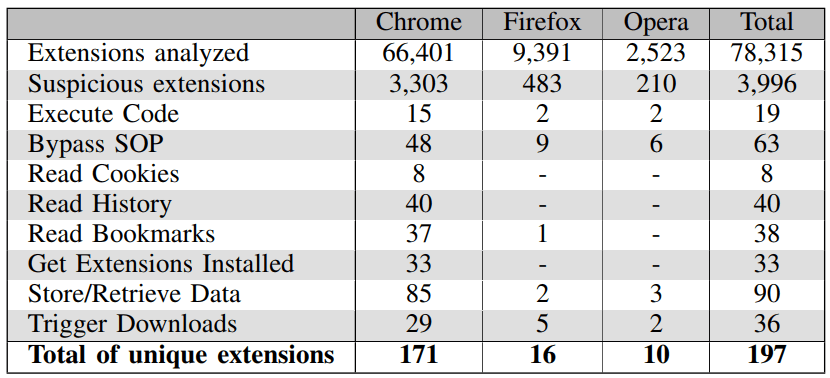
The researcher behind the paper focused on a specific class of web extension called "WebExtensions API," a cross-browser extensions system compatible with major browsers including Chrome, Firefox, Opera and Microsoft Edge. After analyzing 78,315 extensions that used the specific WebExtension API, it found 3,996 that were suspicious. While it seems voluminous, they noted that research found a small number of vulnerable extensions overall, and that concern should be measured. However, "browser vendors need to review extensions more rigorously, in particular take into consideration the use of message passing interfaces in extensions."

Android

Android Q Will Include More Ways For Carriers To SIM Lock Your Phone (9to5google.com) 262

An anonymous reader quotes a report from 9to5Google: Over the weekend, four commits were posted to various parts of Android's Gerrit source code management, all entitled "Carrier restriction enhancements for Android Q." In them, we see that network carriers will have more fine-grained control over which networks devices will and will not work on. More specifically, it will be possible to designate a list of "allowed" and "excluded" carriers, essentially a whitelist and a blacklist of what will and won't work on a particular phone. This can be done with a fine-grained detail to even allow blocking virtual carrier networks that run on the same towers as your main carrier.

Restriction changes are also on the way for dual-SIM devices. At the moment, carriers can set individual restrictions for each SIM slot, but with Android Q, carriers will be able to lock out the second slot unless there's an approved SIM card in the first slot. This SIM lock restriction is applied immediately and will persist through restarting the phone, and even doing a factory reset. Thankfully, in both cases, emergency phone calls will still work as expected, regardless of any restrictions on the particular SIM cards in your phone.

Science

Mark Zuckerberg-Funded Researchers Test Implantable Brain Devices (scmp.com) 80

Mark Zuckerberg and his pediatrician wife Priscilla Chan have sold close to 30 million shares of Facebook to fund an ambitious biomedical research project, called the Chan Zuckerberg Initiative (CZI), with a goal of curing all disease within a generation. A less publicized component of that US$5 billion program includes work on brain-machine interfaces, devices that essentially translate thoughts into commands. From a report: One recent project is a wireless brain implant that can record, stimulate and disrupt the movement of a monkey in real time. In a paper published in the highly cited scientific journal Nature on Monday, researchers detail a wireless brain device implanted in a primate that records, stimulates, and modifies its brain activity in real time, sensing a normal movement and stopping it immediately. Those researchers are part of the Chan Zuckerberg Biohub, a non-profit medical research group within the CZI. Scientists refer to the interference as "therapy" because it is designed to be used to treat diseases like epilepsy or Parkinson's by stopping a seizure or other disruptive motion just as it starts.

"Our device is able to monitor the primate's brain while it's providing the therapy so you know exactly what's happening," Rikky Muller, a co-author of the new study, told Business Insider. A professor of computer science and engineering at the University of California, Berkeley, Muller is also a Biohub investigator. The applications of brain-machine interfaces are far-reaching: while some researchers focus on using them to help assist people with spinal cord injuries or other illnesses that affect movement, others aim to see them transform how everyone interacts with laptops and smartphones. Both a division at Facebook formerly called Building 8 as well as an Elon Musk-founded company called Neuralink have said they are working on the latter.

Slashdot Top Deals