Games

Epic Is Cutting the Servers For 17 Older Online Games (kotaku.com) 85

Fortnite developer Epic Games announced today that it will no longer provide online service or servers for 17 older games, including six from the Unreal series dating back as far as 1998, and it will end access to some additional games entirely. The shutdowns are already starting to be enacted, but won't be completed until January 24, 2023. Kotaku reports: According to its announcement blog post, Epic described its decision to quit servicing some online games as part of its move toward "solely [supporting] Epic Online Services with its unified friends system, voice chat features, parental controls, and parental verification features." The full list of affected games is as follows: 1000 Tiny Claws, Dance Central 1, Dance Central 2, Dance Central 3, Green Day: Rock Band, Monsters (Probably) Stole My Princess, Rock Band 1, Rock Band 2, Rock Band 3, The Beatles: Rock Band, Supersonic Acrobatic Rocket-Powered Battle-Cars, Unreal Gold, Unreal II: The Awakening, Unreal Tournament 2003, Unreal Tournament 2004, Unreal Tournament 3, and Unreal Tournament: Game of the Year Edition.

And the last Band-Aid: though you can play those previous games if you own them, Epic is performing a few total shutdowns. Players will lose access to the following titles on their specified removal dates: Battle Breakers (December 30), Unreal Tournament: Alpha (January 24), Rock Band Blitz (January 24), Rock Band Companion (January 24), and SingSpace (January 24).

Earth

2022's 'Earthshot Prizes' Recognize Five Innovative Responses to Climate Change (bbc.com) 32

"Childhood friends in Oman who figured out how to turn carbon dioxide into rock are among five winners chosen for the Prince of Wales's prestigious Earthshot Prize," reports the BBC: The annual awards were created by Prince William to fund projects that aim to save the planet. Each winner will receive £1m ($1.2m) to develop their innovation.... "I believe that the Earthshot solutions you have seen this evening prove we can overcome our planet's greatest challenges," Prince William said during the ceremony. "By supporting and scaling them we can change our future," he said.
1,500 projects were nominated, according to the event's web site. Here's the five winners:
  • A Kenya-based company producing stoves powered by processed biomass (made from charcoal, wood and sugarcane) that "burns cleaner, creating 90% less pollution than an open fire," while cutting fuel costs in half.
  • The Indian startup behind Greenhouse-in-a-box. "Plants in the greenhouse require 98% less water than those outdoors and yields are seven-times higher," explains the site, while the greenhouses themselves are 90% cheaper than a standard greenhouse, "more than doubling farmers' incomes [while] using less water and fewer pesticides."
  • A Queensland-based program to expand the network of rangers using drones to monitor reefs and wildfires while sharing information and innovative ideas.
  • The company 44.01 removes CO2 permanently by mineralising it in peridotite, accelerating the natural process by pumping carbonated water into peridotite underground. (Unlike carbon storage, "mineralizing" CO2 removes it forever, making the process safer, cost-effective, and scalable.)

Five prizes will be awarded each year until 2030.


The Almighty Buck

Apple Blocks Coinbase Wallet App From Sending NFTs Because of In-App Purchase Dispute (macrumors.com) 32

Popular NFT and cryptocurrency app Coinbase Wallet today said that Apple required an NFT-sending feature to be removed from the app due to an in-app purchase dispute. MacRumors reports: Apple's App Store review team apparently told Coinbase that the "gas fees required to send NFTs need to be paid through in-app purchase." Apple wanted a cut of transactions, which Coinbase Wallet said is similar to Apple attempting to take a cut of fees for every email that's sent over the internet. Apple is asking for something that is not possible, because the in-app purchase system does not support cryptocurrency to begin with.

Coinbase Wallet says that Apple would not approve an app update until the NFT-sending feature was disabled, and the removal of the functionality will make it more difficult for iPhone users who have an NFT to transfer the NFT to other wallets or gift an NFT to friends or family. The developers behind the app say that Apple has introduced profit-protecting policies that come at the expense of "developer innovation across the crypto ecosystem." Coinbase Wallet is hoping that this is a mistake and has tweeted an invitation to Apple to discuss the matter.

Facebook

Meta Is on the Prowl for 'Suspicious Adults' Messaging Teenagers (gizmodo.com) 31

Meta says it is taking additional steps to help protect the youth on its platforms. Now, anyone under the age of 16 years old can enroll in new privacy settings that are meant to limit who can see their Facebook profile. Likewise, Meta says it's also testing the removal of the messaging button on teen's Instagram profiles when viewed by an adult. From a report: In a company press release, Meta further detailed its initiative to add safeguards to its Facebook and Instagram products that will hopefully protect teenage users from "potentially suspicious adults." The major overhaul in this initiative was Meta setting new privacy defaults for teen Facebook profiles.

Any new users under 16 (or under 18 in certain countries) will automatically be enrolled in the new settings, which includes restricting who is able to view your friends list, tagged posts, pages and people you follow, as well as who is allowed to comment on your posts. Pre-existing teenage users will not be automatically enrolled in the new settings, but can opt in whenever they want. On both Instagram and Facebook, teen users will also now be able to report a user immediately after they have blocked them in both app's messaging interface. Users will first be greeted with a prompt that asks if they know the person they are messaging, and will then be able to block, restrict, or report the user depending on the platform. The dialogue box also explains what blocking and reporting will do, and guides the user to more detailed information pages.
Further reading: Meta Sued in UK To Stop Personal Data Collection for Ads.
Books

Hard Science Fiction Master Greg Bear Dies at Age 71 (thegamer.com) 41

In 1999, Slashdot editor Hemos said Greg Bear was "rightly recognized as a master of hard science fiction" (introducing a review of Bear's then-new book, Nebula-winning book Darwin's Radio). In 2011 Bear began writing the Forerunner Saga , a trilogy of books set 100,000 years before the events in the game Halo.

Today theGamer.com writes that Bear has passed away at age 71: Bear's family and fans are paying tribute to the legendary author, who had more than 50 sci-fi novels to his name. Many share fond memories of reading Bear's work and meeting him at conventions, describing him as generous, welcoming, and brilliant. Fans are also sharing their favourite books from Bear in tribute, encouraging others to explore his works to celebrate his legacy.

Bear's wife, Astrid Bear, confirmed the news of his passing in the early hours of Sunday. This was after she revealed that her husband has been placed on life support, with no chance of making a full recovery after the stroke.

More from File770.com: Bear's novels won Nebulas for Moving Mars (1995) and Darwin's Radio. Three other works of short fiction won Nebulas, and two of those — "Blood Music" (1984) and "Tangents" (1987) — also won the Hugo....

Bear sold his first short story, "Destroyers", to Famous Science Fiction at age 15, and along with high-school friends helped found San Diego Comic-Con.

He also published work as an artist at the beginning of his career, including illustrations for an early version of theÂStar Trek Concordance,Âand covers forÂGalaxyÂandÂF&SF. He was a founding member of the Association of Science Fiction Artists. He even created the cover for his novel, Psychlone...

Cellphones

Do Screens Before Bedtime Actually Improve Your Sleep? (vulture.com) 45

Having trouble falling asleep, a writer for Vulture pondered a study from February in the Journal of Sleep Research that "runs refreshingly counter to common sleep-and-screens wisdom." For years, science and conventional wisdom have stated unequivocally that looking at a device — like a smartphone, tablet, laptop, or television — before bed is akin to lighting years of your natural life on fire, then letting the flames consume your children, your community, and the very concept of human progress....

Specifically interested in the use of "entertainment media" (streaming services, video games, podcasts) before bed, [the new February study's] researchers asked a group of 58 adults to keep a sleep diary and found that, if participants consumed entertainment media in the hour before bed, the habit was associated with an earlier bedtime as well as more sleep overall (though the benefits diminished if participants binged for longer than an hour or multitasked on their phones). Essentially, these researchers explored screen use before bed as a form of relaxation rather than a form of self-harm, which is exactly how I and probably 5 billion other people use it — as a way of distracting our minds from the onslaught of material reality just before we drift off to temporary oblivion.

Vulture's writer interviews Dr. Morgan Ellithorpe, one of the authors of the Journal of Sleep Research study and an assistant professor in the Department of Communication at the University of Delaware who specializes in media psychology. Dr. Ellithorpe is a proponent of intentional media use as a way to relieve stress, but she tells me that, in her research, she's found that the worst types of media to absorb before bed are those that have no "stopping point" — Instagram, TikTok, shows designed to be binge-watched. If you intend to binge a show, that might be fine: "Making a plan and sticking to it seems to matter," she says. We agree that humans are famously bad at that, and that's where the problems begin. The solution, Dr. Ellithorpe says, is figuring out why we're on our screens and if that reason is "meaningful." Are we turning to a screen in order to recover from an eventful day? Because we want something to talk about with our friends? Because we're seeking, as she puts it, a moment of "hedonic enjoyment"? The key is that you must be able to recognize when that need is fulfilled. Then "you're likely to have a good experience, and you won't need to force yourself to stop. But it takes practice."

Dr. Ellithorpe cites several studies for me to review — on gratification, mood-management theory, selective exposure, and self-determination theory — all of which, to various extents, grapple with the notion that human beings can make decisions to use media for purposeful things. "There's this push now to realize that people aren't a monolith, and media uses that seem bad for some people can actually be really good for other people." Although many researchers like Dr. Ellithorpe and her cohort are onboard with this push, she admits that "the movement has not filtered out to the public yet. So the public is still on this kick of 'Oh, media's bad.'"

And that's a huge part of the issue. "We sabotage ourselves when it comes to benefiting from media because we've been taught in our society to feel guilty for spending leisure time with media," Dr. Ellithorpe says. "The research in this area suggests that people who want to use media to recover from stress, if they then feel bad about doing so, they don't actually get the benefit from the media use."

But even Dr. Ellithorpe is prone to unintentional sleep moralizing, saying she is often "bad" and "on her phone two seconds before I turn off the light." She recommends watching a "low-challenge show" before bed and, like Dr. Kennedy, cites Stranger Things specifically as a dangerous pre-bed content choice because "you have to keep track of all the characters, remember what happened three seasons ago, and it's emotionally charged. It might be difficult afterward to come down from that and go to bed." In the end, she suggests watching whatever you want as long as it doesn't delay your bedtime.

Games

Age of Empires is 25 Years Old and Fans Are Shaping the Franchise (arstechnica.com) 15

It's been 25 years since a small studio in Dallas recast the ancient world through the prism of a real-time strategy game. From a report: Age of Empires has echoed Monk wololos about our homes ever since: Parents believed that their kids were learning history; kids believed that they were gaming surreptitiously. And veteran players know that both were right. Yet Age of Empires did not always receive the love it does today. The rise of the Xbox saw PC gaming take a back seat for Microsoft: Communities like AoE's were left to fend for themselves.

In a very real way, it was the passion of these obsessives that led to Microsoft's renewed attention and the release of the franchise's latest entry, 2021's Age of Empires IV. All the games continue to receive updates or DLCs. Age of Empires games are headed for Xbox and mobile devices, complete with cross-play so console gamers can get their hands on the RTS classic and play with their PC-loving friends. Also, Age of Mythology is finally getting a definitive edition. Age IV is building momentum, too, with an anniversary edition crowning a year of updates designed to woo players who found it a tad stripped back at launch. AoE is now a point of real-time-strategy pride and a shining jewel in Microsoft's roster.

Digital

'QR Code Menus Are the Restaurant Industry's Worst Idea' (theatlantic.com) 178

An anonymous reader shares an excerpt from an article written by The Atlantic's Conor Friedersdorf: Thinking of my earliest trips to restaurants, in the 1980s, I faintly remember waiters taking my grandfather's credit card and using a manual flatbed imprinter to make an impression of its raised numbers. My nephew, born early in the coronavirus pandemic, may come of age with similar memories of physical menus as a childhood relic. Recalling them dimly when a dining scene in an old movie jogs his memory, he might ask, "Why did they stop using those?" If that happens, I'll recount the pestilence that raged as he entered the world; the shutdown of bars and restaurants; the push to reopen in the summer of 2020; the persistent if mistaken belief that high-touch surfaces, like restaurant menus, would be a meaningful vector of infection; the counsel of the CDC that July. "Avoid using or sharing items that are reusable, such as menus," the federal agency advised (PDF). "Use disposable or digital menus."

The QR-code menu -- which you access by scanning a black-and-white square with your smartphone -- has taken off ever since. It may dominate going forward. But I hope not, because I detest those digital menus. Never mind dying peacefully in my sleep; I want to go out while sitting in a restaurant on my 100th birthday, an aperitif in my left hand and a paper menu in my right. And as eager as I'll be for heaven if I'm lucky enough to stand on its threshold, I want one last downward glance at a paramedic prying the menu from my fist. In that better future, where old-school menus endure, I'll go to my urn happy that coming generations will still begin meals meeting one another's eyes across a table instead of staring at a screen. QR-code menus are not really an advance. Even when everything goes just right -- when everyone's phone battery is charged, when the Wi-Fi is strong enough to connect, when the link works -- they force a distraction that lingers through dessert and digestifs. "You may just be checking to see what you want your next drink to be," Jaya Saxena observed in Eater late last year, "but from there it's easy to start checking texts and emails." And wasn't it already too easy?
Friedersdorf cites the 2018 study "Smartphone Use Undermines Enjoyment of Face-to-Face Social Interactions," where social-psychology researcher Ryan Dwyer and his colleagues randomly assigned some people to keep their phone out when dining with friends and others to put it away. What they found was that groups assigned to use their phones "enjoyed the experience less than groups that did not use their phones, primarily due to the fact that participants with phones were more distracted."

He also notes the privacy concerns related to QR-code menus. Many of the codes "are actually generated by a different company that collects, uses, and then often shares your personal information, " the ACLU has warned. "In fact, companies that provide QR codes to restaurants like to brag about all the personal information you are sharing along with that food order: your location, your demographics such as gender and age group, and other information about you and your behavior."

In closing, Friedersdorf writes: "[...] I hope that, rather than remembering the pandemic as a tipping point in the digitization of restaurants and bars, we instead look back on its aftermath as the moment when an ever more atomized society better understood the high costs of social isolation, felt new urgency to counteract it, and settled on analog mealtime norms as an especially vital place to focus."

"What if three times every day society was oriented toward replenishing what is growing more absent from the rest of our waking hours: undistracted human interactions unmediated by technology?"
Businesses

Freeway, Crypto Platform That Promised 43% Returns, Halts Withdrawals (gizmodo.com) 42

Freeway, a UK-based crypto platform that promised annual returns up to a mind-boggling 43%, halted withdrawals on Sunday, according to a notice published to the company's website. Freeway's native cryptocurrency, which goes by the ticker FWT, plummeted 74% following the announcement and, to top it all off, the Freeway website appears to be scrubbing the names and photos of some executives. From a report: Upset users have taken to the community Telegram channel for Freeway, expressing frustration that they can't access their accounts. People who told friends and family members to invest in the platform seemed the most angry, based on comments viewed by Gizmodo early Monday. The news, first reported by the crypto-watcher Twitter account FatManTerra, comes in the wake of other high-profile collapses in the crypto space this year, including Celsius, which has filed for bankruptcy. FatManTerra tweeted on Saturday that they believed Freeway was a Ponzi scheme which would likely collapse by this time next year. Well, apparently we didn't have to wait a whole year for things to collapse. It seems to have happened in just a day, as Freeway's website includes a varied assortment of confusing terms to explain that users can no longer access their money. And it sounds a lot like what Celsius said after it announced it was halting withdrawals back in June.
Lord of the Rings

'House of the Dragon' and 'Rings of Power' Face Off In Podcasting (bloomberg.com) 114

An anonymous reader quotes a report from Bloomberg: A good fall TV run comes to an end on Sunday when HBO airs its House of the Dragon season one finale, a week or so after Amazon wrapped up the first season of The Lord of the Rings: The Rings of Power. The shows aren't done yet providing content, though. Both Amazon and HBO offer companion podcasts to keep fans engaged, and both devised wildly different approaches for their audio. The podcasts offer behind-the-scenes chats with cast and crew and strive to become the definitive place to hear conversations around their respective programming. The shows' similarities end there, however.

HBO, for example, released three episodes of The Official Game of Thrones Podcast: House of the Dragon before the actual TV series aired, choosing to hype listeners up for the debut through an interview George R.R. Martin, as well as an "everything we know"-style show. Since then, the program has been released weekly alongside new episodes of the series on Sunday evenings. Michael Gluckstadt, director of podcasts for HBO and HBO Max, says the podcast will continue even after the series breaks between seasons. "There's no end date for this in sight," he said, which is atypical for podcasts the network has released in the past, including for Succession and The Gilded Age. [...] The podcast is available on all platforms, as well as on YouTube and the HBO Max app.

Meanwhile, Amazon didn't release any episodes of its The Official The Lord of the Rings: The Rings of Power Podcast until the season finale. Marshall Lewy, chief content officer at Amazon's Wondery, said the team wanted the streaming series to "speak for itself." Wondery has created companion podcasts before, namely for its own podcasts that were adapted for streaming, like Dr. Death and WeCrashed, but this marks the first time the team has worked in coordination with an Amazon series. "This is really our first opportunity to do a partnership like this connected to Prime Video," Lewy said. The podcast now receives front-and-center promotion ahead of each streaming video episode, which is the first time the coveted space has promoted something other than a Prime video series, he said. A promotion for The Official The Lord of the Rings: The Rings of Power Podcast that surfaces on Prime Video. The podcast is only available on Amazon Music, the Wondery app and Audible, a critical difference from HBO's strategy. Lewy said this decision made sense given that anyone watching the show is a Prime subscriber and can freely access Amazon Music.
"The effort put into these podcasts not only speaks to the need to increase fan engagement with the programming but to create an ongoing dialogue with viewers so they don't drop off from season to season," writes Bloomberg's Ashley Carman. "A person's podcast time likely differs from their streaming time, which in theory minimizes the risk of cannibalizing the hours that viewers could be spending on other Amazon or HBO series."

"The video services want more than just sixty minutes of their viewers' attention once a week -- they want to be a part of their day and part of their conversations with friends for as long as possible."
Security

Signal To Phase Out SMS Support From the Android App 54

schwit1 shares a blog post from Signal, the popular instant messaging app: In the interest of privacy, security, and clarity we're beginning to phase out SMS support from the Android app. You'll have several months to export your messages and either find a new app for SMS or tell your friends to download Signal.

[...] To give some context, when we started supporting SMS, Signal didn't exist yet. Our Android app was called TextSecure and the Signal encryption protocol was called Axolotl. Almost a decade has passed since then, and a lot has changed. In this time we changed our name, built iOS and desktop apps, and grew from a small project to the most widely used private messaging service on the planet. And we continued supporting the sending and receiving of plaintext SMS messages via the Signal interface on Android. We did this because we knew that Signal would be easier for people to use if it could serve as a homebase for most of the messages they were sending or receiving, without having to convince the people they wanted to talk to to switch to Signal first. But this came with a tradeoff: it meant that some messages sent and received via the Signal interface on Android were not protected by Signal's strong privacy guarantees.

We have now reached the point where SMS support no longer makes sense. For those of you interested, we walk through our reasoning in more detail below. In order to enable a more streamlined Signal experience, we are starting to phase out SMS support from the Android app. You will have several months to transition away from SMS in Signal, to export your SMS messages to another app, and to let the people you talk to know that they might want to switch to Signal, or find another channel if not.
Television

After 23 Years, Weather Channel's Iconic Computerized Channel Is Shutting Down (arstechnica.com) 10

An anonymous reader quotes a report from Ars Technica: In the early 2000s, Americans who wanted to catch the local weather forecast at any time might turn on their TV and switch over to Weatherscan, a 24-hour computer-controlled weather forecast channel with a relaxing smooth jazz soundtrack. After 23 years, The Weather Channel announced that Weatherscan will be shutting down permanently on or before December 9. But a group of die-hard fans will not let it go quietly into the night.

Launched in 1999, Weatherscan currently appears in a dwindling number of local American cable TV and satellite markets. It shows automated local weather information on a loop, generated by an Intellistar computer system installed locally for each market. Declining viewership and the ubiquity of smartphone weather apps are the primary reasons it's going offline. There are also technical issues with maintaining the hardware behind the service. "Weatherscan has been dying a slow death over the course of the last 10 years because the hardware is aging," says Mike Bates, a tech hobbyist who collects and restores Weather Channel computer hardware as part of a group of die-hard fans who follow insider news from the company. "It's 20 years old now, and more and more cable companies have been pulling the service." [...]

Hobbyists like Bates (who goes by "techknight" on Twitter) have collected the hardware necessary to run their own Weatherscan stations out of their homes. Some have also created software that simulates the service in a browser. [...] However, getting Weatherscan to run locally was a team effort, primarily by friends named Ethan, Brian, and Jesse. One of the Intellistar computer models behind the service runs FreeBSD on a Pentium 4-based PC in a blue rack-mount enclosure. It includes an ATI card for generating the graphics and a proprietary PowerPC-based card that pulls it all together to make it broadcast-ready. To get Weatherscan working at home, the group of friends found decommissioned Intellistar units on eBay and used forensic tools to reconstruct data from the hard drives, piecing together a working version of the Weatherscan software from multiple sources. Since then, they have exhibited their work at shows like the Vintage Computer Festival Midwest last month.

The Almighty Buck

Fraud, Scam Cases Increasing on P2P Payment Service Zelle, Senate Report Finds (apnews.com) 54

Incidents of fraud and scams are occurring more often on the popular peer-to-peer payment service Zelle, according to a report issued Monday by the office of Sen. Elizabeth Warren, giving the public its first glimpse into the growing problems at Zelle. From a report: The report also found that the large banks that partly own Zelle have been reluctant to compensate customers who have been victims of fraud or scams. For instance, less than half of the money customers reported being sent via Zelle without authorization was being reimbursed. Warren, D-Massachusetts, a long-time critic of the big banks, requested data on fraud and scams on Zelle from seven banks starting in April. The report cites data from four banks that tallied 192,878 cases worth collectively $213.8 million in 2021 and the first half of 2022 where a customer claimed they had been fraudulently tricked into making a payment. In only roughly 3,500 cases did those banks reimburse the customer, the report found.

Further, in the cases where it's clear funds had been taken out of customers' accounts without authorization, only 47% of those dollars were ever reimbursed. Since being launched in June 2017, Zelle has become a popular way for bank customers to send money to friends and family. Almost $500 billion in funds were sent via Zelle in 2021, according to Early Warning Services, the company that operates Zelle. Zelle is the banking industry's answer to the growing popularity of peer-to-peer payment services like PayPal, Venmo and the Cash App. The service allows a bank customer to instantaneously send money to a person via their email or phone number, and it will go from one bank account to another. More than 1,700 banks and credit unions offer the service. But the service has also grown more popular with scammers and criminals. Once money is sent via Zelle, it requires a bank's intervention to attempt to get that money back.

Businesses

Crypto Startup Helium Promised a 'People's Network.' Instead, Its Executives Got Rich. (forbes.com) 52

Helium was touted as the best real-world use case of Web3 technology. But as it struggles to generate revenue, a Forbes investigation found that executives and their friends quietly hoarded the majority of wealth at the project's inception. From a report: A review of hundreds of leaked internal documents, transaction data and interviews with five former Helium employees suggest that as Helium insiders touted the democratized spirit of their "People's Network," they quietly amassed a majority of the tokens earned at the project's start, hoarding much of the wealth generated in its earliest and most lucrative days. Forbes identified 30 digital wallets that appear to be connected to Helium employees, their friends and family and early investors. This group of wallets mined 3.5 million HNT -- almost half of all Helium tokens mined within the first three months of the network's launch in August 2019, according to a Forbes analysis that was confirmed by blockchain forensics firm Certik. Within six months, more than a quarter of all HNT had been mined by insiders -- valued at roughly $250 million when the price of Helium peaked last year. Even after the crypto price crashed, the tokens are still worth $21 million today.

Cryptocurrency companies typically compensate early investors and employees for building their offerings with an allotment of tokens, and disclose these rewards in blog posts or white papers. While Helium and its executives have publicly discussed their incentive plan -- a scheme called Helium Security Tokens, or HST, which guarantees about a third of all HNT for insiders -- they haven't previously disclosed the additional windfall taken from Helium's public token supply, worth millions, that was identified by Forbes. This means that at a time when Helium rewards per hotspot were at their highest, insiders claimed a majority of tokens, while little more than 30% went to Helium's community. Each hotspot earned an average 33,000 HNT in August 2019, according to blockchain data; today, each hotspot only earns around 2 HNT per month. Some insiders exploited vulnerabilities known to the company to increase their hauls even more.

Social Networks

Children May Be Losing the Equivalent of One Night's Sleep a Week From Social Media Use, Study Suggests (businessinsider.com) 31

Children under 12 may be losing the equivalent of one night's sleep every week due to excessive social media use, a new study suggests. Insider reports: Almost 70% of the 60 children under 12 surveyed by De Montfort University in Leicester, UK, said they used social media for four hours a day or more. Two thirds said they used social media apps in the two hours before going to bed. The study also found that 12.5% of the children surveyed were waking up in the night to check their notifications.

Psychology lecturer John Shaw, who headed up the study, said children were supposed to sleep for between nine to 11 hours a night, per NHS guidelines, but those surveyed reported sleeping an average of 8.7 hours nightly. He said: "The fear of missing out, which is driven by social media, is directly affecting their sleep. They want to know what their friends are doing, and if you're not online when something is happening, it means you're not taking part in it. "And it can be a feedback loop. If you are anxious you are more likely to be on social media, you are more anxious as a result of that. And you're looking at something, that's stimulating and delaying sleep."
"TikTok had the most engagement from the children, with 90% of those surveyed saying they used the app," notes Insider. "Snapchat was used by 84%, while just over half those surveyed said they used Instagram."
Amiga

Ask Slashdot: What Was Your First Computer? 523

Long-time Slashdot reader destinyland writes: Today GitHub's official Twitter account asked the ultimate geek-friendly question. "You never forget your first computer. What was yours?"

And within 10 hours they'd gotten 2,700 responses.

Commodore 64, TRS-80, Atari 800, Compaq Presario... People posted names you haven't heard in years, like they were sharing memories of old friends. Gateway 2000, Sony VAIO, Vic-20, Packard Bell... One person just remembered they'd had "some sort of PC that had an orange and black screen with text and QBasic. It couldn't do much more than store recipes and play text based games."

And other memories started to flow. ("Jammed on Commander Keen & Island of Dr. Brain..." "Dammit that Doom game was amazing, can't forget Oregon Trail...")

Sharp PC-4500, Toshiba T3200, Timex Sinclair 1000, NEC PC-8801. Another's first computer was "A really really old HP laptop that has a broken battery!"

My first computer was an IBM PS/2. It had a 2400 baud internal modem. Though in those long-ago days before local internet services, it was really only good for dialing up BBS's. I played chess against a program on a floppy disk that I got from a guy from work.

Can you still remember yours? Share your best memories in the comments.

What was your first computer?
Movies

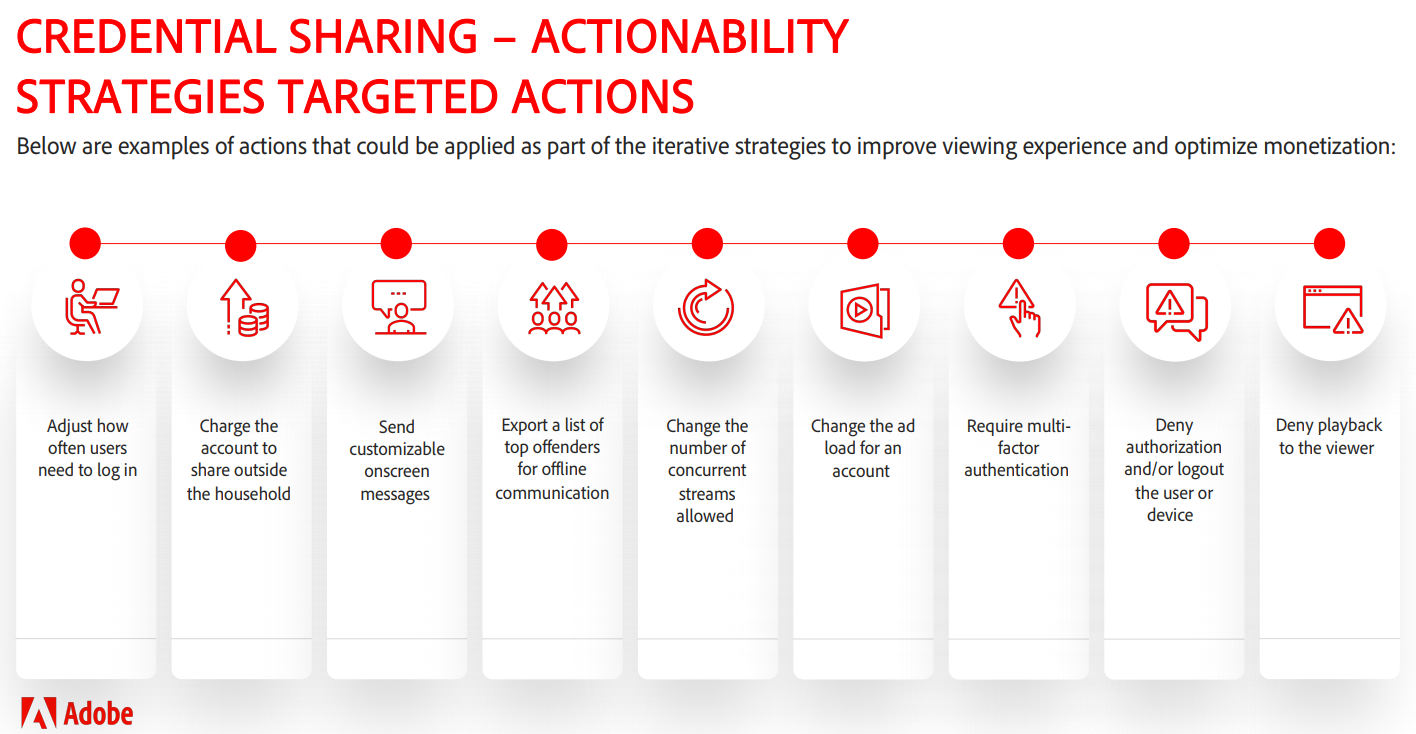
Adobe Thinks It Can Solve Netflix's Password 'Piracy' Problem 81

Adobe thinks it has the answer to Netflix's "password sharing" problem that involves up to 46 million people, according to a 2020 study. TorrentFreak reports: Adobe believes that since every user is different, any actions taken against an account should form part of a data-driven strategy designed to "measure, manage and monetize" password sharing. The company's vision is for platforms like Netflix to deploy machine learning models to extract behavioral patterns associated with an account, to determine how the account is being used. These insights can determine which measures should be taken against an account, and how success or otherwise can be determined by monitoring an account in the following weeks or months. Ignoring the obviously creepy factors for a moment, Adobe's approach does seem more sophisticated, even if the accompanying slide gives off a file-sharing-style "graduated response" vibe. That leads to the question of how much customer information Adobe would need to ensure that the right accounts are targeted, with the right actions, at the right time.

Adobe's Account IQ is powered by Adobe Sensei, which in turn acts as the intelligence layer for Adobe Experience Platform. In theory, Adobe will know more about a streaming account than those using it, so the company should be able to predict the most effective course of action to reduce password sharing and/or monetize it, without annoying the account holder. But of course, if you're monitoring customer accounts in such close detail, grabbing all available information is the obvious next step. Adobe envisions collecting data on how many devices are in use, how many individuals are active, and geographical locations -- including distinct locations and span. This will then lead to a "sharing probability" conclusion, along with a usage pattern classification that should identify travelers, commuters, close family and friends, even the existence of a second home.

Given that excessive sharing is likely to concern platforms like Netflix, Adobe's plan envisions a period of mass account monitoring followed by an on-screen "Excessive Sharing" warning in its dashboard. From there, legal streaming services can identify the accounts most responsible and begin preparing their "graduated response" towards changing behaviors. After monetizing those who can be monetized, those who refuse to pay can be identified and dumped. Or as Adobe puts it: "Return free-loaders to available market." Finally, Adobe also suggests that its system can be used to identify customers who display good behavior. These users can be rewarded by eliminating authentication requirements, concurrent stream limits, and device registrations.
Star Wars Prequels

New Avatar Movie and Star Wars TV Trailers Revealed at D23 Conference (sfgate.com) 53

CNET reveals some Star Wars news shared at Disney's three-day "D23 Expo." Fans were probably most thrilled by the reveal of a new Mandalorian trailer for the upcoming third season of the hit show that brought us Baby Yoda in all his cuteness... Lucasfilm also dropped a final trailer for upcoming Disney Plus series Andor. Diego Luna plays Cassian Andor as he's recruited into the rebellion against the Empire. The show takes place five years before the events of Rogue One.

And the studio presented a trailer for Tales of the Jedi, which offers six original shorts about Ahsoka and Dooku, and arrives October 26. Fans also got a glimpse, though not a trailer, showing Jude Law, who's starring in Star Wars: Skeleton Crew, a story about a group of younglings lost in space.

Also revealed was a "developer update" trailer for the upcoming mobile game Avatar: Reckoning, as part of the news about other franchises: James Cameron called in to the event from New Zealand to discuss Avatar: The Way of Water, and the crowd was given 3D glasses to watch some breathtaking footage [from] Cameron's long-awaited sequel... ahead of its December 16 release.

An exclusive clip from The Ant-Man and the Wasp: Quantumania featured Kang holding Cassie Lang hostage and trying to force Scott to steal something for him. Also featured: Bill Murray!

Samuel L. Jackson returns as Nick Fury in a new Disney Plus show called Secret Invasion, where Fury and friends (Oscar-winner Olivia Colman among them!) takes on shape-changing Skrulls. The trailer looks intense."

News

One of World's Most Polluted Spots Gets Worse as $1 Billion Cleanup Drags On (bloomberg.com) 32

Mismanagement, waste and lack of transparency are making the cleanup in the Niger Delta's Ogoniland anything but exemplary, UN reports indicate. From a report: In the more than a quarter century since Shell Plc left Ogoniland in southern Nigeria, oil has continued to ooze from dormant wellheads and active pipelines, leaving the 386-square mile kingdom's wetlands shimmering with a greasy rainbow sheen, its once-lush mangroves coated in crude, well-water smelling of benzene and farmlands charred and barren. So when the $1 billion Ogoniland cleanup began in 2019, backed by Shell's funding pledge and support from the United Nations, it was heralded as the most ambitious initiative of its kind anywhere in the world. But now, UN Environmental Programme documents seen by Bloomberg and reported for the first time indicate that the project -- far from being exemplary -- is making one of the earth's most polluted regions even dirtier.

"We had hoped that the Ogoniland cleanup process would set the standard for the cleanup that will have to take place in the Niger Delta as a whole," said Mike Karikpo, an Ogoni attorney with Friends of the Earth International. "But we've not seen any impact. There ought to be some impact on the lives and livelihoods of people whose lands and rivers were impacted by this oil." In a scathing review of the Ogoniland cleanup efforts, led by the Hydrocarbon Pollution Remediation Project, or Hyprep, the UN body paints a picture of rampant mismanagement, incompetence, waste and lack of transparency. It highlights the haphazard storage of oil-soaked soil that lets chemicals seep into uncontaminated grounds and creeks, contracts awarded to firms with little environmental-cleanup experience and proposals for millions of dollars in unneeded work.

Businesses

Chinese Behemoth Pinduoduo To Take On Amazon In US (theguardian.com) 64

An anonymous reader quotes a report from The Guardian: Americans addicted to Amazon could soon be wooed by a Chinese tech giant most of them have never heard of. Pinduoduo is planning to expand its reach to the US next month, according to reports in Bloomberg and Reuters. The company is known for delivering goods at rock-bottom prices -- while putting its employees through conditions that a prominent labor activist says should horrify Americans. Described by its founder, the former Google employee Colin Huang, as a cross between "Costco and Disneyland," Pinduoduo has ridden a wave of meteoric Chinese tech growth to become one of the largest e-commerce companies in the world since its founding in 2015.

Pinduoduo targeted China's smaller cities and more rural areas, where consumers tend to be less wealthy and more cost-conscious, says JS Tan, an MIT graduate student who researches the Chinese tech industry. Its signature feature is "group buying," which allows users to organize people to make mass purchases directly from manufacturers at a steep discount. Because Pinduoduo is heavily integrated with WeChat, China's top social media platform, it's a snap for users to gather up friends, family and internet strangers to order big batches of everything from electronics to baby formula to groceries -- something that became a lifeline during China's strict Covid lockdowns.

"Pinduoduo is known for its extreme overtime," said Li Qiang, a veteran labor activist and founder of the non-profit China Labor Watch. "The competition is extremely intense, and the conditions are much crueler than in America." Two Pinduoduo employees died within a two-week period from December 2020 to January 2021, igniting a national scandal. The first worker, 22-year-old Zhang Fei, died on 29 December, when she was heading home around 1.30am after a series of extremely long shifts. The second worker, an engineer in his 20s, jumped to his death on 9 January after abruptly asking for leave from the company and traveling home the same day. The controversy grew when days later, a Pinduoduo employee who called himself Wang Taixu said he had been fired by the company after posting a photo of a colleague being taken into an ambulance after collapsing. Wang subsequently published a lengthy video on the video-sharing site Bilibili detailing labor abuses he had witnessed at the company; he alleged that some workers were made to work as many as 380 hours a month, which the company denied.
"I think that for American tech workers, this definitely isn't a good thing," said Li. "In terms of manufacturing costs, American companies have no way to compete with Pinduoduo. If Pinduoduo succeeds, it could take Chinese-style labor practices and bring them to America."

Slashdot Top Deals