Moon

Astronomers Plan Far Side of the Moon Satellite to Hear Billion-Year-Old Radio Waves (cosmosmagazine.com) 12

An anonymous reader shared this report from Cosmos magazine about a plan to "pick up those faint signals from billions of years ago." Astronomers are planning to launch a tiny spacecraft to the far side of the Moon to listen out for "ancient whispers" in a quest to uncover the secrets of the early universe. The mission will focus on understanding the 'Cosmic Dawn', a period in the early stages of the universe after the Big Bang but before the first stars and galaxies appeared.

One of the difficulties in studying this period of the universe is that silence is essential. With all the electronics and interference in our atmosphere, Earth becomes too loud, making it unsuitable for this kind of research... The proposed mission will utilise the Moon as a giant shield, blocking out the noise from Earth, in order to observe these signals...

The mission, known as CosmoCube, is a joint study between the UK's University of Portsmouth, University of Cambridge and Rutherford Appleton Laboratory Space... CosmoCube's radio will operate at low frequencies (10-100MHz), which should hopefully be able to detect extremely faint signals. The team hope to reach lunar orbit before the end of the decade, with a roughly 5-year roadmap planned.

The article includes this quote from Professor David Bacon, from the University of Portsmouth and CosmoCube researcher. "It's incredible how far these radio waves have travelled, now arriving with news of the universe's history.

"The next step is to go to the quieter side of the Moon to hear that news."
The Internet

FCC Chair Accused of 'Political Theater' to Please Net Neutrality's Foes (freepress.net) 35

The advocacy group Free Press on Friday blasted America's Federal Communications Commission chief "for an order that rips net neutrality rules off the books, without any time for public comment, following an unfavorable court ruling," reports the nonprofit progressive news site Common Dreams: A panel from the U.S. Court of Appeals for the 6th Circuit ruled in January that broadband is an "information service" instead of a "telecommunications service" under federal law, and the FCC did not have the authority to prohibit internet service providers (ISPs) from creating online "fast lanes" and blocking or throttling web content... FCC Chair Brendan Carr said in a Friday statement that as part of his "Delete, Delete, Delete" initiative, "we're continuing to clean house at the FCC, working to identify and eliminate rules that no longer serve a purpose, have been on our books for decades, and have no place in the current Code of Federal Regulations...."

Responding in a lengthy statement, Free Press vice president of policy and general counsel Matt Wood said that "the FCC's so-called deletion today is little more than political grandstanding. It's true that the rules in question were first stayed by the 6th Circuit and then struck down by that appellate court — in a poorly reasoned opinion. So today's bookkeeping maneuver changes very little in reality... There's no need to delete currently inoperative rules, much less to announce it in a summer Friday order. The only reason to do that is to score points with broadband monopolies and their lobbyists, who've fought against essential and popular safeguards for the past two decades straight...."

Wood noted that "the appeals process for this case has not even concluded yet, as Free Press and allies sought and got more time to consider our options at the Supreme Court. Today's FCC order doesn't impact either our ability to press the case there or our strategic considerations about whether to do so," he added. "It's little more than a premature housekeeping step..."

Space

Just How Much Space Data Will the Rubin Observatory Collect? (space.com) 5

In its first 10 hours the Rubin space telescope found 2,104 never-before-seen asteroids in our solar system. And Gizmodo reports the data went directly to the International Astronomical Union's Minor Planet Center (MPC), which "plays an essential role in the early detection and monitoring of asteroids that threaten Earth." The MPC has spent years preparing for the deluge of data from Rubin, ramping up its software to process massive amounts of observations. When the first round officially came flooding in on Monday, it was "nerve-racking and exciting simultaneously," Matthew Payne, MPC director, told Gizmodo.
But Space.com explains how extraordinary that is. "There are approximately a million known asteroids in our cosmic neighborhood; over the next few years, Rubin could very well hike that figure up to five million." "This is five times more than all the astronomers in the world discovered during the last 200 years since the discovery of the first asteroid," Željko IveziÄ, Deputy Director of Rubin's Legacy Survey of Space and Time, said during the conference. "We can outdo two centuries of effort in just a couple of years...." The plan is for Rubin to capture such massive, high-resolution images of the southern sky once every three nights for at least the next 10 years. You can therefore consider it to be a super-fast, super-efficient and super-thorough cosmic imager. Indeed, those qualities are perfect for spotting some of the smallest details trailing through the space around our planet: asteroids. "We make movies of the night sky to see two things: objects that move and objects that change brightness," IveziÄ said. "Objects that move come in two flavors. Stars in our galaxy move, and they move slowly. Much faster objects are asteroids...."

[I]t's tremendously difficult to record an asteroid at all. "Asteroids, they disappear after you get one picture of them," IveziÄ said, calling Rubin's ability to image small objects orbiting the sun "unprecedented."

Space.com notes that the ten million galaxies in its first image are just 0.05% of around 20 billion galaxies that Rubin will have imaged by the end of its 10-year "Legacy Survey of Space and Time" investigating dark energy.

In fact, in its first year of regular operations, the Observation "will collect more data than all previous optical observatories combined," reports Earth.com. That torrent of information — petabytes of images and catalogs — will be processed in near-real time. Alerts will be issued to the worldwide astronomy community within 60 seconds of any detected change in the sky. By democratizing access to its enormous dataset, Rubin Observatory will empower both professionals and citizen scientists. This will foster discoveries that range from mapping the structure of the Milky Way to refining the rate at which the universe is expanding.
Reuters explains just how much data is being generated: The number of alerts the telescope will send every night is equivalent to the inboxes of 83,000 people. It's impossible for someone to look at that one by one," said astrophysicist Francisco Foster. "We're going to have to use artificial intelligence tools."
And New Atlas shares some of the "first look" videos released by the Observatory, including one titled The Cosmic Treasure Chest and another on the Trifid and Lagoon Nebulae (which Space.com describe as clouds of gas and dust condensing to birth new stars).
United States

Zuckerberg's Advocacy Group Warns US Families They Can't Afford Immigration Policy Changes 186

theodp writes: FWD.us, the immigration and criminal justice-focused nonprofit of Meta CEO Mark Zuckerberg -- the world's third richest person, according to Forbes with an estimated $250B net worth -- has released a new research report warning that announced immigration policies will hurt American families, who can't afford it with their meager savings.

The report begins: "Inflation remains a top concern for the majority of Americans. But new immigration policies announced by President Trump, and already underway, such as revoking immigrant work permits, deporting millions of people, and limiting legal immigration, would directly undermine the goal to level out, or even lower, the costs of everyday and essential goods and services. In fact, all Americans, particularly working-class families, are about to unnecessarily see prices for goods and services like food and housing increase substantially again, above and beyond other economic policies like global tariffs that could also raise prices. Announced immigration policies will result in American families paying an additional $2,150 for goods and services each year by the end of 2028, or the equivalent of the average American family's grocery bill for 3 months or their combined electricity and gas bills for the entire year. Such an annual increase would represent a tax that would erase many American families' annual savings, and amount to one of their bi-weekly paychecks each year. Unlike past periods of inflation, Americans have not been saving at the same rate as earlier years, and can't as easily absorb these price increases, squeezing American budgets even further."

In 2021, Zuckerberg's FWD.us teamed with the nation's tech giants to file a brief with the Supreme Court case to help crush WashTech (a tiny programmers' union), who challenged the lawfulness of hiring international students under the Optional Practical Training (OPT) program. "Striking down OPT and STEM OPT," FWD.us and its tech giant partners argued in their filing, [PDF] "would create a sudden labor shortage in the United States for many companies' most important technical jobs" and "hurt U.S. workers." The brief also dismissed WashTech's contention that the programs coupled with a talent surplus would shut U.S. workers out of the labor market, citing Microsoft's President Brad Smith's claim of an acute talent shortage and a 2.4% unemployment rate for computer occupations (that was then, this is now).
Windows

Games Run Faster On SteamOS Than Windows 11, Ars Testing Finds (arstechnica.com) 102

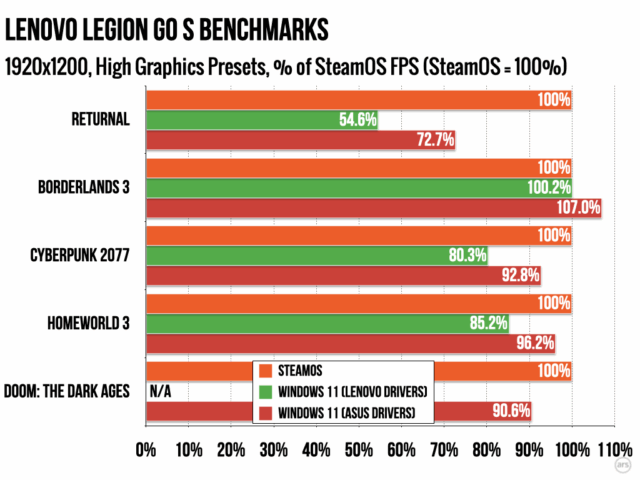
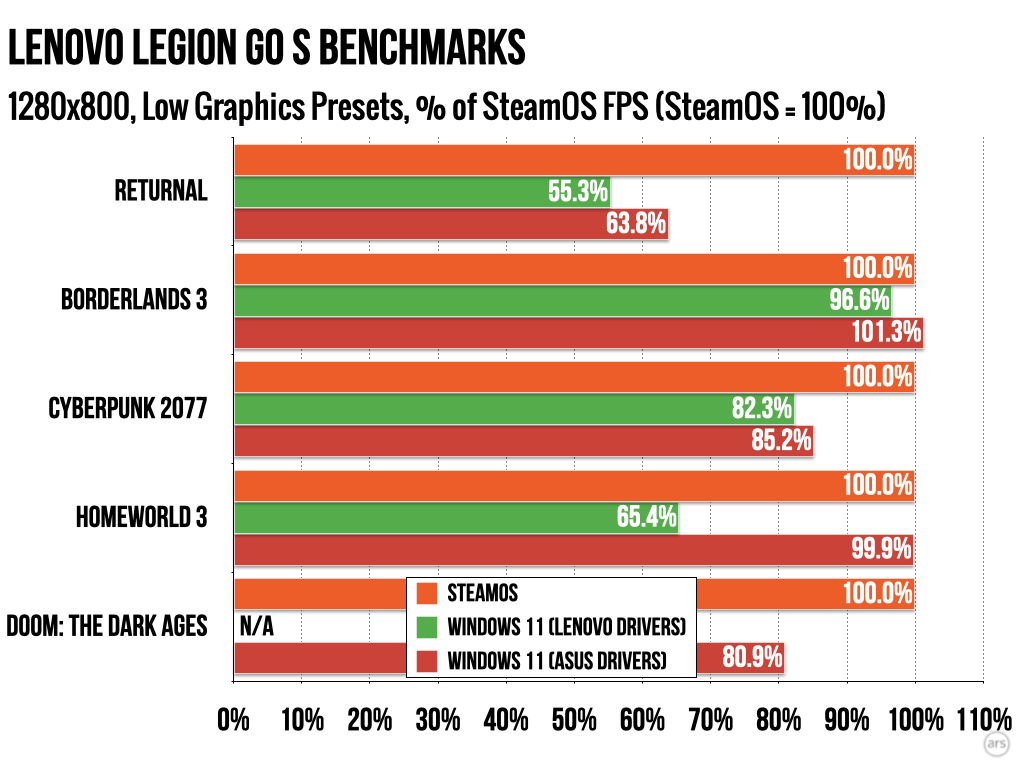
An anonymous reader quotes a report from Ars Technica: Nearly a decade ago, Ars testing found that Valve's "Steam Machines"-era version of SteamOS performed significantly worse than Windows when SteamOS's Linux game ports were tested on the same hardware as their Windows counterparts. Today, though, Ars testing on the Lenovo Legion Go S finds recent games generally run at higher frame rates on SteamOS 3.7 than on Windows 11. [...]

As you can see in the included charts, SteamOS showed noticeable frame rate improvements in four of the five games tested. Only Borderlands 3 showed comparable performance across both operating systems, with Windows eking out ever-so-slightly higher frame rates in that game's benchmarks. For the other four tested games, the stock Lenovo Windows drivers were sometimes significantly worse than those included with SteamOS. When playing Returnal at "High" graphics presets and 1920x1200 resolution, for instance, changing from Lenovo's Windows drivers to SteamOS meant the difference between a hard-to-take 18 FPS average and a downright decent 33 FPS average. Sideloading the updated Asus drivers showed a noticeable improvement in Windows performance across all tested games and even brought Homeworld 3's "Low" graphics benchmark test to practical parity with SteamOS. In all other cases, though, even these updated drivers resulted in benchmark frame rates anywhere from 8 percent to 36 percent lower than those same benchmarks on SteamOS.

These results might seem a bit counterintuitive, considering that games running on SteamOS must go through a Proton translation layer for every native Windows instruction in a game's code. But Valve has put in consistent work over the years to make Proton as efficient and cross-compatible as possible; not to mention its continued work on Linux's Mesa graphics drivers seems to be paying dividends for SteamOS graphics performance. Running SteamOS also means eliminating a lot of operating system overhead that the more generalist Windows uses by default. Microsoft seems aware of this issue for gamers and has recently announced that the upcoming "Xbox Experience for Handheld" will "minimize background activity and defer non-essential tasks" to allow for "more [and] higher framerates" in games.

AI

Hinge CEO Says Dating AI Chatbots Is 'Playing With Fire' (theverge.com) 57

In a podcast interview with The Verge's Nilay Patel, Hinge CEO Justin McLeod described integrating AI into dating apps as promising but warned against relying on AI companionship, likening it to "playing with fire" and consuming "junk food," potentially exacerbating the loneliness epidemic. He emphasized Hinge's mission to foster genuine human connections and highlighted upcoming AI-powered features designed to improve matchmaking and provide coaching to encourage real-world interactions. Here's an excerpt from the interview: Again, there's a fine line between prompting someone and coaching them inside Hinge, and we're coaching them in a different way within a more self-contained ecosystem. How do you think about that? Would you launch a full-on virtual girlfriend inside Hinge?

Certainly not. I have lots of thoughts about this. I think there's actually quite a clear line between providing a tool that helps people do something or get better at something, and the line where it becomes this thing that is trying to become your friend, trying to mimic emotions, and trying to create an emotional connection with you. That I think is really playing with fire. I think we are already in a crisis of loneliness, and a loneliness epidemic. It's a complex issue, and it's baked into our culture, and it goes back to before the internet. But just since 2000, over the past 20 years, the amount of time that people spend together in real life with their friends has dropped by 70 percent for young people. And it's been almost completely displaced by the time spent staring at screens. As a result, we've seen massive increases in mental health issues, and people's loneliness, anxiety, and depression.

I think Mark Zuckerberg was just quoted about this, that most people don't have enough friends. But he said we're going to give them AI chatbots. That he believes that AI chatbots can become your friends. I think that's honestly an extraordinarily reductive view of what a friendship is, that it's someone there to say all the right things to you at the right moment The most rewarding parts of being in a friendship are being able to be there for someone else, to risk and be vulnerable, to share experiences with other conscious entities. So I think that while it will feel good in the moment, like junk food basically, to have an experience with someone who says all the right things and is available at the right time, it will ultimately, just like junk food, make people feel less healthy and mo re drained over time. It will displace the human relationships that people should be cultivating out in the real world.

How do you compete with that? That is the other thing that is happening. It is happening. Whether it's good or bad. Hinge is offering a harder path. So you say, "We've got to get people out on dates." I honestly wonder about that, based on the younger folks I know who sometimes say, âoeI just don't want to leave the house. I would rather just talk to this computer. I have too much social pressure just leaving the house in this way.â That's what Hinge is promising to do. How do you compete with that? Do you take it head on? Are you marketing that directly?

I'm starting to think very much about taking it head on. We want to continue at Hinge to champion human relationships, real human-to-human-in-real-life relationships, because I think they are an essential part of the human experience, and they're essential to our mental health. It's not just because I run a dating app and, obviously, it's important that people continue to meet. It really is a deep, personal mission of mine, and I think it's absolutely critical that someone is out there championing this. Because it's always easier to race to the bottom of the brain stem and offer people junk products that maybe sell in the moment but leave them worse off. That's the entire model that we've seen from what happened with social media. I think AI chatbots could frankly be much more dangerous in that respect.

So what we can do is to become more and more effective and support people more and more, and make it as easy as possible to do the harder and riskier thing, which is to go out and form real relationships with real people. They can let you down and might not always be there for you, but it is ultimately a much more nourishing and enriching experience for people. We can also champion and raise awareness as much as we can. That's another reason why I'm here today talking with you, because I think it's important to put out the counter perspective, that we don't just reflexively believe that AI chatbots can be your friend, without thinking too deeply about what that really implies and what that really means.

We keep going back to junk food, but people had to start waking up to the fact that this was harmful. We had to do a lot of campaigns to educate people that drinking Coca-Cola and eating fast food was detrimental to their health over the long term. And then as people became more aware of that, a whole personal wellness industry started to grow, and now that's a huge industry, and people spend a lot of time focusing on their diet and nutrition and mental health, and all these other things. I think similarly, social wellness needs to become a category like that. It's thinking about not just how do I get this junk social experience of social media where I get fed outraged news and celebrity gossip and all that stuff, but how do I start building a sense of social wellness, where I can create an enriching, intimate connection with important people in my life.
You can listen to the podcast here.
Intel

Intel Will Lay Off 15% To 20% of Its Factory Workers, Memo Says 60

Intel will lay off 15% to 20% of its factory workforce starting in July, potentially cutting over 10,000 jobs as part of a broader effort to streamline operations amid declining sales and mounting competitive pressure. "These are difficult actions but essential to meet our affordability challenges and current financial position of the company. It drives pain to every individual," Intel manufacturing Vice President Naga Chandrasekaran wrote to employees Saturday. "Removing organizational complexity and empowering our engineers will enable us to better serve the needs of our customers and strengthen our execution. We are making these decisions based on careful consideration of what's needed to position our business for the future." The company reiterated that "we will treat people with care and respect as we complete this important work." Oregon Live reports: Intel announced the pending layoffs in April and notified factory workers last week that the cuts would begin in July. It hadn't previously said just how deep the layoffs will go. The company had 109,000 employees at the end of 2024, but it's not clear how many of those worked in its factory division -- called Intel Foundry. The Foundry business includes a broad array of jobs, from technicians on the factory floor to specialized researchers who work years in advance to develop future generations of microprocessors.

Intel is planning major cuts in other parts of its business, too, but employees say the company hasn't specified how many jobs it will eliminate in each business unit. Workers say they believe the impacts will vary within departments. Overall, though, the layoffs will surely eliminate several thousand jobs -- and quite possibly more than 10,000.
Math

Researchers Create World's First Completely Verifiable Random Number Generator (nature.com) 60

Researchers have built a breakthrough random number generator that solves a critical problem: for the first time, every step of creating random numbers can be independently verified and audited, with quantum physics guaranteeing the numbers were truly unpredictable.

Random numbers are essential for everything from online banking encryption to fair lottery drawings, but current systems have serious limitations. Computer-based generators follow predictable algorithms -- if someone discovers the starting conditions, they can predict all future outputs. Hardware generators that measure physical processes like electronic noise can't prove their randomness wasn't somehow predetermined or tampered with.

The new system, developed by teams at the University of Colorado Boulder and the National Institute of Standards and Technology, uses quantum entanglement -- Einstein's "spooky action at a distance" -- to guarantee unpredictability. The setup creates pairs of photons that share quantum properties, then sends them to measurement stations 110 meters apart. When researchers measure each photon's properties, quantum mechanics ensures the results are fundamentally random and cannot be influenced by any classical communication between the stations.

The team created a system called "Twine" that distributes the random number generation process across multiple independent parties, with each step recorded in tamper-proof digital ledgers called hash chains. This means no single organization controls the entire process, and anyone can verify that proper procedures were followed. During a 40-day demonstration, the system successfully generated random numbers in 7,434 of 7,454 attempts -- a 99.7% success rate. Each successful run produced 512 random bits with mathematical certainty of randomness bounded by an error rate of 2^-64, an extraordinarily high level of confidence.
Microsoft

Denmark Is Dumping Microsoft Office and Windows For LibreOffice and Linux (zdnet.com) 277

An anonymous reader quotes a report from ZDNet: Denmark's Minister of Digitalization, Caroline Stage, has announced that the Danish government will start moving away from Microsoft Office to LibreOffice. Why? It's not because open-source is better, although I would argue that it is, but because Denmark wants to claim "digital sovereignty." In the States, you probably haven't heard that phrase, but in the European Union, digital sovereignty is a big deal and getting bigger.

A combination of security, economic, political, and societal imperatives is driving the EU's digital sovereignty moves. EU leaders are seeking to reduce Europe's dependence on foreign technology providers, primarily those from the United States, and to assert greater control over its digital infrastructure, data, and technological future. Why? Because they're concerned about who controls European data, who sets the rules, and who can potentially cut off access to essential services in times of geopolitical tension.
"Money issues have also played a decisive role," writes ZDNet's Steven Vaughan-Nichols. "Copenhagen's Microsoft software bill has soared from 313 million kroner in 2018 to 538 million kroner -- about $53 million in 2023, a 72% increase in just five years.

David Heinemeier Hansson (DHH), a Dane, inventor of Ruby on Rails, and co-owner of the software developer company 37Signals, has said: "Denmark is one of the most highly digitalized countries in the world. It's also one of the most Microsoft-dependent. In fact, Microsoft is by far and away the single biggest dependency, so it makes perfect sense to start the quest for digital sovereignty there."
Businesses

Canva Now Requires Use of LLMs During Coding Interviews 85

An anonymous reader quotes a report from The Register: Australian SaaS-y graphic design service Canva now requires candidates for developer jobs to use AI coding assistants during the interview process. [...] Canva's hiring process previously included an interview focused on computer science fundamentals, during which it required candidates to write code using only their actual human brains. The company now expects candidates for frontend, backend, and machine learning engineering roles to demonstrate skill with tools like Copilot, Cursor, and Claude during technical interviews, Canva head of platforms Simon Newton wrote in a Tuesday blog post.

His rationale for the change is that nearly half of Canva's frontend and backend engineers use AI coding assistants daily, that it's now expected behavior, and that the tools are "essential for staying productive and competitive in modern software development." Yet Canva's old interview process "asked candidates to solve coding problems without the very tools they'd use on the job," Newton admitted. "This dismissal of AI tools during the interview process meant we weren't truly evaluating how candidates would perform in their actual role," he added. Candidates were already starting to use AI assistants during interview tasks -- and sometimes used subterfuge to hide it. "Rather than fighting this reality and trying to police AI usage, we made the decision to embrace transparency and work with this new reality," Newton wrote. "This approach gives us a clearer signal about how they'll actually perform when they join our team."
The initial reaction among engineers "was worry that we were simply replacing rigorous computer science fundamentals with what one engineer called 'vibe-coding sessions,'" Newton said.

The company addressed these concerns with a recruitment process that sees candidates expected to use their preferred AI tools, to solve what Newton described as "the kind of challenges that require genuine engineering judgment even with AI assistance." Newton added: "These problems can't be solved with a single prompt; they require iterative thinking, requirement clarification, and good decision-making."
Programming

Bill Atkinson, Hypercard Creator and Original Mac Team Member, Dies at Age 74 (appleinsider.com) 53

AppleInsider reports: The engineer behind much of the Mac's early graphical user interfaces, QuickDraw, MacPaint, Hypercard and much more, William D. "Bill" Atkinson, died on June 5 of complications from pancreatic cancer...

Atkinson, who built a post-Apple career as a noted nature photographer, worked at Apple from 1978 to 1990. Among his lasting contributions to Apple's computers were the invention of the menubar, the selection lasso, the "marching ants" item selection animation, and the discovery of a midpoint circle algorithm that enabled the rapid drawing of circles on-screen.

He was Apple Employee No. 51, recruited by Steve Jobs. Atkinson was one of the 30 team members to develop the first Macintosh, but also was principle designer of the Lisa's graphical user interface (GUI), a novelty in computers at the time. He was fascinated by the concept of dithering, by which computers using dots could create nearly photographic images similar to the way newspapers printed photos. He is also credited (alongside Jobs) for the invention of RoundRects, the rounded rectangles still used in Apple's system messages, application windows, and other graphical elements on Apple products.

Hypercard was Atkinson's main claim to fame. He built the a hypermedia approach to building applications that he once described as a "software erector set." The Hypercard technology debuted in 1987, and greatly opened up Macintosh software development.

In 2012 some video clips of Atkinson appeared in some rediscovered archival footage. (Original Macintosh team developer Andy Hertzfeld uploaded "snippets from interviews with members of the original Macintosh design team, recorded in October 1983 for projected TV commercials that were never used.")

Blogger John Gruber calls Atkinson "One of the great heroes in not just Apple history, but computer history." If you want to cheer yourself up, go to Andy Hertzfeld's Folklore.org site and (re-)read all the entries about Atkinson. Here's just one, with Steve Jobs inspiring Atkinson to invent the roundrect. Here's another (surely near and dear to my friend Brent Simmons's heart) with this kicker of a closing line: "I'm not sure how the managers reacted to that, but I do know that after a couple more weeks, they stopped asking Bill to fill out the form, and he gladly complied."

Some of his code and algorithms are among the most efficient and elegant ever devised. The original Macintosh team was chock full of geniuses, but Atkinson might have been the most essential to making the impossible possible under the extraordinary technical limitations of that hardware... In addition to his low-level contributions like QuickDraw, Atkinson was also the creator of MacPaint (which to this day stands as the model for bitmap image editorsâ — âPhotoshop, I would argue, was conceptually derived directly from MacPaint) and HyperCard ("inspired by a mind-expanding LSD journey in 1985"), the influence of which cannot be overstated.

I say this with no hyperbole: Bill Atkinson may well have been the best computer programmer who ever lived. Without question, he's on the short list. What a man, what a mind, what gifts to the world he left us.

The Internet

Proxy Services Feast On Ukraine's IP Address Exodus (krebsonsecurity.com) 93

An anonymous reader quotes a report from KrebsOnSecurity: Ukraine has seen nearly one-fifth of its Internet space come under Russian control or sold to Internet address brokers since February 2022, a new study finds. The analysis indicates large chunks of Ukrainian Internet address space are now in the hands of shadowy proxy and anonymity services that are nested at some of America's largest Internet service providers (ISPs). The findings come in a report that examines how the Russian invasion has affected Ukraine's domestic supply of Internet Protocol Version 4 (IPv4) addresses. Researchers at Kentik, a company that measures the performance of Internet networks, found that while a majority of ISPs in Ukraine haven't changed their infrastructure much since the war began in 2022, others have resorted to selling swathes of their valuable IPv4 address space just to keep the lights on.

For example, Ukraine's incumbent ISP Ukrtelecom is now routing just 29 percent of the IPv4 address ranges that the company controlled at the start of the war, Kentik found. Although much of that former IP space remains dormant, Ukrtelecom told Kentik's Doug Madory they were forced to sell many of their address blocks "to secure financial stability and continue delivering essential services." "Leasing out a portion of our IPv4 resources allowed us to mitigate some of the extraordinary challenges we have been facing since the full-scale invasion began," Ukrtelecom told Madory.

Madory found much of the IPv4 space previously allocated to Ukrtelecom is now scattered to more than 100 providers globally, particularly at three large American ISPs -- Amazon (AS16509), AT&T (AS7018), and Cogent (AS174). Another Ukrainian Internet provider -- LVS (AS43310) -- in 2022 was routing approximately 6,000 IPv4 addresses across the nation. Kentik learned that by November 2022, much of that address space had been parceled out to over a dozen different locations, with the bulk of it being announced at AT&T. Ditto for the Ukrainian ISP TVCOM, which currently routes nearly 15,000 fewer IPv4 addresses than it did at the start of the war. Madory said most of those addresses have been scattered to 37 other networks outside of Eastern Europe, including Amazon, AT&T, and Microsoft.

Biotech

Uploading the Human Mind Could One Day Become a Reality, Predicts Neuroscientist (sciencealert.com) 107

A 15-year-old asked the question — receiving an answer from an associate professor of psychology at Georgia Institute of Technology. They write (on The Conversation) that "As a brain scientist who studies perception, I fully expect mind uploading to one day be a reality.

"But as of today, we're nowhere close..." Replicating all that complexity will be extraordinarily difficult. One requirement: The uploaded brain needs the same inputs it always had. In other words, the external world must be available to it. Even cloistered inside a computer, you would still need a simulation of your senses, a reproduction of the ability to see, hear, smell, touch, feel — as well as move, blink, detect your heart rate, set your circadian rhythm and do thousands of other things... For now, researchers don't have the computing power, much less the scientific knowledge, to perform such simulations.

The first task for a successful mind upload: Scanning, then mapping the complete 3D structure of the human brain. This requires the equivalent of an extraordinarily sophisticated MRI machine that could detail the brain in an advanced way. At the moment, scientists are only at the very early stages of brain mapping — which includes the entire brain of a fly and tiny portions of a mouse brain. In a few decades, a complete map of the human brain may be possible. Yet even capturing the identities of all 86 billion neurons, all smaller than a pinhead, plus their trillions of connections, still isn't enough. Uploading this information by itself into a computer won't accomplish much. That's because each neuron constantly adjusts its functioning, and that has to be modeled, too. It's hard to know how many levels down researchers must go to make the simulated brain work. Is it enough to stop at the molecular level? Right now, no one knows.

Knowing how the brain computes things might provide a shortcut. That would let researchers simulate only the essential parts of the brain, and not all biological idiosyncrasies. Here's another way: Replace the 86 billion real neurons with artificial ones, one at a time. That approach would make mind uploading much easier. Right now, though, scientists can't replace even a single real neuron with an artificial one. But keep in mind the pace of technology is accelerating exponentially. It's reasonable to expect spectacular improvements in computing power and artificial intelligence in the coming decades.

One other thing is certain: Mind uploading will certainly have no problem finding funding. Many billionaires appear glad to part with lots of their money for a shot at living forever. Although the challenges are enormous and the path forward uncertain, I believe that one day, mind uploading will be a reality.

"The most optimistic forecasts pinpoint the year 2045, only 20 years from now. Others say the end of this century.

"But in my mind, both of these predictions are probably too optimistic. I would be shocked if mind uploading works in the next 100 years.

"But it might happen in 200..."
Science

Five-Year Study Suggests Chimpanzees Strike Stones Against Trees As Form of Communication (phys.org) 25

A five-year study by Wageningen University and the German Primate Research Center found that wild chimpanzees in Guinea-Bissau repeatedly strike stones against trees, presumably as a form of communication. Phys.Org reports: Over the course of a five-year field study, the research team collected video footage at five distinct locations within a nature reserve in Guinea-Bissau. This was made possible through the use of camera traps and with essential support from local field guides. In specific areas, a striking behavioral pattern was observed: adult male chimpanzees repeatedly struck stones against tree trunks, resulting in characteristic piles of stones at the base of these trees. [...]

The observations point to cultural transmission. Young chimpanzees adopt the behavior from older group members, indicating that it is learned socially rather than genetically inherited. Marc Naguib, Professor of Behavioral Ecology, underscores the broader significance of the discovery: "It illustrates that culture is not unique to humans and that such behaviors need to be considered also in nature conservation."
The study is published in the journal Biology Letters.
Cellphones

OnePlus Is Replacing Its Alert Slider With an AI Button (engadget.com) 19

OnePlus is replacing its iconic Alert Slider with a new customizable "Plus Key" on the upcoming OnePlus 13s, which launches the new AI Plus Mind feature that lets users capture and search content found on screen. This update is part of a broader AI push for its devices that includes tools like AI VoiceScribe for call summaries, AI Translation for multi-modal language support, and AI Best Face 2.0 for photo corrections. Engadget reports: What AI Plus Mind does is save relevant content to a dedicated Mind Space, where users can browse various information that they've saved. Users can then search for the detail they want to find using natural language queries. Both the Plus Key and the AI Plus Mind will debut on the OnePlus 13s in Asia. AI Plus Mind will roll out to the rest of the OnePlus 13 Series devices through a future software update, while all future OnePlus phone will come with the new physical key. Notably, the new button and feature bear similarities to Nothing's physical Essential Key that can also save information inside the Essential Space app. Nothing was founded by Carl Pei who co-founded OnePlus.
Japan

Japan and the Birth of Modern Shipbuilding (construction-physics.com) 25

An interesting piece on Construction Physics that examines how Japan transformed discarded American wartime shipbuilding techniques into a revolutionary manufacturing system that captured nearly half the global market by 1970. The story reveals the essential ingredients for industrial dominance: government backing, organizational alignment, relentless will to improve, and the systematic coordination needed to turn existing technologies into something entirely new. A few excerpts: During WWII, the US constructed an unprecedented shipbuilding machine. By assembling ships from welded, prefabricated blocks, the US built a huge number of cargo ships incredibly quickly, overwhelming Germany's u-boats and helping to win the war. But when the war was over, this shipbuilding machine was dismantled. Industrialists like Henry Kaiser and Stephen Bechtel, who operated some of the US's most efficient wartime shipyards, left the shipbuilding business. Prior to the war, the US had been an uncompetitive commercial shipbuilder producing a small fraction of commercial oceangoing ships, and that's what it became again. At the height of the war the US was producing nearly 90% of the world's ships. By the 1950s, it produced just over 2%.

But the lessons from the US's shipbuilding machine weren't forgotten. After the war, practitioners brought them to Japan, where they would continue to evolve, eventually allowing Japan to build ships faster and cheaper than almost anyone else in the world.

[...] The third strategy that formed the core of modern shipbuilding methods was statistical process control. The basic idea behind process control is that it's impossible to make an industrial process perfectly reliable. There will always be some variation in what it produces: differences in part dimensions, material strength, chemical composition, and so on. But while some variation is inherent to the process (and must be accepted), much of the variation is from specific causes that can be hunted down and eliminated. By analyzing the variation in a process, undesirable sources of variation can be removed. This makes a process work more reliably and predictably, reducing waste and rework from parts that are outside acceptable tolerances.

Canada

Business Owners Are Using AI-Generated 'Concerned Residents' To Fight Proposed Bus Line In Toronto 144

A group of Bathurst Street business owners in Toronto is using AI-generated personas to oppose a proposed bus lane project that would eliminate parking spaces in favor of faster transit. "This may be the first Toronto transit controversy involving angry AI, but tensions have been simmering between drivers and, well, everyone else for some time," reports Toronto Life. Critics argue that better transit is essential for a livable city, while opponents claim the change threatens small businesses and accessibility. From the report: A group of Bathurst business owners are bent out of shape over a recent proposal for priority transit lanes between Eglinton Avenue and Lake Shore Boulevard, part of the city's new RapidTO program. According to the city, the transit lanes would shave up to 7 minutes off some trips during peak commuting hours. It's good news for anyone who has ever cursed the TTC while waiting to catch a bus in inclement weather. Of course, the added convenience for transit commuters would come at a slight cost for drivers, requiring the removal of at least 138 paid street parking spaces to make way for the new lanes. Opposition to the development has sprung up under the banner of Protect Bathurst, a group of hopping mad local business owners claiming that the lack of street parking will make shopping a nightmare for car-bound customers and will cause problems for people with mobility issues.

Notably, Protect Bathurst has no spokesperson or contact info listed on its website. The page is registered to a food marketing consultant employed by Summerhill Market and looks eerily similar to Protect Dufferin, another group of "concerned residents" advocating for the same cause. But this cookie-cutter approach goes even further: author and urbanist Shawn Micallef has found that the people speaking out in the group's allegedly grassroots videos appear to be AI-generated. Brad McMullen, the president of Summerhill Market, which opened an outpost on Bathurst in 2019, says he doesn't know anything about the campaign's use of AI. He says he isn't necessarily opposed to the new bus lanes but believes that three weeks' notice from the city is not enough time for his business to adapt. "We purchased and invested in this location because of the available street parking, and then we figured out the loading situation, which happens on the street," he says. "I don't think Summerhill Market would work here with these bus lanes."
Stats

Thoughts About the Evolution of Mainstream Macroeconomics Over the Last 40 Years (nber.org) 51

Abstract of a paper featured on NBER: This year marks the 40th anniversary of the NBER Macro Annual Conference, founded in 1986. This paper reviews the evolution of mainstream macroeconomics since then. It presents my views, informed by a survey of a number of researchers who have made important contributions to the field. I develop two main arguments.

The first is that, starting from strikingly different positions, there has been substantial convergence, in terms of methodology, architecture, and main mechanisms. Methodology: Explicit micro foundations, explicit treatment of distortions, with, at the same time, an increased willingness to deviate from rational expectations, neoclassical utility and profit maximization. Architecture: The wide acceptance of nominal rigidities as an essential distortion, although with mixed feelings. Mechanisms: The wide nature of the shocks to both the demand and the supply side.

The second is that this convergence has been, for the most part, good convergence, i.e. the creation of a generally accepted conceptual and analytical structure, a core to which additional distortions can be added, allowing for discussions and integration of new ideas and evidence, rather than fights about basic methodology. Not everything is right however, with too much emphasis on general equilibrium implications from the start, rather than, first, on partial equilibrium analysis of the phenomenon at hand.

Open Source

Microsoft Is Open-Sourcing Its Linux Integration Services Automation Image-Testing Service (zdnet.com) 22

An anonymous reader quotes a report from ZDNet: Would you believe Microsoft has announced a new Linux distribution service for its Azure cloud service? You should. For many years, the most popular operating system on Azure has not been Windows Server, it's been Linux. Last time I checked, in 2024, Azure Linux Platforms Group Program Manager Jack Aboutboul told me that 60% of Azure Marketplace offerings and more than 60% of virtual machine cores use Linux. Those figures mean it's sensible for Microsoft to make it easier than ever for Linux distributors to release first-class Linux distros on Azure. The tech giant is taking this step, said Andrew Randall, principal manager for the Azure Core Linux product management team, by making "Azure Image Testing for Linux (AITL) available 'as a service' to distro publishers."

ATIL is built on Microsoft's Linux Integration Services Automation project (LISA). Microsoft's Linux Systems Group originally developed this initiative to validate Linux OS images. LISA is a Linux quality validation system with two parts: a test framework to drive test execution and a set of test suites to verify Linux distribution quality. LISA is now open-sourced under the MIT License. The system enables continuous testing of Linux images, covering a wide range of scenarios from kernel updates to complex cloud-native workloads. [...] Specifically, the ATIL service is designed to streamline the deployment, testing, and management of Linux images on Azure. The service builds on the company's internal expertise and open-source tools to provide:

- Curated, Azure-optimized, security-hardened Linux images
- Automated quality assurance and compliance testing for Linux distributions
- Seamless integration with Azure's cloud-native services and Kubernetes environments
Krum Kashan, Microsoft Azure Linux Platforms Group program manager, said in a statement: "While numerous testing tools are available for validating Linux kernels, guest OS images, and user space packages across various cloud platforms, finding a comprehensive testing framework that addresses the entire platform stack remains a significant challenge. A robust framework is essential, one that seamlessly integrates with Azure's environment while providing coverage for major testing tools, such as LTP and kselftest, and covers critical areas like networking, storage, and specialized workloads, including Confidential VMs, HPC, and GPU scenarios. This unified testing framework is invaluable for developers, Linux distribution providers, and customers who build custom kernels and images."
United Kingdom

Creatives Demand AI Comes Clean On What It's Scraping 60

Over 400 prominent UK media and arts figures -- including Paul McCartney, Elton John, and Ian McKellen -- have urged the prime minister to support an amendment to the Data Bill that would require AI companies to disclose which copyrighted works they use for training. The Register reports: The UK government proposes to allow exceptions to copyright rules in the case of text and data mining needed for AI training, with an opt-out option for content producers. "Government amendments requiring an economic impact assessment and reports on the feasibility of an 'opt-out' copyright regime and transparency requirements do not meet the moment, but simply leave creators open to years of copyright theft," the letter says.

The group -- which also includes Kate Bush, Robbie Williams, Tom Stoppard, and Russell T Davies -- said the amendments tabled for the Lords debate would create a requirement for AI firms to tell copyright owners which individual works they have ingested. "Copyright law is not broken, but you can't enforce the law if you can't see the crime taking place. Transparency requirements would make the risk of infringement too great for AI firms to continue to break the law," the letter states.
Baroness Kidron, who proposed the amendment, said: "How AI is developed and who it benefits are two of the most important questions of our time. The UK creative industries reflect our national stories, drive tourism, create wealth for the nation, and provide 2.4 million jobs across our four nations. They must not be sacrificed to the interests of a handful of US tech companies." Baroness Kidron added: "The UK is in a unique position to take its place as a global player in the international AI supply chain, but to grasp that opportunity requires the transparency provided for in my amendments, which are essential to create a vibrant licensing market."

The letter was also signed by a number of media organizations, including the Financial Times, the Daily Mail, and the National Union of Journalists.

Slashdot Top Deals