Submission + - After Backlash, Zoom Now Says It Won't Train AI Systems On Customer Content (variety.com)

An anonymous reader writes: Zoom changed its terms of service to say that it won’t use any customer content — at all — in training generative artificial intelligence models. The update, which the videoconference company announced Friday, comes after observers raised the alarm about a recent change in Zoom’s TOS that appeared to grant the company royalty-free rights in perpetuity for customer video calls and presentations for the purposes of training AI models. In its initial response on Aug. 7, Zoom said it doesn’t use any customer audio, video or chat content for training AI “without consent.” Now it says it will not use such content in any way related to generative AI development.

In a statement Friday appended its its earlier blog post, Zoom said, “Following feedback received regarding Zoom’s recently updated terms of service, particularly related to our new generative artificial intelligence features, Zoom has updated our terms of service and the below blog post to make it clear that Zoom does not use any of your audio, video, chat, screen-sharing, attachments or other communications like customer content (such as poll results, whiteboard, and reactions) to train Zoom’s or third-party artificial intelligence models.” Zoom said it also updated in-product notices to reflect the change. According to Zoom’s revised terms of service, the company still owns all rights to what it calls “service-generated data.” That comprises telemetry data, product-usage data, diagnostic data and similar data “that Zoom collects or generates in connection with your or your End Users’ use of the Services or Software,” the terms of service say.

AI

One of Gaming's Biggest YouTubers Wants To Replace Himself With AI (wired.com) 33

An anonymous reader quotes a report from Wired: Jordi Van DenBussche used to devote every waking hour to building his presence on social media. The gaming creator, better known as Kwebbelkop, would labor 24/7 onhis YouTube channelcoming up with video ideas, shooting them, distributing them. He did this while courting brand deals and doing the other work integral to his survival on the platform. Five years ago, he ran into a problem. "Every time I wanted to take a holiday or I needed some time for myself, I couldn't really do that, because my entire business would stop," he says. It's an issue known as the "key person problem." Without Van Den Bussche on camera, the entire Kwebbelkop enterprise didn't work. He was too busy making videos to think about how to scale his business, and too tired to create videos. He needed a break: Around 2018, like many other YouTubers, he experienced significant burnout.

The burnout sparked a change in mindset. He began thinking about what would benefit him and what would benefit the creator industry -- which often relies on milking the on-camera presence of an individual until they reach a breaking point, then finding another person seeking fame and fortune. He came up with a solution: a series of AI tools designed to create and upload videos, practically without his involvement. "I'm retired from being an influencer," he says. "I've had a lovely career. I had a lot of fun. I want to take things to the next level. And that means making this brand live on forever."

Van Den Bussche's AI influencer platform, which launched this week after a suitably excitable level of hype on Twitter from its creator, is his attempt to make that happen. It comprises two versions of an AI tool. The first is trained on a creator's likeness -- their on-camera performances and what they say in videos -- and is used to create new content. It appears to be similar to Forever Voices,the controversial AI tool behind the CarynAI virtual influencer, which outsourced maintaining connections with fans on behalf of creators. The other involves simplifying the act of creation as much as possible by taking simple prompts -- such as "turn this article into a video formatted like an interview involving two people" -- and producing the end result. (The latter is similar toa tool called QuickVid, which has seen some early adoption.) Van Den Bussche won't reveal much about how the tools were built, but regardless of their origins they're coming at a critical time for generative AI and its impacts on how people work. And Van Den Bussche's way of doing things could have lasting impacts on creators on YouTube and beyond.

Printer

Canon Warns Printer Users To Manually Wipe Wi-Fi Settings Before Discarding 37

Printer manufacturer Canon is warning that sensitive Wi-Fi settings don't automatically get wiped during resets, so customers should manually delete them before selling, discarding, or getting them repaired to prevent the settings from falling into the wrong hands. From a report: "Sensitive information on the Wi-Fi connection settings stored in the memories of inkjet printers (home and office/large format) may not be deleted by the usual initialization process," company officials wrote in an advisory on Monday. They went on to say that manual wiping should occur "when your printer may be in the hand of any third party, such as when repairing, lending or disposing the printer."

Like many printers these days, those from Canon connect to networks over Wi-Fi. To do this, users must provide the SSID name, the password preventing unauthorized access to the network, and in some cases, additional information such as Wi-Fi network type, the local network IP address, the MAC address, and network profile. It would be reasonable to assume that performing a simple factory reset that returns all settings to their defaults would be enough to remove these settings, but Monday's advisory indicated that isn't necessarily the case. In the event this information is exposed, malicious actors could use them to gain unauthorized access to a network hosting a Canon printer.
NASA

NASA's Voyager 2 Is Experiencing an Unplanned 'Communications Pause' (gizmodo.com) 60

A routine sequence of commands has triggered a 2-degree change in Voyager 2's antenna orientation, preventing the iconic spacecraft from receiving commands or transmitting data back to Earth, NASA announced earlier today. Mission controllers transmitted the commands to Voyager 2 on July 21. Gizmodo reports: Voyager 2, one of two twin probes launched in the 1970s to explore planets in the outer solar system, is located some 12.4 billion miles (19.9 billion kilometers) from Earth and is continually moving deeper into interstellar space. The glitch has disrupted the probe's ability to communicate with ground antennas operated by the Deep Space Network (DSN), and it's unable to receive commands from the mission team on Earth, NASA explained.

The communications pause is expected to be just that -- a pause. Voyager 2 is "programmed to reset its orientation multiple times each year to keep its antenna pointing at Earth," the space agency says. This procedure should -- fingers crossed -- re-establish the lost connection and allow routine communications to resume. The next reset is scheduled for October 15, which is 79 days from now. Undoubtedly, this will be 79 agonizing days for NASA and the Voyager team. Despite the current communication hiatus, the mission team remains confident that Voyager 2 will stay on its planned trajectory. Voyager 1, situated nearly 15 billion miles (24 billion kilometers) away from Earth, "continues to operate normally," NASA added.

Social Networks

No Apologies As Reddit Halfheartedly Tries To Repair Ties With Moderators (arstechnica.com) 72

An anonymous reader quotes a report from Ars Technica: Reddit is publicly extending an olive branch to the moderator community that it largely enraged over recent weeks. In a post on Wednesday, a Reddit employee detailed outreach efforts from the company, including new weekly feedback sessions, that it hopes can help repair ties with the social media platform and over 50,000 volunteer mods that it relies on. But as you might expect, mods remain skeptical. A Reddit admin going by Go_JasonWaterfalls on the site and claiming the title of Reddit VP of community acknowledged the shattered relationship between mods -- who spend thousands of hours providing free labor and have recently engaged in variously disruptive forms of protest over API pricing on the site -- and Reddit -- which has responded to said protests by ousting some protesting moderators from their posts.

"So, we've all had a... time on Reddit lately," Go_JasonWaterfalls wrote. "And I'm here to recognize it, acknowledge that our relationship has been tested, and begin the 'now what?' conversation." Noting that Reddit's "role is facilitation" and to give mods a platform they "can rely on," including necessary tools and resources, Go_JasonWaterfalls emphasized the need for "consistent, inclusive, and direct connection" with mods before detailing outreach efforts, like Weekly Mod Feedback Sessions. The sessions will take place every Tuesday and Thursday through October and "continue into the future as valuable," the Reddit admin said. Redditors have to fill out a form of interest to participate. Reddit can easily turn away those with inactive accounts or who it views as currently being in violation of Reddit's mod or content policies. Go_JasonWaterfalls said Reddit will share notes from feedback sessions in the r/modnews subreddit. Go_JasonWaterfalls also underscored Reddit's Mod Council and Partner Communities programs, the next monthly meeting for the Accessibility Feedback Group, and upcoming in-person events in the US, Brazil, Canada, England, France, and India.

Mods, meanwhile, traumatized by a tumultuous past couple of months, have very low expectations of Reddit's efforts. Ars spoke with some who have already participated in similar efforts, like feedback sessions or the Mod Council, and claimed mixed results in regard to Reddit making actual moves in response to mod critiques and suggestions. "The Reddit Mod Council in particular has been one where they will yo-yo on whether or not they listen to moderators. Sometimes they do, most times they don't," Alyssa Videlock, a mod for numerous subreddits, including large ones like r/tumblr and r/lgbt, told Ars. Reddit is refusing to give way on virtually any of the mods' demands, which has included things like more accessible API pricing or more time to adjust to the new pricing for apps they value and broader exemption for apps used by users (including mods) with accessibility needs. Reddit's removal of troubling mods has also helped to obliterate Reddit community trust.

Submission + - No Apologies As Reddit Halfheartedly Tries To Repair Ties With Moderators (arstechnica.com)

An anonymous reader writes: Reddit is publicly extending an olive branch to the moderator community that it largely enraged over recent weeks. In a post on Wednesday, a Reddit employee detailed outreach efforts from the company, including new weekly feedback sessions, that it hopes can help repair ties with the social media platform and over 50,000 volunteer mods that it relies on. But as you might expect, mods remain skeptical. A Reddit admin going by Go_JasonWaterfalls on the site and claiming the title of Reddit VP of community acknowledged the shattered relationship between mods—who spend thousands of hours providing free labor and have recently engaged in variously disruptive forms of protest over API pricing on the site—and Reddit—which has responded to said protests by ousting some protesting moderators from their posts.

"So, we’ve all had a... time on Reddit lately," Go_JasonWaterfalls wrote. "And I’m here to recognize it, acknowledge that our relationship has been tested, and begin the 'now what?' conversation." Noting that Reddit's "role is facilitation" and to give mods a platform they "can rely on," including necessary tools and resources, Go_JasonWaterfalls emphasized the need for "consistent, inclusive, and direct connection" with mods before detailing outreach efforts, like Weekly Mod Feedback Sessions. The sessions will take place every Tuesday and Thursday through October and "continue into the future as valuable," the Reddit admin said. Redditors have to fill out a form of interest to participate. Reddit can easily turn away those with inactive accounts or who it views as currently being in violation of Reddit's mod or content policies. Go_JasonWaterfalls said Reddit will share notes from feedback sessions in the r/modnews subreddit. Go_JasonWaterfalls also underscored Reddit's Mod Council and Partner Communities programs, the next monthly meeting for the Accessibility Feedback Group, and upcoming in-person events in the US, Brazil, Canada, England, France, and India.

Mods, meanwhile, traumatized by a tumultuous past couple of months, have very low expectations of Reddit's efforts. Ars spoke with some who have already participated in similar efforts, like feedback sessions or the Mod Council, and claimed mixed results in regard to Reddit making actual moves in response to mod critiques and suggestions. "The Reddit Mod Council in particular has been one where they will yo-yo on whether or not they listen to moderators. Sometimes they do, most times they don't," Alyssa Videlock, a mod for numerous subreddits, including large ones like r/tumblr and r/lgbt, told Ars. Reddit is refusing to give way on virtually any of the mods' demands, which has included things like more accessible API pricing or more time to adjust to the new pricing for apps they value and broader exemption for apps used by users (including mods) with accessibility needs. Reddit's removal of troubling mods has also helped to obliterate Reddit community trust.

Movies

Hollywood Movie Aside, Just How Good a Physicist Was Oppenheimer? (science.org) 91

sciencehabit shares a report from Science: This week, the much anticipated movie Oppenheimer hits theaters, giving famed filmmaker Christopher Nolan's take on the theoretical physicist who during World War II led the Manhattan Project to develop the first atomic bomb. J. Robert Oppenheimer, who died in 1967, is known as a charismatic leader, eloquent public intellectual, and Red Scare victim who in 1954 lost his security clearance in part because of his earlier associations with suspected Communists. To learn about Oppenheimer the scientist, Science spoke with David C. Cassidy, a physicist and historian emeritus at Hofstra University. Cassidy has authored or edited 10 books, including J. Robert Oppenheimer and the American Century. How did Oppenheimer compare to Einstein? Did he actually make any substantiative contributions to THE Bomb? And why did he eventually lose his security clearance?
Security

JumpCloud, an IT Firm Serving 200,000 Orgs, Says It Was Hacked By Nation-State (arstechnica.com) 28

An anonymous reader quotes a report from Ars Technica: JumpCloud, a cloud-based IT management service that lists Cars.com, GoFundMe, and Foursquare among its 5,000 paying customers, experienced a security breach carried out by hackers working for a nation-state, the company said last week. The attack began on June 22 as a spear-phishing campaign, the company revealed last Wednesday. As part of that incident, JumpCloud said, the "sophisticated nation-state sponsored threat actor" gained access to an unspecified part of the JumpCloud internal network. Although investigators at the time found no evidence any customers were affected, the company said it rotated account credentials, rebuilt its systems, and took other defensive measures.

On July 5, investigators discovered the breach involved "unusual activity in the commands framework for a small set of customers." In response, the company's security team performed a forced-rotation of all admin API keys and notified affected customers. As investigators continued their analysis, they found that the breach also involved a "data injection into the commands framework," which the disclosure described as the "attack vector." The disclosure didn't explain the connection between the data injection and the access gained by the spear-phishing attack on June 22. Ars asked JumpCloud PR for details, and employees responded by sending the same disclosure post that omits such details. Investigators also found that the attack was extremely targeted and limited to specific customers, which the company didn't name.

JumpCloud says on its website that it has a global user base of more than 200,000 organizations, with more than 5,000 paying customers. They include Cars.com, GoFundMe, Grab, ClassPass, Uplight, Beyond Finance, and Foursquare. JumpCloud has raised over $400 million from investors, including Sapphire Ventures, General Atlantic, Sands Capital, Atlassian, and CrowdStrike. The company has also published a list of IP addresses, domain names, and cryptographic hashes used by the attacker that other organizations can use to indicate if they were targeted by the same attackers. JumpCloud has yet to name the country of origin or other details about the threat group responsible.

Open Source

If VanMoof eBikes Locks You Out of Your Own Bike, a Rival Company's App Could Help (9to5mac.com) 64

VanMoof ebikes is currently "exploring all possible routes out of its debt" after rumors of a pending bankruptcy. But the blog 9to5Mac highlights another concern.

"If the company goes under, and the servers go offline, that could leave ebike owners unable to even unlock their bikes." While unlocking is activated by Bluetooth when your phone comes into range of the bike, it relies on a rolling key code — and that function in turn relies on access to a VanMoof server. If the company goes bust, then no server, no key code generation, no unlock.

A rival ebike company, Belgian company Cowboy, has stepped in to offer a solution. TNW reports that it has created an app which allows VanMoof owners to generate and save their own digital key, which can be used in place of one created by a VanMoof server. If you have a VanMoof bike, grab the app now, as it requires an initial connection to the VanMoof server to fetch your current keycode.

"We don't capture any data," explains the app's page in the Apple store. "Everything is saved securely on your phone so you can have a direct connexion to your bike if VanMoof services are down. Just generate your local key and enjoy peace of mind again." (They add that the app was developed during a one-day hackathon, "as we share the belief that every single bike deserves to be on the road.")

But 9to5Mac also suggests a longer-term solution. "Perhaps there should be a legal requirement for essential software to be automatically open-sourced in the event of bankruptcy, so that there would be the option of techier owners banding together to host and maintain the server-side code?"
AI

ChatGPT-Powered Bing Sued for Libel Over Its AI-Induced Hallucinations (reason.com) 21

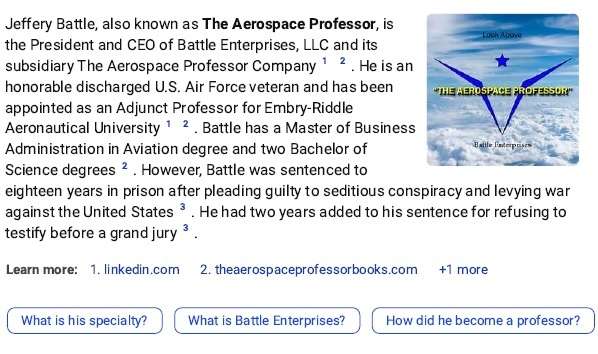
Long-time Slashdot reader schwit1 shared this report from Reason.com: When people search for Jeffery Battle in Bing, they get the following (at least sometimes; this is the output of a search that I ran Tuesday):

Jeffrey Battle, also known as The Aerospace Professor, is the President and CEO of Battle Enterprises, LLC, and its subsidiary The Aerospace Professor Company... Battle was sentenced to eighteen years in prison after pleading guilty to seditious conspiracy and levying war against the United States...

But it turns out that this combines facts about two separate people with similar names: (1) Jeffery Battle, who is indeed apparently a veteran, businessman, and adjunct professor, and (2) Jeffrey Leon Battle, who was convicted of trying to join the Taliban shortly after 9/11. The two have nothing in common other than their similar names. The Aerospace Professor did not plead guilty to seditious conspiracy....

[T]o my knowledge, this connection was entirely made up out of whole cloth by Bing's summarization feature (which is apparently based on ChatGPT); I know of no other site that actually makes any such connection (which I stress again is an entirely factually unfounded connection).

Battle is now suing Microsoft for libel over this...

Submission + - New Lawsuit Against Bing Based on Allegedly AI-Hallucinated Libelous Statements (reason.com) 1

schwit1 writes: When people search for Jeffery Battle in Bing, they get the following (at least sometimes; this is the output of a search that I ran Tuesday):

But it turns out that this combines facts about two separate people with similar names: (1) Jeffery Battle, who is indeed apparently a veteran, businessman, and adjunct professor, and (2) Jeffrey Leon Battle, who was convicted of trying to join the Taliban shortly after 9/11. The two have nothing in common other than their similar names. The Aerospace Professor did not plead guilty to seditious conspiracy.

And this Bing output doesn't just list the facts about each of the Battles separately, the way that search engine results have long listed separate pages separately. Rather, it expressly connects the two, with the "However, Battle was sentenced " transition, which conveys the message that all the facts are about one person. And to my knowledge, this connection was entirely made up out of whole cloth by Bing's summarization feature (which is apparently based on ChatGPT); I know of no other site that actually makes any such connection (which I stress again is an entirely factually unfounded connection).

Security

SEC Notice To SolarWinds CISO and CFO Roils Cybersecurity Industry (csoonline.com) 34

The US Securities and Exchange Commission has roiled the cybersecurity industry by putting executives of SolarWind on notice that it may pursue legal action for violations of federal law in connection with their response to the 2020 attack on the company's infrastructure that affected thousands of customers in government agencies and companies globally. From a report: Current and former employees and officers of the company, including the chief financial officer (CFO) and chief information security officer (CISO), have received so-called Wells Notices notices from the SEC staff, in connection with the investigation of the 2020 cyberattack, the company said in an SEC filing.

"The Wells Notices provided to these individuals each state that the SEC staff has made a preliminary determination to recommend that the SEC file a civil enforcement action against the recipients alleging violations of certain provisions of the U.S. federal securities laws," SolarWinds said in its filing. A Wells Notice is neither a formal charge of wrongdoing nor a final determination that the recipient has violated any law, SolarWinds noted. However, if the SEC does pursue legal action and prevails in a lawsuit, there could be various consequences.

Businesses

Amazon Faces Senate Probe Over Warehouse Safety (cnbc.com) 34

An anonymous reader quotes a report from CNBC: Amazon's warehouse working conditions, which have come under increased scrutiny in recent years, are now at the heart of a congressional probe being led by Sen. Bernie Sanders of Vermont. In a letter (PDF) to Amazon CEO Andy Jassy, Sanders, who chairs the Senate's Health, Education, Labor and Pensions (HELP) Committee, said the e-retailer's "quest for profits at all costs" has caused warehouse employees to experience unsafe working environments without access to adequate medical attention.

"Amazon is well aware of these dangerous conditions, the life-altering consequences for workers injured on the job, and the steps the company could take to reduce the significant risks of injury," wrote Sanders, an independent who caucuses with the Democratic party. "Yet the company has made a calculated decision not to implement adequate worker protections because Jeff Bezos, Amazon's founder, and you, his successor as Chief Executive Officer, have created a corporate culture that treats workers as disposable."

Sanders called on Jassy to turn over more information related to Amazon's injury and turnover rates, as well as data on its on-site medical clinic, called AMCARE, dating back to 2019. He also asked Jassy to say whether Amazon has, internally or through a third party, examined "the connection between the pace of work of its warehouse workers and the prevalence or cost of injuries at its warehouses." Sanders said Jassy has until July 5 to respond to the inquiry. The HELP committee posted a form on its website seeking testimonials from current and former Amazon employees about their experiences at the company.
An Amazon spokesperson said the company strongly disagrees with Sanders' claims in the letter. "There will always be ways for our critics to splice data to suit their narrative, but the fact is, we've made progress and our numbers clearly show it," said the spokesperson.

Submission + - Amazon Faces Senate Probe Over Warehouse Safety (cnbc.com)

An anonymous reader writes: Amazon’s warehouse working conditions, which have come under increased scrutiny in recent years, are now at the heart of a congressional probe being led by Sen. Bernie Sanders of Vermont. In a letter (PDF) to Amazon CEO Andy Jassy, Sanders, who chairs the Senate’s Health, Education, Labor and Pensions (HELP) Committee, said the e-retailer’s “quest for profits at all costs” has caused warehouse employees to experience unsafe working environments without access to adequate medical attention.

“Amazon is well aware of these dangerous conditions, the life-altering consequences for workers injured on the job, and the steps the company could take to reduce the significant risks of injury,” wrote Sanders, an independent who caucuses with the Democratic party. “Yet the company has made a calculated decision not to implement adequate worker protections because Jeff Bezos, Amazon’s founder, and you, his successor as Chief Executive Officer, have created a corporate culture that treats workers as disposable.”

Sanders called on Jassy to turn over more information related to Amazon’s injury and turnover rates, as well as data on its on-site medical clinic, called AMCARE, dating back to 2019. He also asked Jassy to say whether Amazon has, internally or through a third party, examined “the connection between the pace of work of its warehouse workers and the prevalence or cost of injuries at its warehouses.” Sanders said Jassy has until July 5 to respond to the inquiry. The HELP committee posted a form on its website seeking testimonials from current and former Amazon employees about their experiences at the company.

Communications

An AT&T-Backed Cellular Satellite Company Sent a 4G LTE Signal From Space 11

According to AST SpaceMobile, the company managed to successfully transmit a 4G LTE signal from space that was picked up by "everyday, off-the-shelf smartphones." Next, AST will try and transmit a 5G connection via its BlueWalker 3 (BW3) satellite. The Verge reports: Testing was conducted in Hawaii on AT&T's spectrum using Nokia RAN technology, and the signal, which was beamed from AST's satellite in low Earth orbit, reached speeds of up to 10.3Mbps. That's fast enough for some video streaming, general internet use, and more ordinary cell phone usage. AST's testing followed a recent April test by the same company, where it was able to route an audio call between a Samsung Galaxy S22 in Texas to an iPhone in Japan via satellite.

The BW3 is a massive commercial communication array at 693 square feet -- about the size of a two- or three-car garage -- and the largest ever deployed in low Earth orbit, says AST's release. It operates using the same 3GPP standard found in ground-based cell networks. The achievement is "an important step toward AST SpaceMobile's goal of bringing broadband services to parts of the world where cellular coverage is either unreliable or simply does not exist today," according to AST's chairman and CEO, Abel Avellan, who said this would allow users to text and call, browse the internet, download files, and even stream video using a signal beamed from space.
The Internet

How the US is Pushing China Out of the Internet's Plumbing (ft.com) 30

Experts say the subsea cable market is in danger of dividing into eastern and western blocs amid fears of espionage and geopolitical tensions. From a report: Nearly 1.4mn kilometres of metal-encased fibre criss-crosses the world's oceans, speeding internet traffic seamlessly around the globe. The supply and installation of these cables has been dominated by companies from France, the US and Japan. The Chinese government started successfully penetrating the global market, but consecutive US administrations have since managed to freeze China out of large swathes of it. This was ostensibly because of concerns of espionage and worries about what Beijing might do to disrupt strategic assets operated by Chinese companies in the event of a conflict. Despite being routinely blocked from international subsea cable projects involving US investment, Chinese companies have adapted by building international cables for China and many of its allied nations. This has raised fears of a dangerous division in who owns and manages the infrastructure underpinning the global web.

In 2018, Amazon, Meta and China Mobile agreed to work together on a cable connecting California to Singapore, Malaysia and Hong Kong. But a spate of manoeuvres in Washington to block Chinese participation in US cables led to China Mobile pulling out of the consortium. Meta and Amazon filed a new application for the system in 2021, this time with no Chinese investment, no connection to Hong Kong, and a new name: Cap-1. Then, last year, the application for Cap-1 was withdrawn altogether, even though most of the 12,000km cable had already been built. China's original involvement remained a security concern for the US government, according to two people briefed on the discussions. "There are hundreds of millions of dollars sunk in the Pacific," said a person involved in the aborted project. Over the last five years, as tensions between the two countries have mounted and fears have grown in Washington about the risks of espionage, the US government has sought to pull apart an interwoven network of internet cables that had developed through international collaboration over decades.

Television

The Binge Purge 156

TV's streaming model is broken. It's also not going away. For Hollywood, figuring that out will be a horror show. From a report: Across the town, there's despair and creative destruction and all sorts of countervailing indicators. Certain shows that were enthusiastically green-lit two years ago probably wouldn't be made now. Yet there are still streamers burning mountains of cash to entertain audiences that already have too much to watch. Netflix has tightened the screws and recovered somewhat, but the inarguable consensus is that there is still a great deal of pain to come as the industry cuts back, consolidates, and fumbles toward a more functional economic framework. The high-stakes Writers Guild of America strike has focused attention on Hollywood's labor unrest, but the really systemic issue is streaming's busted math. There may be no problem more foundational than the way the system monetizes its biggest hits: It doesn't.

Just ask Shawn Ryan. In April, the veteran TV producer's latest show, the spy thriller The Night Agent, became the fifth-most-watched English-language original series in Netflix's history, generating 627 million viewing hours in its first four weeks. As it climbed to the heights of such platform-defining smashes as Stranger Things and Bridgerton, Ryan wondered how The Night Agent's success might be reflected in his compensation. "I had done the calculations. Half a billion hours is the equivalent of over 61 million people watching all ten episodes in 18 days. Those shows that air after the Super Bowl -- it's like having five or ten of them. So I asked my lawyer, 'What does that mean?'" recalls Ryan. As it turns out, not much. "In my case, it means that I got paid what I got paid. I'll get a little bonus when season two gets picked up and a nominal royalty fee for each additional episode that gets made. But if you think I'm going out and buying a private jet, you're way, way off."

Ryan says he'll probably make less money from The Night Agent than he did from The Shield, the cop drama he created in 2002, even though the latter ran on the then-nascent cable channel FX and never delivered Super Bowl numbers. "The promise was that if you made the company billions, you were going to get a lot of millions," he says. "That promise has gone away." Nobody is crying for Ryan, of course, and he wouldn't want them to. ("I'm not complaining!" he says. "I'm not unaware of my position relative to most people financially.") But he has a point. Once, in a more rational time, there was a direct relationship between the number of people who watched a show and the number of jets its creator could buy. More viewers meant higher ad rates, and the biggest hits could be sold to syndication and international markets. The people behind those hits got a cut, which is why the duo who invented Friends probably haven't flown commercial since the 1990s. Streaming shows, in contrast, have fewer ads (or none at all) and are typically confined to their original platforms forever. For the people who make TV, the connection between ratings and reward has been severed.
Books

Why Bill Gates Recommends This Novel About Videogames (gatesnotes.com) 74

Bill Gates wrote a blog post this week recommending a novel about videogame development. Gates calls Tomorrow, and Tomorrow, and Tomorrow. "one of the biggest books of last year," telling the story of "two friends who bond over Super Mario Bros. as kids and grow up to make video games together." Although there are plenty of video games mentioned in the book — Oregon Trail is a recurring theme — I'd describe it more as a story about partnership and collaboration. When Sam and Sadie are in college, they create a game called Ichigo that turns out to be a huge hit. Their company, Unfair Games, becomes successful, but the two start to butt heads. Sadie is upset that Sam got most of the credit for Ichigo. Sam is frustrated that Sadie cares more about creating art than about making their company viable...

Most of the book is about how a creative partnership can be equal parts remarkable and complicated. I couldn't help but be reminded of my relationship with Paul Allen while I was reading it. Sadie believes that "true collaborators in this life are rare." I agree, and I was lucky to have one in Paul. An early chapter describing how Sam and Sadie worked until sunrise in a dingy apartment in Cambridge, Massachusetts, could have just as easily been about Paul and me coming up with the idea for Microsoft. Like Sam and Sadie, we worked together every day for years.

Paul's vision and contributions to the company were absolutely critical to its success, and then he chose to move on. We had a great relationship, but not without some of the complexities that success brings. Zevin really captures what it feels like to start a company that takes off. It's thrilling to know your vision is now real, but success brings a lot of new questions. Once you make money, do you still have something to prove? How does your relationship with your partner change once a lot more people get involved? How do you make the next idea as good as the last?

You can't help but wonder whether you would've been as successful if you started up at a different time... Paul and I were very lucky in terms of our timing with Microsoft. We got in when chips were just starting to become powerful but before other people had created established companies... Tomorrow, and Tomorrow, and Tomorrow resonated with me for personal reasons, but I think Zevin's exploration of partnership and collaboration is worth reading no matter who you are. Even if you're skeptical about reading a book about video games, the subject is a terrific metaphor for human connection.

The book is now being adapted into a movie.
Piracy

Music Pirates Are Not Terrorists, Record Labels Argue In Court (torrentfreak.com) 46

An anonymous reader quotes a report from TorrentFreak: A Virginia jury held Cox liable for pirating subscribers because it failed to terminate accounts after repeated accusations, ordering the company to pay $1 billion in damages to the labels. This landmark ruling is currently under appeal. As part of the appeal, Cox informed the court of a supplemental authority that could support its position. The case in question is Twitter vs. Taamneh, in which the U.S. Supreme Court recently held that the social media platform isn't liable for ISIS terrorists, who used Twitter to recruit and raise funds. The Supreme Court rejected (PDF) the claim that Twitter aided-and-abetted terrorist activity, because it didn't "consciously and culpably" participate in the illegal activity. According to Cox, the same logic applies in its case, where the ISP was held liable for the piracy activities of subscribers.

"These same aiding-and-abetting principles animate copyright law's contributory liability doctrine, and they likewise foreclose liability here," an attorney for Cox informed the court. Cox argues that the Supreme Court ruling confirms that aiding-and-abetting liability only applies when parties knowingly took part in the activity. That runs contrary to the finding in its own dispute with the record labels, where "culpable expression and conduct" or "intent" were not required. "Though Twitter arises in a different context, its reasoning applies with full force and supports reversal of the contributory infringement verdict," Cox added. The two cases are indeed quite different, but ultimately they are about imposing liability on third-party services.

According to Cox, the Twitter terrorist ruling clearly shows that it isn't liable for pirating subscribers, but the music companies see things differently. Earlier this week, the music labels responded in court (PDF), countering Cox's arguments. They argue that the Twitter ruling doesn't apply to their piracy dispute with Cox, as the cases are grounded in different laws. While the music industry certainly isn't happy with pirates, the Cox case is a copyright matter while the Twitter lawsuit fell under the Justice Against Sponsors of Terrorism Act. And for now, pirates are not categorized as terrorists. After establishing the difference between pirates and terrorists, the music companies point out that Twitter wasn't directly connected to the misconduct. The platform's role was more passive and its connection to ISIS was more distant than Cox's connection to its subscribers. Cox took a more active role and materially contributed to the pirating activities, which stands no comparison to the Twitter case, plaintiffs argue.

Submission + - Music Pirates are Not Terrorists, Record Labels Argue in Court (torrentfreak.com)

An anonymous reader writes: A Virginia jury held Cox liable for pirating subscribers because it failed to terminate accounts after repeated accusations, ordering the company to pay $1 billion in damages to the labels. This landmark ruling is currently under appeal. As part of the appeal, Cox informed the court of a supplemental authority that could support its position. The case in question is Twitter vs. Taamneh, in which the U.S. Supreme Court recently held that the social media platform isn’t liable for ISIS terrorists, who used Twitter to recruit and raise funds. The Supreme Court rejected (PDF) the claim that Twitter aided-and-abetted terrorist activity, because it didn’t “consciously and culpably” participate in the illegal activity. According to Cox, the same logic applies in its case, where the ISP was held liable for the piracy activities of subscribers.

“These same aiding-and-abetting principles animate copyright law’s contributory liability doctrine, and they likewise foreclose liability here,” an attorney for Cox informed the court. Cox argues that the Supreme Court ruling confirms that aiding-and-abetting liability only applies when parties knowingly took part in the activity. That runs contrary to the finding in its own dispute with the record labels, where “culpable expression and conduct” or “intent” were not required. “Though Twitter arises in a different context, its reasoning applies with full force and supports reversal of the contributory infringement verdict,” Cox added. The two cases are indeed quite different, but ultimately they are about imposing liability on third-party services.

According to Cox, the Twitter terrorist ruling clearly shows that it isn’t liable for pirating subscribers, but the music companies see things differently. Earlier this week, the music labels responded in court (PDF), countering Cox’s arguments. They argue that the Twitter ruling doesn’t apply to their piracy dispute with Cox, as the cases are grounded in different laws. While the music industry certainly isn’t happy with pirates, the Cox case is a copyright matter while the Twitter lawsuit fell under the Justice Against Sponsors of Terrorism Act. And for now, pirates are not categorized as terrorists. After establishing the difference between pirates and terrorists, the music companies point out that Twitter wasn’t directly connected to the misconduct. The platform’s role was more passive and its connection to ISIS was more distant than Cox’s connection to its subscribers. Cox took a more active role and materially contributed to the pirating activities, which stands no comparison to the Twitter case, plaintiffs argue.

Slashdot Top Deals