Technology

What Went Wrong With Virtual Reality? (bbc.com) 214

An anonymous reader shares a report: "When I put in the earpieces and goggles the first time it was crazy - it feels so believable," says Anna Taylor, 32, of her visit to a virtual reality (VR) arcade. "The whole experience of being immersed in a compelling virtual world is incredible." Anna has since visited the east London arcade many times, at first alone and then with others. But despite her enthusiasm for gaming, she won't be buying her own virtual reality headset. "I wouldn't invest in buying virtual reality applications for home," she explains. "It's fine to play more of a basic game when you are playing with other people, [and] because it's brand new there are more layers of excitement. But when you're [playing] on your own, you want the quality you are used to." As a keen gamer, Anna should be part of the core audience for at-home VR entertainment. But her lack of interest is pretty common, and it means that virtual reality headsets have yet to take off.

Many big name adopters have abandoned their VR projects. Google recently halted sales of Daydream, its VR headset, admitting that "there just hasn't been the broad consumer or developer adoption we had hoped." Meanwhile, the BBC has announced it is ending the funding for its VR hub, less than two years after it was founded. VR received very little attention at CES, the annual trade show for consumer electronics, which got underway this week. However, PlayStation did announce it has sold five million VR headsets since launch in 2016.

Google

Buying Fitbit Won't Save Google's Failing Wear OS (androidpolice.com) 27

David Ruddock of AndroidPolice technology blog tries to make sense of last week's $2.1 billion acquisition of Fitbit by Google. He argues that Fitbit's offerings -- hardware, software, engineering talent, or even patent wall -- can't save Google's wearable operating system Wear OS. From his column: Hardware is what Google is after, with a blog post cleatly stating its acquisition of Fitbit is about future Wear OS devices, meaning you can probably kiss Fitbit's unloved smartwatch OS goodbye. So, that means we can count on Google leveraging Fitbit's renowned hardware to finally give Wear OS the horsepower and capabilities it needs to compete with Apple, right? Well, no. Fitbit's smartwatches have been most lauded for their long battery life, which has historically been enabled by extremely slow but highly power-efficient processors. The Versa 2 allegedly comes with significant performance improvements, but as a smartwatch, it just isn't very... smart. Michael Fisher points out in his review that the Versa 2's near week-long life on a single charge is only impressive when looked at in a very generous light. The Versa 2 doesn't have GPS, the battery only lasts that long when not using the always-on display (with AoD, it's closer to 3 days), the watch itself doesn't work for almost anything but fitness tracking on its own, and most of your interactions with it end up happening on your smartphone anyway. I can also tell you from experience that the Apple Watch Series 5 lasts about two days on a charge with the always-on display enabled (and Samsung's watches last even longer), so Fitbit managing a day more which a much less useful watch isn't exactly game-changing technology.

In short, Fitbit's products are not ones Google should be excited about buying. The hardware is nothing special, and the software is clearly going in the dumpster. What has Google bought, then? The sad, very practical truth is probably patents and engineers. Fitbit does develop at least some of its hardware in-house, and likely has a decent number of patents related to fitness tracking and basic wearable technology, including those stemming from its acquisition of Pebble. Its product engineers would receive resources and tools at Google that Fitbit may not have afforded them. In short: Google's purchase is almost certainly a speculative one. Google is hoping that Fitbit's technology portfolio and its engineering talent can create a better, faster, stronger Wear OS watch. That isn't the kind of acquisition that screams "our product is successful," it's one that looks far more like a Hail Mary from a company that is rapidly losing any hope of remaining relevant in the wearables space. A more cynical view of Google's acquisition might argue that this is more about Fitbit's brand and users than anything else. If Google simply markets its in-house smartwatches as Fitbits running Wear OS, it would be more able to tap into Fitbit's existing customer base and retail relationships. Customer base is something Wear OS is sorely missing at the moment, and Fitbit is a brand that many consumers recognize, albeit mostly for the company's "dumb" fitness trackers, not its smartwatches. Speaking of, given Google's focus on Wear OS as part of this acquisition, my guess is that those more popular but very basic trackers will be discontinued.

The Internet

Study Casts Doubt On Value of WHO's 'Gaming Disorder' Diagnoses (arstechnica.com) 46

An anonymous reader quotes a report from Ars Technica: Since the World Health Organization proposed new diagnoses for "hazardous gaming" and "gaming disorder" last year, there's been an ongoing scientific debate about which way the causation for these issues really goes. Does an excessive or addictive relationship with gaming actually cause psychological problems, or are people with existing psychological problems simply more likely to have an unhealthy relationship with gaming? A recent study by Oxford's Internet Institute, published in the open access journal Clinical Psychological Science, lends some support to the latter explanation. But it also highlights just how many of the game industry's most devoted players may also be driven by some unmet psychological needs.

To study how so-called "dysfunctional gaming" relates to psychological needs and behaviors, the Oxford researchers surveyed a nationally representative sample of 1,004 UK adolescents and their caregivers. They asked the caregivers to evaluate their adolescents' levels of "psychosocial functioning:" how well the adolescents are able to internalize or externalize problems in their lives as evidenced by their behavior. [...] Of the 1,004 adolescents surveyed, 525 said they played online games daily for an average of about three hours per day. Among that group, over 55% showed at least one of the nine indicators for Internet Gaming Disorder, and even 23% showed at least three indicators. Those reported "dysregulated gaming" effects showed a significant positive correlation with the amount of time spent playing, as well as a significant negative correlation with the reported psychosocial evaluations from caregivers. In other words, those with "dysregulated" gaming habits were more likely to spend more time playing each day and less likely to be able to handle problems in their lives in a healthy way.
Crucially, though, the measured effect of the dysregulated gaming variable in the study "accounted for a practically insignificant share of variability in key outcomes... as compared with the role played by basic psychological needs," as the study authors write. "This evidence suggests that having information about the extent to which an adolescent's video-game play is dysregulated provides no practically useful incremental information when viewed in light caregivers' assessments of emotional, behavioral, peer, or conduct difficulties."

"So while so-called adolescent 'problem gamers' are more likely to show behavioral problems, that fact in and of itself is much less important in predicting those problems than other measures of whether those adolescents' psychological needs are being met," reports Ars Technica. "That suggests that both dysregulated gaming and psychosocial behavior problems are both potential signs of more fundamental underlying psychological frustrations rather than excessive gaming causing problems in and of itself."
Microsoft

Microsoft Might Crush Slack Like Facebook Crushed Snapchat (vox.com) 144

"Tech workers' favorite communications tool, Slack, is losing ground to its biggest rival, Microsoft Teams, which has copied its way into popularity," writes Rani Molla for Recode. "In other words, Slack has the same problem as Snapchat, which has suffered from its bigger rival Facebook's relentless appropriation." From the report: Slack's market share among the world's largest companies is mostly flat, adoption rates are declining, and a bigger portion of these companies indicate they plan on leaving the service, according to a new survey by market research firm ETR, which asks chief information officers and other leaders at the world's biggest organizations* where they plan to spend their company's tech budget. Meanwhile, Teams is seeing increased market share, relatively higher adoption rates, and low rates of defection, according to the data.

Slack, which is currently trading below its first-day opening price, has been beset both by smaller companies hoping to improve upon it and tech giants trying to copy and replace it. Microsoft, at one point, had even considered buying Slack. Instead, nearly four years after Slack's debut, Microsoft launched Teams, which has since adopted many of its competitor's functions, including the basic premise of creating an online office space for coworkers to collaborate and communicate. The situation was similar with Facebook, which after failing to buy Snapchat began to copy it, feature by feature. Facebook did this with impunity because it's not really possible to copyright what software does -- you can only copyright the code itself. Since products like Slack and Microsoft Teams or Facebook and Snapchat are built on different platforms, the code for each is likely distinct, so copying features is fair game.

Hardware

Slashdot Asks: What Do You Do With Your Raspberry Pi? 328

The Raspberry Pi is a small single-board computer that's exploded in popularity over the years thanks to its wide array of uses. While it was originally designed to promote the teaching of basic computer science in schools and in developing countries, the computers have been adapted to be used for robotics, media, game and print servers, and even as replacements for traditional desktop PCs. That last one may be even more of a popular use case with the Raspberry Pi 4, the newest version announced today featuring a more powerful quad-core 64-bit ARM processor, up to 4GB of LPDDR4 SDRAM, and dual monitor support at resolutions up to 4K. For those of you with a Raspberry Pi, what do you use it for? Do you have any plans to upgrade to the $35 Raspberry Pi 4?
Facebook

Facebook Announces Libra Cryptocurrency (fb.com) 219

Facebook has finally revealed the details of its cryptocurrency Libra. From a blog post: Today we're sharing plans for Calibra, a newly formed Facebook subsidiary whose goal is to provide financial services that will let people access and participate in the Libra network. The first product Calibra will introduce is a digital wallet for Libra, a new global currency powered by blockchain technology. The wallet will be available in Messenger, WhatsApp and as a standalone app -- and we expect to launch in 2020. [...] For many people around the world, even basic financial services are still out of reach: almost half of the adults in the world don't have an active bank account and those numbers are worse in developing countries and even worse for women. The cost of that exclusion is high -- approximately 70% of small businesses in developing countries lack access to credit and $25 billion is lost by migrants every year through remittance fees. This is the challenge we're hoping to address with Calibra, a new digital wallet that you'll be able to use to save, send and spend Libra.

From the beginning, Calibra will let you send Libra to almost anyone with a smartphone, as easily and instantly as you might send a text message and at low to no cost. And, in time, we hope to offer additional services for people and businesses, like paying bills with the push of a button, buying a cup of coffee with the scan of a code or riding your local public transit without needing to carry cash or a metro pass. When it launches, Calibra will have strong protections in place to keep your money and your information safe. We'll be using all the same verification and anti-fraud processes that banks and credit cards use, and we'll have automated systems that will proactively monitor activity to detect and prevent fraudulent behavior. We'll also offer dedicated live support to help if you lose your phone or your password -- and if someone fraudulently gains access to your account and you lose some Libra as a result, we'll offer you a refund.
Facebook's currency is backed by more than two dozen companies ranging from Visa and Mastercard to Lyft and Spotify. Apple, Google, Amazon and Microsoft have not yet signed up. Banks decided not to join the starting roster because of uncertainties about regulation and concerns over logistical issues that could hamper take-up, Financial Times reported citing several industry executives. From the report: If successful, the project could dramatically reshape some corners of the finance industry, disintermediating payments platforms and stealing business from retail banks and fintech groups, particularly those that specialise in sending payments across borders. Jorn Lambert, executive vice-president for digital solutions at Mastercard, said he was not worried that fee-free transactions would threaten the payment card business. "It's an addition to what we do, not instead of what we do. It is not a zero-sum game. Today, 85 per cent of transactions are made in cash." It is unclear whether Libra will clear the steep hurdles needed to get off the ground, win over regulators, such as the US Securities and Exchange Commission, and be embraced, or strongly resisted, by the financial services industry. Central banks have already questioned the impact of company-created cryptocurrencies on financial stability. "We see hurdles to scale, we see hurdles to adoption, we see enough of this to decide that we would not participate in a scheme like this," said a senior payments executive at a large global bank.
Microsoft

New Hampshire Unveils a Historical Highway Marker For The BASIC Programming Language (concordmonitor.com) 68

"It took 10 months to get it done, but the Granite State is now officially a Geeky State," writes Concord Monitor science reporter David Brooks.

"The latest New Hampshire Historical Highway Marker, celebrating the creation of the BASIC computer language at Dartmouth in 1964, has officially been installed. Everybody who has ever typed a GOTO command can feel proud..." Last August, I wrote in this column that the 255 official historical markers placed alongside state roads told us enough about covered bridges and birthplaces of famous people but not enough about geekiness. Since anybody can submit a suggestion for a new sign, I thought I'd give it a shot.

The creation of BASIC, the first programing language designed to let newbies dip their intellectual toes into the cutting-edge world of software, seemed the obvious candidate. Beginner's All-purpose Symbolic Instruction Code has probably has done more to introduce more people to computer programming than anything ever created. That includes me: The only functioning programs I've ever created were in vanilla BASIC, and I still recall the great satisfaction of typing 100 END...

But BASIC wasn't just a toy for classrooms. It proved robust enough to survive for decades, helping launch Microsoft along the way, and there are descendants still in use today. In short, it's way more important than any covered bridge.

The campaign for the marker was supported by Thomas Kurtz, the retired Dartmouth math professor who'd created BASIC along with the late John Kemeny. "Our original idea was to mention both BASIC and the Dartmouth Time-Sharing System, an early system by which far-flung computers could share resources. They were created hand-in-hand as part of Kemeny's idea of putting computing in the hands of the unwashed masses.

"However, the N.H. Division of Historical Resources, which has decades of experience creating these markers, said it would be too hard to cram both concepts into the limited verbiage of a sign."

The highway marker calls BASIC "the first user-friendly computer programming languages... BASIC made computer programming accessible to college students and, with the later popularity of personal computers, to users everywhere. It became the standard way that people all over the world learned to program computers, and variants of BASIC are still in use today."

In the original submission, an anonymous Slashdot reader notes that last month, Manchester New Hampshire also unveiled a statue of Ralph Baer, whose team built the first home video game sold as Magnavox Odyssey, sitting on a park bench. "The Granite State isn't shy about its geek side."
Books

Neal Stephenson Says Social Media Is Close To A 'Doomsday Machine' (pcmag.com) 59

PC Magazine interviewed Neal Stephenson about his new upcoming book Fall; Or, Dodge in Hell, as well as "the digital afterlife, and why social media is a doomsday machine." [Possible spoilers ahead]: The hybrid sci-fi/fantasy novel begins in the present day with Richard "Dodge" Forthrast, an eccentric multibillionaire who made his fortune in the video game industry. When a freak accident during a routine medical procedure leaves him brain-dead, his family is left to contend with his request to have his brain preserved until the technology exists to bring him back to life. The near-future world of Fall is full of familiar buzzwords and concepts. Augmented reality headsets, next-gen wireless networks, self-driving vehicles, facial recognition, quantum computing, blockchain and distributed cryptography all feature prominently. Stephenson also spends a lot of time examining how the internet and social media, which Dodge and other characters often refer to in Fall as the Miasma, is irrevocably changing society and altering the fabric of reality...

Q: How would you describe the current state of the internet? Just in a general sense of its role in our daily lives, and where that concept of the Miasma came from for you.

Neal Stephenson: I ended up having a pretty dark view of it, as you can kind of tell from the book. I saw someone recently describe social media in its current state as a doomsday machine, and I think that's not far off. We've turned over our perception of what's real to algorithmically driven systems that are designed not to have humans in the loop, because if humans are in the loop they're not scalable and if they're not scalable they can't make tons and tons of money.

The result is the situation we see today where no one agrees on what factual reality is and everyone is driven in the direction of content that is "more engaging," which almost always means that it's more emotional, it's less factually based, it's less rational, and kind of destructive from a basic civics standpoint... I sort of was patting myself on the back for really being on top of things and predicting the future. And then I discovered that the future was way ahead of me. I've heard remarks in a similar vein from other science-fiction novelists: do we even have a role anymore?

Stephenson answered questions from Slashdot's reader in 2004, and since then has "spent years as an advisor for Amazon CEO Jeff Bezos' private space company Blue Origin," the article points out. He's also currently the "chief futurist" for Magic Leap -- though he tells his interviewer that some ideas go back much further.

Part of his new book builds on "a really old idea" from security researcher Matt Blaze, who in the mid-1990s talked about "Encyclopedia Disinformatica", which Stephenson describes as "a sort of fake Wikipedia containing plausible-sounding but deliberately false information as a way of sending the message to people that they shouldn't just believe everything that they see on the internet."
Businesses

Fortnite is Free, But Kids Are Getting Bullied Into Spending Money (polygon.com) 243

An anonymous reader shares a report: In a private school where tuition is high, students can bicker about clothes, shoe brands, cellphones, or video games. At Paul Towler's middle school, where he teaches English to seventh and eighth graders, some kids "have enough money to be comfortable and others' parents are owners of giant nationwide restaurant chains," he says. Towler is used to seeing such disparities play out in the real world through objects that you can physically hold. But after battle royale sensation Fortnite exploded, the fights between students took an unexpected turn. Fortnite's virtual clothes became a status symbol, and some of Towler's pupils started policing what their classmates wore in-game.

The confrontations could get ugly. One student in Towler's class "begged his parents for [money] to buy a skin because no one would play with him" because he wore basic virtual clothes. While the bullying wasn't always Fortnite-specific, Towler recalls that it seemed "vicious for [the student] to have another avenue for the meaner kids to attack him." Things got better for that kid, but when your social scene begins and ends with Fortnite, having nobody to play with is like a mark of death.

Social Networks

'Hyperscans' Show How Brains Sync As People Interact (scientificamerican.com) 38

"A growing cadre of neuroscientists is using sophisticated technology -- and some very complicated math -- to capture what happens in one brain, two brains, or even 12 or 15 at a time when their owners are engaged in eye contact, storytelling, joint attention focused on a topic or object, or any other activity that requires social give and take," reports Scientific American. "Although the field of interactive social neuroscience is in its infancy, the hope remains that identifying the neural underpinnings of real social exchange will change our basic understanding of communication and ultimately improve education or inform treatment of the many psychiatric disorders that involve social impairments." Here's an excerpt from the report: [T]he first study to successfully monitor two brains at the same time took place nearly 20 years ago. Physicist Read Montague, now at Virginia Tech, and his colleagues put two people in separate functional magnetic resonance imaging (fMRI) machines and observed their brain activity as they engaged in a simple competitive game in which one player (the sender) transmitted a signal about whether he or she had just seen the color red or green and the other player (the receiver) had to decide if the sender was telling the truth or lying. Correct guesses resulted in rewards. Montague called the technique hyperscanning, and his work proved it was possible to observe two brains at once.

Initially, Montague's lead was followed mostly by other neuroeconomists rather than social neuroscientists. But the term hyperscanning is now applied to any brain imaging research that involves more than one person. Today the techniques that fit the bill include electroencephalography (EEG), magnetoencephalography and functional near-infrared spectroscopy. Use of these varied techniques, many of them quite new, has broadened the range of possible experiments and made hyperscanning less cumbersome and, as a consequence, much more popular.
The report also mentions a study from earlier this year that "used hyperscanning to show that eye contact prepares the social brain to empathize by activating the same areas of each person's brain simultaneously: the cerebellum, which helps predict the sensory consequences of actions, and the limbic mirror system, a set of brain areas that become active both when we move any part of the body (including the eyes) and when we observe someone else's movements."
Robotics

Can Marc Andreessen Stop Technology From Eating Our Jobs? (hackernoon.com) 152

Technology writer Tom Chanter explores the life story of venture capitalist Marc Andreessen to ask whether software will not only eat the world, but also the jobs of what one historian predicts will be a "massive new unworking class: people devoid of any economic, political or even artistic value." Can Marc Andreessen prevent a so-called "useless class" who "will not merely be unemployed -- it will be unemployable"?

Andreessen grew up in New Lisbon, Wisconsin (population: 1,500), and taught himself the BASIC programming language at age 8. He co-developed the original Mosaic web browser before he'd graduated from college, went on to co-found Netscape, and by age 23 was worth $53 million. He then transformed into a "super angel" investor in companies like Twitter, Airbnb, Lyft, Facebook, Skype, and GitHub. "Having been an innovator in the tech start-up game, Andreessen is now an innovator in the tech venture capital game," writes Chanter. "He is a jedi that has become the master." In 2011, Marc Andreessen published an article in the Wall Street Journal titled, Why Software Is Eating The World. He wrote, "Over the next 10 years, the battles between incumbents and software-powered insurgents will be epic...." 7 years later, it's clear Andreessen was correct. Lyft has destroyed taxi jobs. Airbnb has destroyed hotel jobs. Amazon destroyed independent bookstores. How does Andreessen feel about that? "Screw the independent bookstores," he said in his New Yorker profile. "There weren't any near where I grew up. There were only ones in college towns. The rest of us could go pound sand."
But the 4,900-word article also notes Andreessen's pledge to give half his income to charitable causes -- and his observation in a 2015 interview that outside of the United States, global income inequality is falling, not rising. "He has seen technology transform his own life, and has seen how technology has bridged the global wealth gap. Why shouldn't he be optimistic about the future of America's working class?"

And Andreessen's ultimate answer to the jobs destroyed by technology may be Udacity. The article cites Andreessen's investment in the company in 2012, and points to the online education platform's hopeful mission statement. "Virtually anyone on the planet with an internet connection and a commitment to self-empowerment through learning can come to Udacity, master a suite of job-ready skills, and pursue rewarding employment."

As a boy in Wisconsin he was starved for information. He has created an education institution accessible from Wisconsin to Africa. As a boy in Wisconsin he was starved for connection. He has married an innovative philanthropist and author, Laura Arrillaga-Andreessen. They have a son named John. Andreessen is optimistic for both the working class and the future tech elite.

In his New Yorker profile he says of his son, "He'll come of age in a world where ten or a hundred times more people will be able to contribute in science and medicine and the arts, a more peaceful and prosperous world."

He added, tongue in cheek, "I'm going to teach him how to take over that world!"

AI

NVIDIA's Latest AI Software Turns Rough Doodles Into Realistic Landscapes (theverge.com) 35

An anonymous reader quotes a report from The Verge: AI is going to be huge for artists, and the latest demonstration comes from Nvidia, which has built prototype software that turns doodles into realistic landscapes. Using a type of AI model known as a generative adversarial network (GAN), the software gives users what Nvidia is calling a "smart paint brush." This means someone can make a very basic outline of a scene (drawing, say, a tree on a hill) before filling in their rough sketch with natural textures like grass, clouds, forests, or rocks. The results are not quite photorealistic, but they're impressive all the same. The software generates AI landscapes instantly, and it's surprisingly intuitive. For example, when a user draws a tree and then a pool of water underneath it, the model adds the tree's reflection to the pool. Nvidia didn't say if it has any plans to turn the software into an actual product, but it suggests that tools like this could help "everyone from architects and urban planners to landscape designers and game developers" in the future. The company has published a video showing off the imagery it handles particularly well.
Chrome

Chrome 70 Won't Ship With a Patch For Autoplay-Blocking Web Audio API Which Broke Web Apps and Games Earlier This Year (theverge.com) 44

An anonymous reader shares a report: Earlier this year, Google made a seemingly crowd-pleasing tweak to its Chrome browser and created a crisis for web game developers. Its May release of Chrome 66 muted sites that played sound automatically, saving internet users from the plague of annoying auto-playing videos. But the new system also broke the audio of games and web art designed for the old audio standard -- including hugely popular games like QWOP, clever experiments like the Infinite Jukebox, and even projects officially showcased by Google. After a backlash over the summer, Google kept blocking autoplay for basic video and audio, but it pushed the change for games and web applications to a later version. That browser version, Chrome 70, is on the verge of full release -- but the new, autoplay-blocking Web Audio API isn't part of it yet. Google communications manager Ivy Choi tells The Verge that Chrome will start learning the sites where users commonly play audio, so it can tailor its settings to their preferences. The actual blocking won't start until Chrome 71, which is due in December.
Role Playing (Games)

RIP Greg Stafford, a Fundamental Personage of the RPG Industry (chaosium.com) 39

"The first published RPG was Dungeons & Dragons, shortly followed by some other imitative games," Greg Stafford once said. "Chaosium, however, was never content to imitate but published games that were original in style of play, content and design."

Greg Stafford died Thursday at the age of 71. Long-time Slashdot reader argStyopa shares this memorial from Chaosium's Michael O'Brien. As one of the greatest game designers of all time; winner of too many awards to count; and a friend, mentor, guide, and inspiration to generations of gamers, "the Grand Shaman of Gaming" influenced the universe of tabletop gaming beyond measure. Greg founded The Chaosium in 1975... Under his leadership, the company quickly became renowned for its originality and creativity, and was responsible for introducing numerous things to the hobby that are standards today. As John Wick (7th Sea, Legend of the Five Rings) memorably said, "The older I get, the more I hear young RPG designers say 'Never been done before!' And then I just point at something Greg Stafford did a few decades ago."

Greg's work in roleplaying games, board games, and fiction have been acclaimed as some of the most engaging and innovative of all time. There will doubtless be many valedictory messages over the coming days from the countless people that Greg inspired and enthused across his many interests and passions -- Glorantha, Oaxaca, King Arthur, shamanism, mythology and more. For now, we leave you with the words of the Myth maker himself, speaking at the 2018 ENnies Awards ceremony, his last public engagement

"When I started Chaosium in 1975... we never imagined, truly, that it would reach the magnitude that it has today," Stafford tells the audience. "It went through a long period of being some strange thing that just random geeks did... I figure when role-playing games get on The X-Files and The Simpsons, we've made it..."

""It's true that it's not us. We're a bunch of obsessive-compulsive, detail-minded game designers, people looking desperately for a job that doesn't make them wear a tie to work, artists who would've never had a market without our industry. We all do a lot of work, but in fact we're just a small handful of people, and truly the phenomenon that we have today is not due to us, but is due to you, the fans and the players. We really appreciate everything that you've done... I want to say thank you to all of you fans."

The forum at Basic Roleplaying Central has started a condolences thread.
Operating Systems

Magic Leap Offers a First Look At Its Mixed Reality OS (cnet.com) 50

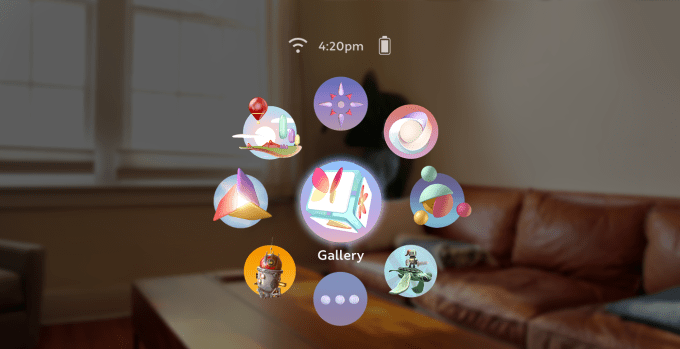
TechCrunch's Lucas Matney describes the Lumin operating system that will power Magic Leap's upcoming Magic Leap One mixed reality headset: Alright, first, this is what the Magic Leap One home screen will apparently look like, it's worth noting that it appears that Magic Leap will have some of its own stock apps on the device, which was completely expected but they haven't discussed much about. Also worth noting is that Magic Leap's operating system by and large looks like most other operating systems, they seem to be well aware that flat interfaces are way easier to navigate so you're not going to be engaging with 3D assets just for the sake of doing so. The company seems to be distinguishing between two basic app types for developers: immersive apps and landscape apps. Landscape apps like what you see in the image above, appear to be Magic Leap's version of 2D where interfaces are mostly flat but have some depth and live inside a box called a prism that fits spatially into your environment. It seems that you'll be able to have several of these running simultaneously. Immersive apps, on the other hand, like the game title, Dr. Grordbort -- which Magic Leap has been teasing for years -- respond to the geometry of the space that you are in and is thus called an immersive app.

Moving beyond apps, the company also had a good deal to share about how you interact with what's happening in the headset. Magic Leap will have a companion smartphone app that you can type into, you can connect a bluetooth keyboard and there will also be an onscreen keyboard with dictation capabilities. One of the big highlights of Magic Leap tech is that you'll be able to share perspectives of these apps in a multi-player experience which we now know is called "casting," apps that utilize these feature will just have a button that you can press to share an experience with a contact.

AI

DeepMind's AI Agents Exceed 'Human-Level' Gameplay In Quake III (theverge.com) 137

An anonymous reader quotes a report from The Verge: AI agents continue to rack up wins in the video game world. Last week, OpenAI's bots were playing Dota 2; this week, it's Quake III, with a team of researchers from Google's DeepMind subsidiary successfully training agents that can beat humans at a game of capture the flag. DeepMind's researchers used a method of AI training that's also becoming standard: reinforcement learning, which is basically training by trial and error at a huge scale. Agents are given no instructions on how to play the game, but simply compete against themselves until they work out the strategies needed to win. Usually this means one version of the AI agent playing against an identical clone. DeepMind gave extra depth to this formula by training a whole cohort of 30 agents to introduce a "diversity" of play styles. How many games does it take to train an AI this way? Nearly half a million, each lasting five minutes. DeepMind's agents not only learned the basic rules of capture the flag, but strategies like guarding your own flag, camping at your opponent's base, and following teammates around so you can gang up on the enemy. "[T]he bot-only teams were most successful, with a 74 percent win probability," reports The Verge. "This compared to 43 percent probability for average human players, and 52 percent probability for strong human players. So: clearly the AI agents are the better players."
AI

EA Created An AI That Taught Itself To Play Battlefield (kotaku.com) 59

Electronic Arts' Search for Extraordinary Experiences (SEED) Division has created a "self-learning AI-agent" that has managed to teach itself how to play Battlefield 1 multiplayer. From a report: In this blog post, Magnus Nordin from SEED details how his team, inspired by Google's work with old Atari games, wondered "how much effort it would take to have a self-learning agent learn to play a modern and more complex first person AAA game like Battlefield." So they tried to find out. The results are an "agent" that, while inferior to human players, "is pretty proficient at the basic Battlefield gameplay." The agent changes behaviour if it's low on health or ammo, and while more complex behaviours like knowing the details of each map are beyond it (at the moment), EA has found that "while the human players outperformed the agents, it wasn't a complete blowout by any stretch."
AI

Google's DeepMind AI Becomes a Superhuman Chess Player In a Few Hours (theverge.com) 93

An anonymous reader quotes a report from The Verge: In a new paper published this week, DeepMind describes how a descendant of the AI program that first conquered the board game Go has taught itself to play a number of other games at a superhuman level. After eight hours of self-play, the program bested the AI that first beat the human world Go champion; and after four hours of training, it beat the current world champion chess-playing program, Stockfish. Then for a victory lap, it trained for just two hours and polished off one of the world's best shogi-playing programs named Elmo (shogi being a Japanese version of chess that's played on a bigger board). One of the key advances here is that the new AI program, named AlphaZero, wasn't specifically designed to play any of these games. In each case, it was given some basic rules (like how knights move in chess, and so on) but was programmed with no other strategies or tactics. It simply got better by playing itself over and over again at an accelerated pace -- a method of training AI known as "reinforcement learning."

Slashdot Top Deals