Power

Chinese Fusion Reactor Maintains Steady State For Almost 18 Minutes (charmingscience.com) 50

Longtime Slashdot readers smooth wombat and AmiMoJo shares a fusion energy breakthrough from China. Charming Science reports: China's "artificial sun," officially known as the Experimental Advanced Superconducting Tokamak (EAST), has achieved a groundbreaking milestone in fusion energy research. According to the Chinese Academy of Sciences (CAS), EAST recently sustained high-confinement plasma operation for an unprecedented 1,066 seconds, shattering the previous world record of 403 seconds, also set by EAST in 2023. [...] The 1,000-second mark is considered a critical threshold in fusion research. Sustaining plasma for such extended durations is essential for demonstrating the feasibility of operating fusion reactors. This breakthrough, accomplished by the Institute of Plasma Physics under the CAS, signifies a major leap towards realizing the potential of fusion energy. [...] The success of EAST's recent experiment can be attributed to several key advancements. Researchers have made significant strides in improving the stability of the heating system, enhancing the accuracy of the control system, and refining the precision of the diagnostic systems. Warning: the source originates from China Daily, an English-language daily newspaper owned by the Central Propaganda Department of the Chinese Communist Party. It's rated "questionable" by Media Bias/Fact Check because of its association with the CCP.
Power

Bill Gates' TerraPower Signs Agreement For Nuclear To Power Data Centers 42

An anonymous reader quotes a report from The Verge: TerraPower, a nuclear energy startup founded by Bill Gates, struck a deal this week with one of the largest data center developers in the US to deploy advanced nuclear reactors. TerraPower and Sabey Data Centers (SDC) are working together on a plan to run existing and future facilities on nuclear energy from small reactors. A memorandum of understanding signed by the two companies establishes a "strategic collaboration" that'll initially look into the potential for new nuclear power plants in Texas and the Rocky Mountain region that would power SDC's data centers. [...]

There's still a long road ahead before that can become a reality. The technology TerraPower and similar nuclear energy startups are developing still have to make it through regulatory hurdles and prove that they can be commercially viable. Compared to older, larger nuclear power plants, the next generation of reactors are supposed to be smaller and easier to site. Nuclear energy is seen as an alternative to fossil fuels that are causing climate change. But it still faces opposition from some advocates concerned about the impact of uranium mining and storing radioactive waste near communities. TerraPower's reactor design for this collaboration, Natrium, is the only advanced technology of its kind with a construction permit application for a commercial reactor pending with the U.S. Nuclear Regulatory Commission, according to the company. The company just broke ground on a demonstration project in Wyoming last year, and expects it to come online in 2030.
Medicine

Hospitals No Longer Allowed To Fix Machine That Costs Six Figures 136

An anonymous reader quotes a report from 404 Media: The manufacturer of a machine that costs six figures used during heart surgery has told hospitals that it will no longer allow hospitals' repair technicians to maintain or fix the devices and that all repairs must now be done by the manufacturer itself, according to a letter obtained by 404 Media. The change will require hospitals to enter into repair contracts with the manufacturer, which will ultimately drive up medical costs, a person familiar with the devices said.

The company, Terumo Cardiovascular, makes a device called the Advanced Perfusion System 1 Heart Lung Machine, which is used to reroute blood during open-heart surgeries and essentially keeps a patient alive during the surgery. Last month, the company sent hospitals a letter alerting them to the "discontinuation of certification classes," meaning it "will no longer offer certification classes for the repair and/or preventative maintenance of the System 1 and its components." This means it will no longer teach hospital repair techs how to maintain and fix the devices, and will no longer certify in-house hospital repair technicians. Instead, the company "will continue to provide direct servicing for the System 1 and its components." [...]

In a brochure for hospitals, Terumo advertises both its device and its maintenance program: "Advanced, precision medical equipment requires genuine parts and top-quality, specialized service -- just as getting the best medical care from qualified specialists. Terumo Cardiovascular Service has the unrivaled expertise, experience, equipment, and parts to provide the optimal level of planned service and repairs needed. Use Terumo Cardiovascular Service and avoid exposure to liability issues." A spokesperson for Terumo told 404 Media that the company "saw declining participation in this program and determined that the best way forward was to require servicing through Terumo Cardiovascular's genuine in-house Service team to continue to ensure Terumo devices are properly maintained."

"Terumo Cardiovascular's Biomed Certification Program was originally structured to train non-Terumo personnel (hospital Biomeds) to service Terumo heart-lung machines and associated hardware. Properly maintained medical devices are necessary for optimal performance which is essential for quality of patient care and outcomes," they added. "Hospitals' existing Terumo Cardiovascular Biomed certifications will remain valid through their expiration dates but will not be renewed once they expire."
"It's no secret that America's healthcare system is the most expensive, and this is one of the reasons why. These machines are actually highly reliable, we've had a low cost of service for it over the last few years. And when something isn't right, we have people in-house who can fix it," a source familiar with Terumo machine repair said. "But the cost of having a service contract with a manufacturer, you're probably talking 10 times the cost. It's not a big deal having a contract for one device, but when that starts happening across many devices, it adds up in the end. If you took every hospital in America and said for every medical device in the hospital, you need to put it on an OEM [original equipment manufacturer] maintenance contract, it would tank your financial system. You just can't do that."
AI

Anthropic Chief Says AI Could Surpass 'Almost All Humans At Almost Everything' Shortly After 2027 94

An anonymous reader quotes a report from Ars Technica: On Tuesday, Anthropic CEO Dario Amodei predicted that AI models may surpass human capabilities "in almost everything" within two to three years, according to a Wall Street Journal interview at the World Economic Forum in Davos, Switzerland. Speaking at Journal House in Davos, Amodei said, "I don't know exactly when it'll come, I don't know if it'll be 2027. I think it's plausible it could be longer than that. I don't think it will be a whole bunch longer than that when AI systems are better than humans at almost everything. Better than almost all humans at almost everything. And then eventually better than all humans at everything, even robotics."

Amodei co-founded Anthropic in 2021 with his sister Daniela Amodei and five other former OpenAI employees. Not long after, Anthropic emerged as a strong technological competitor to OpenAI's AI products (such as GPT-4 and ChatGPT). Most recently, its Claude 3.5 Sonnet model has remained highly regarded among some AI users and highly ranked among AI benchmarks. During the WSJ interview, Amodei also spoke some about the potential implications of highly intelligent AI systems when these AI models can control advanced robotics. "[If] we make good enough AI systems, they'll enable us to make better robots. And so when that happens, we will need to have a conversation... at places like this event, about how do we organize our economy, right? How do humans find meaning?"

He then shared his concerns about how human-level AI models and robotics that are capable of replacing all human labor may require a complete re-think of how humans value both labor and themselves. "We've recognized that we've reached the point as a technological civilization where the idea, there's huge abundance and huge economic value, but the idea that the way to distribute that value is for humans to produce economic labor, and this is where they feel their sense of self worth," he added. "Once that idea gets invalidated, we're all going to have to sit down and figure it out." The eye-catching comments, similar to comments about AGI made recently by OpenAI CEO Sam Altman, come as Anthropic negotiates a $2 billion funding round that would value the company at $60 billion. Amodei disclosed that Anthropic's revenue multiplied tenfold in 2024.
Further reading: Salesforce Chief Predicts Today's CEOs Will Be the Last With All-Human Workforces
Google

Google Invests Another $1 Billion in AI Developer Anthropic 15

Alphabet's Google is backing AI developer Anthropic with a further $1 billion, building its stake in one of the most promising rivals to OpenAI. From a report: The new funding comes in addition to more than $2 billion that Google has already invested in Anthropic, according to a person familiar with the deal, who asked not to be named discussing a private matter. Google has a business agreement with Anthropic that covers the use of a suite of online tools and services.

Amazon counts among its biggest backers. San Francisco-based Anthropic is best known for its Claude family of large language models, which compete with OpenAI's GPT. Like its peers, the company has been raising significant sums to sustain investment in expanding its computing capabilities and keep pace in a race to advance AI. The new deal comes weeks after Bloomberg News reported that Anthropic is in advanced talks to raise $2 billion in a funding round led by Lightspeed Venture Partners that would value the startup at $60 billion.
AI

AI Boom Gives Rise To 'GPU-as-a-Service' 35

An anonymous reader quotes a report from IEEE Spectrum: The surge of interest in AI is creating a massive demand for computing power. Around the world, companies are trying to keep up with the vast amount of GPUs needed to power more and more advanced AI models. While GPUs are not the only option for running an AI model, they have become the hardware of choice due to their ability to efficiently handle multiple operations simultaneously -- a critical feature when developing deep learning models. But not every AI startup has the capital to invest in the huge numbers of GPUs now required to run a cutting-edge model. For some, it's a better deal to outsource it. This has led to the rise of a new business: GPU-as-a-Service (GPUaaS). In recent years, companies like Hyperbolic, Kinesis, Runpod, and Vast.ai have sprouted up to remotely offer their clients the needed processing power.

[...] Studies have shown that more than half of the existing GPUs are not in use at any given time. Whether we're talking personal computers or colossal server farms, a lot of processing capacity is under-utilized. What Kinesis does is identify idle compute -- both for GPUs and CPUs -- in servers worldwide and compile them into a single computing source for companies to use. Kinesis partners with universities, data centers, companies, and individuals who are willing to sell their unused computing power. Through a special software installed on their servers, Kinesis detects idle processing units, preps them, and offers them to their clients for temporary use. [...] The biggest advantage of GPUaaS is economical. By removing the need to purchase and maintain the physical infrastructure, it allows companies to avoid investing in servers and IT management, and to instead put their resources toward improving their own deep learning, large language, and large vision models. It also lets customers pay for the exact amount of GPUs they use, saving the costs of the inevitable idle compute that would come with their own servers.
The report notes that GPUaaS is growing in profitability. "In 2023, the industry's market size was valued at US $3.23 billion; in 2024, it grew to $4.31 billion," reports IEEE. "It's expected to rise to $49.84 billion by 2032."
EU

NATO Will Deploy Unmanned Vessels to Protect Baltic Sea Cables - Plus Data-Assessing AI (twz.com) 56

The BBC brings news from the Baltic Sea. After critical undersea cables were damaged or severed last year, "NATO has launched a new mission to increase the surveillance of ships..." Undersea infrastructure is essential not only for electricity supply but also because more than 95% of internet traffic is secured via undersea cables, [said NATO head Mark Rutte], adding that "1.3 million kilometres (800,000 miles) of cables guarantee an estimated 10 trillion-dollar worth of financial transactions every day". In a post on X, he said Nato would do "what it takes to ensure the safety and security of our critical infrastructure and all that we hold dear".... Estonia's Foreign Minister Margus Tsahkna said in December that damage to submarine infrastructure had become "so frequent" that it cast doubt on the idea the damage could be considered "accidental" or "merely poor seamanship".
The article also has new details about a late-December cable-cutting by the Eagle S (which was then boarded by Finland's coast guard and steered into Finnish waters). "On Monday, Risto Lohi of Finland's National Bureau of Investigation told Reuters that the Eagle S was threatening to cut a second power cable and a gas pipe between Finland and Estonia at the time it was seized." And there's reports that the ship was loaded with spying equipment.

UPDATE (1/19/2024): The Washington Post reports that the undersea cable ruptures "were likely the result of maritime accidents rather than Russian sabotage, according to several U.S. and European intelligence officials."

But whatever they're watching for, NATO's new surveillance of the Baltic Sea will include "uncrewed surface vessels," according to defense-news web site TWZ.com: The uncrewed surface vessels [or USVs], also known as drone boats, will help establish an enhanced common operating picture to give participating nations a better sense of potential threats and speed up any response. It is the first time NATO will use USVs in this manner, said a top alliance commander... There will be at least 20 USVs assigned [a NATO spokesman told The War Zone Friday]... In the first phase of the experiment, the USVs will "have the capabilities under human control" while "later phases will include greater autonomy." The USVs will augment the dozen or so vessels as well as an unspecified number of crewed maritime patrol aircraft committed
One highly-placed NATO official tells the site that within weeks "we will begin to use these ships to give a persistent, 24-7 surveillance of critical areas."

Last week the U.K. government also announced "an advanced UK-led reaction system to track potential threats to undersea infrastructure and monitor the Russian shadow fleet."

The system "harnesses AI to assess data from a range of sources, including the Automatic Identification System (AIS) ships use to broadcast their position, to calculate the risk posed by each vessel entering areas of interest." Harnessing the power of AI, this UK-led system is a major innovation which allows us the unprecedented ability to monitor large areas of the sea with a comparatively small number of resources, helping us stay secure at home and strong abroad.
AI

Nvidia Snaps Back at Biden's 'Innovation-Killing' AI Chip Export Restrictions (theregister.com) 61

Nvidia has hit back at the outgoing Biden administration's AI chip tech export restrictions designed to tighten America's stranglehold on supply chains and maintain market dominance. From a report: The White House today unveiled what it calls the Final Rule on Artificial Intelligence Diffusion from the Biden-Harris government, placing limits on the number of AI-focused chips that can be exported to most countries, but allowing exemptions for key allies and partners.

The intent is to work with AI companies and foreign governments to initiate critical security and trust standards as they build out their AI infrastructure, but the regulation also makes it clear that the focus of this policy is "to enhance US national security and economic strength," and "it is essential that ... the world's AI runs on American rails." Measures are intended to restrict the transfer to non-trusted countries of the weights for advanced "closed-weight" AI models, and set out security standards to protect the weights of such models. However GPU supremo Nvidia claims the proposed rules are so harmful that it has published a document strongly criticizing the decision.

Japan

Japan EV Sales Plummet 33% in 2024, First Decline in Four Years (nikkei.com) 113

Sales of electric vehicles in Japan fell 33% year-on-year to 59,736 cars in 2024, the first decline in four years, according to data from car dealers and importers compiled by Nikkei on Thursday. From the report: EVs' share of all vehicle sales fell below 2% in Japan, the lowest among major advanced economies. While global EV sales are still growing, albeit more slowly, Japan's reluctance to adopt EVs is becoming increasingly apparent.
Government

Biden To Further Limit AI Chip Exports In Final Push (yahoo.com) 29

The Biden administration plans one additional round of restrictions on the export of AI chips before leaving office, "a final push in his effort to keep advanced technologies out of the hands of China and Russia," reports Bloomberg. From the report: The US wants to curb the sale of AI chips used in data centers on both a country and company basis, with the goal of concentrating AI development in friendly nations and getting businesses around the world to align with American standards, according to people familiar with the matter. The result would be an expansion of semiconductor caps to most of the world -- an attempt to control the spread of AI technology at a time of soaring demand. The regulations, which could be issued as soon as Friday, would create three tiers of chip trade restrictions, said the people, who asked not to be identified because the discussions are private.

At the top level, a small number of US allies would maintain essentially unmitigated access to American chips. A group of adversaries, meanwhile, would be effectively blocked from importing the semiconductors. And the vast majority of the world would face limits on the total computing power that can go to one country. Countries in the last group would be able to bypass their national limits -- and get their own, significantly higher caps -- by agreeing to a set of US government security requirements and human rights standards, one of the people said. That type of designation -- called a validated end user, or VEU -- aims to create a set of trusted entities that develop and deploy AI in secure environments around the world.

Communications

Italy Plans $1.6 Billion SpaceX Telecom Security Deal (yahoo.com) 27

An anonymous reader quotes a report from Bloomberg: Italy is in advanced talks with Elon Musk's SpaceX for a deal to provide secure telecommunications for the nation's government -- the largest such project in Europe, people with knowledge of the matter said Sunday. Discussions are ongoing, and a final agreement on the five-year contract hasn't been reached, said the people, who asked not to be identified citing confidential discussions. The project has already been approved by Italy's Intelligence Services as well as Italy's Defense Ministry, they said. Italy on Monday confirmed discussions are ongoing, saying no deal had yet been reached. "The talks with SpaceX are part of normal government business," the government said.

The negotiations, which had stalled until recently, appeared to move forward after Italian Prime Minister Giorgia Meloni visited President-elect Donald Trump in Florida on Saturday. The Italian government said the two didn't discuss the issue during their meeting. Italian officials have been negotiating on a $1.6 billion deal aimed at supplying Italy with a full range of top-level encryption for telephone and Internet services used by the government, the people said. The plan also includes communications services for the Italian military in the Mediterranean area as well as the rollout of so-called direct-to-cell satellite services in Italy for use in emergencies like terror attacks or natural disasters, they said. The possible deal has been under review since mid-2023. It's been opposed by some Italian officials concerned about how the services may detract from local carriers.

Japan

Japan Says Chinese Hackers Targeted Its Government and Tech Companies For Years 8

The Japanese government published an alert on Wednesday accusing a Chinese hacking group of targeting and breaching dozens of government organizations, companies, and individuals in the country since 2019. From a report: Japan's National Police Agency and the National Center of Incident Readiness and Strategy for Cybersecurity attributed the years-long hacking spree to a group called MirrorFace.

"The MirrorFace attack campaign is an organized cyber attack suspected to be linked to China, with the primary objective of stealing information related to Japan's national security and advanced technology," the authorities wrote in the alert, according to a machine translation. A longer version of the alert said the targets included Japan's Foreign and Defense ministries, the country's space agency, as well as politicians, journalists, private companies and tech think tanks, according to the Associated Press. In July 2024 Japan's Computer Emergency Response Team Coordination Center (JPCERT/CC) wrote in a blog post that MirrorFace's "targets were initially media, political organisations, think tanks and universities, but it has shifted to manufacturers and research institutions since 2023."
China

Chinese RISC-V Project Teases 2025 Debut of Freely Licensed Advanced Chip Design (theregister.com) 110

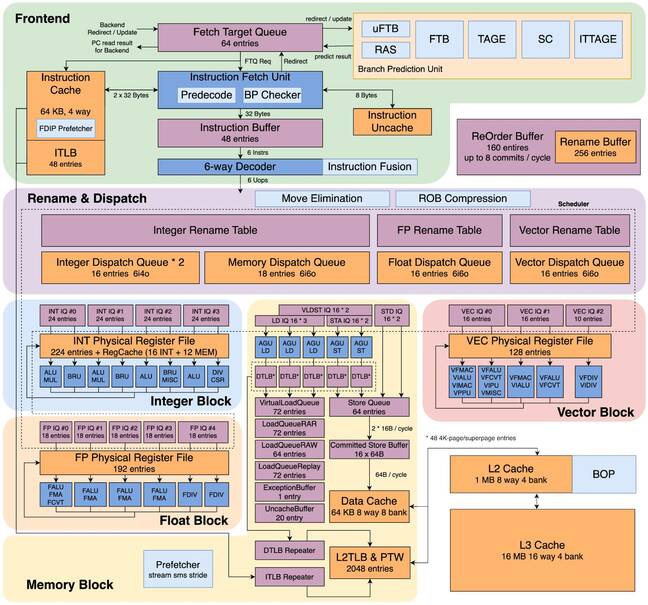
China's Xiangshan project aims to deliver a high-performance RISC-V processor by 2025. If it succeeds, it could be "enormously significant" for three reasons, writes The Register's Simon Sharwood. It would elevate RISC-V from low-end silicon to datacenter-level capabilities, leverage the open-source Mulan PSL-2.0 license to disrupt proprietary chip models like Arm and Intel, and reduce China's dependence on foreign technology, mitigating the impact of international sanctions on advanced processors. From the report: The prospect of a 2025 debut appeared on Sunday in a post to Chinese social media service Weibo, penned by Yungang Bao of the Institute of Computing Technology at the Chinese Academy of Sciences. The academy has created a project called Xiangshan that aims to use the permissively licensed RISC-V ISA to create a high-performance chip, with the Scala source code to the designs openly available.

Bao is a leader of the project, and has described the team's ambition to create a company that does for RISC-V what Red Hat did for Linux -- although he said that before Red Hat changed the way it made the source code of RHEL available to the public. The Xiangshan project has previously aspired to six-monthly releases, though it appears its latest design to be taped out was a second-gen chip named Nanhu that emerged in late 2023. That silicon ran at 2GHz and was built on a 14nm process node. The project has since worked on a third-gen design, named Kunminghu, and published the image [here] depicting an overview of its non-trivial micro-architecture.

AI

AI Startup Anthropic Raising Funding Valuing it at $60 Billion (wsj.com) 17

Anthropic is in advanced talks to raise $2 billion dollars in a deal that would value it at $60 billion, making it the latest artificial-intelligence startup to seize upon investor euphoria for the technology. WSJ: The funding round is being led by the venture firm Lightspeed Venture Partners, people familiar with the matter said. The $60 billion valuation includes the money Anthropic plans to raise in the round.

The deal would make Anthropic the fifth-most valuable U.S. startup after SpaceX, OpenAI, Stripe and Databricks, according to data provider CB Insights. It was valued last year at $18 billion in a round led by Menlo Ventures. There has been a dealmaking frenzy among AI companies since OpenAI raised $6.6 billion in an October round that nearly doubled its value to $157 billion. Two other startups, Elon Musk's xAI and Perplexity, subsequently raised money at substantially increased valuations.

AMD

AMD Reveals Next-Gen Handheld Gaming PC Chips (ign.com) 18

At CES 2025, AMD unveiled the Z2, Z2 Go, and Z2 Extreme chipsets -- all powered by Zen 5 CPU cores and designed for handheld gaming PCs. IGN reports: The AMD Zen 2 Extreme, along with lower-specced cousins the Z2 and Z2 Go, are powered by Zen 5 CPU cores. While the Zen 2 Extreme is using a RDNA 3.5-based GPU, the Z2 and Z2 Go are still using RDNA 3 and RDNA 2, respectively. This creates an entire family of APUs (Advanced Processing Units) for handheld gaming PCs that should hopefully cause the price of handhelds to go down a bit.

With the Z2 Extreme, AMD is hoping to dramatically improve battery life, while also delivering console-like gaming performance to devices like the Lenovo Legion Go. By and large, the biggest limiting factor of these handhelds, especially at the high end, is how quickly their batteries drain when playing demanding games away from a wall outlet.
The company also introduced the "Fire Range" HX3D processors for gaming laptops, leveraging 3D V-cache technology for enhanced gaming performance and efficiency. "All of these mobile chipsets, from 'Fire Range' HX3D to the AMD Z2 Extreme, will end up in gaming laptops and handhelds over the next few months," adds IGN.

AMD published a press release with additional details and specifications.
Programming

Should First-Year Programming Students Be Taught With Python and Java? (huntnewsnu.com) 175

Long-time Slashdot reader theodp writes: In an Op-ed for The Huntington News, fourth year Northeastern University CS student Derek Kaplan argues that real pedagogical merit is what should count when deciding which language to use to teach CS fundamentals (aka 'Fundies'). He makes the case for Northeastern to reconsider its decision to move from Racket to Python and Java later this year in an overhaul of its first-year curriculum.

"Students will get extensive training in Python, which is currently the most requested language by co-op employers," Northeastern explains (some two decades after a Slashdot commenter made the same Hot Languages = Jobs observation in a spirited 2001 debate on Java as a CS introductory language)...

"I have often heard computer science students complain that Fundies 1 teaches Racket instead of a 'useful language' like Python," Kaplan writes. "But the point of Fundies is not to teach Racket — it is to teach program design skills that can be applied using any programming language. Racket is just the tool it uses to do so. A student who does well in Fundies will have no difficulty applying the same skills to Python or any other language. And with how fast the tech industry changes, is it really worth having a course that teaches just Python when tomorrow, some other language might dominate the industry? Our current curriculum focuses on timeless principles rather than fleeting trends."

Also expressing concerns about the selection of suitable languages for novice programming is King's College CS Prof Michael Kölling, who explains, "One of the drivers is the perceived usefulness of the language in a real-world context. Students (and their parents) often have opinions which language is 'better' to learn. In forming these opinions, the definition of 'better' can often be vague and driven by limited insight. One strong aspect commonly cited is the perceived usefulness of a language in the 'real world.' If a language is widely used in industry, it is more likely to be seen as a useful language to learn." Kölling's recommendation? "We need a new language for teaching novices at secondary school and introductory university level," Kölling concludes. "This language should be designed explicitly for teaching [...] Maintenance and adaptation of this language should be driven by pedagogical considerations, not by industry needs."

While noble in intent, one suspects Kaplan and Kölling may be on a quixotic quest in a money wins world, outgunned by the demands, resources, and influence of tech giants like Amazon — the top employer of Northeastern MSCS program grads — who pushed back against NSF advice to deemphasize Java in high school CS and dropped $15 million to have tech-backed nonprofit Code.org develop and push a new Java-based, powered-by-AWS CS curriculum into high schools with the support of a consortium of politicians, educators, and tech companies. Echoing Northeastern, an Amazon press release argued the new Java-based curriculum "best prepares students for the next step in their education and careers."

AI

How AI-Based Military Intelligence Powered Israel's Attacks on Gaza (msn.com) 131

It's "what some experts consider the most advanced military AI initiative ever to be deployed," reports the Washington Post.

But the Israeli military's AI-powered intelligence practices are also "under scrutiny. Genocide charges against Israel brought to The Hague by South Africa question whether crucial decisions about bombing targets in Gaza were made by software, an investigation that could hasten a global debate about the role of AI technology in warfare." After the brutal Oct. 7, 2023, attack by Hamas, the Israel Defense Forces deluged Gaza with bombs, drawing on a database painstakingly compiled through the years that detailed home addresses, tunnels and other infrastructure critical to the militant group. But then the target bank ran low. To maintain the war's breakneck pace, the IDF turned to an elaborate artificial intelligence tool called Habsora — or "the Gospel" — which could quickly generate hundreds of additional targets. The use of AI to rapidly refill IDF's target bank allowed the military to continue its campaign uninterrupted, according to two people familiar with the operation. It is an example of how the decade-long program to place advanced AI tools at the center of IDF's intelligence operations has contributed to the violence of Israel's 14-month war in Gaza... People familiar with the IDF's practices, including soldiers who have served in the war, say Israel's military has significantly expanded the number of acceptable civilian casualties from historic norms. Some argue this shift is enabled by automation, which has made it easier to speedily generate large quantities of targets, including of low-level militants who participated in the Oct. 7 attacks.
In a statement to The Post, the IDF argued that "If anything, these tools have minimized collateral damage and raised the accuracy of the human-led process." The IDF requires an officer to sign off on any recommendations from its "big data processing" systems, according to an intelligence official who spoke on the condition of anonymity because Israel does not release division leaders' names. The Gospel and other AI tools do not make decisions autonomously, the person added...Recommendations that survive vetting by an intelligence analyst are placed in the target bank by a senior officer...

Another machine learning tool, called Lavender, uses a percentage score to predict how likely a Palestinian is to be a member of a militant group, allowing the IDF to quickly generate a large volume of potential human targets... The rule mandating two pieces of human-derived intelligence to validate a prediction from Lavender was dropped to one at the outset of the war, according to two people familiar with the efforts. In some cases in the Gaza division, soldiers who were poorly trained in using the technology attacked human targets without corroborating Lavender's predictions at all, the soldier said.

The article includes an ominous quote from Steven Feldstein, a senior fellow at the Carnegie Endowment who researches the use of AI in war. Feldstein acknowledges questions of accuracy, but also notes the accelerated speed of the systems, and the ultimate higher death count. His conclusion?

"What's happening in Gaza is a forerunner of a broader shift in how war is being fought."
Businesses

UK Bosses Try To Turn Back Clock On Hybrid Working (theguardian.com) 38

As UK workers face a tougher-than-usual January return to offices, many large employers, including Amazon, BT, PwC, and Santander, are enforcing stricter in-person attendance mandates. The Guardian reports: As of 1 January, BT is requiring its 50,000 office-based employees across the UK and several other countries to attend three days a week in what it calls a "three together, two wherever" approach. Workers at the telecoms company have been told that office entry and exit data will be used to monitor attendance. The accountancy firm PwC is also clamping down on remote working; the Spanish-owned bank Santander is formalizing attendance requirements for its 10,000 UK staff; the digital bank Starling has ordered staff back to the office more regularly; and the supermarket chain Asda has made a three-day office week compulsory for thousands of workers at its Leeds and Leicester sites. The international picture is similar. [...]

Multiple studies suggest that the future of work is flexible, with time split between the office and home or another location, in what has been called "the new normal" by the Office for National Statistics. The ONS found in its latest survey that hybrid was the standard pattern for more than a quarter (28%) of working adults in Great Britain in autumn 2024. At the same time, working entirely remotely had fallen since 2021, it found. One of the most frequently reported business reasons for hybrid working was "improved staff wellbeing," the ONS found, while those who worked from home saved an average of 56 minutes each day by dodging the commute.

UK staff have been slower to return to their desks after the pandemic than their counterparts in France, Germany, Italy, Spain and the US. London, in particular, has lagged behind other global cities including Paris and New York, according to recent research from the Centre for Cities thinktank, where workers spent on average 2.7 days a week in the office, attendance levels similar to Toronto and Sydney. It cited the cost, and average length of the commute in and around the UK capital as one of the main reasons for the trend. Despite this, there has been a "slow but steady increase in both attendance and desk use" in British offices, according to AWA, which tracked a 4% rise in attendance, from 29% to 33%, between July 2022 and September 2024.
"Hybrid working is here, it's not going away," said Andrew Mawson, the founder of Advanced Workplace Associates (AWA), a workplace transformation consultancy. "Even though companies are trying to mandate, foolishly in my view, to have their people in the office on a certain number of days, the true reality of it is different."
Microsoft

A New Year's Gift From Microsoft: Surprise, Your Scanners Don't Work (theregister.com) 39

Windows 11 24H2 continues to experience issues with multifunction devices using the eSCL scan protocol, despite Microsoft marking the problem as resolved. According to a Register reader, "It works on a Windows 10 machine, but not on Windows 11, unless both the computer and the scanner are on wired Ethernet." From the report: Microsoft issued a compatibility safeguard hold on USB-connected devices using the Scanner Communication Language (eSCL) protocol in November after users who installed the Windows update experienced glitches with device discovery. The issue was reported resolved by Microsoft in December. However, it seems that KB5048667 might not have fixed all the problems for Canon owners. According to our reader: "Canon support tells me that the 24H2 eSCL issue still is not fixed." We asked Microsoft about the situation, but despite telling us it was looking into the problem on Friday, December 20, the company has yet to provide any further details. Canon was more forthcoming. A spokesperson told The Register it was aware of a problem impacting devices using ScanGear MF.

ScanGear MF is a scanner driver provided by Canon and allows customers to configure advanced settings for scanning. Canon does not appear to be changing its code to rectify whatever problems had been brought on by the Windows 11 update. The spokesperson said: "Microsoft is currently working on an OS amendment to resolve this and we are keeping in close contact with them. The timing for resolving this is yet to be confirmed by Microsoft, however we expect to receive the plan to fix in January 2025." Customers affected by the issue, which manifests itself with a communications error message, according to Canon's support forum, are advised to use either native Microsoft software solutions or go fully wired via USB.

United Kingdom

UK Develops Quantum Clock To Cut Military GPS Dependence (www.gov.uk) 42

Britain's Defence Science and Technology Laboratory has developed a quantum atomic clock that will lose less than one second over billions of years, the Ministry of Defence announced on Thursday.

The UK-built device aims to reduce military reliance on GPS technology, which can be disrupted by adversaries. It will be deployable in military operations within five years, supporting navigation systems, encrypted communications, and advanced weapons systems. The $34.6 million project involves partners including Infleqtion UK, Aquark Technologies, and Imperial College London. The clock was tested outside laboratory conditions for the first time in collaboration with the Royal Navy and Army Futures team.

Slashdot Top Deals