Transportation

Southwest Airlines Says They'll Purchase 'Hundreds' More Boeing 737 Max Aircraft (inc.com) 258

Inc. magazine describes as "stunning" announcement from Southwest Airlines, "by far the biggest 737 Max customer in the United States, with 34 of the planes among its fleet, and plans for many more. " Speaking at a chamber of commerce event in Dallas, Southwest chairman and CEO Gary Kelly said Southwest has no plans to abandon the 737 Max. In fact, he said it will purchase "hundreds" more 737 Max aircraft. "It's a very good airplane, but Boeing has acknowledged that they've got some things they need to address with the software in that airplane," Kelly said, according to the Dallas Business Journal. "It seems like it's a relatively straight-forward modification. We're obviously anxious to get the airplane back in service."

That's it: all-in on the 737 Max. Or at least close to it...

By flying just one aircraft, Southwest knows that almost any of its pilots can fly any of its planes. Its scheduling and maintenance tasks become a lot easier than for airlines with multiple types of aircraft. But it also means that ultimately, Southwest's brand and its overall success are tied up with Boeing and the 737 in a way that few other airlines are.

Marketwatch adds that in fact, major airlines "are hungry for fuel-efficient single-aisle aircraft such as the Max, and there's a long backlog for the jet's closest competitor, Airbus SE, analysts at Oxford Economics said in a note Thursday.

"That will shield Boeing from a mass cancellation of orders," the analysts said.
Facebook

How Facebook Mis-Captioned the Launch of a NASA Supply Rocket (arstechnica.com) 37

An anonymous reader quotes Ars Technica: An Antares rocket built by Northrop Grumman launched on Wednesday afternoon, boosting a Cygnus spacecraft with 3.4 tons of cargo toward the International Space Station. The launch from Wallops Island, Virginia, went flawlessly, and the spacecraft arrived at the station on Friday. However, when NASA's International Space Station program posted the launch video to its Facebook page on Thursday, there was a problem. Apparently the agency's caption service hadn't gotten to this video clip yet, so viewers with captions enabled were treated not just to the glory of a rocket launch, but the glory of Facebook's automatically generated crazywords...

Some of the captions are just hilariously bad. For example, when the announcer triumphantly declares, "And we have liftoff of the Antares NG-11 mission to the ISS," the automatically generated caption service helpfully says, "And we have liftoff of the guitarist G 11 mission to the ice sets."

There's more examples in the photos at the top of their article -- for example, a caption stating that the uncrewed launch "had a phenomenal displaced people at 60 seconds," and translating the phrase "TVC is nominal" to "phenomenal."

While the lift-off announcer does use what may be unfamiliar names for the rockets, along with other technical jargon, the article points out that YouTube's auto-captioning of the same launch "seemed to have no problem with those bits of space argot."
Chrome

Did Google Sabotage Firefox and IE? (zdnet.com) 231

Firefox's former VP accused Google of sabotaging Firefox -- for example, when Gmail and Google Docs "started to experience selective performance issues and bugs on Firefox" and demo sites "would falsely block Firefox as 'incompatible'... There were dozens of oopses. Hundreds maybe... [W]hen you see a sustained pattern of 'oops' and delays from this organization -- you're being outfoxed."

Now Nightingale's accusations have stirred up some follow-up from technology reporters. An anonymous reader shares a blog post by ZDNet security reporter Catalin Cimpanu: Nightingale is not the first Firefox team member to come forward and make such accusations. In July 2018, Mozilla Program Manager Chris Peterson accused Google of intentionally slowing down YouTube performance on Firefox. He revealed that both Firefox and Edge were superior when loading YouTube content when compared to Chrome, and in order to counteract this performance issue, Google switched to using a JavaScript library for YouTube that they knew wasn't supported by Firefox.

At this point, it's very hard not to believe or take Nightingale's comments seriously. Slowly but surely, Google is becoming the new Microsoft, and Chrome is slowly turning into the new IE, an opinion that more and more users are starting to share.
On Twitter, a senior editor at the Verge added "Google did a lot of 'oops' accidents to Windows Phone, too. Same pattern of behavior with its services and Edge. Oopsy this, oopsy that." The site MSPowerUser also shares a similar story from former Microsoft Edge intern, Joshua Bakita. "I very recently worked on the Edge team, and one of the reasons we decided to end EdgeHTML was because Google kept making changes to its sites that broke other browsers, and we couldn't keep up."

Meanwhile, Computerworld argues that data "backs up Nightingale's admission, to a point." [I]f Google monkey business contributed to Firefox's fall, it must have really damaged Microsoft's IE. During the time it took Chrome to replace Firefox as the No. 2 browser, Firefox lost just 9% of its user share, while IE shed 22%. And Chrome's most explosive growth - which began in early 2016 - didn't come at Firefox's expense; instead, it first hollowed out IE, then suppressed any potential enthusiasm for the follow-on Edge.

Chrome didn't reach its current place -- last month capturing nearly 68% of all browser activity -- by raiding Firefox. It did it by destroying IE.

Oops.

Supercomputing

'Pi VizuWall' Is a Beowulf Cluster Built With Raspberry Pi's (raspberrypi.org) 68

Why would someone build their own Beowulf cluster -- a high-performance parallel computing prototype -- using 12 Raspberry Pi boards? It's using the standard Beowulf cluster architecture found in about 88% of the world's largest parallel computing systems, with an MPI (Message Passing Interface) system that distributes the load over all the nodes.

Matt Trask, a long-time computer engineer now completing his undergraduate degree at Florida Atlantic University, explains how it grew out of his work on "virtual mainframes": In the world of parallel supercomputers (branded 'high-performance computing', or HPC), system manufacturers are motivated to sell their HPC products to industry, but industry has pushed back due to what they call the "Ninja Gap". MPI programming is hard. It is usually not learned until the programmer is in grad school at the earliest, and given that it takes a couple of years to achieve mastery of any particular discipline, most of the proficient MPI programmers are PhDs. And this, is the Ninja Gap -- industry understands that the academic system cannot and will not be able to generate enough 'ninjas' to meet the needs of industry if industry were to adopt HPC technology.

As part of my research into parallel computing systems, I have studied the process of learning to program with MPI and have found that almost all current practitioners are self-taught, coming from disciplines other than computer science. Actual undergraduate CS programs rarely offer MPI programming. Thus my motivation for building a low-cost cluster system with Raspberry Pis, in order to drive down the entry-level costs. This parallel computing system, with a cost of under $1000, could be deployed at any college or community college rather than just at elite research institutions, as is done [for parallel computing systems] today.

The system is entirely open source, using only standard Raspberry Pi 3B+ boards and Raspbian Linux. The version of MPI that is used is called MPICH, another open-source technology that is readily available.

But there's an added visual flourish, explains long-time Slashdot reader iamacat. "To visualize computing, each node is equipped with a servo motor to position itself according to its current load -- lying flat when fully idle, standing up 90 degrees when fully utilized."

Its data comes from the /proc filesystem, and the necessary hinges for this prototype were all generated with a 3D printer. "The first lesson is to use CNC'd aluminum for the motor housings instead of 3D-printed plastic," writes Trask. "We've seen some minor distortion of the printed plastic from the heat generated in the servos."
Transportation

'How the Boeing 737 Max Disaster Looks to a Software Developer' (ieee.org) 388

Slashdot reader omfglearntoplay shared this article from IEEE's Spectrum. In "How the Boeing 737 Max Disaster Looks to a Software Developer," pilot (and software executive) Gregory Travis argues Boeing tried to avoid costly hardware changes to their 737s with a flawed software fix -- specifically, the Maneuvering Characteristics Augmentation System (or MCAS): It is astounding that no one who wrote the MCAS software for the 737 Max seems even to have raised the possibility of using multiple inputs, including the opposite angle-of-attack sensor, in the computer's determination of an impending stall. As a lifetime member of the software development fraternity, I don't know what toxic combination of inexperience, hubris, or lack of cultural understanding led to this mistake. But I do know that it's indicative of a much deeper problem. The people who wrote the code for the original MCAS system were obviously terribly far out of their league and did not know it.

So Boeing produced a dynamically unstable airframe, the 737 Max. That is big strike No. 1. Boeing then tried to mask the 737's dynamic instability with a software system. Big strike No. 2. Finally, the software relied on systems known for their propensity to fail (angle-of-attack indicators) and did not appear to include even rudimentary provisions to cross-check the outputs of the angle-of-attack sensor against other sensors, or even the other angle-of-attack sensor. Big strike No. 3... None of the above should have passed muster. None of the above should have passed the "OK" pencil of the most junior engineering staff... That's not a big strike. That's a political, social, economic, and technical sin...

The 737 Max saga teaches us not only about the limits of technology and the risks of complexity, it teaches us about our real priorities. Today, safety doesn't come first -- money comes first, and safety's only utility in that regard is in helping to keep the money coming. The problem is getting worse because our devices are increasingly dominated by something that's all too easy to manipulate: software.... I believe the relative ease -- not to mention the lack of tangible cost -- of software updates has created a cultural laziness within the software engineering community. Moreover, because more and more of the hardware that we create is monitored and controlled by software, that cultural laziness is now creeping into hardware engineering -- like building airliners. Less thought is now given to getting a design correct and simple up front because it's so easy to fix what you didn't get right later.

The article also points out that "not letting the pilot regain control by pulling back on the column was an explicit design decision. Because if the pilots could pull up the nose when MCAS said it should go down, why have MCAS at all?

"MCAS is implemented in the flight management computer, even at times when the autopilot is turned off, when the pilots think they are flying the plane."
Google

'Some Cheers, A Few Sneers For Google's URL Solution For AMP' (theverge.com) 104

The Verge explains what all the commotion is about: AMP stands for "Accelerated Mobile Pages," and you've probably noticed that those pages load super quickly and usually look much simpler than regular webpages. You may have also noticed that the URL at the top of your browser started with "www.google.com/somethingorother" instead of with the webpage you thought you were visiting. Google is trying to fix that by announcing support for something called "Signed Exchanges." What it should mean is that when you click on one of those links, your URL will be the original, correct URL for the story. Cloudflare is joining Google in supporting the standard for customers who use its services.

In order for this thing to work, every step in the chain of technologies involved in loading the AMP format has to support Signed Exchanges, including your browser, the search engine, and the website that published the link. Right now, that means the URL will be fixed only when a Chrome browser loads a Google search link to a published article that has implemented support.

Mozilla'a official position on signed exchanges is they're "harmful," arguing in a 51-page position paper that there's both security and privacy considerations. Pierre Far, a former Google employee, posted on Twitter that the change "breaks many assumptions about how the web works," and that in addition, "Google is acting too quickly. Other browsers and internet stakeholders have well-founded concerns, and the correct mechanism to address them is the standardization process. Google skipped all that. Naughty." Jeffrey Yaskin, from Chrome's web platform team, even acknowledged that criticism with a tweet of his own. "I think it's fair to say we're pushing it. The question is our motives, which I claim is to improve the web rather than to 'all your base' it, but I would say that either way."

Search Engine Land cited both tweets, and shared some concerns of their own. "The compromise we have to consider before getting on board with Signed HTTP Exchanges is whether we're willing to allow a third party to serve up our content without users being able to tell the difference.

"If we, as digital marketers, want to influence the conventions of our future work environment, we'll have to decide if the gains are enough to disrupt long-standing assumptions of how websites are delivered. If so, we'll also have to cede the ability to judge user intent over to Google and swallow the fact that it skipped over the standardization process to implement a process that one of its own created."
Canada

Canada Civil Liberties Group Argues Toronto Shouldn't Be 'Google's Lab Rat' (fastcompany.com) 36

"A civil liberties group in Canada is suing three tiers of government over potential privacy issues posed by Sidewalk Labs's plan to develop a 12-acre smart city in Toronto, which will be approved or denied later this summer," reports Fast Company.

The fight centers around a taxpayer-funded organization jointly created by the federal, provincial, and municipal governments: The Canadian Civil Liberties Association claims that Waterfront Toronto, let alone Sidewalk Labs, doesn't have the jurisdiction to make rules about people's privacy. The government "sold out our constitutional rights to freedom from surveillance and sold it to the global surveillance mammoth of behavioral data collection: Google," said Michael Bryant, the executive director and general counsel of the CCLA, in a press conference.... "Our job at the Canadian Civil Liberties Association is to say to all three levels of government that Canadians should not be Google's lab rat. This lab needs to be shut down and reset...."

Ann Cavoukian, the former Information and Privacy Commissioner for the Canadian province of Ontario who joined the project early, quit in October 2018. The reason? Sidewalk Labs had decided not to require that all data collected by third parties in the development be instantly de-identified at the source, which would mean that sensitive data like people's faces or license plates could still potentially be used for corporate profit. "I knew the smart city of privacy wasn't going to happen," she says. "That's why I resigned: I said, I can't go along with it...."

"If I was still involved, I'd want more decentralized models of data where the individual could truly retain control of the data," she says, citing a new, privacy-centric model from the web's father, Tim Berners-Lee, to decentralize the web and take back control from the corporations that run it.

In a statement Sidewalk Labs said they favor a data trust run by an independent third party partnering with the government to benefit the community and "spur innovation and investment" while protecting privacy. "Sidewalk Labs fully supports a robust and healthy discussion regarding privacy, data ownership, and governance. But this debate must be rooted in fact, not fiction and fear-mongering."

But the CCLA's web site argues that unlawful surveillance "is wrong whether done by data profiteers or the state." The article also quotes their general counsel's complaint that the government has "outsourced our privacy rights and the supervision of our privacy rights and our surveillance to the very company that's doing the surveillance."
Privacy

'Incognito Mode' Isn't Really Private. Try Browser Compartmentalization (fastcompany.com) 119

tedlistens writes: One of the most common techniques people think can help hide their activity is the use of an "incognito" mode in a browser," writes Michael Grothaus at Fast Company. But "despite what most people assume, incognito modes are primarily built to block traces of your online activity being left on your computer -- not the web. Just because you are using incognito mode, that doesn't mean your ISP and sites like Google, Facebook, and Amazon can't track your activity."

However, there's still a way to brew your own, safer "incognito mode." It's called browser compartmentalization. Grothaus writes: "The technique sees users using two or even three browsers on the same computer. However, instead of switching between browsers at random, users of browser compartmentalization dedicate one browser to one type of internet activity, and another browser to another type of internet activity.

Specifically, the article recommends one browser for sites you need to log into, and another for random web surfing and any web searches. "By splitting up your web activity between two browsers, you'll obtain the utmost privacy and anonymity possible without sacrificing convenience or the ease of use of the websites you need to log in to." It recommends choosing a privacy-focused browser like Brave, Firefox, Apple's Safari, or Microsoft's Edge. "As for Chrome: It's made by Google, whose sole aim is to know everything you do online, so it's probably best to stay away from Chrome if you value your privacy."

The article is part of a series titled "The Privacy Divide," which explores "misconceptions, disparities, and paradoxes that have developed around our privacy and its broader impacts on society."
The Internet

26 States Now Ban Or Restrict Community Broadband, Report Finds (vice.com) 202

An anonymous reader quotes a report from Motherboard: A new report has found that 26 states now either restrict or outright prohibit towns and cities from building their own broadband networks. Quite often the laws are directly written by the telecom sector, and in some instances ban towns and cities from building their own broadband networks -- even if the local ISP refuses to provide service. The full report by BroadbandNow, a consumer-focused company that tracks US broadband availability, indicates the total number of state restrictions on community broadband has jumped from 20 such restrictions since the group's last report in 2018.

BroadbandNow's report looks at each state's restrictions individually, and found that while some states simply banned community broadband outright (a notable assault on voters' democratic rights), others impose clever but onerous restrictions on precisely how a local network can be funded, who they can partner with, or how quickly (and where) they're allowed to grow. In Tennessee, for example, state laws allow publicly-owned electric utilities to provide broadband, "but limits that service provision to within their electric service areas." Such restrictions have made it hard for EPB -- the highest rated ISP in America last year according to Consumer Reports -- to expand service into new areas.

Robotics

Robot News Presenter Causes a Stir On Russian TV (bbc.com) 66

Russia state news channel Rossiya 24 has introduced a robot presenter for some of its bulletins. The BBC reports that the robot, named Alex, "has already caused a stir, with some viewers complaining about his appearance and accusing him of peddling political propaganda." From the report: The robot was developed by Promobot in the city of Perm. His silicon head is modeled on the face of the company's co-founder Alexei Yuzhakov. At the moment, the robot anchor can only move his facial features and neck. However, the final robot will have fully mobile limbs as well. Production of the robot began in 2017 and should be fully complete later this year, according to Promobot. It said Alex had cost more than one million roubles ($15,600) to develop and that it had received orders for 12 more humanoids.

Rossiya 24 said its newest presenter was of Russian origin with "software and almost all of its components produced inside the country." Alex has delivered a number of bulletins for the channel, presenting news items about agriculture, a nuclear technology forum and micro-finance. Most observers think on-air Alex is a temporary stunt to inject some fun and promote innovative Russian technology in TV news.

Bitcoin

West Virginia Will Allow 'Blockchain Voting' In the 2020 Election (technologyreview.com) 89

Military voters stationed overseas will be able to cast their votes for the 2020 presidential election via a mobile app that uses a private blockchain. MIT Technology Review reports: Donald Kersey, West Virginia's elections director, tells the cryto news website LongHash that he believes the app, created by a startup called Voatz, can enhance participation by overseas voters. Turnout among this group is very low, in part because the process of receiving a ballot and securely returning it on time is often not straightforward. This is the rationale behind the decision by a number of states to allow overseas military voters to return their ballots via e-mail. West Virginia apparently is of the mind that Voatz's private blockchain will make this kind of online voting more secure. The state first piloted the program during the 2018 midterms.

Though Kersey admits there's no telling for certain whether the app can be compromised, West Virginia is undeterred, especially given the "really good response rate" officials saw during the midterms last year. "We are not saying mobile voting is the best solution to the problem, we are not saying that blockchain technology is the best solution to storage of security data," Kersey tells LongHash. "What we are saying though is that it's better than what we have."

Privacy

Should Vendors Start Adding Physical On/Off Switches To Devices That Can Spy On Us? (larrysanger.org) 231

Larry Sanger, American internet project developer and co-founder of Wikipedia, argues in a blog post that vendors must start adding physical on/off switches to webcams, smartphone cameras/mics, and other devices that spy on us. He writes: Have you ever noticed that your webcam doesn't have an "off" switch? I looked on Amazon, and I couldn't find any webcams for sale that had a simple on/off switch. When I thought I found one, but it turned out just to have a light that turns on when the camera is in use, and off when not -- not a physical switch you can press or slide. The "clever" solution is supposed to be webcam covers (something Mark Zuckerberg had a hand in popularizing); you can even get a webcam (or a laptop) with such a cover built in. How convenient! I've used tape, which works fine. But a cover doesn't cover up the microphone, which could be turned on without your knowledge.
[...]
It's almost as if the vendors of common, must-have devices want to make it possible to spy on us. An enterprising journalist should ask why they don't make such switches. They certainly have deliberately made it hard for us to stop being spied upon -- even though we're their customers. Think about that. We're their bread and butter, and we're increasingly and rightly concerned about our security. Yet they keep selling us these insecure devices. That's just weird, isn't it? What the hell is going on? [...] If your webcam, or your phone, or any other device with an Internet-connected camera or microphone (think about how many you own) has ever been hacked, these [hardware vendors like Logitech and Apple and large software vendors like Skype and Snapchat] are partly to blame if it was always-on by design. They have a duty to worry about how their products make their users less secure. They haven't been doing this duty.
Sanger goes on to urge consumers to care more about our privacy and security, and demand that vendors give us an off switch. "I think we consumers should demand that webcams, smart phones, smart speakers, and laptop cameras and microphones -- and any other devices with cameras and microphones that are connected to the Internet -- be built with hardware 'off' switches that make it impossible for the camera and microphone to be operated," writes Sanger.

Do you agree?
Microsoft

Unexpected Protection Added To Microsoft Edge Subverts IE Security (arstechnica.com) 14

Dan Goodin writes via Ars Technica: A researcher has uncovered strange and unexpected behavior in Windows 10 that allows remote attackers to steal data stored on hard drives when a user opens a malicious file downloaded with the Edge browser. The threat partially surfaced last week when a different researcher, John Page, reported what he called a flaw in Internet Explorer. Page claimed that when using the file manager to open a maliciously crafted MHT file, the browser uploaded one or more files to a remote server. According to Page, the vulnerability affected the most recent version of IE, version 11, running on Windows 7, Windows 10, and Windows Server 2012 R2 with all security updates installed. (It's no longer clear whether any OS other than Windows 10 is affected, at least for some users. More about that in a moment.)

[I]n Page's post was a video demonstration of the proof-of-concept exploit Page created. It shows a booby-trapped MHT file triggering an upload of the host computer's system.ini file to a remote server. Page's video shows the file being downloaded with Edge. "This can allow remote attackers to potentially exfiltrate Local files and conduct remote reconnaissance on locally installed Program version information," Page wrote. "Example, a request for 'c:\Python27\NEWS.txt' can return version information for that program."

Businesses

FTC May Hold Zuckerberg Personally Responsible For Facebook Privacy Failures (arstechnica.com) 94

An anonymous reader quotes a report from Ars Technica: Federal Trade Commission officials are discussing whether to hold Facebook CEO Mark Zuckerberg personally accountable for Facebook's privacy failures, according to reports by The Washington Post and NBC News. Facebook has been trying to protect Zuckerberg from that possibility in negotiations with the FTC, the Post wrote. Federal regulators investigating Facebook are "exploring his past statements on privacy and weighing whether to seek new, heightened oversight of his leadership," the Post reported, citing anonymous sources who are familiar with the FTC discussions. "The discussions about how to hold Zuckerberg accountable for Facebook's data lapses have come in the context of wide-ranging talks between the Federal Trade Commission and Facebook that could settle the government's more than year-old probe," the Post wrote.

According to NBC, FTC officials are "discussing whether and how to hold Facebook Chief Executive Mark Zuckerberg personally accountable for the company's history of mismanaging users' private data." However, NBC said its sources "wouldn't elaborate on what measures are specifically under consideration." According to the Post, one idea raised during the probe "could require [Zuckerberg] or other executives to certify the company's privacy practices periodically to the board of directors." But it's not clear how likely the FTC is to target Zuckerberg in a final settlement, and "Facebook has fought fiercely to shield Zuckerberg as part of the negotiations, one of the sources familiar with the probe said," the Post wrote.

Encryption

French Government Releases In-house IM App To Replace WhatsApp and Telegram Use (zdnet.com) 37

A year ago, the French government unveiled its plan to build its own encrypted messenger service to ease fears that foreign entities could spy on private conversations between top officials. That app, named Tchap, is now official for Android handsets and the iPhone. From a report: A web dashboard is also in the works. Only official French government employees can sign-up for an account; however, the French government also open-sourced Tchap's source code on GitHub so other organizations can roll out their own versions of Tchap for internal use as well. Work on the app started in July 2018, and the app itself is based on Riot, a well-known open-source, self-hostable, and secure instant messaging client-server package. The app was officially developed by DINSIC (Interministerial Directorate of Digital and Information System and Communication of the State), under the supervision of ANSSI, France's National Cybersecurity Agency.
Security

Ransomware Attack Knocks The Weather Channel Off the Air (wsj.com) 36

A computer attack knocked the Weather Channel off the air for more than an hour Thursday morning [Editor's note: the link may be paywalled; alternative source], and federal authorities are investigating the incident, WSJ is reporting. From the report: After its broadcast was disrupted, the weather news service sent a tweet saying it had been the victim of "a malicious software attack," adding that federal law-enforcement officials were investigating the matter. A spokesman for the Federal Bureau of Investigation said the incident was a ransomware attack, and the agency was conducting an investigation. Ransomware is an increasingly common form of digital extortion. Criminals install it on computer networks via trickery or hacking, and the software then spreads from computer to computer, locking up systems until a digital ransom is paid.
Social Networks

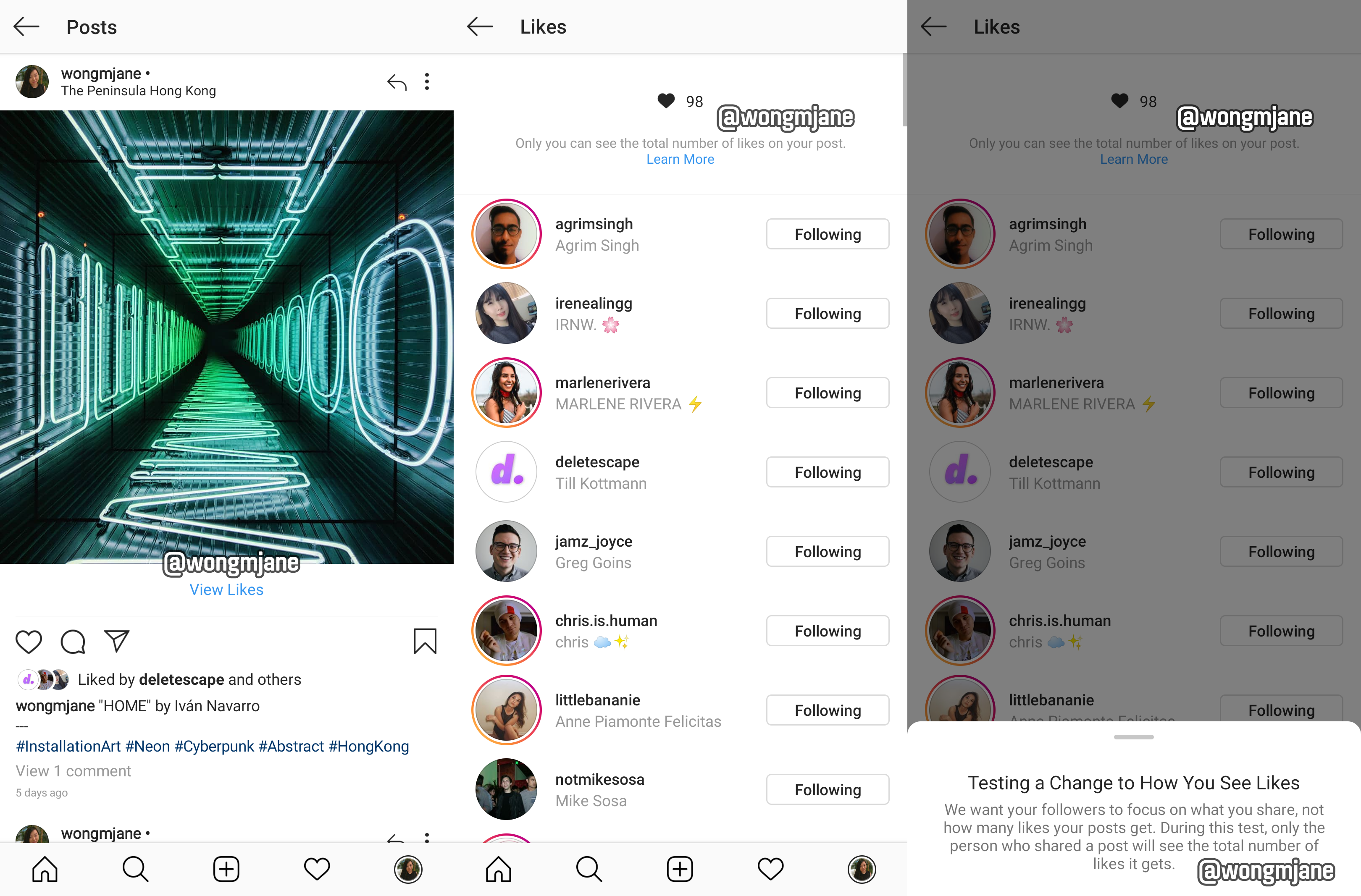
Instagram Hides Like Counts In Leaked Design Prototype (techcrunch.com) 35

Instagram's Android code is hiding a design change that hides the number of likes your posts get. "During this test, only the person who shares a post will see the total number of likes it gets," the company says. TechCrunch reports on the seemingly small design change test and the massive potential impact it'll have on users' well-being: Hiding Like counts could reduce herd mentality, where people just Like what's already got tons of Likes. It could reduce the sense of competition on Instagram, since users won't compare their own counts with those of more popular friends or superstar creators. And it could encourage creators to post what feels most authentic rather than trying to rack up Likes for everyone to see.

You can see [in a leaked screenshot] on the left that the Instagram feed post lacks a Like count, but still shows a few faces and a name of other people who've Liked it. Users are alerted that only they will see their post's Like counts, and anyone else won't. Many users delete posts that don't immediately get "enough" Likes or post to their fake "Finstagram" accounts if they don't think they'll be proud of the hearts they collect. Hiding Like counts might get users posting more because they'll be less self-conscious. It appears there's no plan to hide follower counts on user profiles, which are the true measure of popularity, but also serve a purpose of distinguishing great content creators and assessing their worth to marketers. Hiding Likes could just put more of a spotlight on follower and comment counts. And even if users don't see Like counts, they still massively impact the feed's ranking algorithm, so creators will still have to battle for them to be seen.

Google

Google Will Begin To Block Sign-ins From Embedded Browser Frameworks in June (venturebeat.com) 89

To fight phishing, Google last year announced it would require users to enable JavaScript during Google Account sign-in so that it could run attack-detecting risk assessments, and this week, the company said it'll begin to block all sign-ins from embedded browser frameworks like Chromium Embedded Framework starting in June. From a report: For the uninitiated, embedded browser frameworks enable developers to add basic web browsing functionality to their apps, and to use web languages like HTML, CSS, and JavaScript to create those apps' interface (or portions of it). They're typically cross-platform -- Chromium Embedded Framework runs on Linux, Windows, and macOS -- and they support a range of language bindings. With the change, Google is specifically targeting man in the middle (MITM) attacks, which it says are particularly difficult to spot from automation platforms like embedded browser frameworks.
Privacy

Millions of Rehab Records Exposed on Unsecured Database (cnet.com) 26

Records for potentially tens of thousands of patients seeking treatment at several addiction rehabilitation centers were exposed in an unsecured online database, an independent researcher revealed Friday. From a report: The 4.91 million documents included patients' names, as well as details of the treatments they received, according to Justin Paine, the researcher. Each patient had multiple records in the database, and Paine estimates that the records may cover about 145,000 patients. Paine notified the main treatment center, as well as the website hosting company, when he discovered the database. The data has since been made unavailable to the public. Paine found the data by typing keywords into the Shodan search engine that indexes servers and other devices that connect to the internet.

"Given the stigma that surrounds addiction this is almost certainly not information the patients want easily accessible," Paine said in a blog post that he shared with CNET ahead of publication. Paine hunts for unsecured databases in his free time. His day job is head of trust and safety at web security company Cloudflare. The find is the latest example of a widespread problem: Any organization can easily store customer data on cloud-based services now, but few have the expertise to set them up securely. As a result, countless unsecured databases sit online and can be found by anyone with a few search skills. Many of those databases are full of sensitive personal data.

Microsoft

Windows 8 Will No Longer Get App Updates After This Summer (neowin.net) 52

An anonymous reader shares a report: Last year, Microsoft announced when it would be killing app updates and distribution in the Windows Store for Windows Phone 8.x and Windows 8.x. At the time, the blog post stated that Windows Phone 8.x devices would stop receiving app updates after July 1, 2019, while Windows 8.x devices would get app updates through July 1, 2023. However, it seems as though plans have changed a little bit, as the blog post has quietly been updated earlier this month. Microsoft has changed the wording in the post to state that Windows 8 devices will stop getting updates for their apps at the same time as Windows Phone 8.x, that is, July 1 of this year. Windows 8.1 devices will continue to receive updates through the previously announced date in 2023.

Slashdot Top Deals