Transportation

How Tesla's Bizarre Swipe-To-Drive Gear Selector Works (theverge.com) 215

Tesla's touchscreen-based gear-selector system, which is debuting on the updated Model S and Model X vehicles, has been revealed today. The Verge explains how it works: Tesla decided to remove the gear-selector stalk from the steering wheel and is going to try to automate shifting between park, reverse, neutral, and drive (PRND). The company said there would be an option on the touchscreen as a backup, but it wasn't until today that we had a sense of exactly what that looks like. Instead of touchscreen "buttons" for each drive mode, drivers will have to tap-and-drag on a small car icon on the top-left corner of the new horizontal touchscreen. (In fact, that car icon was visible in the photos Tesla released for the refreshed Model S and Model X, though it wasn't clear what it was for.) Drag up to put the car into drive, drag down to put the car in reverse.

Neutral is buried in a deeper menu, though it's still unclear how you put the car into park. Perhaps since Teslas can operate without the slow "creep" of internal combustion cars (though there is an option to turn that on), you will be able to just stop the car with your brake pedal and it will stand still, maybe even switch into park when you get out. Now, according to Elon Musk, this is all just a backup to the car automatically switching gears for you. "Car guesses drive direction based on what obstacles it sees, context & nav map," Musk tweeted back in January. "After you drive without using a PRND stalk/stick for a few days, it gets very annoying to go back & use a shifter! You can override on touchscreen."

Open Source

Free Software Advocates Seek Removal of Richard Stallman and Entire FSF Board (arstechnica.com) 495

AmiMoJo shares a report from Ars Technica: Richard Stallman's return to the Free Software Foundation's board of directors has drawn condemnation from many people in the free software community. An open letter signed by hundreds of people today called for Stallman to be removed again and for the FSF's entire board to resign. Letter signers include Neil McGovern, GNOME Foundation executive director and former Debian Project Leader; Deb Nicholson, general manager of the Open Source Initiative; Matthew Garrett, a former member of the FSF board of directors; seven of the eight members of the X.org Foundation board of directors; Elana Hashman of the Debian Technical Committee, Open Source Initiative, and Kubernetes project; Molly de Blanc of the Debian Project and GNOME Foundation; and more than 300 others. That number has been rising quickly today: the open letter contains instructions for signing it.

The letter said all members of the FSF board should be removed because they 'have enabled and empowered RMS for years. They demonstrate this again by permitting him to rejoin the FSF Board. It is time for RMS to step back from the free software, tech ethics, digital rights, and tech communities, for he cannot provide the leadership we need.' The letter also called for Stallman to be removed from his position leading the GNU Project. "We urge those in a position to do so to stop supporting the Free Software Foundation," they wrote. "Refuse to contribute to projects related to the FSF and RMS. Do not speak at or attend FSF events, or events that welcome RMS and his brand of intolerance. We ask for contributors to free software projects to take a stand against bigotry and hate within their projects. While doing these things, tell these communities and the FSF why."
UPDATE: For a quick summary of the controversy, long-time Slashdot reader Jogar the Barbarian recommends this article from It's Foss.
Twitter

Twitter Is Exploring the Use of Facebook-Style Emoji Reactions (techcrunch.com) 14

Twitter is surveying users to get input on the use of emoji-style reactions for tweets, similar to what you'd see on Facebook. "We're exploring additional ways for people to express themselves in conversations happening on Twitter," a Twitter spokesperson said of the survey. TechCrunch reports: Specifically, Twitter's survey proposed a few different sets of reaction emojis, all of which include the heart (like), laughing face with tears (funny), thinking face (interesting) and crying face (sad). It then proposed some variations on this basic set, where the "awesome" sentiment could be expressed with either the shocked face or fire emoji, or where a "support" sentiment could be indicated with either the hug emoji or the raised hands.

More controversially, Twitter is considering a way for users to signal a general like or dislike for the tweet with either a thumbs up or thumbs down, a "100" in either green or red to indicate "agree" or "disagree," or a green up arrow icon or red down arrow icon, reminiscent of Reddit's upvote and downvote mechanisms. [...] Twitter told TechCrunch the work it's doing in the space of reactions is exploratory -- it's only running this survey now because the company is thinking about ways people could add more nuance to the conversations they're having, and how, by doing so, readers would be able to better understand the additional context around those conversations. Plus, Twitter notes that the new emoji reactions would not replace the "heart;" they're additive. But although Twitter hasn't yet built out its emoji reaction set or put it into testing, it appears it's on the path to do so.

GNOME

GNOME 40 Released (phoronix.com) 49

The GNOME 40 desktop update has been released with a bunch of new improvements. Phoronix summarizes the major changes: GNOME 40 is out with the GTK4 toolkit in tow, many improvements and alterations to the GNOME Shell including major changes to the dash and workspaces, Mutter has continued refining its Wayland support, Mutter also added a native headless back-end for testing, atomic mode-setting is now supported, input handling is now done in a separate thread, and a wide variety of other improvements. And, yes, there is also the big shift in GNOME's versioning practices moving forward while still sticking to the same six month release regiment. The release announcement and release notes can be found at their respective links.
The Internet

Myanmar Citizens Find Ways Around Crackdown on Internet (bloomberg.com) 15

Sidestepping a crackdown on internet use since the military seized power almost two months ago, hundreds of thousands of protesters and citizens in Myanmar are finding different ways to communicate online, downloading tools to bypass censorship restrictions and turning to alternative media sources and underground networks, according to new research. From a report: They have moved to a mirror site of Facebook on the dark web, used apps that rely on Bluetooth technology to continue messaging each other and turned to lesser known social media platforms to stay connected, according to Recorded Future, a closely held cybersecurity firm based near Boston. Myanmar citizens are following the lead of protesters in Hong Kong, Belarus and elsewhere who have found creative ways around government internet restrictions. Protesters from some of those countries are now providing guidance and support to Myanmar, and online forums are offering tips on how its citizens can stay connected. "In the history of Myanmar and all the coups they've experienced and all this political upheaval, it looks to be the first time the people really had this type of access to alternative platforms, and have used it to reach out to international organizations and other countries for help," said Charity Wright, cyber threat intelligence analyst at Recorded Future, who has been studying the impact of the crackdown on the internet for the past month and a half.
Facebook

Facebook and Twitter Must Do More To Fight Anti-Vaccine Misinformation, a Dozen State Attorneys General Demand (washingtonpost.com) 153

A coalition of 12 state attorneys general on Wednesday sent a letter to Facebook and Twitter, pressing them to do more to ensure online falsehoods aren't undermining efforts to vaccinate the public against covid-19. From a report: Connecticut Attorney General William Tong (D) and 11 other Democratic state attorneys general called Facebook chief executive Mark Zuckerberg and Twitter CEO Jack Dorsey to "take immediate steps" to fully enforce their policies against vaccine misinformation. The attorneys general say the companies have not cracked down hard enough on prominent anti-vaccine accounts that repeatedly violate the companies' terms of service. They also say that falsehoods about the safety of coronavirus vaccines from a small pool of individuals has reached over 59 million followers on Facebook, YouTube, Instagram and Twitter, citing data from the Center for Countering Digital Hate, which studies online misinformation and disinformation. They sent the letter the day before Zuckerberg, Dorsey, and Alphabet and Google CEO Sundar Pichai are expected to testify in front of the House Energy and Commerce Committee. The hearing is broadly focused on disinformation, and lawmakers and their staff have been in communication with leaders of Anti-Vax Watch, a collection of people and organizations concerned about vaccine disinformation.
Social Networks

India Antitrust Body Orders Investigation Into WhatsApp's privacy policy changes (techcrunch.com) 2

WhatsApp's planned policy changes aren't sailing smoothly in India, the instant messaging service's biggest market by users. From a report: Indian antitrust body, Competition Commission of India, on Wednesday ordered an investigation into WhatsApp's privacy policy changes, saying that Facebook-owned service breached local antitrust laws in the guise of a policy update. The Indian watchdog has ordered nation's Director General (DG) to investigate WhatsApp's new policy to "ascertain the full extent, scope and impact of data sharing through involuntary consent of users." The Director General has been ordered to complete the investigation and submit the report within 60 days. In its order, the Indian watchdog said WhatsApp's "take-it-or-leave-it" nature of privacy policy and terms of service "merit a detailed investigation in view of the market position and market power enjoyed by WhatsApp."
Bitcoin

Tesla Now Accepts Bitcoin as Payment (nytimes.com) 89

Elon Musk, the chief executive of Tesla, said on Wednesday that the company now accepts Bitcoin as payment for cars in the United States. From a report: Tesla will hold the digital currency, rather than convert payments to dollars, and handle the crypto transactions internally, Mr. Musk said. "Bitcoin paid to Tesla will be retained as Bitcoin, not converted to fiat currency," Mr. Musk explained in a tweet. That means when someone buys a Tesla with Bitcoin, the price of the car could well rise -- or fall -- over time. In other words, Tesla is turning one-time payments into assets with shifting value, or, essentially, investments. Buyers outside the United States will have the option to use Bitcoin "later this year," Mr. Musk said. Mr. Musk said last month that the company bought $1.5 billion in Bitcoin for its treasury. The announcement on Wednesday confirms speculation in the crypto community that Tesla would not simply contract out payments to a third-party processor and treat Bitcoin like dollars. Musk tweeted, "Tesla is using only internal & open source software & operates Bitcoin nodes directly."
Facebook

Mark Zuckerberg Suggests How To Tweak Tech's Liability Shield (axios.com) 52

Facebook CEO Mark Zuckerberg will tell lawmakers his plan for "thoughtful reform" of a key tech liability shield rests on requiring best practices for treating illegal content online. From a report: Tech giants are starting to embrace changes to the foundational law that shields platforms from liability from content users post as lawmakers from both parties threaten it. In written testimony ahead of the House hearing Thursday with Google, Twitter and Facebook CEOs, Zuckerberg suggested making Section 230 protections for certain types of unlawful content conditional on platforms' ability to meet best practices to fight the spread of the content. "Instead of being granted immunity, platforms should be required to demonstrate that they have systems in place for identifying unlawful content and removing it," Zuckerberg wrote in the testimony. "Platforms should not be held liable if a particular piece of content evades its detection -- that would be impractical for platforms with billions of posts per day -- but they should be required to have adequate systems in place to address unlawful content." The detection system would be proportionate to platform size, with practices defined by a third party. The best practices would not include "unrelated issues" like encryption or privacy changes, he notes. He also suggested Congress bring more transparency and oversight on how companies make and enforce rules about content that is harmful but still legal.
The Internet

LA Times Investigates Sneaker Resale Industry As Amazon Promotes It To Kids (latimes.com) 40

theodp writes: Sneakerheads like to complain about the one that got away," writes the L.A. Times' Ronald D. White. "About haunting sneaker apps and websites yet failing to win shoe-drop raffles or find what they want at semiaffordable prices. About how the system must be rigged by resellers using bots and inside connections. Now, a scandal involving a Nike executive and her reseller son is roiling the sneaker world, highlighting worst suspicions about a booming market in which shoes can be traded like stocks. For serious sneaker collectors, this is more than a tempest in a shoebox."

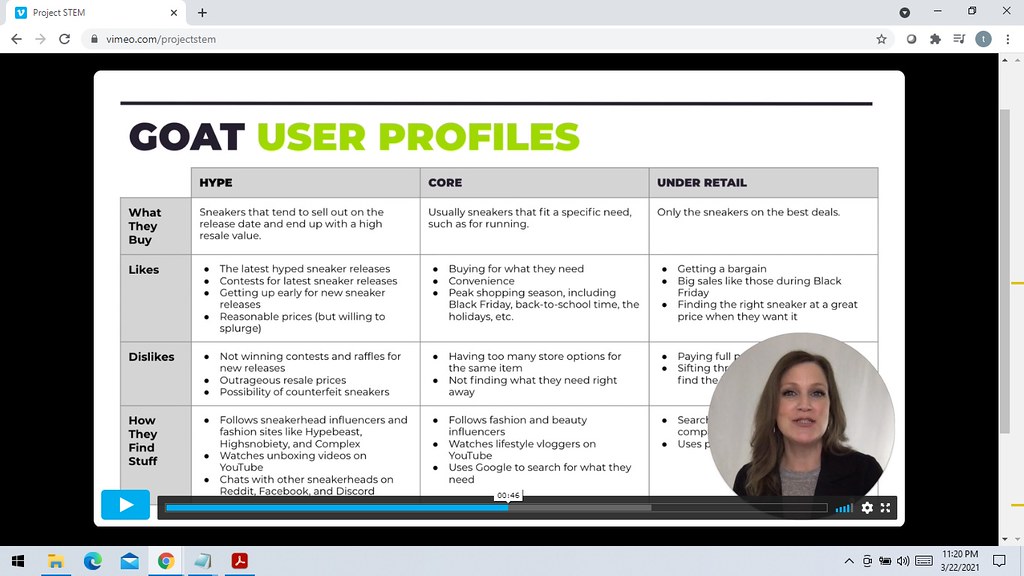
In a case of remarkably bad timing, just as the ethics of the lucrative sneaker resale industry came under scrutiny in the wake of the Nike scandal and questions were raised about exorbitant pandemic-fueled profits, Amazon launched a program for K-12 students that highlights how CS makes the sneaker resale marketplace gold rush possible. "Amazon and the AWS Services are really the backbone and foundation of how we do all of our work in Data Science," explains a GOAT Data Platform Engineer in an Amazon Future Engineer lesson that teaches kids how AI and data can be used to help flip sneakers by classifying GOAT website visitors as "Hype" ['willing to splurge'], "Core", or "Under Retail" user types.

Cloud

Amazon Hires Former Executive Adam Selipsky To Run AWS (cnbc.com) 18

Amazon has chosen Adam Selipsky to run its Amazon Web Services division. Currently, Selipsky is CEO of Salesforce-owned data-visualization software maker Tableau. Andy Jassy made the decision as the current head of AWS, after he was chosen to replace Jeff Bezos as CEO of Amazon. CNBC reports: Amazon rules the market for public cloud infrastructure that companies use to run internal and external applications, a modern alternative to relying on in-house servers, storage and networking equipment. In 2019 industry research company Gartner estimated that Amazon had 45% of the market, more than any other company, including Microsoft and Google. As such, Selipsky becomes the most visible person in the growing industry, perhaps second only to Jassy, who enters a bigger job when he becomes Amazon CEO in the third quarter.

Selipsky is one of the people several insiders had identified as a possible successor to Jassy. Selipsky had held a prominent position inside AWS, as vice president for sales, marketing and support, before leaving to run then-public Tableau in 2016. Salesforce bought Tableau for $15.7 billion in 2019.

Android

The OnePlus 9 Pro Has a 120Hz Display, Hasselblad Cameras, and Costs $969 (theverge.com) 56

The OnePlus 9 and OnePlus 9 Pro are OnePlus' newest smartphones powered by Qualcomm's latest Snapdragon 888 chipset. The flagship device is the OnePlus 9 Pro, featuring a 120Hz LPTO curved display, 8GB of RAM, 128GB storage, Hasselblad-branded cameras, and a starting price of $969. If that price is too much to stomach, the OnePlus 9 features slightly lower-end specs and a more affordable $729 starting price. The Verge has already called the OnePlus 9 Pro "the best Android alternative to Samsung." From the report: OnePlus spent much of its announcement talking about the cameras on the new phones, which have been developed in partnership with Hasselblad. OnePlus says the colors have been tuned to look more natural and that the ultrawide sensor on the 9 Pro and 9 is one of the biggest to ever ship on a smartphone. The ultrawide uses a 50-megapixel Sony IMX766 sensor that's 1/1.56" in size with an aperture of f/2.2. Meanwhile, the 9 Pro's main Sony IMX789 sensor has a resolution of 48 megapixels and is 1/1.43" in size. (The regular 9 has a Sony IMX689 sensor, but it has the same resolution of 48 megapixels.) Both have a 2-megapixel monochrome sensor and 16-megapixel selfie camera, but only the 9 Pro has an 8-megapixel telephoto.

As previously announced, the 9 Pro has a 1440p 120Hz curved display that makes use of LPTO technology to adjust its refresh rate between 1 and 120Hz based on the content being displayed on-screen, reducing power consumption by "up to 50 percent." OnePlus also claims it should feel more responsive to use in games that support its Hyper Touch technology. The screen has a maximum brightness of 1300 nits and supports HDR10+. Meanwhile, the OnePlus 9 has a flat rather than curved display. It's not LTPO, it's slightly less bright at 1,100 nits, and it's also lower resolution at 1080p. It's still got a refresh rate of 120Hz, however.
Additionally, both phones support Warp Charge 65T, which OnePlus claims should be able to charge the phones' 4,500mAh batteries to 100 percent in under half an hour. The 9 Pro and 9 can also charge wirelessly at up to 50W and 15W, respectively. Both phones will go on sale on April 2nd, with preorders starting March 26th.
Businesses

Intel To Spend $20 Billion To Build Two New Chip Fabs In Arizona (cnbc.com) 59

phalse phace writes: During today's "Intel Unleashed: Engineering the Future" webcast, Intel CEO Pat Gelsinger gave an update on the company's future plans and developments, one of which includes a $20 billion investment to build two new chip fabs in Arizona.

The new factories are expected to "become a major provider of foundry capacity in the U.S. and Europe" to serve the global demand for semiconductor manufacturing. "To deliver this vision, Intel is establishing a new standalone business unit, Intel Foundry Services (IFS), led by semiconductor industry veteran Dr. Randhir Thakur. IFS will be differentiated from other foundry offerings with a combination of leading-edge process technology and packaging, committed capacity in the U.S. and Europe, and a world-class IP portfolio for customers, including x86 cores as well as ARM and RISC-V ecosystem IPs."
"Gelsinger said the foundry business will compete in a market potentially worth $100 billion by 2025," reports CNBC. "A slide displayed by Intel suggested that companies including Amazon, Google, Microsoft and Qualcomm could be customers for the business."

The company is also partnering with IBM to improve chip logic and packaging technologies, which will "enhance the competitiveness of the U.S. semiconductor industry and support key U.S. government initiatives."
Google

In 2020, Two Thirds of Google Searches Ended Without a Click (sparktoro.com) 89

AmiMoJo shares a report: In August of 2019, I published research from now-defunct clickstream data provider, Jumpshot, showing that 50.33% of all Google searches ended without a click to any web property in the results. Today, thanks to new data from SimilarWeb, I've got a substantive update to that analysis. From January to December, 2020, 64.82% of searches on Google (desktop and mobile combined) ended in the search results without clicking to another web property. That number is likely undercounting some mobile and nearly all voice searches, and thus it's probable that more than 2/3rds of all Google searches are what I've been calling "zero-click searches." Some folks have pointed out that "zero-click" is slightly misleading terminology, as a search ending with a click within the Google SERP itself (for example, clicking on the animal sounds here or clicking a phone number to dial a local business in the maps box) falls into this grouping. The terminology seems to have stuck, so instead I'm making the distinction clear.

[...] Here are the headline statistics from the data:
SimilarWeb analyzed ~5.1 trillion Google searches in 2020
These searches took place on the 100M+ panel of mobile and desktop devices from which SimilarWeb collects clickstream data
Of those 5.1T searches, 33.59% resulted in clicks on organic search results
1.59% resulted in clicks on paid search results
The remaining 64.82% completed a search without a direct, follow-up click to another web property
Searches resulting in a click are much higher on desktop devices (50.75% organic CTR, 2.78% paid CTR)
Zero-click searches are much higher on mobile devices (77.22%)

Facebook

Facebook Guidelines Allow Users To Call For Death of Public Figures (theguardian.com) 86

Facebook's bullying and harassment policy explicitly allows for "public figures" to be targeted in ways otherwise banned on the site, including "calls for [their] death," according to a tranche of internal moderator guidelines leaked to the Guardian. From the report: Public figures are defined by Facebook to include people whose claim to fame may be simply a large social media following or infrequent coverage in local newspapers. They are considered to be permissible targets for certain types of abuse "because we want to allow discussion, which often includes critical commentary of people who are featured in the news," Facebook explains to its moderators. It comes as social networks face renewed criticism over abuse on their platforms, including of the Duke and Duchess of Sussex and of professional footballers, in particular black stars such as Marcus Rashford.Facebook, which also owns Instagram, has changed its policies in response to the criticism, introducing new rules to cover abuse sent through direct messages and committing to cooperate with law enforcement over hate speech. In the detailed guidelines seen by the Guardian, running to more than 300 pages and dating from December 2020, Facebook spells out how it differentiates between protections for private and public individuals.
The Internet

Google and Microsoft Team Up To Fix Compatibility Issues Between Browsers (engadget.com) 41

Google, Microsoft and the broader web community are working together to make it easier for developers to build websites that work seamlessly across browsers. From a report: They've teamed up for a cross-browser effort called #Compat2021, which aims to eliminate the top five browser compatibility pain points on the web for developers. The group identified the issues they decided to focus on based on usage data, number of bugs reports, survey feedback and test results. One of the most problematic issue that they want to address is with CSS Flexbox, since images as flex items are often stretched incorrectly and differently between browsers. They also want to improve CSS Grid so that it can be used to create animated grid layouts on Chromium and WebKit -- at the moment, the ability is only supported in Gecko. The group wants to work on sticky positioning so that any content that's stickied looks consistent across browsers, as well. Similarly, they want to make sure web elements maintain a consistent width-to-height ratio and that animations and 3D effects look the same whatever browser a user is on.
Facebook

Facebook Waited Too Long To Stop 10 Billion Pageviews of Repeat Misinformation Spreaders (ft.com) 168

Facebook could have prevented more than 10bn pageviews of prominent misinformation-spreading accounts in the US if it had acted sooner in the run-up to the 2020 presidential election, a new report has claimed [Editor's note: the link may be paywalled; alternative source]. Financial Times: The social media giant took a number of eleventh-hour steps to combat misinformation ahead of November's highly polarised election, such as demoting some misinformation superspreaders and blocking new political advertisements. However according to the US-based non-profit activism group Avaaz, if the platform had tweaked its algorithm and moderation policies in March last year, instead of waiting until October, it would have prevented an estimated 10.1bn additional pageviews on the 100 top-performing pages it classified as repeat spreaders of misinformation. The list comprised pages that Avaaz had identified as sharing at least three misinformation claims that were fact-checked between October 2019 and October 2020, with at least two of the posts falling within 90 days of each other. The report said that Facebook's delay in acting had been critical because it allowed prolific spreaders of misinformation to increase their online footprint dramatically, with some tripling their engagement over the course of the election campaign and even catching up with mainstream US media pages. It added that even after Facebook acted to block top-performing misinformation pages from October 10, the effect was inconsistent. While the average decline in interaction was 28 per cent, not all major figures were affected.
Youtube

YouTube Is Testing Automatic Product Detection In Videos (theverge.com) 33

An anonymous reader quotes a report from The Verge: YouTube is always running experiments. One of its latest: testing an automated list of products detected in videos uploaded to the site. As of March 22nd this year, that test is being expanded to "people watching videos in the US," according to YouTube. In one of its blogs, a YouTube representative gave a little more detail about how this particular feature will be deployed: "We are experimenting with a new feature that displays a list of products detected in some videos, as well as related products. The feature will appear in between the recommended videos, to viewers scrolling below the video player. The goal is to help people explore more videos and information about those products on YouTube.
Medicine

Hospitals Hide Pricing Data From Search Results (beckershospitalreview.com) 158

According to a Wall Street Journal investigation, hospitals are blocking confidential prices from web searches with special coding embedded on their websites. It's problematic because pricing information for hospital services must be disclosed under a new federal price transparency rule that went into effect on Jan. 1. Becker's Hospital Review reports: The code prevents pages from appearing in searches, such as a hospital's name and prices, computer experts told the Journal. While the prices are still there, it requires clicking through multiple layers of pages to find them. "It's technically there, but good luck finding it," Chirag Shah, an associate computer professor at the University of Washington, told the Journal. "It's one thing not to optimize your site for searchability, it's another thing to tag it so it can't be searched. It's a clear indication of intentionality."

Hospitals burying their pricing data include those owned by HCA Healthcare and Universal Health Services as well as the University of Pennsylvania Health System, NYU Langone Health, Beaumont Health and Novant Health, according to the Journal. Penn Medicine, NYU Langone Health and Novant Health told the publication they used the blocking code to direct patients first to information they "considered more useful than raw pricing data," for which they included web links. UHS uses the blocking code to ensure consumers acknowledge a disclosure statement before viewing prices and is making no effort to hide information, a hospital spokesperson told the Journal.

After the Journal reached out to hospitals about its discovery, the search-blocking code was removed from sites including those of HCA, Penn Medicine, Beaumont, Avera Health, Ballad Health and Northern Light Health. An HCA spokesperson told the publication the search blocker was "a legacy code that we removed," and Avera, Ballad, Beaumont and Northern Light said the code had been left on their websites by mistake.

United Kingdom

British Army To Be Reduced By About 10,000 Soldiers As Part of Move Towards Robots, Drones, and Cyber Warfare (bbc.com) 73

An anonymous reader quotes a report from the BBC: The size of the Army is to be reduced to 72,500 soldiers by 2025 as part of a move towards drones and cyber warfare. Defence Secretary Ben Wallace said "increased deployability and technological advantage" meant greater effect could be delivered by fewer people. He set out plans for new capabilities such as electronic warfare and drones in a command paper in the Commons. Labour has warned that "size matters" when it comes to defence.

Announcing a major overhaul of the armed forces, Mr Wallace said it marked a shift from "mass mobilization to information age speed," insisting they must be able to "seek out and understand" new threats to the country's security. A cut to the size of the Army had been anticipated -- with a reduction of 10,000 widely trailed. What Defence Secretary Ben Wallace announced was a cut to the target for the number of fully trained people in the Army, from 82,040 today to 72,500 in 2025. The changes set out in the paper -- titled Defence in a Competitive Age -- include 3 billion pounds for new vehicles, long-range rocket systems, drones, electronic warfare and cyber capabilities.
The UK is putting more resources into cyber warfare via the creation of the National Cyber Force based in the North West of England. It's also putting more resources ($6.6 billion for research and development) into space that may function similarly to the U.S. Space Force.

Slashdot Top Deals