Programming

Hundreds of Tech, Business and Nonprofit Leaders Urge States To Boost CS Education 49

theodp writes: In partnership with tech-bankrolled nonprofit Code.org, over 500 of the nation's business, education and nonprofit leaders issued a letter calling for state governments and education leaders to bring more Computer Science to K-12 students across the U.S. The signatories include a who's who of tech leaders, including Bill Gates, Jeff Bezos, Satya Nadella, Steve Ballmer, Tim Cook, Sundar Pichai, and Mark Zuckerberg. A new website -- CEOs for CS -- was launched in conjunction with the campaign. "The United States leads the world in technology, yet only 5% of our high school students study computer science. How is this acceptable?" the CEOs demand to know in their letter addressed "To the Governors and Education Leaders of the United States of America." They add, "Nearly two-thirds of high-skilled immigration is for computer scientists, and every state is an importer of this strategic talent. The USA has over 700,000 open computing jobs but only 80,000 computer science graduates a year. We must educate American students as a matter of national competitiveness."

A press release explains that the announcement "coincides with the culmination of the National Governors Association Chairman's Initiative for K-12 computer science, led by Arkansas Gov. Asa Hutchinson." Hutchinson is a founding Governor of the Code.org-led advocacy group Govs for CS, which launched in anticipation of President Obama's tech-supported but never materialized $4 billion CS for All initiative. Hutchinson was a signatory of an earlier 2016 Code.org organized letter from Governors, business, education, and nonprofit leaders that implored Congress to make CS education for K-12 students a priority.
Businesses

FTC Warns Tech Companies Against Misusing Health Data (cnn.com) 32

Tech companies and data brokers that misuse or misrepresent how they handle Americans' personal data, including reproductive health information, may find themselves on the hook with the Federal Trade Commission, the agency warned this week. From a report: On Monday, the FTC renewed its vow to investigate or sue companies that use Americans' digital data in unfair or deceptive ways, following an executive order by the Biden administration that explicitly called for it and other agencies to consider steps to protect abortion-seekers. Since the Supreme Court decision overturning Roe v. Wade, civil liberties experts have warned that Americans' extensive digital footprints could give away whether they have visited an abortion clinic or sought information on how to access an abortion, prompting questions about the security of that data.

"The misuse of mobile location and health information -- including reproductive health data -- exposes consumers to significant harm," the FTC said in a blog post. "The exposure of health information and medical conditions, especially data related to sexual activity or reproductive health, may subject people to discrimination, stigma, mental anguish, or other serious harms." It added: "The Commission is committed to using the full scope of its legal authorities to protect consumers' privacy. We will vigorously enforce the law if we uncover illegal conduct that exploits Americans' location, health, or other sensitive data."

Hardware

Nothing Officially Announces Flashy Phone 1, Starting at $475 (theverge.com) 55

After weeks of teases, Nothing is finally announcing its debut smartphone -- the Nothing Phone 1 -- at a launch event today. From a report: Led by OnePlus co-founder Carl Pei, it's the well-funded startup's second product released following last year's Ear 1 true wireless earbuds. The big news is that the Nothing Phone 1 will be sold with a modest starting price of $475 USD (though it's not getting a widespread release in the US) when it goes on sale on July 21st. $475 gets you the model with 8GB of RAM and 128GB of storage, while stepping up to $535 gets you 256GB of storage. The model with 12GB of RAM and 256GB of storage goes on sale later this summer for $593 USD.
Businesses

BMW Starts Selling Heated Seat Subscriptions for $18 a Month (theverge.com) 374

BMW is now selling subscriptions for heated seats in a number of countries -- the latest example of the company's adoption of microtransactions for high-end car features. From a report: A monthly subscription to heat your BMW's front seats costs roughly $18, with options to subscribe for a year ($180), three years ($300), or pay for "unlimited" access for $415. It's not clear exactly when BMW started offering this feature as a subscription, or in which countries, but a number of outlets this week reported spotted its launch in South Korea. BMW has slowly been putting features behind subscriptions since 2020, and heated seats subs are now available in BMW's digital stores in countries including the UK, Germany, New Zealand, and South Africa. It doesn't, however, seem to be an option in the US -- yet.
Technology

Nikon To Stop Making SLR Cameras and Focus on Mirrorless Models (nikkei.com) 111

Japanese camera maker Nikon will withdraw from the single-lens reflex camera business and shift toward digital offerings amid intensifying competition from smartphone cameras, Nikkei reported Tuesday. From the report: Nikon's SLR cameras have been widely used by professional photographers for more than 60 years and have come to be seen as synonymous with the Japanese company. It now plans to focus resources on mirrorless cameras, which have become mainstream products on the back of more advanced digital technologies.

Nikon's cameras have been losing out to smartphones, which increasingly feature powerful cameras. Nikon aims to beat them by offering products with more unique features. Since June 2020, when Nikon launched its flagship D6 SLR, no new SLR models have been released. The company has already stopped development of compact digital cameras. From now on, Nikon intends to focus on digital mirrorless cameras, but production and distribution of existing SLR models will continue.

Emulation (Games)

Xbox Series X Can Run Windows 98, Along With Classic PC Games of The Era (purexbox.com) 23

Alex Battaglia from the YouTube channel "Digital Foundry" was able to use the "RetroArch" software emulator to run Windows 98 on the Xbox Series X, along with several PC games of the era. "Technically, you're supposed to be an Xbox developer to access this, and you will need to sign up to the paid Microsoft Partner program and turn on 'Developer Mode' for your system to activate it," notes Pure Xbox. "In DF's case, rather than directly playing emulated games through RetroArch, they used the program to install Windows 98 software." From the report: Beyond the novelty of actually booting up Win98 on a modern console the channel then decided to test out some games, running through the older version of Windows. Playthroughs of Turok, Command & Conquer, Quake 2 and more were all pretty successful, although the act of loading them onto the software requires a bit of messing about (you have to create ISO files and transfer them over -- sadly, Xbox's disc drive can't read the original discs). Of course, this wouldn't be a Digital Foundry video without some performance comparisons, so the team did just that. The video compares hardware of the era with Xbox Series X's emulation, and while the console often lags behind due to the fact that it's literally emulating an entire version of Windows, and then a game on top of that, it fares pretty well overall. You can watch Digital Foundry's video here.
Transportation

Hackers Uncover Ways To Unlock and Start Nearly All Modern Honda-Branded Vehicles (thedrive.com) 40

An anonymous reader quotes a report from The Drive: Hackers have uncovered ways to unlock and start nearly all modern Honda-branded vehicles by wirelessly stealing codes from an owner's key fob. Dubbed "Rolling Pwn," the attack allows any individual to "eavesdrop" on a remote key fob from nearly 100 feet away and reuse them later to unlock or start a vehicle in the future without owner's knowledge. Despite Honda's dispute that the technology in its key fobs "would not allow the vulnerability," The Drive has independently confirmed the validity of the attack with its own demonstration.

Older vehicles used static codes for keyless entry. These static codes are inherently vulnerable, as any individual can capture and replay them at will to lock and unlock a vehicle. Manufacturers later introduced rolling codes to improve vehicle security. Rolling codes work by using a Pseudorandom Number Generator (PRNG). When a lock or unlock button is pressed on a paired key fob, the fob sends a unique code wirelessly to the vehicle encapsulated within the message. The vehicle then checks the code sent to it against its internal database of valid PRNG-generated codes, and if the code is valid, the car grants the request to lock, unlock, or start the vehicle. The database contains several allowed codes, as a key fob may not be in range of a vehicle when a button is pressed and may transmit a different code than what the vehicle is expecting to be next chronologically. This series of codes is also known as a "window," When a vehicle receives a newer code, it typically invalidates all previous codes to protect against replay attacks. This attack works by eavesdropping on a paired keyfob and capturing several codes sent by the fob. The attacker can later replay a sequence of valid codes and re-sync the PRNG. This allows the attacker to re-use older codes that would normally be invalid, even months after the codes have been captured.

[...] Contrary to Honda's claim, I independently confirmed the vulnerability by capturing and replaying a sequence of lock and unlock requests with my 2021 Honda Accord and a Software-Defined Radio. Despite being able to start and unlock the car, the vulnerability doesn't allow the attacker to actually drive off with the vehicle due to the proximity functionality of the key fob. However, the fact that a bad actor can get this far is already a bad sign. At this time, the following vehicles may be affected by the vulnerability: 2012 Honda Civic, 2018 Honda X-RV, 2020 Honda C-RV, 2020 Honda Accord, 2021 Honda Accord, 2020 Honda Odyssey, 2021 Honda Inspire, 2022 Honda Fit, 2022 Honda Civic, 2022 Honda VE-1, and 2022 Honda Breeze. It's not yet clear if this affects any Acura-branded vehicles.
"[W]e've looked into past similar allegations and found them to lack substance," said a Honda spokesperson in a statement to The Drive. "While we don't yet have enough information to determine if this report is credible, the key fobs in the referenced vehicles are equipped with rolling code technology that would not allow the vulnerability as represented in the report. In addition, the videos offered as evidence of the absence of rolling code do not include sufficient evidence to support the claims."
Operating Systems

Apple's iOS 16, macOS Ventura and watchOS 9 Public Betas Are Ready To Download (engadget.com) 29

We're a couple of months out from Apple officially rolling out the next major versions of its various operating systems. However, you can try out iOS 16, iPadOS 16, watchOS 9, macOS Ventura and tvOS 16 right now. Apple has released a public beta, a few weeks after it offered up the first developer betas. To access them, you'll need to sign up for the Apple Beta Software Program and follow the directions.
Government

'Hit the Kill Switch': How Uber Used Covert Tech to Thwart Government Raids (msn.com) 85

The Washington Post shares details from "a trove of more than 124,000 previously undisclosed Uber records." For example, in 2015 Uber CEO Travis Kalanick often pulled an emergency kill switch on its data — that is, "ordered the computer systems in Amsterdam cut off from Uber's internal network, making data inaccessible to authorities as they raided its European headquarters, documents show." "Please hit the kill switch ASAP," Kalanick had emailed, ordering a subordinate to block the office laptops and other devices from Uber's internal systems. "Access must be shut down in AMS," referring to Amsterdam. Uber's use of what insiders called the "kill switch" was a brazen example of how the company employed technological tools to prevent authorities from successfully investigating the company's business practices as it disrupted the global taxi industry, according to the documents.

During this era, as Uber's valuation was surging past $50 billion, government raids occurred with such frequency that the company distributed a Dawn Raid Manual to employees on how to respond. It ran more than 2,600 words with 66 bullet points. They included "Move the Regulators into a meeting room that does not contain any files" and "Never leave the Regulators alone."

That document, like the text and email exchanges related to the Amsterdam raid, are part of the Uber Files, an 18.7-gigabyte trove of data obtained by the Guardian and shared with the International Consortium of Investigative Journalists, a nonprofit newsroom in Washington that helped lead the project, and dozens of other news organizations, including The Washington Post. The files, spanning 2013 to 2017, include 83,000 emails and other communications, presentations and direct messages. They show that Uber developed extensive systems to confound official inquiries, going well past what has been known about its efforts to trip up regulators, government inspectors and police. Far from simply developing software to connect drivers and customers seeking rides, Uber leveraged its technological capabilities in many cases to gain a covert edge over authorities....

According to the documents and interviews with former employees, the company used a program called Greyball to keep authorities from hailing cars — and potentially impounding them and arresting their drivers. It used a technology called "geofencing" that, based on location data, blocked ordinary use of the app near police stations and other places where authorities might be working. And it used corporate networking management software to remotely cut computers' access to network files after they had been seized by authorities.... Greyball was created as a fraud-fighting tool to limit scammers' access to the app, a former executive said, and was at times used to frustrate violent Uber opponents hunting drivers. But Uber operations executives took control of the program and redeployed it against the government, former employees said.

The International Consortium of Investigative Journalists describes their trove of documents as "the secret story of how the tech giant won access to world leaders, cozied up to oligarchs and dodged taxes amid chaotic global expansion."
Japan

Japan's KDDI Mobile Service Criticized After 86-Hour Failure Last Weekend (japantoday.com) 14

Earlier this week, long-time Slashdot reader ThinkPad760 wrote: How is this not news everywhere?

KDDI, Japan's 2nd largest mobile phone provider and carrier to multiple critical government agencies — including the weather service — failed for 86 hours. After failing to inform users and the government about the problems, questions are starting to be asked.

Japan's government "will set up an expert panel to compile measures to prevent a recurrence," reports Japan Today, citing Japan's Internal Affairs and Communications Minister. The network failure occurred when a router for voice calls was replaced during regular maintenance, with repair work triggering a concentration of traffic that led the company to reduce user access. During that time, the carrier experienced a cascade of technical problems that further prolonged the connection difficultie
40 million users were affected by the outage, Reuters reports — adding that it's not the first time for something like this: Japan's three big telcos have all had widespread network failures in recent years. NTT Docomo's [29-hour] outage last October affected 12.9 customers, while disruption to SoftBank Corp's network in late 2018 cast a shadow over its bumper public listing.
Social Networks

Jimmy Wales Solicits Donations for His Ad-Free Social Network 54

"I need your help," reads an email that Jimmy Wales just sent to financial supporters of his ad-free social network, WikiTribune Social (which currently has 494,296 members): All the problems in the world that I've set out to try to solve with WikiTribune Social are as bad as ever... WikiTribune has a different model. A strange model, to be sure, but it's one that I believe in. We don't want our platform to grow by focussing on having as many pageviews as possible by maximizing addiction and outrage. We want to build something that people like you care enough about to support voluntarily, financially. It's a "pay if you want" model. I've joked many times — it may not be a great business model to give things away and hope people will voluntarily support them — but this is how I've built my career so far!

We are severely short on funds

There's no simple way to avoid saying it. I've chosen not to raise venture capital money because I want to maintain full creative control to build the vision that I have in mind. Over the past two years, I've been personally the major funder of the project — but it's straining my personal resources.

Over the past several months, we've gone back to the codebase and completely re-architected it from scratch pulling from everything that we've learned so far. We've got a great small community and the new software will have new ways to support and reward people for making quality posts (instead of how all other social networks reward people for making viral addictive fluff). Finishing this redesign will have a huge impact. I'm excited about it!

But to finish, I need your support. I have to pay for the development work to finish the new version of the site, and I need to do some PR and marketing to get the word out. I need to really start pushing this forward as a relaunch. If each of you can afford to give even a little, I think we have a real shot at making something revolutionary and new. We won't know unless we keep trying.

This is our chance to break the back of toxic social media by offering a better alternative... so please donate today.

Jimmy Wales
AI

GM's Cruise so Far: A Crash, and 60 RoboTaxis 'Disabled' After Losing Server Contact (thedrive.com) 146

On June 2nd California approved General Motors' Cruise robotaxi service. The Drive describes an accident that happened the next day: The autonomous car made an unprotected left turn and was hit by a Toyota Prius on June 3, though the accident wasn't reported until Wednesday. When reached for comment by The Drive, the San Francisco Police Department explained that the Cruise vehicle had three passengers, all in the backseat, while the Prius had two occupants in total.... According to the incident report Cruise filed with the California DMV, the Cruise taxi was making a green light left turn from Geary Boulevard onto Spruce Street in downtown San Francisco. It began the turn and stopped in the middle of the intersection, presumably noticing the Toyota headed for it. The Prius then hit the right rear of the Chevy Bolt.

Cruise explained that afterward, "occupants of both vehicles received medical treatment for allegedly minor injuries." GM's incident report points out the Prius was speeding at the time of the accident, and was in the right turn lane before heading straight and hitting the Bolt. SFPD told The Drive that "no arrest or citation was issued at the time of the initial investigation," which is still ongoing. The National Highway Traffic Safety Administration has opened up a special crash investigation into the accident, but there are no public results yet.

Wired reports: In response to that crash, Cruise temporarily reprogrammed its vehicles to make fewer unprotected left turns, according to internal messages seen by WIRED. At an internal meeting Jeff Bleich, Cruise's chief legal officer, said the company was investigating the incident, according to a recording reviewed by WIRED. He also warned employees not working on that investigation to try and tune out crashes or related news reports, saying they were unavoidable and would increase in frequency as the company scaled up its operations. "We just have to understand that at some point this is now going to be a part of the work that we do, and that means staying focused on the work ahead," he said.
Wikipedia's entry for Cruise notes a few other incidents: In April 2022, the San Francisco Police Department stopped an empty (operating without any human safety attendants) Cruise AV for driving at night without its headlights on.... Also in April 2022, an empty Cruise AV blocked the path of a San Francisco Fire Department truck responding to a fire.
But Wired also reports on a more troubling incident that happened "around midnight" on June 28th: Internal messages seen by WIRED show that nearly 60 vehicles were disabled across the city over a 90-minute period after they lost touch with a Cruise server. As many as 20 cars, some of them halted in crosswalks, created a jam in the city's downtown in an incident first reported by the San Francisco Examiner and detailed in photos posted to Reddit....

The June 28 outage wasn't Cruise's first. On the evening of May 18, the company lost touch with its entire fleet for 20 minutes as its cars sat stopped in the street, according to internal documentation viewed by WIRED. Company staff were unable to see where the vehicles were located or communicate with riders inside. Worst of all, the company was unable to access its system which allows remote operators to safely steer stopped vehicles to the side of the road.

A letter sent anonymously by a Cruise employee to the California Public Utilities Commission that month, which was reviewed by WIRED, alleged that the company loses contact with its driverless vehicles "with regularity," blocking traffic and potentially hindering emergency vehicles. The vehicles can sometimes only be recovered by tow truck, the letter said. Images and video posted on social media in May and June show Cruise vehicles stopped in San Francisco traffic lanes seemingly inexplicably, as the city's pedestrians and motorists navigate around them.

The Almighty Buck

Man Set Up Fake ISP To Scam Low-Income People Seeking Gov't Discounts, FCC Says (arstechnica.com) 24

An anonymous reader quotes a report from Ars Technica: An Ohio man created a fake broadband provider in order to scam low-income consumers who thought they were getting government-funded discounts on Internet service and devices, according to the Federal Communications Commission. In a Notice of Apparent Liability for Forfeiture released Friday, the FCC proposed a fine of $220,210 against alleged scammer Kyle Traxler. Traxler created an entity called Cleo Communications that sought authorization to be a provider in the FCC's Emergency Broadband Benefit (EBB) program, which provided $50 monthly discounts on Internet service and discounts for devices. "Cleo apparently existed for the sole purpose of taking financial advantage of customers under the disguise of being a legitimate EBB Program provider," the FCC notice said. "Cleo Communications has had no business activity outside of the EBB Program and no other business purpose."

The FCC began investigating after receiving complaints from consumers in at least eight states who ordered devices and/or "hotspot service." In some cases, consumers said that Cleo threatened to sue them after they asked for refunds for items and service they didn't receive. Cleo's terms of service stated that it never issues refunds and that attempting to get refunds via bank chargebacks is a "breach of contract," according to the FCC. The FCC said it got no response to a subpoena it issued to Traxler and Cleo in December 2021. The now-discontinued EBB program and its replacement, the $30-per-month Affordable Connectivity Program, have provided money directly to participating broadband providers that offer monthly discounts. Some forms of telecom fraud involve the use of fictitious, ineligible, or duplicate customers to obtain payments from FCC programs, but the FCC said Traxler instead scammed consumers directly...

Security

Most Government Websites Serve Tracking Cookies Without Consent, Report Finds (hothardware.com) 27

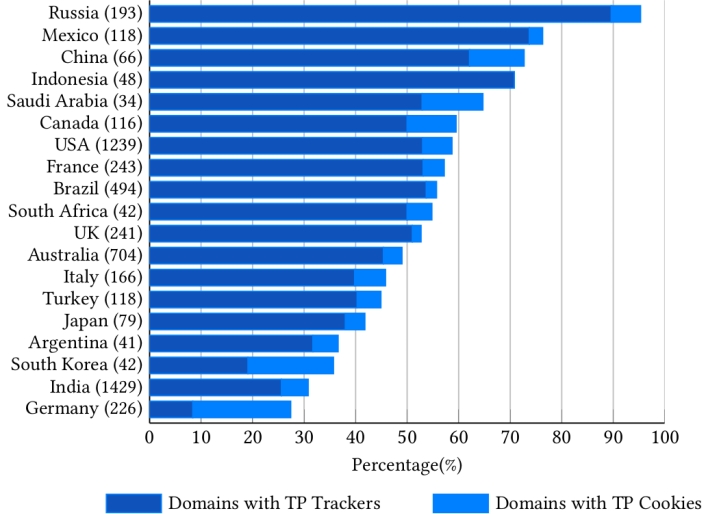
A new study published by the IMDEA Networks Institute shows just how common it is for government websites to install third-party cookies in visitors' web browsers. HotHardware reports: The study makes a distinction between third-party (TP) cookies and third-party tracking (TPT) cookies, because not all third-party cookies are "set by domains that are known to be tracking users for data collection purposes." The chart [here] shows the percentage of government websites for each country that install at least one third-party cookie, as well as the percentage of said cookies that are associated with domains that are known to be tracking users. Russia tops out the list with over 90% of its government websites installing third-party cookies in visitors' web browsers. Meanwhile, nearly 60% of US government websites install at least one third-party cookie. Germany sits at the bottom of the list with a little under 30% of government websites serving up third-party cookies.

Most of the third-party cookies installed by government websites are known tracking cookies, except in the case of Germany, where under 10% of third-party cookies are associated with domains that are known to track users. The researchers also found that, depending on the country, 20% to 60% of the third party cookies installed by government websites remain in visitors' browsers without expiring for a year or more. That's a long time for a tracker installed without your knowledge or consent to remain active. Beyond specifically tracking cookies, the researchers measured the number of trackers of any kind present on government websites. The Russian gov.ru has the most trackers out of any government website analyzed by the researchers, numbering 31 trackers in total. However, Brazil and Canada aren't far behind, with 25 trackers present on both investexportbrasil.gov.br and nac-cna.ca. The US government website with the most trackers is hhs.gov, which has 13.

The researchers point out that both third-party tracking cookies are automatically installed in visitors' web browsers without their consent. However, the researchers guess that web developers and administrators likely include third-party content without intending to add trackers to their websites. A great many websites now rely on third-party resources and include social content that come with trackers built-in.

Power

North Carolina Looks To Remove Public EV Chargers, Probably To the Trash (caranddriver.com) 239

An anonymous reader quotes a report from Car and Driver, written by Ezra Dyer: Politicians have to run on some kind of platform, and Ben Moss -- my incoming state House representative here in North Carolina's District 52 -- decided that his animating principle is Being Mad at Electricity. To prove his animosity toward this invisible menace, he's sponsoring House Bill 1049, which would allocate $50,000 to destroy free public car chargers. It contains some other enlightened ideas, but that's the main theme: We've simply got to do something about these free public chargers, even if it costs us $50,000! Those things cost tens of cents per hour, when they're being used.

Of course, there's a caveat here. Moss isn't saying that free public Level 2 chargers -- of which there are three in my town, with plans in the works to convert to paid kiosks -- definitely need to get crushed by a monster truck. That rule only comes into play if a town refuses to build free gas and diesel pumps next to the EV chargers. So anyway, warm up El Toro Loco, we're smashin' some car zappers! But what about private businesses? you ask. Don't worry, Moss hasn't forgotten that a business might put a charger on its property as an inducement for EV owners to patronize the establishment. And small business is the heart of the local economy. That's why he's staying out of the way when it comes to private property. Just kidding! Ben Moss cares about the consumers being harmed by these hypothetical free chargers -- namely, any customer who arrived via internal-combustion vehicle, or on foot, or in a sedan chair. Why is someone else gaining some advantage based on a decision they made? That's not how life works.

Thus, House Bill 1049 decrees that all customer receipts will have to show what share of the bill went toward the charger out in the lot. That way, anyone who showed up for dinner in an F-150 (not the electric one) can get mad that their jalapeno poppers helped pay for a business expense not directly related to them. It's the same way you demand to know how much Applebee's spends to keep the lights on in its parking lot overnight, when you're not there. Sure, this will be an accounting nightmare, but it'll all be worth it if we can prevent even one person from adding 16 miles of charge to a Nissan Leaf while eating a bloomin' onion -- not that restaurants around here have free chargers, but you can't be too careful. Now, there is a charger at the neighborhood Ford dealership, which is marking up Broncos by $20,000. Coincidence? I think not.
"Critics of this bill might point out that increasing the number of electric cars could actually benefit owners of internal-combustion vehicles, thanks to reduced demand for petroleum products," adds Dyer. "Electron heads, as I call them, also like to point out that electricity is generated domestically, so your transportation dollars are staying in the U.S. rather than going to, say, Saudi Arabia."
Google

Google Offers Concessions To Fend Off US Antitrust Lawsuit (wsj.com) 13

Alphabet's Google has offered concessions in an attempt to head off a possible U.S. antitrust lawsuit aimed at its massive ad-tech business, WSJ reported Friday, citing people familiar with the matter, a sign that legal and regulatory pressures on the tech giant are coming to a head. From the report: As part of one offer, Google has proposed splitting parts of its business that auctions and places ads on websites and apps into a separate company under the Alphabet umbrella, some of the people said. That entity could potentially be valued at tens of billions of dollars, depending on what assets it contained. It couldn't be determined whether any offer short of asset sales would satisfy the U.S. Department of Justice, where antitrust officials have signaled a preference for deep structural changes to Google's ad-tech business, rather than promises to change business practices, the people said. The Justice Department has been conducting a long-running investigation into allegations that Google abuses its role as both a broker and auctioneer of digital advertisements to steer itself business at the expense of rivals. The department is preparing a lawsuit alleging Google's ad-tech practices are anticompetitive, an action that could be filed as soon as this summer, the people said.
Google

Google Tests Battery-Conserving Feature Perfect for Hoarding Tabs (arstechnica.com) 20

Google is testing a method to boost the battery life of Chromebooks by changing how they work with the Chrome web browser. It's shaping up to be a potentially attractive update for users who leave a lot of tabs open on their Chromebooks. From a report: Google Chrome currently cuts the CPU time and throttles the CPU load for any tab you haven't touched or looked at for five minutes. Google calls this "intensive throttling of JavaScript timer wake up," and it's supposed to help conserve system battery life. The feature also makes the page wake up once every 60 seconds to check if you're actively using the tab again. It seems Google is interested in pushing the idea even further, at least for Chromebook users. About Chromebooks this week spotted a new flag in Chrome OS 105, currently being tested in the dev channel, that changes this five-minute period to 10 seconds.
Canada

A Major Rogers Outage Has Cut Off 25 Percent of Canada's Internet Traffic (theverge.com) 89

Canadian telecom Rogers is suffering a major outage affecting landline phones, cellular connections, and internet connectivity throughout Canada that started early this morning. DownDetector listed thousands of reports for the issue as people started to get up around 5AM ET and couldn't get online. From a report: Rogers first addressed the outage in a tweet from its official support account just before 9AM ET, and then went silent for a couple of hours. In a statement given to The Verge and tweeted at around 11:30AM ET, Rogers said, "We are currently experiencing an outage across our wireline and wireless networks and our technical teams are working hard to restore services as quickly as possible. On behalf of all of us at Rogers, we sincerely apologize to our customers, and we will continue to keep you updated as we have more information to share, including when we expect service to be back up. Thank you for your patience as we work to resolve this issue."
Linux

Alder Lake-Powered Linux Laptop Arrives With 14 Hours of Battery Life (tomshardware.com) 48

System76, the Colorado-based Linux laptop, desktop, and server specialist, has announced a new highly portable laptop with an Intel Alder Lake processor inside. Tom's Hardware reports: The new Lemur Pro(opens in new tab) is a "lighter than Air" 14-inch form factor laptop with excellent battery life and attractions such as open firmware (powered by Coreboot) and a 180-degree hinge. In addition, buyers can choose to go with Pop!_OS 22.04 LTS or Ubuntu 22.04 LTS pre-installed. The new Lemur Pro has many attractive modern features you might see advertised in many rival mainstream thin and light designs. However, the special sauce here is the "System76 Open Firmware with Coreboot." Coreboot, known initially as LinuxBIOS, is significant as it is an open-source BIOS implementation embraced by Linux users. It is lightweight, flexible, and feature-rich. [...]

System76 has designed the Lemur Pro with monitor-based docking in mind. It envisions users connecting to a big screen using the USB-C connection to benefit from the more expansive workspace and laptop charging. Like Windows, Linux had to have some serious tinkering under the hood to prepare for the mix of Performance and Efficiency cores in Alder Lake chips. However, rest assured, efficient hybrid scheduling is taken care of with the two OS options that can be pre-installed on the Lemur Pro.

System76 allows customers to configure and buy Lemur Pro laptops right now. There are many RAM and storage configurations to pick through, and you can add external keyboards and monitors to the bundle. The entry price with an Intel Core i5-1235U, 8GB RAM, 240GB of storage, and no extras is $1,149. However, the Core i7-1255U model is a bit of a stretch, adding $200 to the base price for the faster CPU clocks.

Transportation

Will EVs Mean the End of AM Radio In Cars? (thedrive.com) 150

Some carmakers are leaving AM radios out of their new cars. They say it's because of audio quality, but it isn't that simple. James Gilboy writes via The Drive. From the report: BMW and Volvo told me it was due to audio quality problems rooted in electromagnetic interference, of which EVs' drivetrains produce a significant amount. Cars' engines and other complex electronics have always made EM interference, but low-wattage static is relatively easy to shield against. It's not as simple with EVs that may pull hundreds of watts from their batteries, generating far more interference, reducing audio quality to a level both BMW and Volvo told me they consider insufficient. But it's hard to take them at their word when EVs are built with AM radios and in no small numbers. Detroit's Three -- Ford, General Motors, and Stellantis -- have produced or currently make EVs that include AM radio, even on flagship models. That goes for the Ford F-150 Lightning and Mustang Mach-E, GM EVs from the Cadillac Lyriq to the Chevy Bolt EUV and GMC Hummer EV, and even Stellantis's almost-forgotten Fiat 500e. Clearly, some carmakers don't think EM interference is a problem, and some EV owners agree. One user of an EV forum user said that AM radio "works fine" in their 500e and older Chevy Bolt.

We contacted all three of Detroit's giants for why they continue to include AM radios when some European makes have phased them out, but the answer establishes itself across those very same lines. AM radio has fallen out of favor in Europe, with Radio Info reporting in 2015 that stations were shutting down en masse from France to the Netherlands and Russia. The frequency has largely been superseded by the DAB format, which is a more advanced form of radio broadcasting with better audio quality and choice of stations. AM radio stations and their listeners are all but gone in Europe, so European carmakers may not need to include technology that many of its customers can't use.

In the U.S., on the other hand, radio remains a must for car buyers, with 89 percent of responders in a 2021 survey stating radio should be standard in new cars. That makes radio even more important to U.S. car buyers than USB ports, which only 84 percent said were necessary. AM audiences were in rapid decline as of a 2017 report by Inside Radio, but not to enough a degree for American carmakers to leave AM radios out of their products. It's not hard to figure out why AM's holding on here, either: AM signals travel further than FM broadcasts do and are cheaper to transmit, allowing them to cater to audiences in sparsely populated areas. Audio quality can't compare, but that's secondary to having anything to listen to at all in some parts of the continental United States.

Slashdot Top Deals