AI

A Brain Scanner Combined With an AI Language Model Can Provide a Glimpse Into Your Thoughts 23

An anonymous reader quotes a report from Scientific American: Functional magnetic resonance imaging (fMRI) captures coarse, colorful snapshots of the brain in action. While this specialized type of magnetic resonance imaging has transformed cognitive neuroscience, it isn't a mind-reading machine: neuroscientists can't look at a brain scan and tell what someone was seeing, hearing or thinking in the scanner. But gradually scientists are pushing against that fundamental barrier to translate internal experiences into words using brain imaging. This technology could help people who can't speak or otherwise outwardly communicate such as those who have suffered strokes or are living with amyotrophic lateral sclerosis. Current brain-computer interfaces require the implantation of devices in the brain, but neuroscientists hope to use non-invasive techniques such as fMRI to decipher internal speech without the need for surgery.

Now researchers have taken a step forward by combining fMRI's ability to monitor neural activity with the predictive power of artificial intelligence language models. The hybrid technology has resulted in a decoder that can reproduce, with a surprising level of accuracy, the stories that a person listened to or imagined telling in the scanner. The decoder could even guess the story behind a short film that someone watched in the scanner, though with less accuracy. "There's a lot more information in brain data than we initially thought," said Jerry Tang, a computational neuroscientist at the University of Texas at Austin and the study's lead author, during a press briefing. The research, published on Monday in Nature Communications, is what Tang describes as "a proof of concept that language can be decoded from noninvasive recordings of brain activity."

The decoder technology is in its infancy. It must be trained extensively for each person who uses it, and it doesn't construct an exact transcript of the words they heard or imagined. But it is still a notable advance. Researchers now know that the AI language system, an early relative of the model behind ChatGPT, can help make informed guesses about the words that evoked brain activity just by looking at fMRI brain scans. While current technological limitations prevent the decoder from being widely used, for good or ill, the authors emphasize the need to enact proactive policies that protect the privacy of one's internal mental processes. [...] The model misses a lot about the stories it decodes. It struggles with grammatical features such as pronouns. It can't decipher proper nouns such as names and places, and sometimes it just gets things wrong altogether. But it achieves a high level of accuracy, compared with past methods. Between 72 and 82 percent of the time in the stories, the decoder was more accurate at decoding their meaning than would be expected from random chance.
Here's an example of what one study participant heard, as transcribed in the paper: "i got up from the air mattress and pressed my face against the glass of the bedroom window expecting to see eyes staring back at me but instead finding only darkness." The model went on to decode: "i just continued to walk up to the window and open the glass i stood on my toes and peered out i didn't see anything and looked up again i saw nothing."

The research was published in the journal Nature Communications.
Movies

Why Are Movies So Dark These Days? (polygon.com) 105

A filmmaker walks us through the reasons behind the 'dark cinematography' that's causing so many complaints. From a report: Take, for instance, Wes Craven's 1996 horror classic Scream -- a film often remarked on for just how lit everything in it is at all times. An early scene depicts protagonist Sidney Prescott embracing her boyfriend Billy Loomis in the wake of a terrifying home invasion and her near-death at the hands of a masked killer. After Sidney throws her arms around Billy, Craven cuts to a tight close-up on Billy's face, which is illuminated by a harsh, ominous, icy-cool light that telegraphs his sinister intentions. But where is that light coming from? The bedroom they're in has no lamps switched on. Could it be the moon? Hard to justify, as the only windows in the space are behind Billy, and the light we're staring at is so much brighter and closer than the moon could ever be. So what on Earth is that light?

The answer is, simply enough, nothing. Craven often didn't feel any real need to rationalize why a bright light would suddenly appear one second before disappearing again in the following shot. It's a purely stylistic choice, employed for that one moment to cast doubt on Billy's trustworthiness in the audience's mind. Itâ(TM)s an extremely stagey choice that fits neatly within the larger series' heightened, melodramatic style. Scream wouldn't really be Scream without it. The hyper-lit style was a staple of cinematography in American films during the '90s, and like all trends, it eventually fell out of fashion -- in this case, a few years after Scream hit theaters. The 2000s saw filmmakers embracing more directional, shadowy lighting styles, evoking a grittier, more "grounded" aesthetic while retaining a sense of classic Hollywood polish. The 2010s featured another huge shift in style, this time toward hyper-naturalism. Even broad, big-budget blockbusters like Harry Potter and the Deathly Hallows -- Part 1 embraced a look torn straight from indie cinema. Not only are the lights in that film always motivated, they're realistic. Where earlier films might have used the presence of the moon or a table lamp to justify much brighter lighting, movies like Deathly Hallows, Interstellar, and Dawn of the Planet of the Apes let the light of a lamp simply look like a lamp.

Lord of the Rings

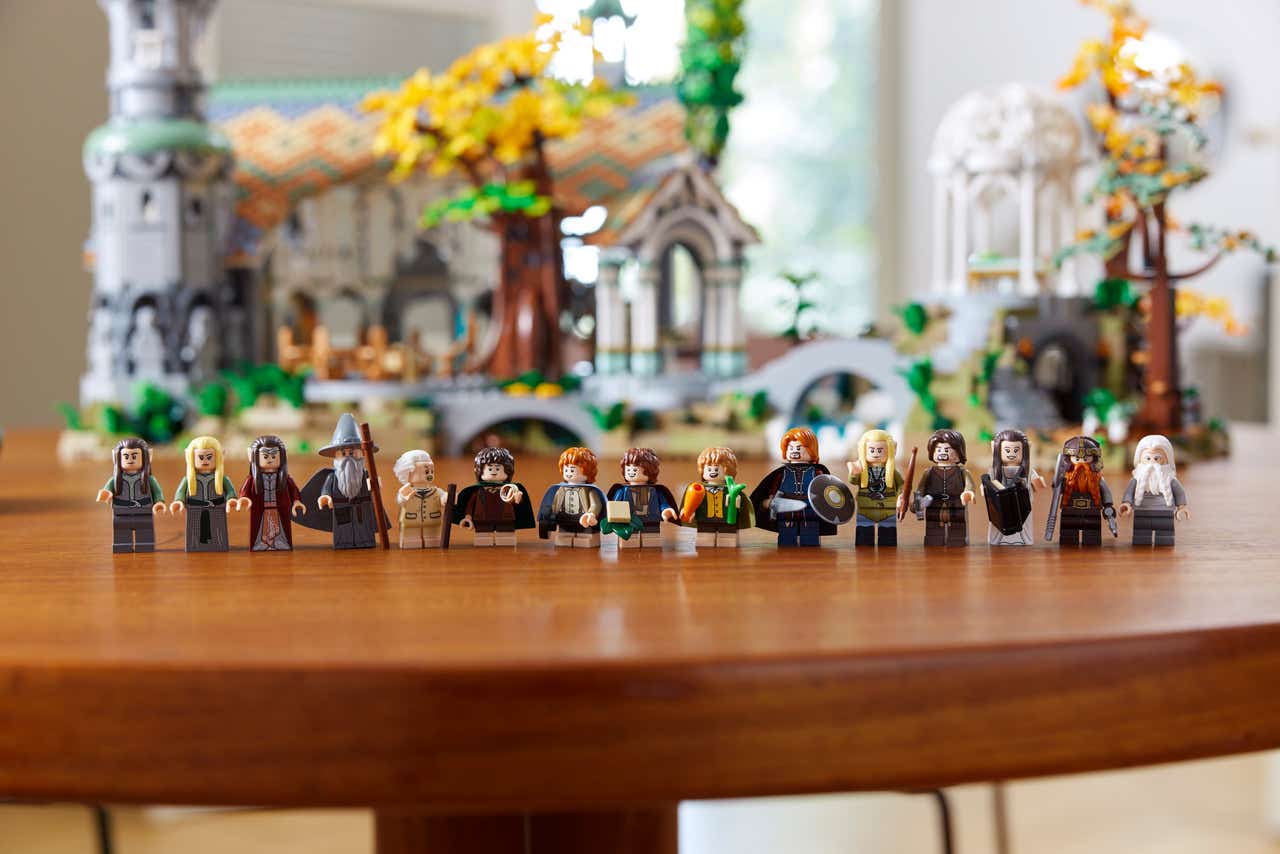
Lego Releases 'Insanely Detailed' Lord of the Rings Set for $500 (cnet.com) 81

In J.R.R. Tolkein's The Two Towers, it's in Elrond's home city of Rivendell that Frodo chooses to destroy the ring of power.

And now Lego has created "a truly grand plastic-brick re-creation," reports CNET — costing $500 (£430, AU$800): The stronghold of the elves is a magical place, a sensation Lego managed to encapsulate in 6,167 pieces of plastic stretching 29.5 inches (75 centimeters) wide. "We know many of our fans have been anticipating a set like this for a long time — but a great Lego The Lord of the Rings set is never late, it arrives precisely when it means to!" said Lego design master Mike Psaiki in a statement Tuesday.

The colorful set is based on the design from the Peter Jackson movies. Lego's vision of Rivendell includes Frodo's bedroom, Elrond's study and the Council Ring where you can assemble the Fellowship. The rest of the set features an elven tower and a gazebo, river and bridge.... The set comes with a large cast of 15 minifigure characters, including Gandalf, Frodo, Samwise, Merry, Pippin, Legolas, Gimli and, of course, Elrond.

Technology

3D Printing Reaches New Heights With Two-Story Home (reuters.com) 48

A 3D printer is taking home building to a new level -- literally. From a report: The enormous printer weighing more than 12 tons is creating what is believed to be the first 3D-printed, two-story home in the United States. The machine steadily hums away as it extrudes layers of concrete to build the 4,000-square-foot home in Houston. Construction will take a total of 330 hours of printing, said architect Leslie Lok, co-founder of design studio Hannah and designer of the home. "You can actually find a lot of 3D-printed buildings in many states," Lok said. "One of the things about printing a second story is you require, you know, the machine... And of course, there are other challenges: structural challenges, logistic challenges when we print a second-story building." The three-bedroom home with wooden framing is about halfway finished and is being sold to a family, who wish to remain anonymous, she said.
Privacy

Meet the Spy Tech Companies Helping Landlords Evict People (vice.com) 263

schwit1 shares an excerpt from a Motherboard article: Some renters may savor the convenience of "smart home" technologies like keyless entry and internet-connected doorbell cameras. But tech companies are increasingly selling these solutions to landlords for a more nefarious purpose: spying on tenants in order to evict them or raise their rent. "You CAN raise rents in NYC!" reads the headline of one promotional email sent to landlords. It was a sales pitch from Teman, a tech company that makes surveillance systems for apartment buildings. Teman's sales pitch proposes a solution to a frustration for many New York City landlords, who have tenants living in older apartments that are protected by a myriad of rent control and stabilization laws. The company's email suggests a workaround: "3 Simple Steps to Re-Regulate a Unit." First, use one of Teman's automated products to catch a tenant breaking a law or violating their lease, such as by having unapproved subletters or loud parties. Then, "vacate" them and merge their former apartment with one next door or above or below, creating a "new" unit that's not eligible for rent protections. "Combine a $950/mo studio and $1400/mo one-bedroom into a $4200/mo DEREGULATED two-bedroom," the email enticed. Teman's surveillance systems can even "help you identify which units are most-likely open to moving out (or being evicted!)." [...]

Erin McElroy, a professor of American Studies at the University of Texas at Austin who tracks eviction trends, also says that digital surveillance of residential buildings is increasing, particularly in New York City, which she calls the "landlord tech epicenter." Any camera system can document possibly eviction-worthy behavior, but McElroy identified two companies, Teman and Reliant Safety, that use the biometrics of tenants with the explicit goal of facilitating evictions. These companies are part of an expanding industry known as "proptech," encompassing all the technology used for acquiring and managing real estate. A report by Future Market Insights predicts that proptech will quadruple its current value, becoming a $86.5 billion industry by 2023. It is also sprouting start-ups to ease all aspects of the business -- including the unsavory ones. [...]

Reliant Safety, which claims to watch over 20,000 apartment units nationwide, has a less colorful corporate pedigree. It is owned by the Omni Organization, a private developer founded in 2004 that "acquires, rehabilitates, builds and manages quality affordable housing throughout the United States," according to its website. The company claims it has acquired and managed more than 17,000 affordable housing units. Many of the properties it lists are in New York City. Omni's website features spotless apartment complexes under blue skies and boasts about sponsorship of after-school programs, food giveaways, and homeless transition programs. Reliant's website features videos that depict various violations detected by its surveillance cameras. The website has a page of "Lease Violations" it says its system has detected, which include things such as "pet urination in hallway," "hallway fistfight," "improper mattress disposal," "tenant slips in hallway," as well as several alleged assaults, videos of fistfights in hallways, drug sales at doorways and break-ins through smashed windows. Almost all of them show Black or brown people and almost all are labeled as being from The Bronx -- where, in 2016, Omni opened a 140-unit affordable housing building at 655 Morris Avenue that boasted about "state-of-the-art facial recognition building access" running on ubiquitous cameras in common areas. Reliant presents these as "case studies" and lists outcomes that include arrest and eviction. Part of its package of services is "illegal sublet detection" using biometrics submitted by tenants to suss out anyone not authorized to be there. While Reliant claims its products are rooting out illegal and dangerous activity, the use of surveillance and biometrics to further extend policing into minority communities are a major cause for concern to privacy advocates.

Graphics

How 'Homestar Runner' Re-Emerged After the End of Flash (homestarrunner.com) 28

Wikipedia describes Homestar Runner as "a blend of surreal humour, self-parody, and references to popular culture, in particular video games, classic television, and popular music." But after launching in 2000, the web-based cartoon became a cultural phenomenon, co-creator Mike Chapman remembered in 2017: On the same day we received a demo of a song that John Linnell from They Might Be Giants recorded for a Strong Bad Email and a full-size working Tom Servo puppet from Jim Mallon from Mystery Science Theater 3000.... The Homestar references in the Buffy and Angel finales forever ago were huge. And there was this picture of Joss Whedon in a Strong Bad shirt from around that time that someone sent us that we couldn't believe. Years later, a photo of Geddy Lee from Rush wearing a Strong Bad hat on stage circulated which similarly freaked us out. We have no idea if he knew what Strong Bad was, but our dumb animal character was on his head while he probably shredded 'Working Man' so I'll take it!
After a mutli-year hiatus starting around 2009, the site has only been updating sporadically — and some worried that the end of Flash also meant the end of the Flash-based cartoon and its web site altogether. But on the day Flash Player was officially discontinued — December 31st, 2020 — a "post-Flash update" appeared at HomestarRunner.com: What happened our website? Flash is finally dead-dead-dead so something drastic had to be done so people could still watch their favorite cartoons and sbemails with super-compressed mp3 audio and hidden clicky-clicky easter eggs...!

[O]nce you click "come on in," you'll find yourself in familiar territory thanks to the Ruffle Project. It emulates Flash in such a way that all browsers and devices can finally play our cartoons and even some games.... Your favorite easter eggs are still hidden and now you can even choose to watch a YouTube version if there is one.

Keep in mind, Ruffle is still in development so not everything works perfectly. Games made after, say 2007, will probably be pretty janky but Ruffle plans on ulitmately supporting those too one day. And any cartoons with video elements in them (Puppet Jams, death metal) will just show you an empy box where the video should be. But hang in there and one day everything will be just like it was that summer when we got free cable somehow and Grandma still lived in the spare bedroom.

And since then, new content has quietly been appearing at HomestarRunner.com. (Most recently, Thursday the site added a teaser for an upcoming Halloween video.)

The Homestar Runner wiki is tracking this year's new content, which includes:

And past videos are now also being uploaded on the site's official YouTube channel.


Privacy

University Can't Scan Students' Rooms During Remote Tests, Judge Rules (theverge.com) 84

An Ohio judge has ruled that a Cleveland State University's virtual scan of a student's room prior to an online test was unconstitutional. The ruling marks a victory for digital privacy advocates around the country, who have spoken loudly against the practices of online test proctoring for many years. From a report: Chemistry student Aaron Ogletree sat for an online test in the spring 2021 semester. Ogletree was asked to show the virtual proctor his bedroom through his webcam prior to the beginning of the test. A recording of the room scan as well as the testing process that followed was retained by Honorlock, the university's third-party vendor. Ogletree sued the university on the grounds that the practice violated his rights under the Fourth Amendment, which protects US citizens against "unreasonable searches and seizures." The university, in defense, argues that "room scans are 'standard industry wide practice,'" and that "students frequently acquiesce in their use." Federal Judge J. Philip Calabrese sided with Ogletree yesterday, determining that the university's room scan did constitute an unreasonable search. "Mr. Ogletree's subjective expectation of privacy at issue is one that society views as reasonable and that lies at the core of the Fourth Amendment's protections against governmental intrusion," Calabrese wrote in the decision.
Australia

Installing Rooftop Solar Can Be a Breeze. Just Look at Australia. (nytimes.com) 418

Dr. Saul Griffith, the author of "Electrify" and the founder and chief scientist of Rewiring America, Rewiring Australia and Otherlab, writes in a column: I recently moved back here to my home country partly because I believe Australians can show the world how much money households can save through simple climate solutions like rooftop solar. How is it that Australia, a country that historically has been a coal-burning climate pariah, is leading the world on solar? The four-bedroom house we recently bought provides a hint: It came with two rooftop solar systems of 11 kilowatts of combined capacity and a battery with 16 kilowatt-hours of storage. This system should produce more than enough to power my family's home, one electric car and both of our electric bikes with some left over to send back to the grid. Solar is now so prevalent in Australia that over a quarter of households here have rooftop panels, compared with roughly 2.5 percent of American households.

Australia pays its solar installers salaries comparable to those in the United States, and it buys most of its solar modules from China at 25 cents per watt, just a little less than what American buyers pay. Our houses are mostly detached single-family, like America, too. But unlike in the United States, it's easy to get permits and install rooftop solar in Australia. Australia's rooftop solar success is a function partly of luck, partly of design. In the early 1990s, regulators considered rooftop solar a hobby, and no one stood in the way of efforts to make the rules favorable to small-scale solar. Looking for a good headline to varnish over Australia's refusal to agree to the same greenhouse emissions reductions as the rest of the world in the 1997 Kyoto climate agreement, the federal government embraced renewable energy policies that set the stage for rooftop solar. Households were given rebates for the upfront costs, and were paid to send excess electricity back to the grid. In 2007, Prime Minister John Howard doubled the rebate, a move that is credited with kick-starting a solar installation boom.

Why has America been significantly slower to adopt this solution to high energy costs? The failures are mostly regulatory: local building codes and zoning laws, state rules that govern the grid connection and liability issues. Permitting can take as little as a day in Australia and is done over the web; in the United States permitting and connecting to the grid can take as long as six months. Many customers just give up. America also generally requires a metal conduit around the wiring; in Australia, the connections can be less expensive soft cables, similar to extension cords. The cost of rooftop solar in the United States depends on many things, including the latitude, tree cover and federal and state incentives. Installation costs can also vary quite a bit, depending on what laborers charge and the local permitting and inspection policies. My friend Andrew Birch, co-founder of the solar and solar software companies OpenSolar in Sydney and Sungevity in the United States, wrote an excellent critique of American rooftop solar and its high price in 2018.

Security

The Math Prodigy Whose Hack Upended DeFi Won't Give Back His Millions (bloomberg.com) 119

An 18-year-old graduate student exploited a weakness in Indexed Finance's code and opened a legal conundrum that's still rocking the blockchain community. Then he disappeared. An excerpt from a report: On Oct. 14, in a house near Leeds, England, Laurence Day was sitting down to a dinner of fish and chips on his couch when his phone buzzed. The text was from a colleague who worked with him on Indexed Finance, a cryptocurrency platform that creates tokens representing baskets of other tokens -- like an index fund, but on the blockchain. The colleague had sent over a screenshot showing a recent trade, followed by a question mark. "If you didn't know what you were looking at, you might say, 'Nice-looking trade,'" Day says. But he knew enough to be alarmed: A user had bought up certain tokens at drastically deflated values, which shouldn't have been possible. Something was very wrong. Day jumped up, spilling his food on the floor, and ran into his bedroom to call Dillon Kellar, a co-founder of Indexed. Kellar was sitting in his mom's living room six time zones away near Austin, disassembling a DVD player so he could salvage one of its lasers. He picked up the phone to hear a breathless Day explaining that the platform had been attacked. "All I said was, 'What?'" Kellar recalls.

They pulled out their laptops and dug into the platform's code, with the help of a handful of acquaintances and Day's cat, Finney (named after Bitcoin pioneer Hal Finney), who perched on his shoulder in support. Indexed was built on the Ethereum blockchain, a public ledger where transaction details are stored, which meant there was a record of the attack. It would take weeks to figure out precisely what had happened, but it appeared that the platform had been fooled into severely undervaluing tokens that belonged to its users and selling them to the attacker at an extreme discount. Altogether, the person or people responsible had made off with $16 million worth of assets. Kellar and Day stanched the bleeding and repaired the code enough to prevent further attacks, then turned to face the public-relations nightmare. On the platform's Discord and Telegram channels, token-holders traded theories and recriminations, in some cases blaming the team and demanding compensation. Kellar apologized on Twitter to Indexed's hundreds of users and took responsibility for the vulnerability he'd failed to detect. "I f---ed up," he wrote. The question now was who'd launched the attack and whether they'd return the funds. Most crypto exploits are assumed to be inside jobs until proven otherwise. "The default is going to be, 'Who did this, and why is it the devs?'" Day says.

As he tried to sleep the morning after the attack, Day realized he hadn't heard from one particular collaborator. Weeks earlier, a coder going by the username "UmbralUpsilon" -- anonymity is standard in crypto communities -- had reached out to Day and Kellar on Discord, offering to create a bot that would make their platform more efficient. They agreed and sent over an initial fee. "We were hoping he might be a regular contributor," Kellar says. Given the extent of their chats, Day would have expected UmbralUpsilon to offer help or sympathy in the wake of the attack. Instead, nothing. Day pulled up their chat log and found that only his half of the conversation remained; UmbralUpsilon had deleted his messages and changed his username. "That got me out of bed like a shot," Day says.

Google

Google Explains Why It's All In On Matter, the First True Smart Home Standard (theverge.com) 66

Matter is a new open-source, interoperability smart home standard that's been created by over 200 companies to allow all of your devices to communicate with each other locally, without the need for a cloud. The Verge sat down with Michele Turner, the senior director of Google Smart Home Ecosystem, to hear how the company plans to implement Matter when it finally arrives later this year. Here's an excerpt from the interview: Matter has evolved substantially from that first meeting, and there have been delays and setbacks. Do you still feel confident in that original vision, that it's being carried through and is on track to achieve what you set out to do at that Woodside dinner three years ago?

Michele Turner: I do. And, in fact, I think it's exceeding our original vision in some ways. It's been incredibly heartening to see the enthusiasm and the adoption and the number of companies that have joined the CSA and the Matter workgroup. We're at 200 companies -- it's amazing.

How is Matter going to change the smart home experience for the Google Home user?

Michele Turner: "For the Google Home user, I think the bigger areas of Matter where they'll see change first is in getting your devices set up. I just set up some lights at my mother-in-law's house, and it still took me 45 minutes to set up four lights. It shouldn't have been so hard. The first thing is going to be that significantly simpler setup. The second piece is the speed and the reliability of the local network. This has been a big pain point for users. My team spent a lot of time working with partners on improving reliability and reducing latency. Because in our mind, if it's not as fast as a light switch, what's the point? We believe Matter's going to drive down those latency numbers significantly and improve the overall reliability of devices in the home. Then, I think interoperability for users is going to be a big piece. As much as we love having everybody using the Google Assistant, the reality is people have iPhones and Android phones in their homes. Some of them want to use HomeKit. We just don't have that kind of compatibility today for users. And I think that's hard. Being able to have multi-admin really work well between these ecosystems is going to be a big benefit for users.

Then, our long-term goal is to build out what we call the proactive home. Instead of having a whole bunch of connected devices, how do we build that truly proactive home that works for the benefit of users? ... Matter is going to be absolutely foundational to that. It's the architecture behind the proactive home. If we don't have a home that's reliable, if we don't have things running locally, if it doesn't work consistently, we cannot deliver on that promise. The proactive home is really that intelligence layer, whether it's being able to predict that I'm going upstairs, it's 10 at night, and I always go into my bedroom at that time, so turn on the lights for me; or, I'm watching TV, it's 9:30PM, the kids are in bed, and I get a notification on my phone that the lights just went on in the kid's bedroom. Is somebody sick? Are they watching YouTube? Being able to do anomaly detection. Now, Matter doesn't do that. But it's foundational to be able to enable the rest of that. Because if that core foundation of the home -- of the smart home -- isn't solid, the rest of it just doesn't work."

As you've said, Matter is complicated. And there's a lot of expectation that's been placed on its shoulders. What would you say is the biggest misconception right now with Matter?

Michele Turner: "I think the biggest misconception is that Matter is going to solve every problem in IoT. It doesn't have a native intelligence layer that's going to automatically give you the proactive home. In my mind, it's solving three very foundational things. It's solving making setup easier for the majority of the devices that people put in their homes. Not the majority of device types, necessarily, but the majority of devices people put in their homes. It's making the IoT more reliable and faster. And then it's going to solve this multi-admin problem. It's going to provide that device interconnectivity that we don't have today that is really great for users. While it's going to be a lot more than that, it's not today. But it's solving what we believe are really the core problems that have challenged adoption by mainstream users in the past."
The report notes that all of Google's existing Nest branded smart speakers and displays will be upgraded to support Matter, "allowing you to use Google's voice assistant to control any Matter-enabled device in your home, no matter who made it."
It's funny.  Laugh.

The Patagonia Vest Endures in San Francisco Tech Circles, Despite Ridicule (npr.org) 59

Long associated with Wall Street and Silicon Valley, the Patagonia vest has endured as a tribal symbol of finance and tech. But those who've dared in recent weeks to put on their vests in San Francisco have been the target of a resistance of sorts. From a report: "Urgent: Stop wearing vests," implore flyers plastered around the city. "You live in San Francisco now. It's time to start acting like it." It's the latest show of frustration from city residents against the tech workers that many blame for making the city one of the nation's most expensive. NPR tried but was unable to track down the creator of the flyers. Not everyone who sports a Patagonia vest is a "tech bro," says proud Patagonia vest-wearer Sam Runkle.

"The kind of people who wear Patagonia are maybe raising rents and maybe are the kind of people that these other groups are trying to push back on," he said on a recent afternoon as he played fetch with his golden retriever, with a lacrosse stick and ball, in a grassy field overlooking the San Francisco Bay. "But there's another cohort of people who do wear Patagonia who are not at all part of that." For instance, Runkle, who works in sales at the software startup Paylode, said of his digs in the city's trendy Marina neighborhood: "I live in a four-bedroom that's really a two-bedroom with a plywood wall, so I don't think I'm raising any rents."

And, he notes, a Patagonia vest is practical in San Francisco: the perfect wind shield for a city on the tip of a peninsula. "It's comfy," Runkle says. It gets the job done." Indeed, plenty of women and non-tech workers adore the vests in the Bay Area for the same reason, but Runkle admits it's most often sported by bros. In particular, bros who know something about venture capital or software engineering. "It's true," he says. The tension fueled by the vests comes as no surprise to historian Margaret O'Mara at the University of Washington and author of the book, The Code: Silicon Valley and the Remaking of America. She said the rise of the fleece vest in tech circles coincided with the throng of new investors piling into flashy startups in the early 2000s.

The Courts

Fall On Walk From Bed To Desk Is Workplace Accident, German Court Rules (theguardian.com) 148

An anonymous reader quotes a report from The Guardian: A German court has ruled that a man who slipped while walking a few meters from his bed to his home office can claim on workplace accident insurance as he was technically commuting. The man was working from home and on his way to his desk one floor below his bedroom, the federal social court, which oversees social security issues, said in its decision. While walking on the spiral staircase connecting the rooms, the unnamed man slipped and broke his back.

The court noted that the employee usually started working in his home office "immediately without having breakfast beforehand," but did not explain why that was relevant to the case. However, later it said that statutory accident insurance was only afforded to the "first" journey to work, suggesting that a trip on the way to get breakfast after already being in the home office could be rejected. The employer's insurance refused to cover the claim. While two lower courts disagreed on whether the short trip was a commute, the higher federal social court said it had found that "the first morning journey from bed to the home office [was] an insured work route." It ruled: "The plaintiff suffered an accident at work when he fell on the way to his home office in the morning."

The German federal court said: "If the insured activity is carried out in the household of the insured person or at another location, insurance cover is provided to the same extent as when the activity is carried out at the company premises." It is not clear if the man was working from home due to the pandemic or had done so previously. The ruling said the law applied to "teleworking positions," which are "computer workstations that are permanently set up by the employer in the private area of the employees."

AI

Dead-End SF Street Plagued With Confused Waymo Cars Trying To Turn Around 'Every 5 Minutes' (cbslocal.com) 117

A normally quiet neighborhood in San Francisco is buzzing about a sudden explosion of traffic. Neighbors say their Richmond District dead end street has suddenly become crowded with Waymo vehicles. From a report: "I noticed it while I was sleeping," says Jennifer King. "I awoke to a strange hum and I thought there was a spacecraft outside my bedroom windowï." The visitors Jennifer King is talking about don't just come at night. They come all day, right to the end of 15th Avenue, where there's nothing else to do but make some kind of multi-point turn and head out the way they came in. Not long after that car is gone, there will be another, which will make the same turn and leave, before another car shows up and does the exact same thing. And while there are some pauses, it never really stops. "There are some days where it can be up to 50," King says of the WayMo count. "It's literally every five minutes. And we're all working from home, so this is what we hear." At several points this Tuesday, they showed up on top of each other. The cars, packed with technology, stop in a queue as if they are completely baffled by the dead end. While some neighbors say it is becoming a bit of a nuisance, everyone finds it a little bizarre.
Science

A Teenager on TikTok Disrupted Thousands of Scientific Studies With a Single Video (theverge.com) 49

Thousands of scientific studies had to toss out weeks of data because of a 56-second TikTok video by a teenager. From a report: The July 23rd video is short and simple. It opens with recent Florida high school graduate and self-described "teen author" Sarah Frank sitting in her bedroom and smiling at the camera. "Welcome to side hustles I recommend trying -- part one," she says in the video, pointing users to the website Prolific.co. "Basically, it's a bunch of surveys for different amounts of money and different amounts of time." That video got 4.1 million views in the month after it was posted and sent tens of thousands of new users flooding to the Prolific platform. Prolific, a tool for scientists conducting behavioral research, had no screening tools in place to make sure that it delivered representative population samples to each study. Suddenly, scientists used to getting a wide mix of subjects for their Prolific studies saw their surveys flooded with responses from young women around Frank's age.

Though not particularly well known, Prolific is part of a small collection of online tools that have transformed the way corporations and scientists study the way people think and act. The first and largest of these research platforms is Amazon-owned Mechanical Turk, which was released in 2005 as a general-purpose platform for crowdsourcing work on repetitive tasks. Soon after it was released, behavioral scientists realized its potential value for their research, and it quickly revolutionized several research fields. [...] The Behavioral Lab at Stanford mainly uses the newer, smaller Prolific platform for online studies these days, said Nicholas Hall, director of the Behavioral Lab at the Stanford School of Business. While many Mechanical Turk customers are big businesses conducting corporate research, Prolific gears its product to scientists.

The smaller platform offers more transparency, promises to treat survey participants more ethically, and promises higher-quality research subjects than alternative platforms like Mechanical Turk. Scientists doing this sort of research in the United States generally want a pool of subjects who speak English as a first language, are not too practiced at taking psychological surveys, and together make up a reasonably representative demographic sample of the American population. Prolific, most agreed, did a good job providing high-quality subjects. The sudden change in the platform's demographics threatened to upend that reputation. In the days and weeks after Frank posted her video, researchers scrambled to figure out what was happening to their studies. A member of the Stanford Behavioral Laboratory posted on a Prolific forum, "we have noticed a huge leap in the number of participants on the platform in the US Pool, from 40k to 80k. Which is great, however, now a lot of our studies have a gender skew where maybe 85% of participants are women. Plus the age has been averaging around 21."

Operating Systems

Happy Birthday, Linux: From a Bedroom Project To Billions of Devices in 30 Years (theregister.com) 122

On August 25, 1991, Linus Torvalds, then a student at the University of Helsinki in Finland, sent a message to the comp.os.minix newsgroup soliciting feature suggestions for a free Unix-like operating system he was developing as a hobby. Thirty years later, that software, now known as Linux, is everywhere. From a report: It dominates the supercomputer world, with 100 per cent market share. According to Google, the Linux kernel is at the heart of more than three billion active devices running Android, the most-used operating system in the world. Linux also powers the vast majority of web-facing servers Netcraft surveyed. It is even used more than Microsoft Windows on Microsoft's own Azure cloud. And then there are the embedded electronics and Internet-of-Things spaces, and other areas.

Linux has failed to gain traction among mainstream desktop users, where it has a market share of about 2.38 per cent, or 3.59 per cent if you include ChromeOS, compared to Windows (73.04 per cent) and macOS (15.43 per cent). But the importance of Linux has more to do with the triumph of an idea: of free, open-source software. "It cannot be overstated how critical Linux is to today's internet ecosystem," Kees Cook, security and Linux kernel engineer at Google, told The Register via email. "Linux currently runs on everything from the smartphone we rely on everyday to the International Space Station. To rely on the internet is to rely on Linux." The next 30 years of Linux, Cook contends, will require the tech industry to work together on security and to provide more resources for maintenance and testing.

Privacy

Is Big Tech Pressuring Its Call-Center Workers to Install Cameras in Their Homes? (nbcnews.com) 95

NBC News reports: Colombia-based call center workers who provide outsourced customer service to some of the nation's largest companies are being pressured to sign a contract that lets their employer install cameras in their homes to monitor work performance, an NBC News investigation has found. Six workers based in Colombia for Teleperformance, one of the world's largest call center companies, which counts Apple, Amazon and Uber among its clients, said that they are concerned about the new contract, first issued in March. The contract allows monitoring by AI-powered cameras in workers' homes, voice analytics and storage of data collected from the worker's family members, including minors.

Teleperformance employs more than 380,000 workers globally, including 39,000 workers in Colombia. "The contract allows constant monitoring of what we are doing, but also our family," said a Bogota-based worker on the Apple account who was not authorized to speak to the news media. "I think it's really bad. We don't work in an office. I work in my bedroom. I don't want to have a camera in my bedroom." The worker said that she signed the contract, a copy of which NBC News has reviewed, because she feared losing her job. She said that she was told by her supervisor that she would be moved off the Apple account if she refused to sign the document. She said the additional surveillance technology has not yet been installed.

The concerns of the workers, who all spoke on the condition of anonymity because they were not authorized to speak to the media, highlight a pandemic-related trend that has alarmed privacy and labor experts: As many workers have shifted to performing their duties at home, some companies are pushing for increasing levels of digital monitoring of their staff in an effort to recreate the oversight of the office at home... "Surveillance at home has really been normalized in the context of the pandemic," said Veena Dubal, a labor law professor at the University of California, Hastings. "Companies see a lot of benefit in putting in software to do all kinds of monitoring they would have otherwise expected their human managers to do, but the reality is that it's much more intrusive than surveillance conducted by a boss."

An Uber spokesperson confirmed to NBC News that it Uber actually requested the monitoring of its workers, the article reports. Interviewed by NBC News, an Uber spokespreson "said that its customer service agents have access to private and sensitive user information, including credit card details and trip data, and that protecting that information is a priority for Uber.

"As a result, Uber requested Teleperformance to monitor staff working on its accounts to verify that only a hired employee is accessing the data; that outsourced staff weren't recording screen data on another device such as a phone; and that no unauthorized person was near the computer."
Security

How a Security Researcher Took Over a Hotel's IoT Devices (zdnet.com) 36

"The moment you network IoT and hand over control to third parties, you may also give individuals the keys to a digital kingdom — and the ability to cause mischief, or worse," writes ZDNet.

For example, at a hotel where guests control the devices in their room with an iPod Touch... Speaking at Black Hat USA, Las Vegas, security consultant Kya Supa from LEXFO explained how a chain of security weaknesses were combined and exploited to gain control of rooms at a capsule hotel, a budget-friendly type of hotel offering extremely small — and, therefore, cozy — spaces to guests, who are stacked side-by-side... A neighbor, "Bob," kept waking Supa up by making loud phone calls in the early hours of the morning. While Bob had agreed to keep it down, he did not keep his promise — and the researcher set to work since he needed his sleep, especially during his vacation. The first thing Supa did was to explore his room, finding an emergency light installed for safety reasons; a Nasnos automaton center for use in controlling products in case the iPod Touch was lost; an electric motor used to manage the incline of the capsule's bed; and a Nasnos router, hidden in the wall.

If you connected to the router via a smartphone, it was then possible to control other devices on the network, and this was the setup the hotel chose to use... Supa found that two networks were connected — the hotel Wi-Fi and the router. To retrieve the router key, Supa targeted WEP, a protocol that has been known to be weak for years. Access points, each being one of the bedrooms, were found. Supa inspected the traffic and found weak credentials in place — "123" — and you can guess the rest...

By using an Android smartphone, the iPod Touch, and a laptop, the researcher created a Man-in-The-Middle (MiTM) architecture and inspected the network traffic. No encryption was found and he created a simple program to tamper with these connections, allowing the researcher to seize control of his bedroom through his laptop... Now that he could "control every bedroom," and Bob was still there, Supa then tampered with the lights of different bedrooms until he found the right one. He created a script that, every two hours, would change the bed into a sofa and turn the lights on and off. The script was launched at midnight. We can probably assume Bob did not enjoy his stay.

"I hope he will be more respectful in the future," Supa commented.

Books

Ask Slashdot: Because of Social Media, Are We Reading Fewer Books? (theatlantic.com) 136

Long-time Slashdot reader destinyland writes: Twitter did something that I would not have thought possible: It stole reading from me," argues a former New Yorker writer (who was once nominated for the Pulitzer Prize). In a new piece in the Atlantic this week, they argue that Twitter "hacked itself so deep into my circuitry that it interrupted the very formation of my thoughts..."

"For the past few years, I've felt a strange restlessness as I read, and the desk in my bedroom is piled with wonderful books I gave up on long before the halfway mark. I had started to wonder if we were in a post-reading age, or if reading loses its pleasure as we age — but I knew that wasn't really true... I had suspected for a while that my reading problems had something to do with Twitter, and several times I'd tried leaving the phone in another room — but it was no good. Twitter didn't live in the phone. It lived in me."

Maybe it all comes back to brain plasticity — the idea that our brains adapt to whatever activities we're doing the most, in a kind of "accidental optimization." But what happens if we feed our minds a continual diet of quick bursts of information? It's what I call hit-and-run reading — skimming headlines, comments, comment headlines, tweets, pictures on Instagram... Doesn't it seem like that would have some kind of impact?

I once spoke to a trial attorney who complained about the ever-shortening attention spans of juries...

I'm still haunted by a free 37-minute documentary I saw two years ago on YouTube called Bookstores: How to Read More Books in the Golden Age of Content. It followed Max Joseph, the former host of the TV show Catfish (and the documentary's director) as he spoke to several reading experts (including a speed reader) about how he could form better habits. But at one point he calculates he was spending 20 minutes a day just on news, plus another 30 minutes a day on social media — which adds up to 304 hours a year that could've been spent reading books. (Enough time to read 30 books a year.)

And along with that goes the mental exercise of retaining an entire books' worth of material in your brain at one time. (The documentary even suggests that in our busy world, reading becomes a kind of "forced meditation.") So does your focus come back if you just keep on reading books?

I've been forcing myself to stay offline for one day a week, to at least create the time for revisiting that stack of unfinished books by my bed. But is that enough? The Atlantic's author titled their piece, "You Really Need to Quit Twitter." After describing how it had somehow stolen the joy of reading, the piece closes by asking, "What is it stealing from you?"

What's been the experience of Slashdot readers? Share your own thoughts and stories in the comments.

Are we reading fewer books because of social media?
Privacy

4+ Years in Prison for Home Security Worker Who Accessed Security Cameras to Spy on Women (msn.com) 107

A security camera installation worker for ADT was sentenced Wednesday to a little more than four years in federal prison for illegally accessing the security cameras of more than 200 North Texas customers, reports the Dallas Morning News: Telesforo Aviles, age 35, faced a maximum of five years in prison for computer fraud under the terms of his plea agreement, in which he admitted to accessing customer accounts over 9,600 times since 2015.

He was cuffed and taken into custody to begin serving his sentence after the hearing.

The quiet and introverted technician, a senior supervisor with 17 years at ADT, was caught last year after the company was alerted by a customer to suspicious activity, said his lawyer, Tom Pappas. Aviles, who is married with five children, turned himself in when he was asked to, Pappas said. "He's mortified by what he did," Pappas said. "He sees what he did as a betrayal of himself, too." Of the nearly 10,000 images Aviles accessed, about 40 were "sexual in nature" and none involved children, Pappas said.

An ADT spokesman said the company had no comment.

Assistant U.S. Attorney Sid Mody had asked Starr to give Aviles the maximum sentence, saying that while 217 accounts were accessed, the total number of victims is much higher given that each household had multiple family members. That violation, he said, destroyed "in the worst way" their sense of feeling safe and secure at home... Starr said he considered Aviles' cooperation with authorities and lack of a criminal history as well as the fact that the conduct involved a "lengthy period of time." Aviles noted the homes that had "attractive women" and repeatedly logged into their accounts to view the footage, prosecutors said...

ADT has since been hit with class-action lawsuits from customers over the breach.

The article also notes the story of one woman who filed a federal lawsuit last month against ADT. She'd told the court Aviles persuaded her to install cameras in her bedrooms after she'd specifically questioned whether it was truly necessary. "Aviles told her that it was necessary because a burglar could enter the house through the bedroom windows, and the cameras would monitor that," her lawsuit says. "Of course, Aviles' placement of the cameras had nothing to do with potential burglars."

In a statement filed with the court, one female homeowner reportedly wrote that "This deliberate and calculated invasion of privacy is arguably more harmful than if I had installed no security system and my house had been burglarized."
Earth

Sharks Use Earth's Magnetic Field To Navigate the Seas (sciencemag.org) 16

A new study suggests some sharks can read Earth's field like a map and use it to navigate the open seas. ScienceMag: The result adds sharks to the long list of animals -- including birds, sea turtles, and lobsters -- that navigate with a mysterious magnetic sense. "It's great that they've finally done this magnetic field study on sharks," says Michael Winklhofer, a biophysicist at the Carl von Ossietzky University of Oldenburg in Germany, who was not involved in the study. In 2005, scientists reported that a great white shark swam from South Africa to Australia and back again in nearly a straight line -- a feat that led some scientists to propose the animals relied on a magnetic sense to steer themselves. And since at least the 1970s, researchers have suspected that the elasmobranchsâ"a group of fish containing sharks, rays, skates, and sawfish -- can detect magnetic fields. But no one had shown that sharks use the fields to locate themselves or navigate, partly because the animals aren't so easy to work with, Winklhofer says. "It's one thing if you have a small lobster, or a baby sea turtle, but when you work with sharks, you have to upscale everything."

Bryan Keller, an ecologist at Florida State University, and his colleagues decided to do just that. The researchers lined a bedroom-size cage with copper wire and placed a small swimming pool in the center of the cage. By running an electrical current through the wiring, they could generate a custom magnetic field in the center of the pool. The team then collected 20 juvenile bonnethead sharks -- a species known to migrate hundreds of kilometers -- from a shoal off the Florida coast. They placed the sharks into the pool, one at a time, and let them swim freely under three different magnetic fields, applied in random succession. One field mimicked Earth's natural field at the spot where the sharks were collected, whereas the others mimicked the fields at locations 600 kilometers north and 600 kilometers south of their homes. When the applied field was the same as at the collection site, the researchers found that the animals swam in random directions. But when subjected to the southern magnetic field, the sharks persistently changed their headings to swim north into the pool's wall, toward home, the researchers report today in Current Biology

Slashdot Top Deals