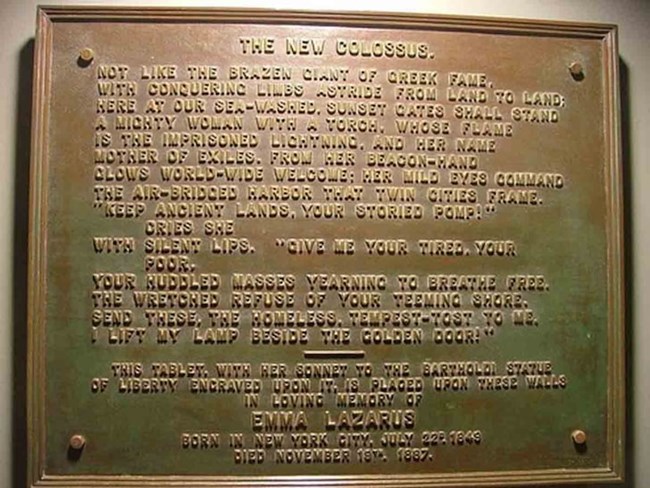
By not spending all their time grouping people into different "races" and judging them by their stereotypes of said races as invariant characteristics of not only first-generation immigrants, but all descendants therefrom, despite the latter growing up in your society, while freaking out about any change, as though every society is constantly changing, let alone one that specifically formed as a melting pot that prided itself on inviting everyone in?
Not that there haven't always been racists.
1840s-1880s: "F***ing Irish!"
1850s-1940s: "F***ing Chinese!"
1880s-1920s: "F***ing Italians! F***ing Slavs! F***ing Jews!"
1890s-1940s: "F***ing Japanese!"
1914-1920: "F***ing Germans!"
Late 1800s-Present: "F***ing Mexicans!"
1970s-Present: "F***ing Muslims!"
Who do you think will be next, while the previous groups become "normal" in the US? How many people of Italian descent do you see going around speaking Italian and living as if it were Italy in the early 1900s? In general, often even in the second generation, and esp. by third and beyond, immigrants' origins generally just becomes a historic fact rather than a daily lived thing. There may be some signature dish that you cook, or you may have a dream to some day visit the country your ancestors came from, or you (might) still be the religion of your ancestors, or whatnot. But you speak the local language, your hobbies are and interests by and large in-distribution for the country, your education was the same standardized education, etc. And over time, due to intermarriage, ancestry increasingly becomes diverse and less defining - "I'm X% Irish, Y% English, Z% Italian..." etc. Skin colour or part of the world doesn't change it. Ever met a south Asian-ancestry Brit? They're not out there talking like a call centre operator from New Delhi and eating curry every day, they're eating at Nandos and calling each other "bruv" and the like.
This is how all "peoples" form. Do you think there just happened to be 143 million people defining themselves as "Russian" living across this massive landmass? No - the Russian empire conquered a massive diverse range of people, and then assimilated them to be "Russians", through education, intermarriage, etc. At least in the US people are living there willingly and had a choice in the matter.
It's like this everywhere. Do you think there just happened to be a people called "The English"? No, there were Gaelic peoples there, then Romans, then Angles and Saxons, then vikings, and on and on. Flows of people are the nature of history, both during wartime and peacetime. I'm as white as they come, but genetic tests show a tiny bit of African ancestry - from a percentage basis, maybe back into the 1600-1700s - because hey, there were "Moors" in Europe then too. "Most" genetics in Iceland sees Y chromosomes *mainly* showing Scandinavian roots and mitochondria *mainly* showing British isles roots, but there's also, for example, a not insignificant bit of Greenlandic genetics here.
Even the most isolated places in the world see a free flow of genetics. Tristan da Cunha is considered the most remote settlement on Earth, with its 238 people. Boats only arrive once every few months, and to visit you have to get special permission from the Island Council. There were 7 surnames on the island, from the island's original male settlers. This expanded to 10 in the 1960s after some islanders intermarried during an evacuation due to the island's volcano. But genetics show the presence of an Eastern European ancestor from the early 1900s, possibly from a Russian sailing ship. Even on the most remote place on Earth, genetic flow exists - and it does not harm a damned thing, and is in fact, very much a good thing.
And culture flows even easier than genetics. Culture is constantly changing, radically. Even the things that ultraconservatives see as timeless and want to force society back to aren't nearly as timeless as they think. Think, for example, of the idea of the "housewife", a woman who stays at home and raises the kids while the husband goes out to work. That's a Victorian invention that only became the "norm" for a few decades in the post-WWII period. Traditionally (after the hunter-gatherer phase, and the agrarian phase), the standard family unit was the family business. People work from home, and everyone - husband, wife, children - all work on different aspects of the business. Maybe the husband is a fisherman and the wife a fishmongerer. Maybe it's a family of cobblers, and the husband cuts the leather pieces while his wife stitches them. Etc. But everyone worked. In comes the Industrial Revolution. Now most everyone still works, but they're working out of the house. The home becomes a refuge, separate from the workplace. An increasing (though small) percentage of the population is starting to gain a comfortable income and gain airs of nobility. The notion of "separate spheres" arises, with the workplace being "the man's sphere" and the home being "the woman's sphere", and it became an aspirational goal to have a wife at home who doesn't have to work, a status symbol of wealth. Very few people actually lived like this - most people still needed to work. It wasn't until the post-WWII boom that this actually became any sort of "norm" in society, where it was the status for most adult women and those who had to work were looked down on for it. And it was a status that most women found they hated, which is what led to the later liberation movement.
Genetics shift. Culture shifts. And people are not their ancestors. Societies are fluid things, where genes flow and a marketplace of ideas works not based on ancestry, but what people enjoy. Focus on actually competing in the marketplace of ideas. If what you define as your "culture" is so great, convince people that it is. "Being a racist bigot" is, I hate to break it to you, not a good way to accomplish that. It's always the most cringeworthy inbred yokels out there drawling "The WHITE RACE is the SUPERIOR RACE!".