Forgot your password?
typodupeerror
Math

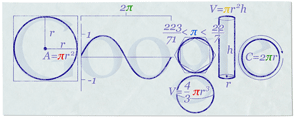
Pi Day and an Interview With a Pi Researcher 188

JoshuaInNippon writes "In honor of Pi Day, March 14 (or 3.14 for those who may need a hint), readers may be interested in reading an interview with Professor Daisuke Takahashi, the Japanese researcher who found 2.5 trillion digits of Pi back in August, before being apparently being edged out in December by a French computer programmer looking to prove his efficient coding abilities. Professor Takahashi's interview gives some unique insight into one man who truly marvels at the number that has driven people to ever greater lengths to find more digits for centuries." Plant Kingdom adds "There have been a number of proposals for alternatives to March 14 (see the Wikipedia page for Pi Day). Here's mine: when the Earth has gone through 1/pi-th of its orbit, as measured from Winter Solstice to Winter Solstice. I've put together a web site to make the case."

Comment Architecture Visualization-travel (Score 1) 386

Likely outside of a specific programming language, city architecture or an architectural class would be worthwhile to take. Some cities, like Prague as an example where I've visited, have intricate/ornately designed buildings, cemetaries and bridges, etc. Here in Seattle it is somewhat grid-like with interesting buildings and construction as well. I didn't take Computer Science, but took an architecture class in London and it was very interesting and helpful to learn human nature, design, function and aesthetics.
Science

Researchers Develop Self-Cleaning Clothes 220

Ponca City, We Love You writes "Researchers at Monash University, in Australia, have found a process to coat natural fibers such as wool, silk, and hemp that will automatically remove food, grime, and even red-wine stains by coating their fibers with titanium dioxide nanocrystals, which break down food and dirt in sunlight. Titanium dioxide is a strong photocatalyst and in the presence of ultraviolet light and water vapor, it forms hydroxyl radicals, which oxidize, or decompose, organic matter. "These nanocrystals cannot decompose wool and are harmless to skin," says organic chemist and nanomaterials researcher Walid Daoud. Titanium dioxide can also destroy pathogens such as bacteria in the presence of sunlight by breaking down the cell walls of the microorganisms making self-cleaning fabrics especially useful in hospitals and other medical settings."

Feed Science Daily: Forteo's Bone-building Power Shown In Arthritis Patients (sciencedaily.com)

In a head-to-head comparison of the two drugs, Forteo increased lumbar spine density measurements by 7.2 percent compared to 3.4 percent for Fosamax, and it boosted hip density measurements by 3.8 percent compared to 2.4 percent for Fosamax. The study looked at changes in bone density over the course of 18 months in arthritis patients with prednisone-induced osteoporosis.

Feed Science Daily: Helping Bangladesh Save Lives: Supercomputer Models Provided 24 Hours In Advance (sciencedaily.com)

Early on the morning of Nov. 16, Cyclone Sidr hit Bangladesh and showed no mercy. The death toll continues to rise even today. Hundreds of thousands of people were left homeless. But, nearly 24 hours in advance of the storm, Hassan Mashriqui, assistant extension professor of coastal engineering with LSU, the LSU AgCenter and the Louisiana Sea Grant College Program, gave Bangladesh emergency officials storm surge maps so detailed that area agencies were able to take action, saving countless lives.

Slashdot Top Deals

Unix is the worst operating system; except for all others. -- Berry Kercheval

Working...