Forgot your password?
typodupeerror
Data Storage

Researchers Develop Atomic-Scale Hard Drive That Writes Information Atom By Atom (techcrunch.com) 68

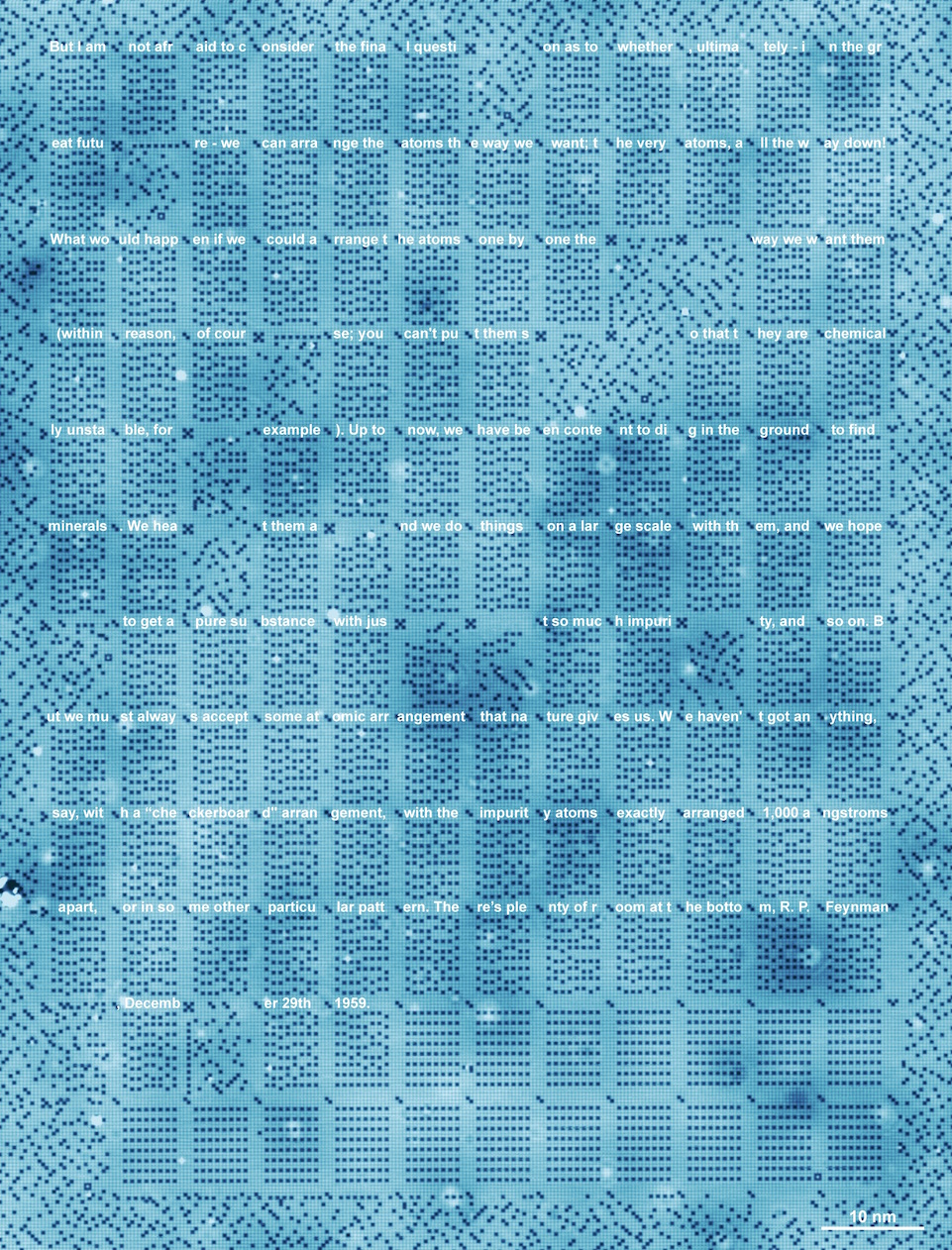
An anonymous reader quotes a report from TechCrunch: Researchers in the Netherlands have created a microscopic storage system that encodes every bit with a single atom -- allowing them to fit a kilobyte in a space under 100 nanometers across. That translates to a storage density of about 500 terabits per square inch. For comparison, those 4-terabyte hard drives you can buy today are about 1 terabit per square inch. That's because, unlike this new system, they use hundreds or thousands of atoms to store a single bit. "Every bit consists of two positions on a surface of copper atoms, and one chlorine atom that we can slide back and forth between these two positions," explained Sander Otte, lead scientist at Delft University of Technology, in a news release. Because chlorine on copper forms into a perfectly square grid, it's easy (relatively, anyway) to position and read them. If the chlorine atom is up top, that's a 1; if it's at the bottom, that's a 0. Put 8 chlorine atoms in a row and they form a byte. The data the researchers chose to demonstrate this was a fragment of a Feynman lecture, "There's plenty of room at the bottom" (PDF) -- fittingly, about storing data at extremely small scales. (You can see a high-resolution image of the array here.) The chlorine-copper array is only stable in a clean vacuum and at 77 kelvin -- about the temperature of liquid nitrogen. Anything past that and heat will disrupt the organization of the atoms. The research was published today in the journal Nature Nanotechnology.
Wireless Networking

Former Employee Accuses Wireless Charging Startup uBeam of Being a Sham (ieee.org) 118

uBeam, a startup which has raised over $25 million for its transmitter that can charge phones, tablets, and other devices wirelessly, is under attack. Paul Reynolds, former VP of engineering at the company has accused the company of making false promises. Reynolds, who has more than 20 years of experience working on ultrasound devices, says uBeam has overstated its technology's capabilities, and there's no way it can deliver anything close to its claim in a working prototype later this year. In fact, he went all the way to call uBeam "the next Theranos". For the uninitiated, uBeam plans to create a charging station which utilizes sound waves to beam power to devices in the same room. The company, which has a team of more than 30 engineers and physicists, has been working on the product since 2011. Some of its investors include Marc Andreessen, Marissa Mayer, and "Shark" Mark Cuban. From an IEEE report: Physicists have long questioned the practicality of uBeam's plans to deliver electricity to mobile devices using ultrasound. Mark Suster, a prominent venture capitalist and uBeam investor has defended uBeam. IEEE report adds: In his article today, Suster writes that when Reynolds was at uBeam, the engineer gave no indication that he had any problems with the company's direction -- implying that the issues raised in Reynolds' blog were essentially out of the blue. uBeam itself has yet to respond to anything Reynolds has written. "Throughout my time working with him he reassured me we could solve the technical challenges and our approach was viable," Suster writes. But Reynolds told IEEE Spectrum that is simply not the case. He says that he was rarely allowed to communicate directly with Suster, on account of Perry's (Editor's note: Meredith Perry is the Founder and CEO at uBeam) management preferences. But Reynolds said that in two meetings with Suster during the summer of 2015, he voiced concerns about what the company was telling investors and reporters it could do.

Slashdot Top Deals

A method of solution is perfect if we can forsee from the start, and even prove, that following that method we shall attain our aim. -- Leibnitz

Working...