Comment Re:In unrelated news... (Score 1) 1856
No, they're not just guesses. If they were, you'd have a point, but the amount of C14 is measured from samples of known age. Counting down ice cores and tree rings allows scientists to create a catalog of what the atmosphere's C14 levels looked like over the years. You say they're just guesses, but in reality, quite a lot of work goes into standardizing the data. As I said before, though, there are other methods that are even better because they are able to self-check for problems like the ones you describe.
Sure, scientists can look at what historically has been, but remember, an ape, a tree, and ice absorb C14 from the air. Each specimen will breath in a different amount of air giving a different original amount of C-14 So, even though hours of research have gone into it, they truly are little more than just assumptions. If you'd like some evidence to back this up, here it is: "Radio-carbon dating is a method of obtaining age estimates on organic materials. The word "estimates" is used because there is a significant amount of uncertainty in these measurements.......The C-14:C-12 atmospheric ratio is known to vary over time and it is not at all certain that the curve is "well behaved."" Here's the Source
I've said this before in these discussions and I'll probably say it again but, please show your work. Don't take it personally, but the assertion you just made is far too handwavy to be taken at face value, and as far as I know, quantum mechanics gives us no theoretical reason for this to be true in the temperature regimes you're talking about. As far as I can recall (and I don't have copy of Dalrymple with me, so please forgive me from working from memory), changes of over 1000 degrees C don't seem to alter C14's decay constant. I seriously doubt that a few degrees C are going to do it under normal Earth conditions. If you have some numbers to show, I'd be interested.
I'm sorry for the confusion here, what I meant by decay was non-radioactive decay. "In early September, British researchers reported that warmer temperatures were causing the soil to heat up and dramatically increasing rates of decay. The temperate forests and fields of the United Kingdom are becoming, in essence, semitropical." Here's the Source I was simply trying to point out that the earth is constantly changing and we can not just assume that processes are always occurring at the same rates. And since science is based on observation (look at the scientific method), observation is necessary to prove something. In this case, since the half-life of C-14 has been CALCULATED to be AROUND 5700 years, we can't actually observe the full length decay and thereby can't prove that it doesn't fluctuate over time.
It should be noted that ad hominem isn't Latin for, "That was a mean thing to say!" I suggest that if you'd prefer that your physics be taken seriously, start doing some calculations and stop inventing physical laws that don't exist. I was already a bit grouchy when you responded to me, and you did so by essentially calling thousands of scientists incompetent, stupid, or frauds. You can't seriously think that the objections that you're bringing up have gone unnoticed by the scientific community until now, can you? Obviously not, so they must either be too thick headed or incompetent to understand them, or the entire community of atomic physicists is involved in a conspiracy to defraud us. I'll leave it to you to decide which one you were suggesting.
Actually, for those latin scholars out there, Ad Hominem literally means "To the Man" it is when an argument is focused on a person rather than their argument and it's considered a logical fallacy. Radiometric Dating in NOT supported by the entire scientific community. Let's please try to keep this debate on the arguments and not on the people.
If you honestly believe that, whoever taught you about isochron has sold you a bill of goods. You might seriously consider rethinking whatever other material they sold you while you're at it. What, specifically, are you wrong about? Well: * Isochron dating does not require that the initial amount of the daughter isotope be known. * Contamination of either the parent or daughter isotope can generally be detected because the data will no longer be collinear. To some extent, isochron dating is "self calibrating" in that finding data that are not collinear immediately means that something is wrong, and that finding collinear data is a strong indication that the system is working. Is it foolproof? Certainly not. The ICR's grand canyon dating project shows that sufficiently careful selection of data can break nearly every dating tool. Does it suffer from the same problems as C14 dating? No. The only "assumption" it relies on that you brought up before was the constancy of radioactive decay, which is well supported and hasn't exactly been knocked down by your global warming model. If you have more to bring to the table on radioactive decay, I'm more than happy to discuss it.
To get a basic sense of what isocrhon dating is, let's look at wikipedia:
"All forms of isochron dating assume that the source of the rock or rocks contained unknown amounts of both radiogenic and non-radiogenic isotopes of the daughter element, along with some amount of the parent nuclide. Thus, at the moment of crystallization, the ratio of the concentration of the radiogenic isotope of the daughter element to that of the non-radiogenic isotope is some value independent of the concentration of the parent. As time goes on, some amount of the parent decays into the radiogenic isotope of the daughter, increasing the ratio of the concentration of the radiogenic isotope to that of the daughter. The greater the initial concentration of the parent, the greater the concentration of the radiogenic daughter isotope will be at some particular time. Thus, the ratio of the daughter to non-radiogenic isotope will become larger with time, while the ratio of parent to daughter will become smaller. For rocks that start out with a small concentration of the parent, the daughter/non-radiogenic ratio will not change quickly as compared to rocks starting with a large concentration of the parent."
So, once again we have the problem of unknowns, we don't know the ratio of parent to daughter element in the original. We can try to calibrate, but we can't truly know the original ratio. Isocrhon dating relies on the same assumptions as Carbon dating, it simply changes the formulas and the specimens around. The same problems still occur.
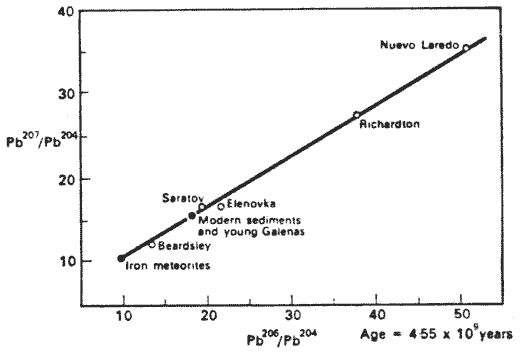
Here is my challenge to you: Can you explain the collinear arrangement of the data in the graph in this document? For bonus points, please try to explain the remarkably consistent numbers in the table below it. If the whole system was a house of cards, it would be rather surprising to find so many interesting correlations.
Okay, here's my explanation: Let's look at a very important assumption that paper makes: "If the solar system formed from a common pool of matter, which was uniformly distributed in terms of PB isotope ratios, then the initial plots for all objects from that pool of matter would fall on a single point." There is a big, huge IF right there. But, I digress, let's look at the chart itself (found here , logically, if the mathematical calculation for the ishochron dating itself is accurate, then quite obviously as the ratio of PB (lead) 207 to PB (lead) 204 increased, then the estimated age of the sample must increase also. If those samples didn't fall in line, then we would have great reason to believe that the mathematician who calculated those made a mistake.
Thanks for the lively debate!