38253567
story
Zothecula writes
"The internet has revolutionized global communications and now researchers at Stanford University are looking to provide a similar boost to bioengineering with a new process dubbed "Bi-Fi." The technology uses an innocuous virus called M13 to increase the complexity and amount of information that can be sent from cell to cell. The researchers say the Bi-Fi could help bio-engineers create complex, multicellular communities that work together to carry out important biological functions."
18634916
story
theodp writes
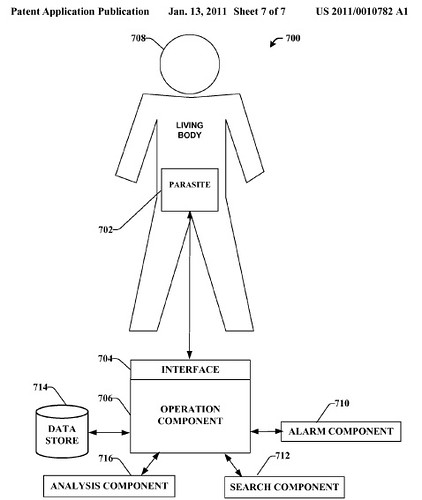
"In its just-published patent application for Adapting Parasites to Combat Disease, Microsoft lays out plans to unleash 'altered parasitic organisms' on humans, including mosquitoes, fleas, ticks, bed bugs, leeches, pinworms, tapeworms, hookworms, heart worms, roundworms, lice (head, body, and pubic), and the like. 'Irradiated mosquitoes can be used to deliver damaged Plasmodium to individuals,' explains Microsoft. 'Instead of contracting malaria, an individual receiving the damaged Plasmodium develops an immune response that renders the individual resistant to contracting malaria.' Don't worry about runaway breeding, advises Microsoft — 'a termination feature [that] can include programmed death' makes this impossible. As David Spade might say, I liked this movie the first time I saw it — when it was called Jurassic Park."
11362064
story
ByronScott writes
"A team of researchers at MIT has just announced that they have successfully modified a virus to split apart molecules of water, paving the way for an efficient and non-energy-intensive method of producing hydrogen fuel. 'The team, led by Angela Belcher, the Germeshausen Professor of Materials Science and Engineering and Biological Engineering, engineered a common, harmless bacterial virus called M13 so that it would attract and bind with molecules of a catalyst (the team used iridium oxide) and a biological pigment (zinc porphyrins). The viruses became wire-like devices that could very efficiently split the oxygen from water molecules. Over time, however, the virus-wires would clump together and lose their effectiveness, so the researchers added an extra step: encapsulating them in a microgel matrix, so they maintained their uniform arrangement and kept their stability and efficiency.'"
10630262
story
ByronScott writes
"In today's 'gross news' category, some female insects just might be getting lucky. As an alternative to toxic pesticides, scientists at the Hebrew University of Jerusalem have created 'super-sexed' sterilized male leafhoppers to knock bug boots with females in the wild, resulting in decreased populations. Yes, that means that the female bugs will miss out on the joys of motherhood, but the idea that the insects will be having some fun instead of being gassed to death by poisons is pretty cool."
7079282
story
MikeChino writes
"Sifting through minefields to remove hidden threats is a dangerous, tedious, and expensive process. Scientists at the University of Edinburgh recently announced that they have engineered a strain of bacteria that glows green in the presence of explosives, making mine detection a snap. The new strain of bacteria can be sprayed onto local affected areas or air-dropped over entire fields of mines. Within a few hours the bacteria strain begins to glow wherever traces of explosive chemicals are present."