Follow Slashdot blog updates by subscribing to our blog RSS feed


Forgot your password?
typodupeerror

Comment Thank you so much. (Score 1) 1521

[checks to make sure it's not April 1st]

Right, so this is real.

I can think of only one thematically appropriate quote: "So long, and thanks for all the fish."

I've been on Slashdot for just about as long as its been up. It was probably the first web site that I read with any regularity. Your creation was the form of useful community website in my mind; the yard stick that every other site is compared to. It was the start of Web 2.0 that got it's start just as Web 1.0 was starting to come into its own.

You and your site have been there for so many of the ups and downs of my personal and professional life. Deaths, births, news and politics. From the Columbine rampage, the death of W. Richard Stevens, to September 11, and beyond. Your site was a gathering spot for a certain sort. Sure, some of these people were (and are) assholes, but more of them are thoughtful people; friends that I wouldn't have otherwise met.

Please know that your site has touched my life. You have my profound thanks, and I am in your debt. Good luck in whatever life brings you.

Josh

Comment Oops! (Score 2, Informative) 359

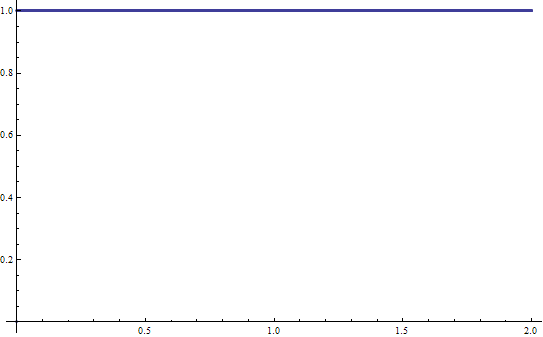
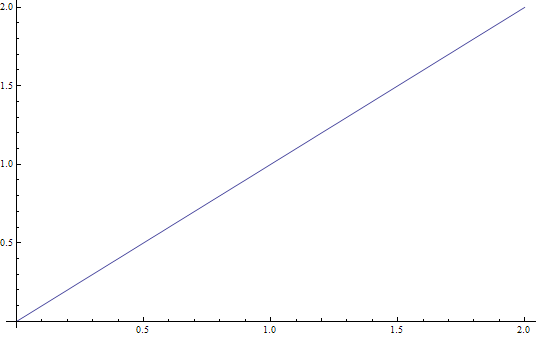
Well, so much for my smug mathy reply! Amusingly, the reason it worked so well is that my "Evaluate" statement asked Mathematica to symbolically evaluate the function prior to graphing. So, the graph looked nice because Mathematica was just graphing the "Abs[x]" function!
Without the symbolic evaluation or requesting a particular precision level, the graph you actually get is this:
http://www.untruth.org/~josh/real-rounding-oops1.png
You can get a more reasonable looking answer by messing with the calculation precision and accuracy...

Comment Re:Hard to debug floating point when it goes wrong (Score 2, Interesting) 359

That is neat, but some (math oriented) languages do just fine:
Some Mathematica code:

h[x_] := Module[{y, w, k},
y = Abs[x];
For[k = 1, k <= 128, k++, y = Sqrt[y]];
w = y;
For[k = 1, k <= 128, k++, w = w^2];
w
]
Plot[Evaluate[h[x]], {x, 0, 2}]

The result: http://www.untruth.org/~josh/real-rounding.png

Comment Re:Hate (Score 1) 170

Whole paragraphs?!? Amateurs! I assigned an (extra credit!) essay in one of my classes, and of the 15 projects that I got back 8 of them were almost entirely comprised of text copied from Wikipedia and the other top Google result.

My favorite two were the ones who had (I presume) copied the web page directly into MS Word, which dutifully changed the style to "Web", and then printed the web content with a faint blue background. The end result is that these papers were about 4 pages long, mostly faint blue, with occasional breaks for stuff they actually wrote.

That's how you do it!

Comment Re:iirc (Score 1) 339

For the people not in engineering/math/science, I don't see why they need to be deprived a calculator or similar for a calculus class.

I don't have a strong opinion, but I have seen people use calculators as a brain crutch. The point of the homework and test questions is to encourage thought, not to encourage mad calculator skills.

I enjoyed learning it, but only a math professor has to know how to perform integration by parts by hand.

This comment makes me wonder at your notion of a math prof's day. Is it anything like this?
9am: Get to work. Hard integral
10am: teach class
11am: hard integral (using integration by parts)
noon: light lunch (don't want to get cramps in the integration muscle!)
1pm: teach class
2pm: office hours
3pm: hard integral (stupid trig substitutions!)
4pm: hard integral (using partial fraction decomposition)
5pm: go home

Slashdot Top Deals

Any circuit design must contain at least one part which is obsolete, two parts which are unobtainable, and three parts which are still under development.

Working...