It took about 5 minutes for me, but had to be *total* dakness. So dark I couldn't tell if my eyes were open or shut. This was in a lab where we were doin nuclear emission spectroscopy (just gas discharge tubes). Any outside light would pollute the results, so the lab was really dark until we turned on the juice. During that period I could see as clearly as i'm seeing this screen flowing sheets of glowing pastel paint sliding down a wall that wasn't there. Not true hallucinations of course--by definition if you know it's not real it's not a hallucination. Phosphenes I think they were called.
Anyhow, very beautiful and unusual. I don't think my lab partners saw anything--at least they didn't say they did. Or they were afraid people would think they were nuts.
Later i blacked out my dorm room & reproduced the effect. And learned it's really hard to produce absolute darkness. Tinfoil is *full* of tiny holes! And black paint is not as opaque as it seems.
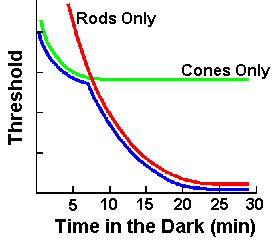
5 minutes is not long enough to fully adapt the human visual system see: http://www.visualexpert.com/im... 5-8 minutes your cones (the photoreceptors concentrated in the central visual field that are used to encode color) and 20+ minutes for the rod (what we use to see in low light situation) to full adapt. Phosphenes are normal and can be produced by placing slight pressure on the eye. Also interesting dark adaptation can be done independently in each eye. Black out one eye for 8 minutes or so (easier to do than a whole room) then open both your eyes. It is a fun and a little disorienting experience if done correctly.
Keep the number of passes in a compiler to a minimum. -- D. Gries