Forgot your password?
typodupeerror
Data Storage

The Hairy State of Linux Filesystems 187

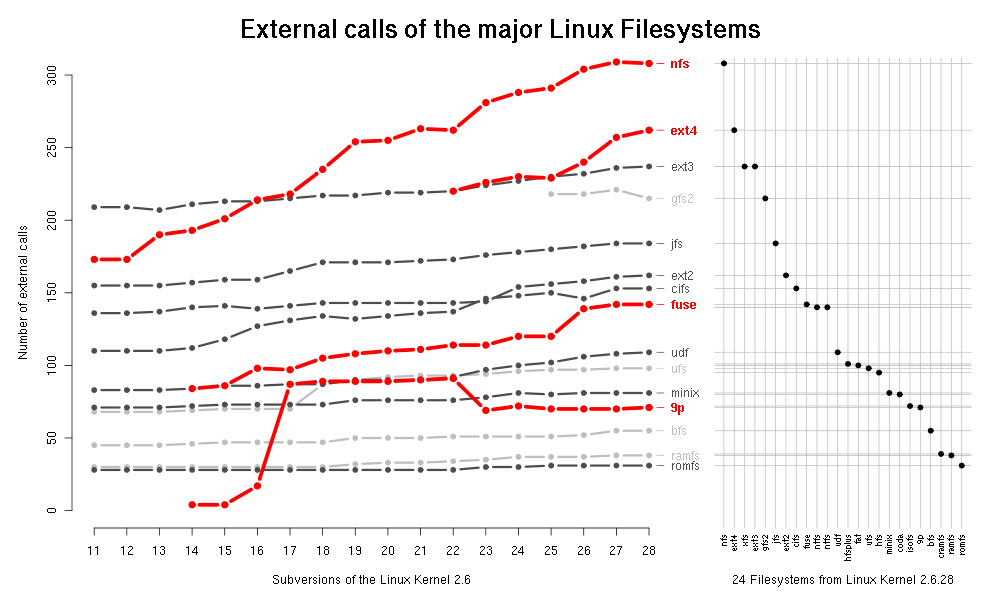
RazvanM writes "Do the OSes really shrink? Perhaps the user space (MySQL, CUPS) is getting slimmer, but how about the internals? Using as a metric the number of external calls between the filesystem modules and the rest of the Linux kernel I argue that this is not the case. The evidence is a graph that shows the evolution of 15 filesystems from 2.6.11 to 2.6.28 along with the current state (2.6.28) for 24 filesystems. Some filesystems that stand out are: nfs for leading in both number of calls and speed of growth; ext4 and fuse for their above-average speed of growth and 9p for its roller coaster path."

Feed FCC Tells Phone Companies You Can't Arbitrarily Block Calls To Numbers You Don't (techdirt.com)

A few months back, telcos like ATT and Sprint started blocking calls to various free conference call lines based in Iowa. As we had explained earlier, these systems were basically abusing bad regulations in Iowa, forcing telcos to pay them a lot of money for every incoming call. Even so, it seemed questionable that telcos could arbitrarily block who customers could call. It certainly echoed some of the concerns about network neutrality, where ISPs conceivably could block what sites users could visit. Based on all of this, it was somewhat surprising that the FCC didn't get involved. Eventually, however, the telcos backed down. We had assumed it was a combination of the bad publicity over the blocked calls (even if the Iowa telcos involved seriously overhyped the importance of being able to scam bigger telcos through regulatory loopholes) and the fact that the FCC was finally holding meetings on the issue. However, earlier today, FCC Chair Kevin Martin admitted that the FCC quickly called the big telcos in question to let them know, in no uncertain terms, that this was a violation of FCC rules. In fact, he claims that a week after the big telcos backed down, the FCC discovered that at least one was still somehow limiting or degrading calls to those Iowa numbers -- and the FCC contacted the telco again to tell them that this was not allowed. It's good to know that the FCC took this seriously (especially since it's one of the few times that it seems to have gone against the wishes of its good friends in the telco industry). It's still odd that the FCC didn't make any public announcement about this to make it abundantly clear to others not to go down this route. Perhaps Martin wanted to save his friends from some embarrassment. In the meantime, can anyone explain why no one is changing the silly regulations to get rid of the ridiculous and unnecessary fees to these Iowa telcos?
Media

Submission + - The Unauthorized State-Owned Chinese Disneyland

rmnoon writes: "Apparently Japanese TV and bloggers have just discovered Disney's theme park in China, where young children can be part of the Magic Kingdom and interact with their favorite characters (like Mickey Mouse, Donald Duck, and the Seven Dwarfs). The park's slogan is "Because Disneyland is Too Far", and there's even an Epcot-like dome. The only problem? Disney didn't build it, and they didn't authorize it. What's more? It's state-owned!

Now that China is hosting the Olympics and seeking to build international credibility, what responsibility does it have to not engage in blatant violations of international trademarks in publicly-owned operations?"
Music

Submission + - RIAA Backs Down Again in Chicago

NewYorkCountryLawyer writes: "The RIAA seems to have a problem making things stick in the Windy City. It has once again backed down in BMG v. Thao, after suing a misidentified defendant. Same thing occurred last October in Elektra v. Wilke. In the Thao case, the RIAA based its case on information that the cable modem used to partake in file sharing was registered to Mr. Thao. However, it turned out that Mr. Thao was not even a subscriber (pdf) of the ISP (pdf) at the time of the alleged file-sharing, and therefore did not have possession of the suspect cable modem at that time."

Feed Fedora merges Core and Extra repositories (slashdot.org)

At noon EDT today Red Hat developers began merging the Fedora Core and Extras repositories. The new merged Fedora repository is one of the major changes for the upcoming Fedora 7 release, and marks the first time a major distribution supported by a...
Networking

Submission + - Improvements to the Download Process

ant_tmwx writes: Metalinks collect information about files in an XML format used by programs that download. The information includes mirror lists, ways to retrieve the file on P2P networks, checksums for verifying and correcting downloads, operating system, language, and other details. Using Metalinks details the Free Software programs you can use to download them with. There are also clients on Mac and Windows. With a list of multiple ways to download a file, programs can switch to another method if one goes down. Or a file can be downloaded from multiple mirrors at once, usually making the download go much faster. Downloads can be repaired during transfer to guarantee no errors. All this makes things automatic which are usually not possible or at least difficult, and increases efficiency, availability, and reliability over regular download links. OpenOffice.org, openSUSE, and other Linux/BSD distributions use them for large downloads.

Comment Reminds me of a link from an earlier /. posting (Score 0) 728

http://www.macfergus.com/niels/dmca/cia.html

How there is some huge security hole in hdcp. I really don't think we have much to worry about, as people will break this, publish the results, and we can get all the movies pirated.

I'd much rather download movies and have the risk of being caught then paying a ton of money for movies that won't even play at full resolution on the computer I already own.

Slashdot Top Deals

A man is known by the company he organizes. -- Ambrose Bierce

Working...