AI

US Chipmakers Fear Ceding China's AI Market to Huawei After New Trump Restrictions (msn.com) 99

The Trump administration is "taking measures to restrict the sale of AI chips by Nvidia, Advanced Micro Devices and Intel," especially in China, reports the New York Times. But that's triggered a series of dominoes. "In the two days after the limits became public, shares of Nvidia, the world's leading AI chipmaker, fell 8.4%. AMD's shares dropped 7.4%, and Intel's were down 6.8%." (AMD expects up to $800 million in charges after the move, according to CNBC, while NVIDIA said it would take a quarterly charge of about $5.5 billion.)

The Times notes hopeful remarks Thursday from Jensen Huang, CEO of Nvidia, during a meeting with the China Council for the Promotion of International Trade. "We're going to continue to make significant effort to optimize our products that are compliant within the regulations and continue to serve China's market." But America's chipmakers also have a greater fear, according to the article: "that their retreat could turn the Chinese tech giant Huawei into a global chip-making powerhouse." "For the U.S. semiconductor industry, China is gone," said Handel Jones, a semiconductor consultant at International Business Strategies, which advises electronics companies. He projects that Chinese companies will have a majority share of chips in every major category in China by 2030... Huang's message spoke to one of his biggest fears. For years, he has worried that Huawei, China's telecommunications giant, will become a major competitor in AI. He has warned U.S. officials that blocking U.S. companies from competing in China would accelerate Huawei's rise, said three people familiar with those meetings who spoke on the condition of anonymity.

If Huawei gains ground, Huang and others at Nvidia have painted a dark picture of a future in which China will use the company's chips to build AI data centers across the world for the Belt and Road Initiative, a strategic effort to increase Beijing's influence by paying for infrastructure projects around the world, a person familiar with the company's thinking said...

Nvidia's previous generation of chips perform about 40% better than Huawei's best product, said Gregory C. Allen, who has written about Huawei in his role as director of the Wadhwani AI Center at the Center for Strategic and International Studies. But that gap could dwindle if Huawei scoops up the business of its American rivals, Allen said. Nvidia was expected to make more than $16 billion in sales this year from the H20 in China before the restriction. Huawei could use that money to hire more experienced engineers and make higher-quality chips. Allen said the U.S. government's restrictions also could help Huawei bring on customers like DeepSeek, a leading Chinese AI startup. Working with those companies could help Huawei improve the software it develops to control its chips. Those kinds of tools have been one of Nvidia's strengths over the years.

TechRepublic identifies this key quote from an earlier article: "This kills NVIDIA's access to a key market, and they will lose traction in the country," Patrick Moorhead, a tech analyst with Moor Insights & Strategy, told The New York Times. He added that Chinese companies will buy from local rival Huawei instead.
Iphone

Apple To Launch Thinner iPhone 17 'Air' as Step Toward Port-Free Design (macrumors.com) 43

Apple will introduce a slimmer iPhone 17 "Air" this fall, marking a strategic shift toward potentially port-free devices in future product lines, according to a Bloomberg report.

The new model will feature a 6.6-inch display with ProMotion scrolling, Dynamic Island interface, and a Camera Control button while measuring approximately 2 millimeters thinner than current models -- roughly a 20% reduction in depth, the report said. Despite its slimmer profile, the device will maintain battery life comparable to existing iPhones through redesigned display and silicon components. It will incorporate Apple's power-efficient C1 in-house modem chip but will retain USB-C connectivity, despite earlier internal discussions about eliminating ports entirely.
Facebook

After Meta Blocks Whistleblower's Book Promotion, It Becomes an Amazon Bestseller (thetimes.com) 39

After Meta convinced an arbitrator to temporarily prevent a whistleblower from promoting their book about the company (titled: Careless People), the book climbed to the top of Amazon's best-seller list. And the book's publisher Macmillan released a defiant statement that "The arbitration order has no impact on Macmillan... We will absolutely continue to support and promote it." (They added that they were "appalled by Meta's tactics to silence our author through the use of a non-disparagement clause in a severance agreement.")

Saturday the controversy was even covered by Rolling Stone: [Whistleblower Sarah] Wynn-Williams is a diplomat, policy expert, and international lawyer, with previous roles including serving as the Chief Negotiator for the United Nations on biosafety liability, according to her bio on the World Economic Forum...

Since the book's announcement, Meta has forcefully responded to the book's allegations in a statement... "Eight years ago, Sarah Wynn-Williams was fired for poor performance and toxic behavior, and an investigation at the time determined she made misleading and unfounded allegations of harassment. Since then, she has been paid by anti-Facebook activists and this is simply a continuation of that work. Whistleblower status protects communications to the government, not disgruntled activists trying to sell books."

But the negative coverage continues, with the Observer Sunday highlighting it as their Book of the Week. "This account of working life at Mark Zuckerberg's tech giant organisation describes a 'diabolical cult' able to swing elections and profit at the expense of the world's vulnerable..."

Though ironically Wynn-Williams started their career with optimism about Facebook's role in the app internet.org. . "Upon witnessing how the nascent Facebook kept Kiwis connected in the aftermath of the 2011 Christchurch earthquake, she believed that Mark Zuckerberg's company could make a difference — but in a good way — to social bonds, and that she could be part of that utopian project...

What internet.org involves for countries that adopt it is a Facebook-controlled monopoly of access to the internet, whereby to get online at all you have to log in to a Facebook account. When the scales fall from Wynn-Williams's eyes she realises there is nothing morally worthwhile in Zuckerberg's initiative, nothing empowering to the most deprived of global citizens, but rather his tool involves "delivering a crap version of the internet to two-thirds of the world". But Facebook's impact in the developing world proves worse than crap. In Myanmar, as Wynn-Williams recounts at the end of the book, Facebook facilitated the military junta to post hate speech, thereby fomenting sexual violence and attempted genocide of the country's Muslim minority. "Myanmar," she writes with a lapsed believer's rue, "would have been a better place if Facebook had not arrived." And what is true of Myanmar, you can't help but reflect, applies globally...

"Myanmar is where Wynn-Williams thinks the 'carelessness' of Facebook is most egregious," writes the Sunday Times: In 2018, UN human rights experts said Facebook had helped spread hate speech against Rohingya Muslims, about 25,000 of whom were slaughtered by the Burmese military and nationalists. Facebook is so ubiquitous in Myanmar, Wynn-Williams points out, that people think it is the entire internet. "It's no surprise that the worst outcome happened in the place that had the most extreme take-up of Facebook." Meta admits it was "too slow to act" on abuse in its Myanmar services....

After Wynn-Williams left Facebook, she worked on an international AI initiative, and says she wants the world to learn from the mistakes we made with social media, so that we fare better in the next technological revolution. "AI is being integrated into weapons," she explains. "We can't just blindly wander into this next era. You think social media has turned out with some issues? This is on another level."

Security

Microsoft Comes Under Blistering Criticism For 'Grossly Irresponsible' Security (arstechnica.com) 55

An anonymous reader quotes a report from Ars Technica: Microsoft has once again come under blistering criticism for the security practices of Azure and its other cloud offerings, with the CEO of security firm Tenable saying Microsoft is "grossly irresponsible" and mired in a "culture of toxic obfuscation." The comments from Amit Yoran, chairman and CEO of Tenable, come six days after Sen. Ron Wyden (D-Ore.) blasted Microsoft for what he said were "negligent cybersecurity practices" that enabled hackers backed by the Chinese government to steal hundreds of thousands of emails from cloud customers, including officials in the US Departments of State and Commerce. Microsoft has yet to provide key details about the mysterious breach, which involved the hackers obtaining an extraordinarily powerful encryption key granting access to a variety of its other cloud services. The company has taken pains ever since to obscure its infrastructure's role in the mass breach.

On Wednesday, Yoran took to LinkedIn to castigate Microsoft for failing to fix what the company said on Monday was a "critical" issue that gives hackers unauthorized access to data and apps managed by Azure AD, a Microsoft cloud offering for managing user authentication inside large organizations. Monday's disclosure said that the firm notified Microsoft of the problem in March and that Microsoft reported 16 weeks later that it had been fixed. Tenable researchers told Microsoft that the fix was incomplete. Microsoft set the date for providing a complete fix to September 28.

"To give you an idea of how bad this is, our team very quickly discovered authentication secrets to a bank," Yoran wrote. "They were so concerned about the seriousness and the ethics of the issue that we immediately notified Microsoft." He continued: "Did Microsoft quickly fix the issue that could effectively lead to the breach of multiple customers' networks and services? Of course not. They took more than 90 days to implement a partial fix -- and only for new applications loaded in the service."
In response, Microsoft officials wrote: "We appreciate the collaboration with the security community to responsibly disclose product issues. We follow an extensive process involving a thorough investigation, update development for all versions of affected products, and compatibility testing among other operating systems and applications. Ultimately, developing a security update is a delicate balance between timeliness and quality, while ensuring maximized customer protection with minimized customer disruption." Microsoft went on to say that the initial fix in June "mitigated the issue for the majority of customers" and "no customer action is required."

In a separate email, Yoran responded: "It now appears that it's either fixed, or we are blocked from testing. We don't know the fix, or mitigation, so hard to say if it's truly fixed, or Microsoft put a control in place like a firewall rule or ACL to block us. When we find vulns in other products, vendors usually inform us of the fix so we can validate it effectively. With Microsoft Azure that doesn't happen, so it's a black box, which is also part of the problem. The 'just trust us' lacks credibility when you have the current track record."
The Almighty Buck

GrubHub Was Getting 6,000 Orders A Minute During Its Promo Day, Overwhelming Restaurants (buzzfeednews.com) 54

A delivery app marketing campaign offering a "free lunch" -- aka a $15 promo code valid for three hours -- sent customers and restaurant workers alike into a spiral on Tuesday as thousands of orders jammed the system and disgruntled New Yorkers tweeted through their hunger pains. BuzzFeed News reports: GrubHub's New York City campaign on May 17 touted the physical and mental benefits of eating lunch, but yielded dozens of complaints, cancelled orders and service workers telling BuzzFeed News they were "exhausted" trying to keep up. GrubHub told BuzzFeed News that at times during the promotion that ran from 11 a.m. to 2 p.m. the app was averaging 6,000 orders per minute.

"It got overwhelming," said Brandon Ching, who was working the counter at Greenberg's Bagels, a popular sandwich spot in Bedford-Stuyvesant, Brooklyn. "We were short-staffed today so it really added extra stress to my day." And customers were frustrated at the delays. Ebenezer Ackon told BuzzFeed News he was in 3,630th place in line to talk to GrubHub's customer service when he gave up, after waiting more than an hour for food, and went to get something from across the street from his apartment. Blake, who didn't want to use his last name, said the small Brooklyn cafe he ordered from received 200 orders in five minutes as soon as the promo began, so they reluctantly had to cancel orders -- including his. [...] Customers may be frustrated about not getting a product they wanted, but for service industry workers it was a day of non-stop stress.

A spokesperson from GrubHub sent BuzzFeed News a statement following the fiasco: "It's clear, New Yorkers were hungry for lunch! While we knew 72% of New York workers call lunch the most important meal of the day, our free lunch promotion exceeded all expectations." Tuesday's campaign received six times more orders than a similar promo last year, they said. The company's statement mentioned that "initial demand temporarily overwhelmed" the app and served customers an error message that was "rectified so New Yorkers could enjoy their much-deserved lunch."

Australia

Australia Sues Facebook Over Its Use of Onavo To Snoop (techcrunch.com) 28

Australia's Competition and Consumer Commission (ACCC) is suing Facebook over its use, in 2016 and 2017, of the Onavo VPN app to spy on users for commercial purposes. From a report: The ACCC's case accuses Facebook of false, misleading or deceptive conduct toward thousands of Australian consumers, after it had promoted the Onavo Protect app -- saying it would keep users personal activity data private, protected and secret and not use it for any other purpose, when it was being used to gather data to help Facebook's business. "Through Onavo Protect, Facebook was collecting and using the very detailed and valuable personal activity data of thousands of Australian consumers for its own commercial purposes, which we believe is completely contrary to the promise of protection, secrecy and privacy that was central to Facebook's promotion of this app," said ACCC chair Rod Sims in a statement. "Consumers often use VPN services because they care about their online privacy, and that is what this Facebook product claimed to offer. In fact, Onavo Protect channelled significant volumes of their personal activity data straight back to Facebook."
Businesses

Apple Hires Former Venture Capitalist Josh Elman For App Store Discovery Role (appleinsider.com) 10

As part of Apple's ongoing efforts to improve app discovery, the company has hired former venture capitalist Josh Elman for a related role on the App Store. AppleInsider reports: In a statement Monday, Elman said he would be joining Apple to "help customers discover the best apps for them." He added that he was excited to "build ways to help over a billion customers and millions of developers connect." As part of the transition to the new role at Apple, Elman said he would be stepping back from some of his active boards and investments -- including Discord and Medium.

Elman was previously a venture capitalist at Greylock Partners and led early investments in Discord and the precursor to TikTok. Until 2019, he was also the vice president of product at Robinhood. Elman's experience identifying and investing in apps that later became hits could help Apple in its app and software promotion endeavors. According to Bloomberg, the former venture capitalist could also help smooth over the relationship between Apple and developers.

AI

Former Siri Chief Is Leaving Apple To Join Microsoft's AI Division (theverge.com) 15

Bill Stasior, the former head of Apple's Siri division, is leaving the company after nearly a decade to join Microsoft's artificial intelligence division, reports The Information. "Although Stasior left Apple in May, he's only joining Microsoft later this month as a corporate vice president, reporting to Chief Technology Officer Kevin Scott," reports The Verge. "Stasior worked at Apple for more than seven years, joining back in 2012." From the report: After Giannandrea took a more hands-on role in the Siri division upon being hired last summer, he was subsequently promoted to a senior vice president role at Apple in December. That meant he was reporting directly to CEO Tim Cook, and he was also responsible for all machine learning and general AI projects at Apple. According to The Information, that promotion resulted in Stasior walking away from day-to-day duties running the Siri team.

Prior to Giannandrea joining, Stasior had the responsibility of running Siri, who was vice president of the division for more than seven years. But Apple effectively tossed executive leadership of the product around like a hot potato. It was initially former iOS software chief Scott Forstall's job to oversee Siri, but after he left the company unceremoniously over the controversial Apple Maps fiasco, the role went to services chief Eddy Cue and then eventually VP of software engineering Craig Federighi. Finally, when Giannandrea joined, Siri had a proper executive to oversee it, but that seems to have resulted in Stasior's departure for reasons unknown.
The Information notes that Stasior will not be working on Cortana. Instead, he'll be leading up an AI group, although it's unclear what exactly he'll be working on.
Businesses

Amazon To Launch Mobile Ads, in a Threat To Google and Facebook (bloomberg.com) 33

Amazon.com has been beta testing its in-house made ads on Apple's iOS platform for several months, Bloomberg reported Thursday, in a move that is described as ecommerce giant's growing efforts to grab a chunk of the $129 billion digital advertising market that is currently dominated by Google and Facebook. Bloomberg's report added that Amazon plans to introduce a similar ad product on Google's Android platform later this year. From the report: Amazon has emerged as a fast-growing challenger in the digital advertising market since it captures 50 percent of all online sales in the US. Amazon's digital advertising market share will grow to 8.8 percent this year from 6.8 percent in 2018, according to EMarketer Market-leader Google will see its share slip to 37.2 percent from 38.2 percent. Selling more video ads opens a new revenue opportunity for Amazon's advertising division, which mostly sells space featuring brand logos, product photographs and descriptions that are the equivalent of digital billboards. Video ad spots are similar to television commercials and can deepen the power of promotion.
Youtube

YouTube Will Remove Ads, Downgrade Discoverability of Channels Posting Offensive Videos (techcrunch.com) 314

Earlier today, YouTube barred Logan Paul from serving ads on his video channel in response to a "recent pattern of behavior" from him. Now, YouTube has announced a more formal and wider set of sanctions it's prepared to level on any creator that starts to post videos that are harmful to viewers, others in the YouTube community, or advertisers. TechCrunch reports: "We may remove a channel's eligibility to be recommended on YouTube, such as appearing on our home page, trending tab or watch next," Ariel Bardin, Vice President of Product Management at YouTube, writes in a blog post.

The full list of steps, as outlined by YouTube:
1. Premium Monetization Programs, Promotion and Content Development Partnerships. We may remove a channel from Google Preferred and also suspend, cancel or remove a creator's YouTube Original.
2. Monetization and Creator Support Privileges. We may suspend a channel's ability to serve ads, ability to earn revenue and potentially remove a channel from the YouTube Partner Program, including creator support and access to our YouTube Spaces.
3. Video Recommendations. We may remove a channel's eligibility to be recommended on YouTube, such as appearing on our home page, trending tab or watch next.

The changes are significant not just because they could really hit creators where it hurts, but because they also point to a real shift for the platform. YouTube has long been known as a home for edgy videos filled with pranks and potentially offensive content, made in the name of comedy or freedom of expression. Now, the site is turning over a new leaf, using a large team of human curators and AI to track the content of what's being posted, and these videos have a much bigger chance of falling afoul of YouTube's rules and getting dinged.

Google

'The Web is Not Google, and Should Not be Just Google': Developers Express Concerns About AMP (ampletter.org) 99

A group of prominent developers published an open-letter on Tuesday, outlining their deep concerns about Accelerated Mobile Pages, a project by Google that aims to improve user experience of the Web. Google services already dominate the Web, and the scale at which AMP is growing, it could further reinforce Google's dominance of the Web, developers wrote. The letter acknowledges that web pages could be slow at times, but the solutions out there to address them -- AMP, Facebook's Instant Articles, Apple News -- are creating problems of their own, developers say. From the letter: Search engines are in a powerful position to wield influence to solve this problem. However, Google has chosen to create a premium position at the top of their search results (for articles) and a "lightning" icon (for all types of content), which are only accessible to publishers that use a Google-controlled technology, served by Google from their infrastructure, on a Google URL, and placed within a Google controlled user experience. The AMP format is not in itself, a problem, but two aspects of its implementation reinforce the position of Google as a de facto standard platform for content, as Google seeks to drive uptake of AMP with content creators: Content that "opts in" to AMP and the associated hosting within Google's domain is granted preferential search promotion, including (for news articles) a position above all other results. When a user navigates from Google to a piece of content Google has recommended, they are, unwittingly, remaining within Google's ecosystem.

If Google's objective with AMP is indeed to improve user experience on the Web, then we suggest some simple changes that would do that while still allowing the Web to remain dynamic, competitive and consumer-oriented: Instead of granting premium placement in search results only to AMP, provide the same perks to all pages that meet an objective, neutral performance criterion such as Speed Index. Publishers can then use any technical solution of their choice. Do not display third-party content within a Google page unless it is clear to the user that they are looking at a Google product. It is perfectly acceptable for Google to launch a "news reader," but it is not acceptable to display a page that carries only third party branding on what is actually a Google URL, nor to require that third party to use Google's hosting in order to appear in search results. We don't want to stop Google's development of AMP, and these changes do not require that.

Education

Hour of Code 2015 Star Wars Tutorial: Spare the IF Statement, Spoil the Child? 156

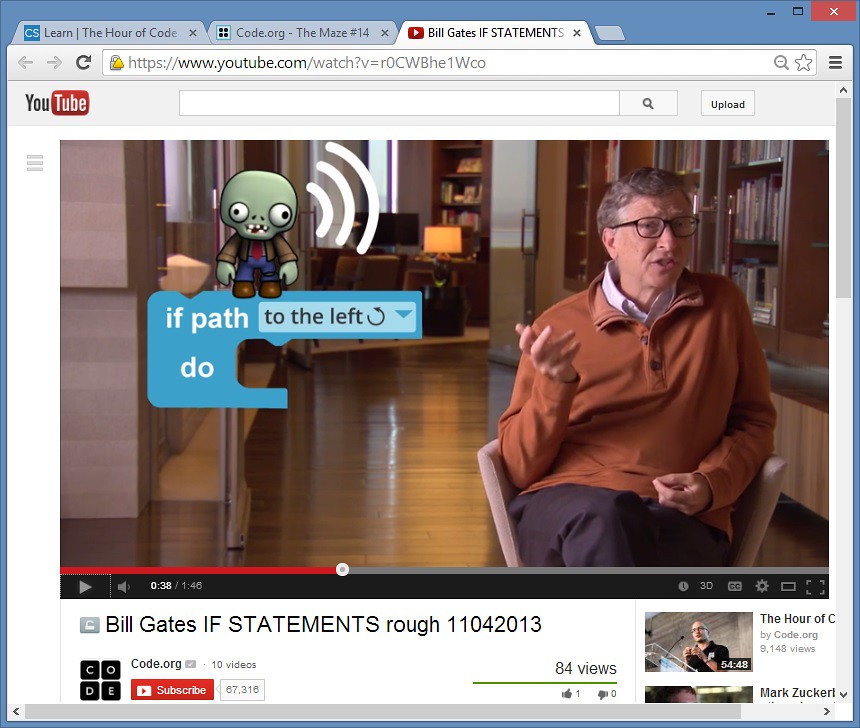
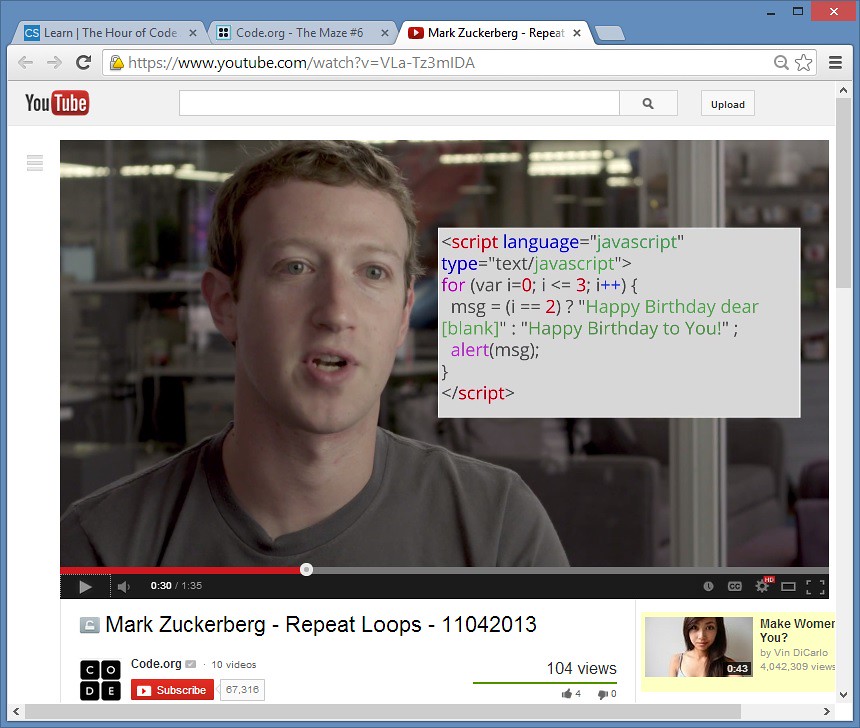
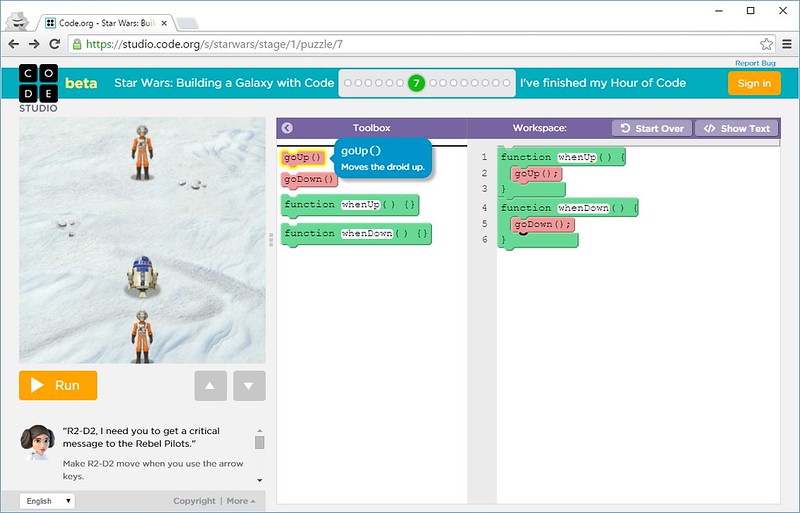
theodp writes: Teaching U.S. K-12 kids their programming fundamentals in past Hours of Code were an IF-fy Bill Gates and a LOOP-y Mark Zuckerberg. Interestingly, the new signature tutorial — Star Wars: Building a Galaxy with Code — created by Lucasfilm and Code.org ("in a locked room with no windows") for this December's Hour of Code, eschews both IF statements and loops. The new learn-to-code tutorial instead elects to show students "events" after they've gone through the usual move-up-down-left-right drills. With the NY Times and National Center for Women & Information Technology recently warning against putting Star Wars in the CS classroom ("Attracting more female high school students to computer science classes might be as easy as tossing out the Star Wars posters," claimed an Aug. 29th NCWIT Facebook post), the theme of the new tutorial seems an odd choice for Code.org, whose stated mission includes "increasing [CS] participation by women." But if Star Wars is, as some suggest, more aimed at boys, perhaps Code.org has something up its sleeve for girls (a la last year's Disney Princesses) with another as yet unannounced signature tutorial that it teased would be "just as HUGE" as the Star Wars one. Any guesses on what that might be?
Facebook

Should Facebook 'Likes' Count As Commercial Endorsements? 189

Slashdot contributor Bennett Haselton writes: "Facebook settled out of court over displaying ads that told you which of your friends had 'liked' a product or service, and another lawsuit is currently pending over the use of minors' pictures specifically in similar ads. (Not to be confused with another recently filed lawsuit alleging that Facebook converts private messages into public 'likes'.) Google+ tried to limit its liability by only showing the faces of users over 18 when showing which friends 'like' a page. I'm all for more privacy for social networking users, and if it's true that Facebook has been silently marking users as publicly 'liking' a page because they mentioned the page in a private message, the plaintiff's lawyers ought to clean them out for that one. But in cases where you willingly and knowingly 'liked' a page, Facebook and Google+ ought to be able to tell that to your friends in advertisements, without being sued for it." Read on for the rest of Bennett's thoughts.
Businesses

Two Changes To Quirky Could Change The World 103

"Quirky.com has generated a lot of buzz," writes frequent contributor Bennett Haselton, "but it's hard to see how it could ever be more than a novelty unless they change two key features of their process. Fortunately, they already have all the infrastructure in place for bringing inventions to fruition, so that with these two changes, Quirky really could deliver on their early promise to change the way products get invented." Read on for Bennett's thoughts — which seem more sensible than quirky.
Patents

Video CES: Formlabs Co-Founder Describes Their Stereolithographic 3D Printer (Video) 59

"It uses a totally different process called Stereolithography," says Max Lobovsky, while other low-cost 3D printers use a process called FDM (fused deposition modeling). Max explains the differences between the two processes in the video, but what it comes down to in the real world is that his process can "do features down to 0.3 mm," which, he says, is much finer than you can get with FDM. It also seems that structures made with Stereolithography can be made stronger and can be machined more accurately than those made by the FDM process. So this is another step toward fully-useful home fabrication of... almost anything. So Formlabs and the company's initial product, the Form 1, are interesting. And surely there will be other "consumer" Stereolithography machines in the market before long, and prices for both the machine and the chemicals they use as raw materials will come down. Meanwhile, a company called 3D Systems is suing Formlabs for patent infringement. This isn't a nickel and dime deal; Formlabs raised $2,945,885 through Kickstarter, says TechCrunch in a story about the suit. And since their 3D printer is an order of magnitude less expensive than earlier Stereolithography machines and the company's future looks bright, 3D Systems might be better off taking a stock settlement than going for cash. They've settled with other alleged infringers before, so there's a precedent for that idea. Suit or no suit, Formlabs is going forward, building and shipping 3D printers as fast as they can -- and President Obama mentioned 3D printing in his State of the Union speech last night, which will surely help boost the entire industry, including Formlabs.
Image

Drupal E-commerce With Ubercart 2.x Screenshot-sm 65

Michael J. Ross writes "In the past, a Web developer tasked with building an online store would most likely do so using a dedicated e-commerce system, instead of a content management system (CMS), because even though the leading CMSs offered more features and flexibility, they did not provide robust e-commerce capabilities, such as product listings, bulk import, pricing in multiple currencies, a built-in shopping cart, and integration with tax and shipping information sources. Since that time, e-commerce systems have become more like CMSs, by adding features such as blogging and forums. At the same time, CMSs are continually expanding their e-commerce potential, usually in the form of developers adding plug-ins. For developers using Drupal, there traditionally have been two major e-commerce plug-ins (known as "modules"): Ubercart and e-Commerce. The former has emerged as the leader, and is explored in Drupal E-commerce with Ubercart 2.x." Read on for the rest of Michael's review.
Advertising

Power To the Pop-Ups 204

Slashdot frequent contributor Bennett Haselton writes a piece advocating for Pop-Ups and even more obtrusive advertising. But not for the reasons you might think. He says "Annoying pop-up ads have been a great friend to Internet freedom, by enabling the operation of proxy sites that would be too expensive to operate otherwise. With the rising costs of making new proxy sites to stay ahead of the 'censorware' companies, even more intrusive ads could be an even bigger friend to Internet freedom. Got any ideas for how those more intrusive ads could work?" Clicky clicky below to read his point.
Image

The Social Media Marketing Book Screenshot-sm 87

brothke writes "The fact that President Barack Obama has over 7 million Facebook fans, and First Lady Michelle Obama over 650,000 fans, are confirmation that social media has come of age. That is a far cry from former President Bush's comment in 2006 that he used the Google. While it is relatively easy for the President to get millions of followers, the challenge for businesses of all sizes is how to use social media to get fans and followers, and use them to drive business." Read below for the rest of Ben's review.
Databases

EC Formally Objects To Oracle's Purchase of Sun 334

eldavojohn writes "The EC has presented Oracle and Sun with a statement of objections. Despite the promotion of former MySQL CEO Marten Mickos, the statement seems to focus entirely on what many have feared: MySQL vs. Oracle databases. From Sun's 8-K SEC filing: 'The Statement of Objections sets out the Commission's preliminary assessment regarding, and is limited to, the combination of Sun's open source MySQL database product with Oracle's enterprise database products and its potential negative effects on competition in the market for database products.' The EU and the EC are getting a rep for disagreeing with US counterparts." On Monday afternoon the DoJ reiterated its support for the deal. Matthew Aslett has a helpful timeline of the action from the EC.
Sci-Fi

The History of the Ghostbusters Game 54

Ars Technica takes a look at the development of the Ghostbusters game due out later this year. They go through the promising early demonstrations, the subsequent relegation to developmental limbo, and the project's eventual resurrection. Quoting: "Everyone involved with the game was extremely enthusiastic about its progress, as evidenced both by Sierra's heavy promotion of the title, as well as by how genuinely excited a number of the company's PR team were about it. Now, it isn't all that uncommon to talk with PR folk and be fed a line about how great whatever product they're promoting is, but even after several hours of drinking copious amounts of alcohol, the enthusiasm never waned; this definitely wasn't the case when we discussed some of the other titles that had been on display during the day's event. Even the members of the press corps, as we huddled together and compared notes, generally agreed that Ghostbusters had been the most impressive thing we'd gotten to see at the event. All in all, it looked like Sierra was going to deliver a game that finally gave the Ghostbusters franchise the respect it deserved, and none of us could wait to get our hands on it."

Slashdot Top Deals