Electronic Frontier Foundation

EFF Issues April Fool's Day Newsletter (eff.org) 21

An anonymous reader writes: There were some surprises in today's edition of the EFF's "EFFector" newsletter. Noting that it's their sqrt(-1)th issue, they report that the EU will protect the privacy of its data by building a 30-foot wall around the United States. "Only U.S. tech companies that comply with EU privacy restrictions and prohibit U.S. government access to their data will be given fiber optic grappling hooks to transport Europeans' data across the Atlantic, over the wall, and back to their U.S.-based servers."

The newsletter also reports that the bipartisan leaders of the U.S. House and Senate Intelligence Committees "apologized during a press conference this morning for failing to provide rigorous supervision of the intelligence community." And the newsletter also reports that Deadpool won an Oscar after PricewaterhouseCoopers mistakenly handed the presenters an envelope with a list of the most-frequently torrent-ed movie of 2016. But perhaps its most unexpected headline is "Comcast to Assimilate with the Borg."

The Borg said the deal would increase its market share, nationwide reach, and overall reputation for evil -- while Comcast claimed that the deal would boost competition.
It's funny.  Laugh.

Steve Wozniak's Biographer Pranked By Woz's Mom? (groovypost.com) 11

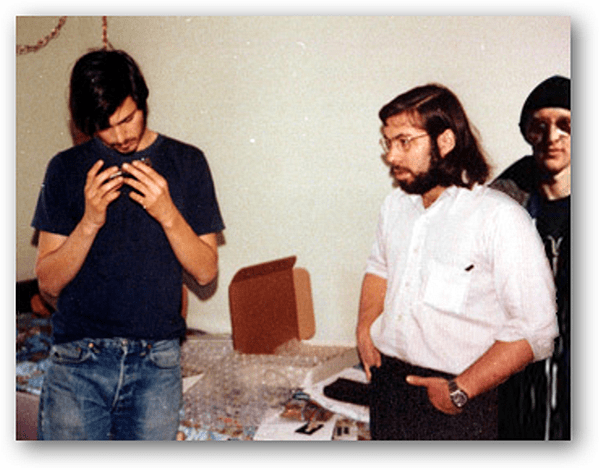
An anonymous reader writes: Gina Smith is the co-author of Steve Wozniak's 2006 biography. On the day that Steve Jobs died, she posted a poignant story Woz had shared about their early days in Silicon Valley, remembering how Jobs sold his Volkswagen van while Woz sold his calculator to raise funds to build the first Apple 1 computer kit.

The post includes a picture of 22-year-old Steve Jobs standing next to young Steve Wozniak. But there's also an unexpected figure in the background wearing a black ski hat and glasses. It's "tourist guy," the figure from a 9/11 meme whose stoic face was spliced into the background of everything from the explosion of the Hindenburg to the Kennedy assassination, and even into the original Star Trek and Quentin Tarantino's Reservoir Dogs. The picture is attributed to Margaret Wozniak. So does that mean Steve Wozniak's biographer got pranked by Woz's mom?

Interestingly, in 2011 the tourist guy actually apologized for creating the original fake World Trade Center image. "I assumed my friends would recognise me and call me to see if I was alright, but they didn't, they posted it on to other friends and suddenly it was all over the world... I am ashamed that even now the police still get calls about it."
Government

Connecticut May Become First US State To Allow Deadly Police Drones (reuters.com) 83

According to Reuters, Connecticut lawmakers are considering a new bill that would allow police to equip drones with potentially lethal weapons. The bill, which was approved overwhelmingly by the state legislature's judiciary committee on Wednesday, actually aims to ban weaponized drones, but exempts the ban from law enforcement agencies. From the report: Connecticut would become the first U.S. state to allow law enforcement agencies to use drones equipped with deadly weapons if a bill opposed by civil libertarians becomes law. The legislation was introduced as a complete ban on weaponized drones but just before the committee vote it was amended to exclude police from the restriction. "Data shows police force is disproportionately used on minority communities, and we believe that armed drones would be used in urban centers and on minority communities," said David McGuire, executive director of the American Civil Liberties Union in Connecticut. "That's not the kind of precedent we want to set here," McGuire said of the prospect that Connecticut would become the first state to allow police to use lethally armed drones. If Connecticut's Democratic-controlled House passes the bill it will move to the Senate, which is split evenly between Democrats and Republicans.
Government

Trump Extends Obama Executive Order On Cyberattacks (infoworld.com) 35

"U.S. President Donald Trump is extending by one year special powers introduced by former President Barack Obama that allow the government to issue sanctions against people and organizations engaged in significant cyberattacks and cybercrime against the U.S.," according to InfoWorld. An anonymous reader quotes their report: Executive Order 13694 was introduced on April 1, 2015, and was due to expire on Saturday, but the president sent a letter to Congress on Wednesday evening informing it of his plans to keep it active. Significant malicious cyber-enabled activities originating from, or directed by persons located, in whole or in substantial part, outside the United States, continue to pose an unusual and extraordinary threat to the national security, foreign policy, and economy of the United States," Trump wrote in the letter. "Therefore, I have determined that it is necessary to continue the national emergency declared in Executive Order 13694 with respect to significant malicious cyber-enabled activities."

The executive order gave the U.S. new powers to retaliate for hacking of critical infrastructure, major denial of service attacks or large scale economic hacking. It was expanded in December 2016 to include election-related systems and used to sanction Russian agents and organizations for their alleged role in a series of attacks during the presidential election.

Security

Flatbed Scanners Used As Relay Point For Controlling Malware (bleepingcomputer.com) 14

An anonymous reader writes: "Scientists from two Israeli universities have come up with a way to use flatbed scanners as relay points when sending commands to malware installed on an air-gapped computer," reports BleepingComputer. "Further research also revealed the scanner could also be used to relay stolen data to a nearby attacker. The technique they came up with revolves around the idea that a beam of light could be interpreted as a binary 1 and the lack of visual stimulant can be considered a binary 0."

The attacks can be carried out with lasers mounted on drones, on fixed stands, or by hacking smart light bulbs present near the targeted computer. Attack distances can go up to 900 meters (0.56 miles). During their tests, researchers sent various commands to the PC, such as "d x.pdf" (delete file x.pdf) and "en q" (encrypt folder q). Relaying such commands took between 50 to 100 milliseconds. This research was done by the same team that created methods to steal data from PCs using a hard drive's LED, fan heat, sounds emanated by a computer's GPU fan, electromagnetic signals given out by the GPU, and electromagnetic signals given out by an USB bus.

Here's a PDF of the report, which is titled "Oops!...I think I scanned a malware."
Classic Games (Games)

Google Maps Adds 'Ms. Pac-Man' Feature (blog.google) 31

An anonymous reader quotes a blog post by Google Maps: Starting now until April 4, you can chomp fruit, avoid ghosts, and collect PAC-Dots along city streets in Google Maps worldwide -- all as Ms. PAC-Maps. Just tap on the Ms. PAC-Maps icon on iOS and Android, or click the Ms. PAC-Maps button at the bottom left on desktop, to enter the maze and start chompin'. Sign in to save your top score on the leaderboard and share with friends.
A playable Google doodle commemorated Pac-Man's 30th anniversary in 2010 -- and was estimated to have cost the IT sector (and other workplaces) 4.8 million hours in lost productivity.
It's funny.  Laugh.

Ask Slashdot: Seen Any Good April Fool's Pranks Today? 106

An anonymous reader writes: It's that special time of year where sites around the net celebrate April Fool's Day with parodies of their own product offerings. Google Home announces a new companion service for smart yards called Google Gnome. Stack Overflow announces Dance Dance Authentication. The Russian foreign ministry changed their voicemail to include new menu options like "Press 2 to use the services of Russian hackers," and "press 3 to request election interference." And in what's either a really good prank or a horrific piece of bad timing, Phrack.org announces that they've been seized by the FBI.

Has anybody else noticed anything funny today?

The internet has a long history of April Fool's Day pranks, and it looks like 2017 is no exception. So use the comments to share what you're seeing around the web today. Seen any good April Fool's Day pranks today?
Programming

Someone on Medium Just Said C++ Was Better Than C (medium.com) 315

Developer David Timothy Strauss is publishing a call to code "straightforward, easy-to-reason-about approaches" -- in an essay titled "Choosing 'Some C++' Over C". (Alternate title: "C++ for Lovers of C." The problem with just picking C++ is that most criticism of it is legitimate. Whether it's the '90s-era obsession with object orientation and exceptions or the template errors that take up an entire terminal window, there have been -- and remain -- rough edges to C++. But, these rough edges are avoidable, unlike the problems in C that get worse with modern event and library programming. The opinionated essay calls for "adopting a subset of C++ to smooth out C's rough edges," arguing that C++ offer a better, type-safe approach for event-driven design (as well as destructors to avoid memory allocation leaks). Are there any readers who'd like to weigh in on the advantages of C versus C++?
Earth

Robots Could Solve the Lionfish Ecological Disaster (mashable.com) 20

"Lionfish are an invasive species that are destroying our coral reefs and fisheries," writes SkinnyGuy. "The non-profit RISE (from iRobot's Colin Angle) has a plan to use robots to fish these Lionfish and serve them up to us on a delicious, golden platter." Mashable reports: This was not as crazy of an idea as it sounds and Angle had already been wondering "if there was still a way to use robot technology to solve larger environmental problems and maybe more proactively than merely sending our defense robots to natural disaster zones"... Could, Angle wondered, a robot even do the job and could it do it at scale? "Spending half a million dollars to build a robot that kill 10 lionfish is absurd," he told me...

They started with fresh-water electro fishing technology and adapted it for salt water. The robot stuns, but doesn't kill the lionfish and then it sucks them into the robot. It does this over and over again, until full of unconscious fish and then rises to the surface where a fisherman can unload the catch and deliver them to waiting restaurants and food stores. "Ultimately, the control of this device is like a PlayStation game: you're looking at screen and using a joystick controller. Zap it, catch it, do it again, said RISE Executive Director John Rizzi who told me that a team of unpaid volunteers have been working on the prototype for over a year."

The fish-killing robot will launch in Bermuda at the America's Cup festivities on April 19th, where there'll also be a celebrity chef lionfish cook-off and other events to help raise money "to further developer, build and deliver these robots to commercial fishermen and women."
The Internet

There's A New New JavaScript Framework (infoworld.com) 70

An anonymous reader quotes InfoWorld: Mithril, an open source JavaScript framework for single-page applications, is looking to best Facebook's React, Google's Angular, and Vue JavaScript tools in performance and ease of use. The framework is small and fast, and it provides routing and XHR (XMLHttpRequest) out of the box. Mithril also offers benefits in relative density, lead developer Leo Horie said. "It's possible to develop entire applications without resorting to other libraries, and it's not uncommon for Mithril apps to weigh a third of other apps of similar complexity." Horie said that the framework feels closer to vanilla JavaScript.

Mithril's website features a comparison to Angular, React, and Vue. Mithril, for example, offers much quicker library load times and update performance than React, and it has a better learning curve and update performance than Angular. Compared to Vue, Mithril supposedly offers better library load times and update performance.

Since its initial release, version 1.0.1 has added performance improvements in IE, while 1.1.0 added support for ES6 class components and support for closure components.
IBM

OS/2-Based 'Arcanos 5.0' Has Finally Been Releas -- Oh Wait, No It Wasn't. Never Mind. (arcanoae.com) 42

"Because we want ArcaOS 5.0 to be the best that it can be, Arca Noae has made the difficult decision to delay release two weeks, with a new projected delivery date of April 15, 2017," reads a new announcement on the Arca Noae web site. Because we don't believe in selling anything we are not ready to ship, we will not be taking pre-orders for ArcaOS 5.0. Please be patient while we get the last few things as they should be, so that your experience installing and using ArcaOS 5.0 is as smooth as possible.
One of last week's most popular stories was about the upcoming release of this x86 OS/2-based operating system (codenamed "Blue Lion") which will offer full backward compatibility with legacy OS/2, DOS and Windows 3.1 applications, as well as "ported Linux applications." It's still on its way, the developers explain, but "Finishing touches can often take longer than expected."
Facebook

Telcos Gear Up To Fight Facebook and Google Over How You Log Into Websites (mashable.com) 50

Mashable has an interesting article that talks about the penetration of "social authentication" services: There are two ways to log in on websites: try to recall the email address and password you registered with -- or simply hit the "Facebook Login" button. The convenience of the latter underscores the popularity of social authentication options. You'll see Facebook and Google login buttons on popular sites including Netflix, Uber, Spotify, Imgur and Linkedin, just to name some. Facebook itself estimates that some 350 million people log into a new app or site with their Facebook credentials every month. Olga Kuznetsova, Engineering Manager at Facebook told us that the Facebook Login button ranks in the top three of consumer account creation and sign-in preferences worldwide. More than 85 of the top 100 apps in the U.S. market use Facebook's Login gateway as a login, she added. For years, Google and Facebook have assumed control over the social authentication space, the article adds, citing numbers from companies and analysts. But interestingly, telecom operators are prepping to fight for a slice of the space. So-called mobile identity is one of several projects being developed in the industry to reinforce the position of network operators, which have already suffered an erosion of their traditional communications businesses by the rise of large US technology groups such as Facebook and Google, analysts say. The article adds: Mobile Connect is an authentication solution that the GSMA, the global telecoms industry trade organisation, has been working on for over three years. Through Mobile Connect, GSMA is offering users a much more convenient and "more secure" sign-in option, Jaikishan Rajaraman, global head of technology at GSMA said. The authentication service only requires users to enter their phone number when signing in. There is no password box. When a customer enters her phone number, her carrier (telecom operator, in this case) vouches for her identity. Incredibly, over 42 operators in 22 nations are on-board with Mobile Connect, and the service is already live to over 3.1 billion people. The article adds that GSMA is in talks with governments to add Mobile Connect on their websites and apps. Interestingly, banks, that have long resisted the idea of having Google's and Facebook's authentication service, are also showing interesting.
Space

Simulation Suggests 68 Percent of the Universe May Not Actually Exist (newatlas.com) 106

boley1 quotes a report from New Atlas: According to the Lambda Cold Dark Matter (Lambda-CDM) model, which is the current accepted standard for how the universe began and evolved, the ordinary matter we encounter every day only makes up around five percent of the universe's density, with dark matter comprising 27 percent, and the remaining 68 percent made up of dark energy, a so-far theoretical force driving the expansion of the universe. A new study has questioned whether dark energy exists at all, citing computer simulations that found that by accounting for the changing structure of the cosmos, the gap in the theory, which dark energy was proposed to fill, vanishes. According to the new study from Eotvos Lorand University in Hungary and the University of Hawaii, the discrepancy that dark energy was "invented" to fill might have arisen from the parts of the theory that were glossed over for the sake of simplicity. The researchers set up a computer simulation of how the universe formed, based on its large-scale structure. That structure apparently takes the form of "foam," where galaxies are found on the thin walls of each bubble, but large pockets in the middle are mostly devoid of both normal and dark matter. The team simulated how gravity would affect matter in this structure and found that, rather than the universe expanding in a smooth, uniform manner, different parts of it would expand at different rates. Importantly, though, the overall average rate of expansion is still consistent with observations, and points to accelerated expansion. The end result is what the team calls the Avera model. If the research stands up to scrutiny, it could change the direction of the study of physics away from chasing the ghost of dark energy. "The theory of general relativity is fundamental in understanding the way the universe evolves," says Dr Laszlo Dobos, co-author of the new paper. "We do not question its validity; we question the validity of the approximate solutions. Our findings rely on a mathematical conjecture which permits the differential expansion of space, consistent with general relativity, and they show how the formation of complex structures of matter affects the expansion. These issues were previously swept under the rug but taking them into account can explain the acceleration without the need for dark energy." The study has been published in the Monthly Notices of the Royal Astronomical Society. You can view an animation that compares the different models here.
Canada

New UBI Program Launches In Canada To 'Define Our Future' (thestar.com) 300

As automation continues to replace human workers, a universal basic income program will begin paying $1,689 per month to select Ontario residents later this year, as Canada joins other countries testing a UBI (which include America, Scotland, the Netherlands, Finland, India, Rwanda, Kenya and Uganda). An anonymous reader quotes the Toronto Star: Public support in Ontario for the province's three-year UBI project to be launched this spring in three Ontario communities is remarkably strong. The 35,000 Ontarians canvassed by Queen's Park for their input were near-unanimous in supporting the UBI projects. And they insisted that a UBI augment, rather than replace, existing welfare, medical and other social supports...

A well-designed UBI equates to freedom. Freedom from exploitative employers. Freedom to launch a small business or develop an invention despite a lack of employment income. Liberation from the "poverty trap," where taking a paying job means surrendering welfare and other benefits... Fact is, job scarcity in traditional vocations is acute, worsening and permanent. In 2013, two Oxford professors forecast that about 45 per cent of U.S. jobs could be eliminated by automation within the next 20 years. And a more recent report by researchers at Indiana's Ball State University found that 88 per cent of U.S. job loss has been caused by automation, not globalization.

Interestingly, the U.S. launched a Universal Basic Income pilot program which ran for three years starting in 1968. It was run by 36-year-old Donald Rumsfeld (who would later become Secretary of Defense) working with special assistant Dick Cheney (who went on to become America's vice president from 2001-2009). U.S. representatives even voted to replace welfare with a UBI, but the measure ultimately failed in the Senate.

Slashdot Top Deals