Spam

Nuisance Call Firm Keurboom Hit With Record Fine (bbc.com) 81

An anonymous reader writes: A cold-calling firm has been fined a record $515,000 by the Information Commissioner's Office (ICO) for making almost 100 million nuisance calls. Keurboom Communications called people, sometimes at night, to see if they were eligible for road-accident or PPI compensation, the ICO said. It breached privacy laws by calling people without their consent. The company has since gone into liquidation but the ICO said it was committed to recovering the fine. It said it had received more than 1,000 complaints about automated calls from the Bedfordshire-registered company. The ICO said Keurboom Communications called some people repeatedly and during unsocial hours. It also hid its identity so that people would find it harder to complain. "The unprecedented scale of its campaign and Keurboom's failure to co-operate with our investigation has resulted in the largest fine issued by the Information Commissioner for nuisance calls," said Steve Eckersley, head of enforcement at the ICO.

Microsoft

Microsoft Is Surprisingly Comfortable With Its New Place In a Mobile, Apple, and Android World (fastcompany.com) 73

An anonymous reader writes: The company that once held a mock funeral for the iPhone -- complete with dedicated "iPhone trashcans" -- now has a very different attitude about the company of Jobs. The Microsoft whose old CEO Steve Ballmer in 2007 famously predicted the iPhone had "no chance; no chance at all" of getting market share, now readily accepts and embraces a world where the iPhone and Android dominate personal computing. Microsoft talked a lot here at its Build 2017 developer conference about extending Windows experiences over to iOS and Android devices. And it's not just about fortifying Windows. Microsoft says it not only wants to connect with those foreign operating systems, but by bringing over functionality from Windows 10 (along with content) it hopes to "make those other devices better," as one Microsoft rep said in a press briefing yesterday. The developers here at Build cheered when Microsoft announced XAML Standard 1.0, which provides a single markup language to make user interfaces that work on Windows, iOS, and Android. In one demo, the company demonstrated how an enterprise sales app could be extended to an iOS device so someone could continue capturing a potential client's data on a mobile device. Windows not only sent over the client data that had already been captured, but also the business-app shell that had captured it.
HP

HP Issues Fix For Keylogger Found On Several Laptop Models (zdnet.com) 72

HP says it has a fix for a flaw that caused a number of its PC models to keep a log of each keystroke a customer was entering. The issue, caused by problematic code in an audio driver, affected PC models from 2015 and 2016. From a report: HP has since rolled out patches to remove the keylogger, which will also delete the log file containing the keystrokes. A spokesperson for HP said in a brief statement: "HP is committed to the security and privacy of its customers and we are aware of the keylogger issue on select HP PCs. HP has no access to customer data as a result of this issue." HP vice-president Mike Nash said on a call after-hours on Thursday that a fix is available on Windows Update and HP.com for newer 2016 and later affected models, with 2015 models receiving patches Friday. He added that the keylogger-type feature was mistakenly added to the driver's production code and was never meant to be rolled out to end-user devices. Nash didn't how many models or customers were affected, but did confirm that some consumer laptops were affected. He also confirmed that a handful of consumer models that come with Conexant drivers are affected.
The Courts

Waymo's Case Against Uber Sent By Judge To US Prosecutors (bloomberg.com) 52

An anonymous reader quotes a report from Bloomberg: The judge presiding over Waymo's trade-secrets theft lawsuit against Uber Technologies Inc. asked federal prosecutors to investigate the claims in the case. U.S. District Judge William Alsup said in Thursday's order he takes no position on whether prosecution is warranted. The specter of a possible prosecution has hung over the case for weeks, ever since the engineer at the center of the dispute, Anthony Levandowski, said he could potentially be the subject of a criminal investigation. Levandowski cited the explosive allegations that he downloaded thousands of proprietary files at the Alphabet Inc. unit before he left. He later joined the ride-hailing giant. Alsup said at a May 3 hearing that Waymo hadn't presented "smoking gun" proof of wrongdoing by Uber even though the evidence strongly suggested that Levandowski downloaded files that Waymo accused him of stealing. The judge's brief order referring case to the U.S. attorney's office made reference to a ruling he issued a few minutes earlier -- sealed from public view -- with a detailed description of evidence.
AI

Star Trek Bridge Crew Gets IBM Watson-Powered Voice Commands (theverge.com) 61

PolygamousRanchKid writes: Star Trek Bridge Crew -- the VR game that puts you in the slip-on space shoes of a Starfleet officer -- already emphasizes vocal communication when you're playing with real humans, but it will soon allow you to use your voice to issue orders to computer-controlled characters, too. The feature has been made possible using IBM's VR Speech Sandbox. The software combines IBM Watson's Speech to Text and Conversation services with the company's Unity SDK, using the natural language processing capabilities of IBM's Watson software to parse your barked commands, and allow AI-controlled characters to act on them. Players will be able to launch photon torpedoes, jump to warp speed, or lock S-foils in attack formation (maybe not that last one) by requesting that your crew members push the relevant blinking buttons on their own command consoles. The feature will go live in beta form this summer, soon after the game's release on May 30th, and will allow players to complete missions across VR platforms and with a mixture of human and AI teammates.

Slashdot reader PolygamousRanchKid adds: "Let's just skip all that stuff, and cut right to the part where Kirk gets the girl... How well it actually works in practice, we'll see this summer, aboard our own starships. "Scotty, beam up the IBM stock price!" -- Posterior Admiral Ginni Rometty

Power

Germany Sets New National Record With 85 Percent of Its Electricity Sourced From Renewables (digitaltrends.com) 404

Germany was able to set a new national record for the last weekend of April with 85 percent of all electricity consumed in the country being produced from renewables -- wind, solar, biomass, and hydroelectric power. Digital Trends reports: Aided by a seasonal combination of windy but sunny weather, during that weekend the majority of Germany's coal-fired power stations weren't even operating, while nuclear power stations (which the country plans to phase out by the year 2022) were massively reduced in output. To be clear, this is impressive even by Germany's progressive standards. By comparison, in March just over 40 percent of all electricity consumed in the country came from renewable sources. However, while the end-of-April weekend was an aberration, the hope is that it won't be for too much longer. According to Patrick Graichen of the country's sustainability-focused Agora Energiewende Initiative, German renewable energy percentages in the mid-80s should be "completely normal" by the year 2030.
Government

Trump Signs Executive Order On Cybersecurity (techcrunch.com) 173

President Trump on Thursday signed a long-delayed executive order on cybersecurity that "makes clear that agency heads will be held accountable for protecting their networks, and calls on government and industry to reduce the threat from automated attacks on the internet," reports The Washington Post. From the report: Picking up on themes advanced by the Obama administration, Trump's order also requires agency heads to use Commerce Department guidelines to manage risk to their systems. It commissions reports to assess the country's ability to withstand an attack on the electric grid and to spell out the strategic options for deterring adversaries in cyberspace. [Thomas Bossert, Trump's homeland security adviser] said the order was not, however, prompted by Russia's targeting of electoral systems last year. In fact, the order is silent on addressing the security of electoral systems or cyber-enabled operations to influence elections, which became a significant area of concern during last year's presidential campaign. The Department of Homeland Security in January declared election systems "critical infrastructure." The executive order also does not address offensive cyber operations, which are generally classified. This is an area in which the Trump administration is expected to be more forward-leaning than its predecessor. Nor does it spell out what type of cyberattack would constitute an "act of war" or what response the attack would invite. "We're not going to draw a red line," Bossert said, adding that the White House does not "want to telegraph our punches." The order places the defense secretary and the head of the intelligence community in charge of protecting "national security" systems that operate classified and military networks. But the secretary of homeland security will continue to be at the center of the national plan for protecting critical infrastructure, such as the electric grid and financial sector.
Medicine

Apple Watch Can Detect An Abnormal Heart Rhythm With 97 Percent Accuracy, UCSF Study Says (techcrunch.com) 102

According to a study conducted through heartbeat measurement app Cardiogram and the University of California, San Francisco, the Apple Watch is 97 percent accurate in detecting the most common abnormal heart rhythm when paired with an AI-based algorithm. TechCrunch reports: The study involved 6,158 participants recruited through the Cardiogram app on Apple Watch. Most of the participants in the UCSF Health eHeart study had normal EKG readings. However, 200 of them had been diagnosed with paroxysmal atrial fibrillation (an abnormal heartbeat). Engineers then trained a deep neural network to identify these abnormal heart rhythms from Apple Watch heart rate data. Cardiogram began the study with UCSF in 2016 to discover whether the Apple Watch could detect an oncoming stroke. About a quarter of strokes are caused by an abnormal heart rhythm, according to Cardiogram co-founder and data scientist for UCSF's eHeart study Brandon Ballinger. Cardiogram tested the deep neural network it had built against 51 in-hospital cardioversions (a procedure that restores the heart's normal rhythm) and says it achieved a 97 percent accuracy in the neural network's ability to find irregular heart activity. Additional information available via a Cardiogram blog post.
Education

Why Doesn't Harvard Want To Talk About Its Mystery Microsoft Azure Project? (geekwire.com) 51

theodp writes: GeekWire's Tom Krazit reports, "Microsoft Azure appears to have scored a high-profile customer: Harvard University's prestigious CS50 computer science class, not that anybody wants to talk about it." A deleted-today-but-still-cached Microsoft Technical Case Study on the software giant's GitHub account touts the success of a recent DevOps collaboration effort between Microsoft's Azure team and an unnamed "major U.S. research university." "This U.S. university is world-class," explains the case study, "well known for its research and its alumni. For now, they would prefer to remain anonymous, so this document will refer to them as 'the university' (the case study web page, however, is a not-so-anonymous 'CS50.html')." Like many IT projects, there seems to be a disconnect between the software vendor and the client. "The project we defined and delivered was exactly what they were looking for," boasts the case study's three Microsoft authors, who add that "full deployment and migration will wait until summer." Contacted for comment by GeekWire, however, Harvard CS professor extraordinaire David Malan seemed less committed to the relationship. "We're actually still on AWS," Malan wrote, "though most every summer we do tend to re-evaluate our apps' architecture for the coming year, with AWS, Azure, Google, et al. always among the candidates. So no plans yet, but happy to reach out toward summer's end if we've made any decisions!"
Verizon

Verizon Outbids AT&T For Nationwide 5G Wireless Spectrum (theverge.com) 34

Verizon has agreed to pay $3.1 billion for wireless spectrum holder Straight Path Communications, beating out rival AT&T, which had offered to buy Straight Path for $1.6 billion in stock. Verizon's acquisition will give it access to the frequencies necessary to build a 5G network across the U.S. The Verge reports: The news that AT&T was aiming to buy the Glen Allen, VA-based Straight Path was first reported last month, prompting a bidding war between the carriers that the WSJ describes as "unusually intense." Straight Path's purchase gives Verizon access to millimeter wave frequencies that are set to be used by 5G networks across the United States, making it a useful purchase from the start. Experts have also noted that the company's owner may also be afforded even more spectrum in future auctions with the FCC, potentially giving Verizon access to the entire 39GHz band down the line.
Operating Systems

Windows 10 On ARM Will Support x86 Apps From Outside the Store (liliputing.com) 115

An anonymous reader quotes a report from Liliputing: First announced last year, Microsoft provided an update on Windows 10 ARM at the MS Build developer conference today. And the company confirmed that not only would Windows 10 ARM be able to run legacy apps developed for computers with x86 processors but you'd be able to just download any old Win32 app from the internet, install it, and run it on a computer running Windows 10 ARM. In other words, Windows 10 S runs on devices with ARM or x86 processors, but only supports Windows Store apps. Windows 10 ARM only runs on devices with ARM chips... but supports apps from pretty much any source. Developers don't need to convert their software in any way, because Windows 10 ARM includes a built-in emulation layer that allows Win32 apps to run on an ARM-powered system. But Microsoft demonstrated how you could download a common program like 7zip from the internet and simply install it on a device with a Qualcomm Snapdragon 835 processor. Of course, developers can also package software optimized for ARM as Universal Windows Platform apps for distribution in the Windows Store. But they don't necessarily have to.
Government

Expiring Section 702 of FISA Helped US Conclude Russia Hacked Election To Help Trump, NSA Chief Says (reuters.com) 390

Dustin Volz, reporting for Reuters: A top U.S. intelligence official said Thursday a controversial surveillance law that allows the broad electronic spying of foreigners played a major role in understanding Russia's alleged interference in the 2016 presidential election. The statement from Admiral Mike Rogers, the director of the U.S. National Security Agency, may bolster efforts by intelligence agencies to fully preserve the authority, known as Section 702 of the Foreign Intelligence Surveillance Act, before it expires at the end of the year. Privacy advocates have for years said Section 702 allows for excessively broad surveillance, including warrantless access to some American communications, and should be reformed to include new curbs. "I would highlight much, not all, much of what was in the intelligence community's assessment, for example, on the Russian efforts against the U.S. election process in 2016, was informed by knowledge we gained through (Section) 702 authority," Rogers said. Rogers said allowing the statute to expire on Dec. 31, unless Congress votes to reauthorize it, would degrade U.S. intelligence agencies' ability to provide "timely warning and insight" on a variety of criminal and national security threats.
Google

German Publishers' Lawsuit Against Google May Backfire (npr.org) 29

jowifi writes: VG Media, a German publishing company, filed a lawsuit against Google claiming Google's use of snippets in their search results infringed the publishers' copyrights. However, the suit may backfire because the Berlin court is now reviewing the law itself to determine if it is even valid. The question arose because Germany did not submit the rule for review by the EU before enacting it, violating an EU Directive. If the law is invalidated, the decision could present problems for a proposed EU-wide directive that is similar to the German rule. Germany's rule had a rough start when it was implemented in 2014. Google refused to pay fees to publishers, instead allowing them to opt in to having snippets shown. One publisher declined to opt in, but changed their mind after traffic from Google dropped 40% and traffic from Google News dropped 80%. Handelsblatt Global explains why Germany decided not to notify the EU about the draft of this law: "While typically a formality, notification reviews of national laws by Brussels can take up to two years or more. In 2013, Germany did not submit the copyright law for notification, citing a Justice Ministry argument that the law's scope was so limited, it didn't fall under the E.U.'s notification requirement."
Patents

Cloudflare Declares War On a Patent Troll With a $50,000 Bounty (fortune.com) 54

Internet security company Cloudflare has declared war on a company called Blackbird that consists of a group of lawyers who file patent lawsuits against tech and retail firms. In a blog post titled "Standing Up to a Dangerous New Breed of Patent Troll," Cloudflare called Blackbird's business model destruction and unethical, and announced a $50,000 bounty to anyone who would help invalidate Blackbird's patents. Fortune reports: "There's no social value here. There's no support for a maligned inventor. There's no competing business or product. There's no validation of an incentive structure that supports innovation. This is a shakedown where a patent troll, Blackbird Tech, creates as much nuisance as it can so its attorney-principals can try to grab some cash. Cloudflare does not intend to play along," said the blog post. While patent trolling has been around for years -- and is a particular bug bear of the tech industry -- Cloudflare says Blackbird's model of trolling involves a new and unethical twist. Specifically, the company says Blackbird's lawyer-executives are violating their professional obligations by buying the claims of potential clients and engaging in questionable fee-splitting arrangements. Here is how Cloudflare, which says it is filing complaints with the state bars of Massachusetts and Illinois, explains it: "Blackbird's 'new model' seems to be only that its operations set out to distort the traditional Attorney-Client relationship. Blackbird's website makes a direct pitch of its legal services to recruit clients with potential claims and then, instead of taking them on as a client, purchases their claims and provides additional consideration that likely gives the client an ongoing interest in the resulting litigation. In doing so, Blackbird is flouting its ethical obligations meant to protect clients and distorting the judicial process by obfuscating and limiting potential counterclaims against the real party in interest."
Operating Systems

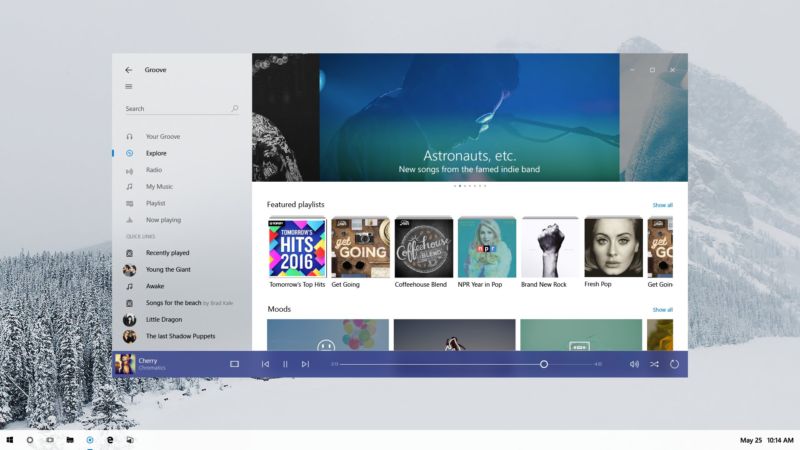
New Windows Look and Feel, Neon, Is Officially the 'Microsoft Fluent Design System' (arstechnica.com) 95

An anonymous reader quotes a report from Ars Technica: Earlier this year, pictures of a new Windows look and feel leaked. Codenamed Project Neon, the new look builds on Microsoft Design Language 2 (MDL2), the styling currently used in Windows 10, to add elements of translucency and animation. Neon has now been officially announced, and it has an official new name: the Microsoft Fluent Design System. The switch from "design language" to "design system" is deliberate; Fluent is intended to define more than just the appearance, but also the interactivity. Though visually there are common elements, the system is designed to work across virtual/augmented reality, phones, tablets, desktop PCs, games consoles, using mice, keyboards, motion controllers, voice, gestures, touch, and pen, with the interactivity and input optimized to each particular form factor. Fluent is described as having five "fundamentals": light, depth, motion, material, and scale. "Light" means that the interface should avoid distracting and strive to ensure that attention is drawn to where it needs to be. With "depth," Fluent apps will make greater use of layering and the relationships between objects and interface elements. Fluent will use "motion" to indicate relationships and connections between elements, establishing context. Microsoft is using "Material" to mean making best use of the screen space and giving room to content. "Scale" means building interfaces that can go beyond two dimensions, and go beyond the size of a screen, to embrace new form factors and input methods as they arrive.

Slashdot Top Deals