Intel

Intel Launches Mainstream Optane SSD 800P Series Based On 3D Xpoint Memory (hothardware.com) 36

MojoKid writes: Intel just launched a new family of consumer-targeted Optane solid state drives today, dubbed the Intel Optane SSD 800P. Unlike Intel Optane Memory sticks, which accelerate hybrid storage configurations with hard drives through intelligent data caching, or Intel's flagship Optane SSD 900P that's aimed squarely at hardcore enthusiasts with big budgets, these M.2 form factor Intel Optane 800P SSDs target the meat of the mobile and desktop markets, with higher capacities than Optane Memory but more affordable pricing than the 900P. In the benchmarks, the Optane SSD 800P series drives offered a mixed-bag of performance, with sequential transfers that top out at about 1.4GB/s, but with small file transfers, 4K random and mixed workloads, latency, and overall QoS looking strong. Intel will initially be offering two drives in the Optane SSD 800P series, with M.2 80mm 58GB and 118GB models. Suggested pricing for the drives is $129 for the 58GB capacity and $199 for the 118GB drive.
Piracy

Trump Promises Copyright Crackdown As DoJ Takes Aim At Streaming Pirates (torrentfreak.com) 107

An anonymous reader quotes a report from TorrentFreak: Yesterday, a panel discussion on the challenges associated with piracy from streaming media boxes took place on Capitol Hill. Hosted by the Information Technology and Innovation Foundation (ITIF), "Unboxing the Piracy Threat of Streaming Media Boxes" (video) went ahead with some big name speakers in attendance, not least Neil Fried, Senior Vice President, Federal Advocacy and Regulatory Affairs at the MPAA. ITIF and various industry groups tweeted many interesting comments throughout the event. Kevin Madigan from Center for the Protection of Intellectual Property told the panel that torrent-based content "is becoming obsolete" in an on-demand digital environment that's switching to streaming-based piracy. "There's a criminal enterprise going on here that's stealing content and making a profit," Fried told those in attendance. "The piracy activity out there is bad, it's hurting a lot of economic activity & creators aren't being compensated for their work," he added.

And then, of course, we come to President Trump. Not usually that vocal on matters of intellectual property and piracy, yesterday -- perhaps coincidentally, perhaps not -- he suddenly delivered one of his "something is coming" tweets. "The U.S. is acting swiftly on Intellectual Property theft," Trump tweeted. "We cannot allow this to happen as it has for many years!" Given Trump's tendency to focus on problems overseas causing issues for companies back home, a comment by Kevin Madigan during the panel yesterday immediately comes to mind. "To combat piracy abroad, USTR needs to work with the creative industries to improve enforcement and target the source of pirated material," Madigan said.

Windows

Windows 10 Is Finally Adding Tabs To File Explorer (bleepingcomputer.com) 161

Microsoft has released insider preview build 17618 that includes tabs in File Explorer as part of its Sets feature. Bleeping Computer reports: Windows 10 Sets is an upcoming feature where you can group documents and apps into one tabbed window that are related to the particular task at hand. This feature was released for testing to a small controlled group of insiders in Insider Preview Build 17063 and was subsequently removed after the test. With build 17618, Sets are back and with it come tabs in File Explorer. You can now open different folders in the same File Explorer window with each one having their own tabs. This way one File Explorer window can have a tab for the pictures folder, a tab for the documents folder, and a tab for your documents, which you can easily switch between. If you look closely, though, the Sets feature does more than just allow you to have different tabs for different folders, but also allows you to add applications as a tab in File Explorer. According to Microsoft, in addition to File Explorer, Notepad, Command Prompt, and Powershell are also getting tabbed support.
Bitcoin

Qarnot Unveils a Cryptocurrency Heater For Your Home (techcrunch.com) 65

Qarnot, the French startup known for using Ryzen Pro processors to heat homes and offices for free, is unveiling a new computing heater specifically made for cryptocurrency mining. "The QC1 is a heater for your home that features a passive computer inside," reports TechCrunch. "And this computer is optimized for mining." From the report: The QC1 features two AMD GPUs (Sapphire Nitro+ Radeon RX580 with 8GB of VRAM) and is designed to mine Ethers by default. You can set it up in a few minutes by plugging an Ethernet cable and putting your Ethereum wallet address in the mobile app. You'll then gradually receive ethers on this address -- Qarnot doesn't receive any coin, you keep 100 percent of your cryptocurrencies. If you believe Litecoin or another cryptocurrency is the future, you can also access the computer and mine another cryptocurrency. It's a Linux server and you can access it directly. If your home is cold and you desperately need to turn on the heaters, the QC1 is going to turn on the two GPUs and mine at a 60 MH/s speed. There are also traditional heating conductors in case those two GPUs are not enough. Qarnot heaters don't have any hard drive and rely on passive heating. You won't hear any fan buzzing in the background. You can order the QC1 for $3,600 starting today -- you can also pay in bitcoins. The company hopes to sell hundreds of QC1 in the next year.
China

Elon Musk Sides With Trump On Trade With China, Citing 25 Percent Import Duty On American Cars (cnbc.com) 331

Elon Musk believes China isn't playing fair in the car trade with the U.S. since it puts a 25 percent import duty on American cars, while the U.S. only does 2.5 percent for Chinese cars. "I am against import duties in general, but the current rules make things very difficult," Musk tweeted. "It's like competing in an Olympic race wearing lead shoes." CNBC reports: Tesla's Elon Musk is complaining to President Donald Trump about China's car tariffs. "Do you think the US & China should have equal & fair rules for cars? Meaning, same import duties, ownership constraints & other factors," Musk said on Twitter in response to a Trump tweet about trade with China. He added that no American car company is "allowed to own even 50% of their own factory" in the Asian country, but China's auto firms can own their companies in the U.S. Trump responded to Musk's tweets later at his steel and aluminum tariff press conference Thursday. "We are going to be doing a reciprocal tax program at some point, so that if China is going to charge us 25% or if India is going to charge us 75% and we charge them nothing ... We're going to be at those same numbers. It's called reciprocal, a mirror tax," Trump said after reading Musk's earlier tweets out loud.
United States

'Personal Drone' Crash Causes 335-Acre Wildfire In Coconino National Forest (azcentral.com) 70

McGruber writes: A "personal drone" that crashed and burst into flames was the cause of the Kendrick Fire, a 335-acre fire in the Coconino National Forest in northern Arizona. Coconino National Forest spokesman George Jozens said that about 30 firefighters from the U.S. Forest Service and Summit Fire and Medical worked to quell the fire.
Transportation

Bay Area Cities Consider Rideshare Tax On Uber, Lyft (arstechnica.com) 92

An anonymous reader quotes a report from Ars Technica: A local city council member is beginning to float the idea of taxing ridehailing companies like Uber and Lyft as a possible way to raise millions of dollars and help pay for local public transportation and infrastructure improvements. If the effort is successful, Oakland could become the first city in California -- Uber and Lyft's home state -- to impose such a tax. However, it's not clear whether Oakland or any other city in the Golden State has the authority to do so under current state rules. Councilwoman Rebecca Kaplan told the East Bay Express that she wants the city council to put forward a ballot measure that would tax such rides. A similar proposal in nearby San Francisco, projecting a fee of $0.20 to $1 per ride, would allow the city to collect an estimated $12.5 to $62.5 million annually. However, an October 2017 city analysis noted that San Francisco "cannot initiate locally without state authorizing legislation" and that the fee "may disproportionately impact lower-income households."
Mozilla

Firefox Quantum Leader Takes Over All Mozilla Products (cnet.com) 98

CNET reports: Mozilla launched the faster Quantum version of its Firefox browser last fall in a bid to restore the nonprofit's reach and influence. Now, the leader of that effort has been promoted to oversee all Mozilla products. Mark Mayo, formerly senior vice president of Firefox, is now Mozilla's chief product officer, CNET has learned. That means he's taking over more projects, including the Pocket tool and mobile app. Pocket lets people save websites they'd like to revisit, but Mozilla also plans to use the resulting data to help recommend interesting or useful sites to Firefox users. In addition, Mozilla has promoted Denelle Dixon, formerly head of business and legal work, to chief operations officer. She's overseen an effort to diversify Mozilla revenue sources, including through the Pocket acquisition in February 2017.
IT

Slack Is Shutting Down Its IRC Gateway (slack.help) 89

Slack, a team collaboration communication service, has updated its IRC support page to note that it is ending support for IRC on its platform: Unfortunately, support for gateways is ending. Starting on May 15th, it will no longer be possible to connect to Slack using the IRC and XMPP gateways. In another support page, which requires you to log in to one of your Slack groups, the company elaborates: As Slack has evolved over the years, we've built features and capabilities -- like Shared Channels, Threads, and emoji reactions (to name a few) -- that the IRC and XMPP gateways aren't able to handle. Our priority is to provide a secure and high-quality experience across all platforms, and so the time has come to close the gateways.

Please note that the gateways will be closed according to the following schedule: March 6, 2018: No longer available to newly-created workspaces; April 3, 2018: Removed from workspaces where they're not in use; May 15, 2018: Closed for all remaining workspaces.

Communications

Comcast's Protected Browsing Is Blocking PayPal, Steam and TorrentFreak, Customers Say (vice.com) 82

Comcast's Xfinity internet customers have been reporting multiple websites, including PayPal, Steam, and TorrentFreak have been getting blocked by the ISP's "protected browsing" setting. From a report: The "protected browsing" setting is designed to "reduce the risk of accessing known sources of malware, spyware, and phishing for all devices connected to your home network." This, in general, isn't a bad thing. It's similar to Google Chrome's security settings that warn you when you have an insecure connection. But it's odd that Xfinity's security setting would be blocking perfectly harmless sites like PayPal. Multiple consumers have been reporting on Comcast's forums and elsewhere that they've been blocked while trying to access sites that many people use every day. After posting about it on the forums, one user who said they couldn't access PayPal said the problem with that particular site had been fixed. Further reading: Comcast's Protected Browsing Blocks TorrentFreak as "Suspicious" Site (TorrentFreak).
Twitter

Scientists Prove That Truth is No Match For Fiction on Twitter (theguardian.com) 194

Researchers find fake news reaches users up to 20 times faster than factual content -- and real users are more likely to spread it than bots. From a report: "Falsehood flies, and the truth comes limping after it," wrote Jonathan Swift in 1710. Now a group of scientists say they have found evidence Swift was right -- at least when it comes to Twitter. In the paper, published in the journal Science, three MIT researchers describe an analysis of a vast amount of Twitter data: more than 125,000 stories, tweeted more than 4.5 million times in total, all categorised as being true or false by at least one of six independent fact-checking organisations. The findings make for unhappy reading. "Falsehood diffused significantly farther, faster, deeper and more broadly than the truth in all categories of information," they write, "and the effects were more pronounced for false political news than for false news about terrorism, natural disasters, science, urban legends or financial information."

How much further? "Whereas the truth rarely diffused to more than 1,000 people, the top 1% of false-news cascades routinely diffused to between 1,000 and 100,000 people," they write. In other words, true facts don't get retweeted, while too-good-to-be-true claims are viral gold. How much faster? "It took the truth about six times as long as falsehood to reach 1,500 people, and 20 times as long as falsehood to reach a cascade depth of 10" -- meaning that it was retweeted 10 times sequentially (so, for example, B reads A's feed and retweets a tweet, and C then reads B's feed and retweets the same tweet, all the way to J).

Google

Can the Most Contentious Piece of the Web Form the Basis of a New Standard? Inside Google's Plan To Make the Whole Web as Fast as AMP (theverge.com) 59

Dieter Bohn, writing for The Verge: In a blog post today, Google is announcing that it's formally embarking on a project to convince the group in charge of web standards to adopt technology inspired by its Accelerated Mobile Pages (AMP) framework. In theory, it would mean that virtually any webpage could gain the same benefits as AMP: near-instantaneous loading, distribution on multiple platforms, and (critically) more prominent placement on Google properties. This is important, a little tricky to understand, and critical to how the web and Google interact in the future. In many ways, Google's success or failure in this endeavor will play a major role in shaping how the web works on your phone.

[...] By creating AMP, Google blithely walked right into the center of a thicket comprised of developers concerned about the future of the web. Publishers are worried about ceding too much control of their distribution to gigantic tech companies, and all of the above are worried that Google is not so much a steward of the web but rather its nefarious puppet master. The whole situation is slightly frustrating to David Besbris, VP of search engineering at Google. Earlier this week, I went to Mountain View to talk with Besbris and Malte Ubl, engineering lead for AMP. "This is honestly a fairly altruistic project from our perspective," says Besbris. "It wasn't like we invented AMP because we wanted to control everything, like people assume," he says. Instead, he argues, go back and look at how dire the state of the mobile web was a few years ago, before AMP's inception.

Star Wars Prequels

'Iron Man' Director Jon Favreau Will Write And Produce a Live-Action 'Star Wars' TV Series For Disney's New Streaming Service (cnet.com) 90

From a report: Jon Favreau is going from "Avengers" blockbusters to a galaxy far, far away. The director, actor, producer and writer will take on a Star Wars starring role by helming a series destined for Disney's new streaming video service. While Favreau is multi-talented, his focus will be on producing and writing the unnamed show. Favreau is a bonafide Star Wars fan who voiced a character in the animated "Star Wars: The Clone Wars" and also has appearance in the upcoming "Solo: A Star Wars Story."In a statement, Favreau said, "If you told me at 11 years old that I would be getting to tell stories in the Star Wars universe, I wouldn't have believed you. I can't wait to embark upon this exciting adventure."
Security

Businesses Under Pressure To 'Consumerize' Logins (betanews.com) 47

Almost two-thirds (64 percent) of IT leaders say their security teams are considering implementing consumer-grade access to cloud services for employees. From a report: According to the 2018 Identity and Access Management Index from digital security company Gemalto 54 percent of respondents believe that the authentication methods they implement in their businesses are not as good compared to those found on popular sites including Amazon and Facebook. Authentication methods applied in the consumer world can be applied to secure access to enterprise resources 70 percent of IT professionals believe. But despite this, 92 percent of IT leaders express concern about employees reusing personal credentials for work. This comes as 61 percent admit they are still not implementing two-factor authentication to allow access to their network, potentially leaving themselves vulnerable to cyber criminals.
AI

Why Humans Learn Faster Than AI (technologyreview.com) 98

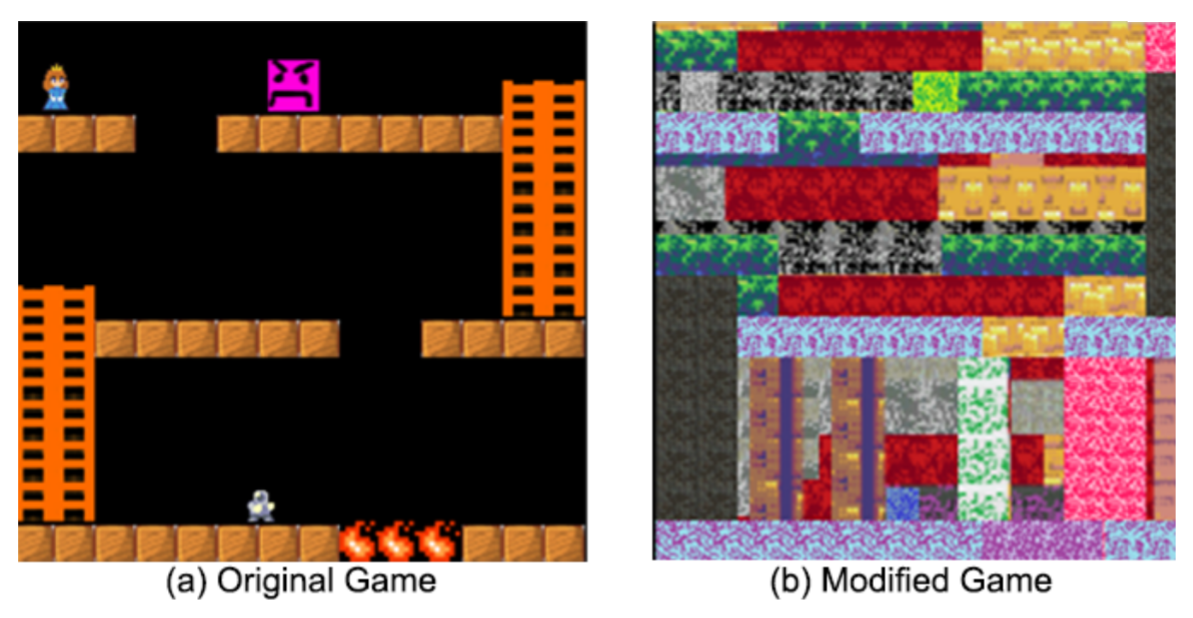
What is it about human learning that allows us to perform so well with relatively little experience? MIT Technology Review: Today we get an answer of sorts thanks to the work of Rachit Dubey and colleagues at the University of California, Berkeley. They have studied the way humans interact with video games to find out what kind of prior knowledge we rely on to make sense of them. It turns out that humans use a wealth of background knowledge whenever we take on a new game. And this makes the games significantly easier to play. But faced with games that make no use of this knowledge, humans flounder, whereas machines plod along in exactly the same way. Take a look at the computer game shown here. This game is based on a classic called Montezuma's Revenge, originally released for the Atari 8-bit computer in 1984. There is no manual and no instructions; you aren't even told which "sprite" you control. And you get feedback only if you successfully finish the game.

Would you be able to do so? How long would it take? You can try it at this website. In all likelihood, the game will take you about a minute, and in the process you'll probably make about 3,000 keyboard actions. That's what Dubey and co found when they gave the game to 40 workers from Amazon's crowdsourcing site Mechanical Turk, who were offered $1 to finish it. "This is not overly surprising as one could easily guess that the game's goal is to move the robot sprite towards the princess by stepping on the brick-like objects and using ladders to reach the higher platforms while avoiding the angry pink and the fire objects," the researchers say. By contrast, the game is hard for machines: many standard deep-learning algorithms couldn't solve it at all, because there is no way for an algorithm to evaluate progress inside the game when feedback comes only from finishing.

Slashdot Top Deals