AI

Will 'AI-Assisted' Journalists Bring Errors and Retractions? (msn.com) 22

Meet the "journalist" who "uploads press releases or analyst notes into AI tools and prompts them to spit out articles that he can edit and publish quickly," according to the Wall Street Journal.

"AI-assisted stories accounted for nearly 20% of Fortune's web traffic in the second half of 2025." And most were written by 42-year-old Nick Lichtenberg, who has now written over 600 AI-assisted stories, producing "more stories in six months than any of his colleagues at Fortune delivered in a year." One Wednesday in February, he cranked out seven. "I'm a bit of a freak," Lichtenberg said... A story by Lichtenberg sometimes starts with a prompt entered into Perplexity or Google's NotebookLM, asking it to write something based on a headline he comes up with. He moves the AI tools' initial drafts into a content-management system and edits the stories before publishing them for Fortune's readers... A piece from earlier that morning about Josh D'Amaro being named Disney CEO took 10 minutes to get online, he said...

Like other journalists, Lichtenberg vets his stories. He refers back to the original documents to confirm the information he's reporting is correct. He reaches out to companies for comment. But he admits his process isn't as thorough as that of magazine fact-checkers.

While Lichtenberg started out saying his stories were co-authored with "Fortune Intelligence", he now typically signs his own name, according to the article, "because he feels the work is mostly his own." (Though his stories "sometimes" disclose generative AI was used as a research tool...) The article asks with he could be "a bellwether for where much of the media business is headed..."

"Much of the content people now consume online is generated by artificial intelligence, with some 9% of newly published newspaper articles either partially or fully AI-generated, according to a 2025 study led by the University of Maryland. The number of AI-generated articles on the web surpassed human-written ones in late 2024, according to research and marketing agency Graphite." Some executives have made full-throated declarations about the threat posed by AI. New York Times publisher A.G. Sulzberger said AI "is almost certainly going to usher in an unprecedented torrent of crap," referencing deepfakes as an example. The NewsGuild of New York, the union representing Fortune employees and journalists at other media outlets, said the people are what makes journalism so powerful. "You simply can't replicate lived experiences, human judgment and expertise," said president Susan DeCarava.

For Chris Quinn, the editor of local publications Cleveland.com and the Plain Dealer, AI tools have helped tame other torrents facing the industry. AI has allowed the outlets to cover counties in Ohio that otherwise might go ignored by scraping information from local websites and sending "tips" to reporters, he said. It has also edited stories and written first drafts so the newsrooms' journalists can focus on the calls, research and reporting needed for their stories.... Newsrooms from the New York Times to The Wall Street Journal are deploying AI in various ways to help reporters and editors work more efficiently....

Not all newsrooms disclose their use of AI, and in some cases have rolled out new tools that resulted in errors or PR gaffes. An October study from the European Broadcasting Union and the BBC, which relied on professional journalists to evaluate the news integrity of more than 3,000 AI responses, found that almost half of all AI responses had at least one significant issue.

Last week the New York Times even issued a correction when a freelance book reviewer using an AI tool unknowingly included "language and details similar to those in a review of the same book published in The Guardian." But it was actually "the second time in a few days that the Times was called out for potential AI plagiarism," according to the American journalist writing The Handbasket newsletter. We must stem the idea being pushed by tech companies and their billionaire funders who've sunk too much into their products to admit defeat that the infiltration of AI into journalism is inevitable; because from my perch as an independent journalist, it simply is not...

Some AI-loving journalists appear to believe that if they're clear enough with the AI program they're using, it will truly understand what they're seeking and not just do what it's made to do: steal shit... If you want to work with machines, get a job that requires it. There are a whole lot more of those than there are writing jobs, so free up space for people who actually want to do the work. You're not doing the world a favor by gifting it your human/AI hybrid. Journalism will not miss you if you leave...

But meanwhile, USA Today recently tried hiring for a new position: AI-Assisted reporter. (The lucky reporter will "support the launch and scaling of AI-assisted local journalism in a major U.S. metro," working with tools including Copilot and Perplexity, pioneering possible future expansions and "AI-enabled newsroom operations that support and augment human-led journalism.") And Google is already sponsoring a "publishing innovation award"...
The Courts

Judge Allows BitTorrent Seeding Claims Against Meta, Despite Lawyers 'Lame Excuses' (torrentfreak.com) 9

An anonymous reader quotes a report from TorrentFreak: In an effort to gather material for its LLM training, Meta used BitTorrent to download pirated books from Anna's Archive and other shadow libraries. According to several authors, Meta facilitated the infringement of others by "seeding" these torrents. This week, the court granted the authors permission to add these claims to their complaint, despite openly scolding their counsel for "lame excuses" and "Meta bashing." [...] The judge acknowledged that the contributory infringement claim could and should have been added back in November 2024, when the authors amended their complaint to include the distribution claim. After all, both claims arise from the same factual allegations about Meta's torrenting activity.

"The lawyers for the named plaintiffs have no excuse for neglecting to add a contributory infringement claim based on these allegations back in November 2024," Judge Chhabria wrote. The lawyers of the book authors claimed that the delay was the result of newly produced evidence that had "crystallized" their understanding of Meta's uploading activity. However, that did not impress the judge. He called it a "lame excuse" and "a bunch of doubletalk," noting that if the missing discovery truly prevented the contributory claim from being added in November 2024, the same logic would have prevented the distribution claim from being added at that time as well. "Rather than blaming Meta for producing discovery late, the plaintiffs' lawyers should have been candid with the Court, explaining that they missed an issue in a case of first impression..," the order reads.

Judge Chhabria went further, noting that the authors' law firm, Boies Schiller, showed "an ongoing pattern" of distracting from its own mistakes by attacking Meta. He pointed specifically to the dispute over when Meta disclosed its fair use defense to the distribution claim, which we covered here recently, characterizing it as a false distraction. "The lawyers for the plaintiffs seem so intent on bashing Meta that they are unable to exercise proper judgment about how to represent the interests of their clients and the proposed class members," the order reads. Despite the criticism, Chhabria granted the motion. [...] For now, the case moves forward with a fourth amended complaint, three new loan-out companies added as named plaintiffs, and a growing list of BitTorrent-related claims for Judge Chhabria to resolve.

Music

Anna's Archive Quietly 'Releases' Millions of Spotify Tracks, Despite Legal Pushback (torrentfreak.com) 56

Anna's Archive, the shadow library that announced last December it had scraped Spotify's entire catalog, has quietly begun distributing the actual music files despite a federal preliminary injunction signed by Judge Jed Rakoff on January 16 that explicitly barred the site from hosting or distributing the copyrighted works.

The site's backend torrent index now lists 47 new torrents added on February 8, containing roughly 2.8 million tracks across approximately 6 terabytes of audio data. Anna's Archive had previously released only Spotify metadata -- about 200 GB compressed -- and appeared to comply by removing its dedicated Spotify download section and marking it "unavailable until further notice."
Books

How Anthropic Built Claude: Buy Books, Slice Spines, Scan Pages, Recycle the Remains (msn.com) 122

Court documents unsealed last week in a copyright lawsuit against Anthropic reveal that the AI company ran an operation called "Project Panama" to buy millions of physical books, slice off their spines, scan the pages to train its Claude chatbot, and then send the remains to recycling companies.

The company spent tens of millions of dollars on the effort and hired Tom Turvey, a Google executive who had worked on the legally contested Google Books project two decades earlier. Anthropic bought books in batches of tens of thousands from retailers including Better World Books and World of Books. A vendor document noted the company was seeking to scan between 500,000 and two million books.

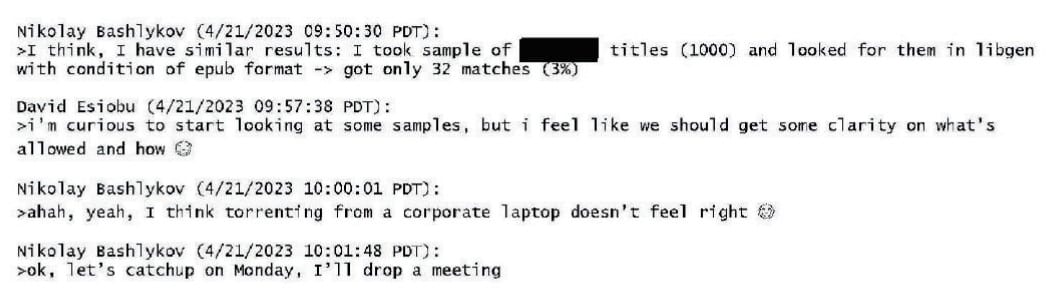
Before Project Panama, Anthropic co-founder Ben Mann downloaded books from LibGen, a shadow library of pirated material, over 11 days in June 2021. He later shared a link to the Pirate Library Mirror site with colleagues, writing "this is awesome!!!" Meta employees similarly downloaded books from torrent platforms after approval from Mark Zuckerberg, court filings allege, though one engineer wrote that "torrenting from a corporate laptop doesn't feel right." Anthropic settled for $1.5 billion in August without admitting wrongdoing.
Piracy

LimeWire Re-Emerges In Online Rush To Share Pulled '60 Minutes' Segment (arstechnica.com) 128

An anonymous reader quotes a report from Ars Technica: CBS cannot contain the online spread of a "60 Minutes" segment that its editor-in-chief, Bari Weiss, tried to block from airing. The episode, "Inside CECOT," featured testimonies from US deportees who were tortured or suffered physical or sexual abuse at a notorious Salvadoran prison, the Center for the Confinement of Terrorism. "Welcome to hell," one former inmate was told upon arriving, the segment reported, while also highlighting a clip of Donald Trump praising CECOT and its leadership for "great facilities, very strong facilities, and they don't play games."

Weiss controversially pulled the segment on Monday, claiming it could not air in the US because it lacked critical voices, as no Trump officials were interviewed. She claimed that the segment "did not advance the ball" and merely echoed others' reporting, NBC News reported. Her plan was to air the segment when it was "ready," insisting that holding stories "for whatever reason" happens "every day in every newsroom." But Weiss apparently did not realize that the "Inside CECOT" would still stream in Canada, giving the public a chance to view the segment as reporters had intended.

Critics accusing CBS of censoring the story quickly shared the segment online Monday after discovering that it was available on the Global TV app. Using a VPN to connect to the app with a Canadian IP address was all it took to override Weiss' block in the US, as 404 Media reported the segment was uploaded to "to a variety of file sharing sites and services, including iCloud, Mega, and as a torrent," including on the recently revived file-sharing service LimeWire. It's currently also available to stream on the Internet Archive, where one reviewer largely summed up the public's response so far, writing, "cannot believe this was pulled, not a dang thing wrong with this segment except it shows truth."
"Yo what," joked Reddit user Howzitgoin, highlighting only the word "LimeWire." Another user responded, "man, who knew my nostalgia prof pic would become relevant again, WTF."

"Bringing back LimeWire to illegally rip copies of reporting suppressed by the government is definitely some cyberpunk shit," a Bluesky user wrote.

"We need a champion against the darkness," a Reddit commenter echoed. "I side with LimeWire."
Piracy

Apple Pulls iPhone Torrent App From AltStore PAL in Europe (theverge.com) 31

An anonymous reader shares a report: Apple has removed the iPhone torrenting client, iTorrent, from AltStore PAL's alternative iOS marketplace in the EU, showing that it can still exert control over apps that aren't listed on the official App Store. iTorrent developer Daniil Vinogradov told TorrentFreak that Apple has revoked his distribution rights to publish apps in any alternative iOS stores, so the issue isn't tied to AltStore PAL itself.
Space

Just How Much Space Data Will the Rubin Observatory Collect? (space.com) 5

In its first 10 hours the Rubin space telescope found 2,104 never-before-seen asteroids in our solar system. And Gizmodo reports the data went directly to the International Astronomical Union's Minor Planet Center (MPC), which "plays an essential role in the early detection and monitoring of asteroids that threaten Earth." The MPC has spent years preparing for the deluge of data from Rubin, ramping up its software to process massive amounts of observations. When the first round officially came flooding in on Monday, it was "nerve-racking and exciting simultaneously," Matthew Payne, MPC director, told Gizmodo.
But Space.com explains how extraordinary that is. "There are approximately a million known asteroids in our cosmic neighborhood; over the next few years, Rubin could very well hike that figure up to five million." "This is five times more than all the astronomers in the world discovered during the last 200 years since the discovery of the first asteroid," Željko IveziÄ, Deputy Director of Rubin's Legacy Survey of Space and Time, said during the conference. "We can outdo two centuries of effort in just a couple of years...." The plan is for Rubin to capture such massive, high-resolution images of the southern sky once every three nights for at least the next 10 years. You can therefore consider it to be a super-fast, super-efficient and super-thorough cosmic imager. Indeed, those qualities are perfect for spotting some of the smallest details trailing through the space around our planet: asteroids. "We make movies of the night sky to see two things: objects that move and objects that change brightness," IveziÄ said. "Objects that move come in two flavors. Stars in our galaxy move, and they move slowly. Much faster objects are asteroids...."

[I]t's tremendously difficult to record an asteroid at all. "Asteroids, they disappear after you get one picture of them," IveziÄ said, calling Rubin's ability to image small objects orbiting the sun "unprecedented."

Space.com notes that the ten million galaxies in its first image are just 0.05% of around 20 billion galaxies that Rubin will have imaged by the end of its 10-year "Legacy Survey of Space and Time" investigating dark energy.

In fact, in its first year of regular operations, the Observation "will collect more data than all previous optical observatories combined," reports Earth.com. That torrent of information — petabytes of images and catalogs — will be processed in near-real time. Alerts will be issued to the worldwide astronomy community within 60 seconds of any detected change in the sky. By democratizing access to its enormous dataset, Rubin Observatory will empower both professionals and citizen scientists. This will foster discoveries that range from mapping the structure of the Milky Way to refining the rate at which the universe is expanding.
Reuters explains just how much data is being generated: The number of alerts the telescope will send every night is equivalent to the inboxes of 83,000 people. It's impossible for someone to look at that one by one," said astrophysicist Francisco Foster. "We're going to have to use artificial intelligence tools."
And New Atlas shares some of the "first look" videos released by the Observatory, including one titled The Cosmic Treasure Chest and another on the Trifid and Lagoon Nebulae (which Space.com describe as clouds of gas and dust condensing to birth new stars).
The Media

Should Climate Change Be Acknowledged In Movies? (latimes.com) 229

The Los Angeles Times publishes a weekly "Boiling Point" newsletter about climate change and energy issues. And this week they examined whether the scientific fact of a change climate is reflected in the mass media: For the second year running, nonprofit consulting firm Good Energy applied its Climate Reality Check to the actual Oscar-nominated films [which] tests whether a movie and its characters acknowledge global warming... Of last year's 13 Oscar-nominated films that met Good Energy's criteria (feature-length movies set in present-day or near-future Earth) three passed the test. This year, there were 10 eligible films. Only "The Wild Robot" passed...

Maybe a few years from now, studios will release a torrent of movies and shows reflecting the realities of a scary-but-still-salvageable world, helmed by producers and writers jolted into renewed awareness by the infernos. But for now, the picture is bleak. A peer-reviewed study slated for publication this month, led by Rice University English and environmental studies professor Matthew Schneider-Mayerson, analyzes climate change mentions in 250 of the most popular movies of the last decade. The authors found that just 12.8% of the films allude to global warming. Just 3.6% depict or mention the climate crisis in two or more scenes. "A lot of times, it's really being mentioned in passing," Schneider-Mayerson said...

[Good Energy Chief Executive Anna Jane Joyner] pointed to another analysis led by Schneider-Mayerson, which found that movies passing the Climate Reality Check and released in theaters earned 10% more at the box office, on average, than films failing the test. Netflix, meanwhile, says on its website that 80% of its customers "choose to watch at least one story on Netflix that helps them better understand climate issues or highlight hopeful solutions around sustainability...." [Netflix's "Sustainability Stories" collection includes Dr. Seuss' The Lorax, Chicken Run: Dawn of the Nugget, and Waterworld]

Sponsors are interested in selling audiences on climate-friendly products, too. I was sitting in a movie theater last weekend enjoying "Captain America: Brave New World" — the latest entry in Disney's Marvel Cinematic Universe — when, to my surprise, Sam Wilson (Anthony Mackie) got out of his SUV and pulled his iconic red-white-and-blue shield out of the front trunk. Yes, a front trunk, where an internal combustion engine would normally be. That meant Captain America was driving an electric vehicle, right? Indeed, he was. I did some research after I got home and learned that Wilson was driving a GMC Hummer EV, the result of a paid partnership between Marvel Studios and GMC parent company General Motors.

Ironically, the movie does not at any point acknowledge global warming, the article points out (adding "Also, SUVs kill more pedestrians and cyclists than smaller cars.")

"But the more movies and TV shows spotlight climate solutions — electric vehicles, solar panels, induction stoves — the more likely people are to support those solutions. For Hollywood, that's a step in the right direction."
Piracy

ISP Must Unmask 100 Alleged BitTorrent Pirates In RIAA Lawsuit (torrentfreak.com) 31

An anonymous reader quotes a report from TorrentFreak: Altice, parent company of Internet provider Optimum, must disclose the personal details of a hundred alleged music pirates. The request comes from a group of prominent record labels and is part of an ongoing copyright infringement liability lawsuit (PDF). Altice, meanwhile, will receive anti-piracy information, including that related to a letter the RIAA previously sent to BitTorrent Inc., the owner of popular torrent client uTorrent. [...] Details are scarce, but the group will likely consist of subscribers who were repeatedly warned over alleged piracy activity. The music labels could use this information to gather further evidence to support their allegations. For example, subscriber testimony could help to strengthen the argument that the ISP failed to take effective measures against repeat infringers.

There's nothing to suggest that these people will be approached with any claims directly. The names, emails, and addresses of the subscribers are marked as "highly confidential" and can only be viewed by attorneys acting for the music companies. The subscribers will be informed about the forthcoming disclosure of their personal details and any objections will be heard by the court. [...] Subscriber details are just a fraction of the information requested by the parties during discovery. Altice, for example, will also gain access to some non-privileged documents and communications between the music companies and their anti-piracy partners, including the RIAA, OpSec, and Audible Magic.

This includes information regarding a letter (PDF) the RIAA sent to the company behind the uTorrent and BitTorrent clients in 2015. [...] The nature of information sought by Altice isn't clear. The company previously said that if music labels are concerned about piracy, they are free to go after developers of 'piracy' software. While neutral torrent clients don't fall into that category, the ISP will be interested in any related legal considerations that took place behind the scenes.

AI

Authors Seek Meta's Torrent Client Logs and Seeding Data In AI Piracy Probe (torrentfreak.com) 15

An anonymous reader quotes a report from TorrentFreak: Meta is among a long list of companies being sued for allegedly using pirated material to train its AI models. Meta has never denied using copyrighted works but stressed that it would rely on a fair use defense. However, with rightsholders in one case asking for torrent client data and 'seeding lists' for millions of books allegedly shared in public, the case now takes a geeky turn. [...] A few weeks ago, the plaintiffs asked for permission to submit a third amended complaint (PDF). After uncovering Meta's use of BitTorrent to source copyright-infringing training data from pirate shadow library, LibGen, the request was justified, they argued. Specifically, the authors say that Meta willingly used BitTorrent to download pirated books from LibGen, knowing that was legally problematic. As a result, Meta allegedly shared copies of these books with other people, as is common with the use of BitTorrent.

"By downloading through the bit torrent protocol, Meta knew it was facilitating further copyright infringement by acting as a distribution point for other users of pirated books," the amended complaint notes. "Put another way, by opting to use a bit torrent system to download LibGen's voluminous collection of pirated books, Meta 'seeded' pirated books to other users worldwide." Meta believed that the allegations weren't sufficiently new to warrant an update to the complaint. The company argued that it was already a well-known fact that it used books from these third-party sources, including LibGen. However, the authors maintained that the 'torrent' angle is novel and important enough to warrant an update. Last week, United States District Judge Vince Chhabria agreed, allowing the introduction of these new allegations. In addition to greenlighting the amended complaint, the Judge also allowed the authors to conduct further testimony on the "seeding" angle. "[E]vidence about seeding is relevant to the existing claim because it is potentially relevant to the plaintiffs' assertion of willful infringement or to Meta's fair use defense," Judge Chhabria wrote last week.

With the court recognizing the relevance of Meta's torrenting activity, the plaintiffs requested reconsideration of an earlier order, where discovery on BitTorrent-related matters was denied. Through a filing submitted last Wednesday, the plaintiffs hope to compel Meta to produce its BitTorrent logs and settings, including peer lists and seeding data. "The Order denied Plaintiffs' motion to compel production of torrenting data, including Meta's BitTorrent client, application logs, and peer lists. This data will evidence how much content Meta torrented from shadow libraries and how much it seeded to third parties as a host of this stolen IP," they write. While archiving lists of seeders is not a typical feature for a torrent client, the authors are requesting Meta to disclose any relevant data. In addition, they also want the court to reconsider its ruling regarding the crime-fraud exception. That's important, they suggest, as Meta's legal counsel was allegedly involved in matters related to torrenting. "Meta, with the involvement of in-house counsel, decided to obtain copyrighted works without permission from online databases of copyrighted works that 'we know to be pirated, such as LibGen," they write. The authors allege that this involved "seeding" files and that Meta attempted to "conceal its actions" by limiting the amount of data shared with the public. One Meta employee also asked for guidance, as "torrenting from a corporate laptop doesn't feel right."

Piracy

Supreme Court Wants US Input On Whether ISPs Should Be Liable For Users' Piracy (arstechnica.com) 114

An anonymous reader quotes a report from Ars Technica: The Supreme Court signaled it may take up a case that could determine whether Internet service providers must terminate users who are accused of copyright infringement. In an order (PDF) issued today, the court invited the Department of Justice's solicitor general to file a brief "expressing the views of the United States."

In Sony Music Entertainment v. Cox Communications, the major record labels argue that cable provider Cox should be held liable for failing to terminate users who were repeatedly flagged for infringement based on their IP addresses being connected to torrent downloads. There was a mixed ruling at the US Court of Appeals for the 4th Circuit as the appeals court affirmed a jury's finding that Cox was guilty of willful contributory infringement but reversed a verdict on vicarious infringement "because Cox did not profit from its subscribers' acts of infringement." That ruling vacated a $1 billion damages award and ordered a new damages trial. Cox and Sony are both seeking a Supreme Court review. Cox wants to overturn the finding of willful contributory infringement, while Sony wants to reinstate the $1 billion verdict.

The Supreme Court asking for US input on Sony v. Cox could be a precursor to the high court taking up the case. For example, the court last year asked the solicitor general to weigh in on Texas and Florida laws that restricted how social media companies can moderate their platforms. The court subsequently took up the case and vacated lower-court rulings, making it clear that content moderation is protected by the First Amendment.

United States

US Senate To Revive Software Patents With PERA Bill Vote On Thursday (eff.org) 111

zoobab writes: The US Senate to set to revive Software Patents with the PERA Bill, with a vote on Thursday, November 14, 2024.

A crucial Senate Committee is on the cusp of voting on two bills that would resurrect some of the most egregious software patents and embolden patent trolls. The Patent Eligibility Restoration Act (PERA), S. 2140, would dismantle vital safeguards that prohibit software patents on overly broad concepts. If passed, courts would be compelled to approve software patents on mundane activities like mobile food ordering or basic online financial transactions. This would unleash a torrent of vague and overbroad software patents, which would be wielded by patent trolls to extort small businesses and individuals.

The EFF is inviting members of the public to contact their Senators.

Nintendo

Nintendo Switch Modder Faces Tech Giant in Court Without Lawyer (ign.com) 59

A Nintendo Switch modder has entered a legal battle against Nintendo without legal representation, Torrent Freak reports. Ryan Daly, alleged owner of Modded Hardware, denied all allegations in a lawsuit filed by Nintendo in July. Nintendo claims Modded Hardware offers hardware and firmware for creating and playing pirated games, as well as providing customers with pirated Nintendo titles.

The company filed suit after Daly allegedly ignored warnings to cease operations in March and May 2024. Daly's court response denies wrongdoing and ownership of the business. His defenses include fair use, invalid copyrights, and unjust enrichment. The Modded Hardware website is now password-protected.
AI

Mistral Releases Pixtral 12B, Its First-Ever Multimodal AI Model 8

Mistral AI has launched Pixtral 12B, its first multimodal model with language and vision processing capabilities, positioning it to compete with AI leaders like OpenAI and Anthropic. You can download its source code from Hugging Face, GitHub, or via a torrent link. VentureBeat reports: While the official details of the new model, including the data it was trained upon, remain under wraps, the core idea appears that Pixtral 12B will allow users to analyze images while combining text prompts with them. So, ideally, one would be able to upload an image or provide a link to one and ask questions about the subjects in the file. The move is a first for Mistral, but it is important to note that multiple other models, including those from competitors like OpenAI and Anthropic, already have image-processing capabilities.

When an X user asked [Sophia Yang, the head of developer relations at the company] what makes the Pixtral 12-billion parameter model unique, she said it will natively support an arbitrary number of images of arbitrary sizes. As shared by initial testers on X, the 24GB model's architecture appears to have 40 layers, 14,336 hidden dimension sizes and 32 attention heads for extensive computational processing. On the vision front, it has a dedicated vision encoder with 1024x1024 image resolution support and 24 hidden layers for advanced image processing. This, however, can change when the company makes it available via API.
Movies

'The Pirate Bay' TV Series Teaser Appears Online (torrentfreak.com) 17

A new TV series is capturing the dramatic saga of the The Pirate Bay, the notorious file-sharing website that openly challenged the entertainment industry in the early 2000s. A just-launched teaser is available on YouTube. TorrentFreak reports: A few years ago, news broke that The Pirate Bay story was being turned into a TV series. Written by Piotr Marciniak and directed by Jens Sjogren, who also made the "I am Zlatan" documentary, production was in the hands of B-Reel Films, working for the Swedish broadcaster SVT. American distribution company Dynamic Television scooped up worldwide rights. As far as we know, international deals have not yet been announced. The Swedish premiere on November 8 is coming closer, however, and a few days ago SVT released an official teaser.

The founders of The Pirate Bay -- Anakata, Brokep and Tiamo -- are played by Arvid Swedrup, Simon Greger Carlsson and Willjam Lempling. The teaser doesn't give away much, but it's interesting that one of The Pirate Bay's infamous responses to legal threats features prominently. The teaser quotes from Anakata's response to a letter from DreamWorks, written twenty years ago. The movie company sent a DMCA takedown notice requesting the removal of a torrent for the film Shrek 2, but the reply was not what they had hoped for. "As you may or may not be aware, Sweden is not a state in the United States of America. Sweden is a country in northern Europe. Unless you figured it out by now, US law does not apply here," Anakata wrote. "It is the opinion of us and our lawyers that you are ........ morons, and that you should please go sodomize yourself with retractable batons."

The response was public information and made it into the series. Whether there will be any new revelations has yet to be seen, however, as none of the site's founders were actively involved in production. Instead, the producers used interviews with other people involved, plus the vast amount of public information available on the Internet. That includes the infamous responses to legal threats. Time will tell how the producers and director have decided to tell this story. Production took place in Stockholm, Sweden, but also ventured to other countries, including Chile and Thailand, where Fredrik Neij was arrested and paraded in front of the press in 2014.

Social Networks

Laid-Off California Tech Workers Are Sick To Death of LinkedIn (sfgate.com) 161

An anonymous reader quotes a report from SFGATE: Over the past few years, scores of California tech workers have ended up in the exact same position: laid-off, looking for work on LinkedIn and sick of it. LinkedIn, part job site and part social network, has become an all but necessary tool for the office-job-seeking masses in the Bay Area and beyond. As tech companies gut their workforces, people who would otherwise give the blue-and-white site a wide berth feel compelled to scroll for hours every day for job opportunities. LinkedIn is a dominant force in the professional world, with more than 1 billion users and 67 million weekly job searchers. That scale, plus the torrent of self-promotion and corporate platitudes fueling the platform, has long made it a symbol of modern capitalism. Now, in the age of tech's layoffs, it's also a symbol of dread.

The platform's specter looms so large because it does exactly what it needs to. Tech workers are stuck on Linkedin: In a competitive job market rife with spam listings, the free platform's networking-focused features set it a peg above competitors like Indeed, Dice and Levels.fyi in the search for full-time work. Since February, SFGATE has spoken with 10 recently laid-off tech workers; most of them see LinkedIn as painful but necessary and have locked up new jobs in part thanks to the platform.
Tech worker Kyle Kohlheyer told SFGATE that returning to LinkedIn after losing his job at Cruise in December felt like "salt in the wound" and called the job site a "cesspool" of wannabe thought leaders and "temporarily embarrassed millionaires."

"I found success on their platform, but I f-king hate LinkedIn," Kohlheyer said. "It sucks. It is a terrible place to exist every day and depend on a job for. [...] There's just such a capitalist-centric mindset on there that is so annoying as a worker who has been fundamentally screwed by companies," he said. "Wading" through LinkedIn, he said, it's hard to tell if people feel like an alternative to the top-heavy, precarious tech economy is even possible.

Another tech worker, Mark Harris, added: "Is [LinkedIn] a terrible sign that we live in a capitalist hellscape? Hell yes! But we do live in a capitalist hellscape, and girl's gotta eat."
The Courts

Anna's Archive Faces Millions In Damages, Permanent Injunction (torrentfreak.com) 28

Anna's Archive, a meta-search engine for pirated books and other sources, faces monetary damages and a permanent injunction at a U.S. court. According to TorrentFreak, the operators of the site "failed to respond to a lawsuit filed by [Online Computer Library Center (OCLC)], after its WorldCat database was scraped and published online." From the report: The site launched in the fall of 2022, just days after Z-Library was targeted in a U.S. criminal crackdown, to ensure continued availability of 'free' books and articles to the broader public. Late last year, Anna's Archive expanded its offering by making information from OCLC's proprietary WorldCat database available online. The site's operators took more than a year to scrape several terabytes of data and published roughly 700 million unique records online, for free.

This 'metadata' heist was a massive breakthrough in the site's quest to archive as much published content as possible. However, OCLC wasn't pleased and responded with a lawsuit (PDF) at an Ohio federal court, accusing the site and its operators of hacking and demanding damages. The non-profit says that it spent more than a million dollars responding to Anna's Archive's alleged hacking efforts. Even then, it couldn't prevent the data from being released through a torrent. "Defendants, through the Anna's Archive domains, have made, and continue to make, all 2.2 TB of WorldCat data available for public download through its torrents," OCLC wrote in the complaint it filed in an Ohio federal court.

In the months that passed since then, the operators of Anna's Archive didn't respond in court. The only named defendant flat-out denied all connections to the site, and OCLC didn't receive any response from any of the official Anna's Archive email addresses that were served. Meanwhile, the pirate library continues to offer the WorldCat data, which is a major problem for the organization. Without the prospect of a two-sided legal battle, OCLC has now moved for a default judgment. [...] In addition to monetary damages, the non-profit also seeks injunctive relief. The motion doesn't specify the requested measures, but the original complaint sought an order that prevents Anna's Archive from scraping WorldCat data going forward. In addition, all previously scraped data should no longer be distributed. Instead, it should be destroyed in full, including all the torrents that are currently being offered.

Piracy

South Korean ISP 'Infected' 600,000 Torrenting Subscribers With Malware (torrentfreak.com) 21

An anonymous reader quotes a report from TorrentFreak: Last week, an in-depth investigative report from JBTC revealed that Korean Internet provider KT, formerly known as Korea Telecom, distributed malware onto subscribers' computers to interfere with and block torrent traffic. File-sharing continues to be very popular in South Korea, but operates differently than in most other countries. "Webhard" services, short for Web Hard Drive, are particularly popular. These are paid BitTorrent-assisted services, which also offer dedicated web seeds, to ensure that files remain available.

Webhard services rely on the BitTorrent-enabled 'Grid System', which became so popular in Korea that ISPs started to notice it. Since these torrent transfers use a lot of bandwidth, which is very costly in the country, providers would rather not have this file-sharing activity on their networks. KT, one of South Korea's largest ISPs with over 16 million subscribers, was previously caught meddling with the Grid System. In 2020, their throttling activities resulted in a court case, where the ISP cited 'network management' costs as the prime reason to interfere. The Court eventually sided with KT, ending the case in its favor, but that wasn't the end of the matter. An investigation launched by the police at the time remains ongoing. New reports now show that the raid on KT's datacenter found that dozens of devices were used in the 'throttling process' and they were doing more than just limiting bandwidth.

When Webhard users started reporting problems four years ago, they didn't simply complain about slow downloads. In fact, the main concern was that several Grid-based Webhard services went offline or reported seemingly unexplainable errors. Since all complaining users were KT subscribers, fingers were pointed in that direction. According to an investigation by Korean news outlet JBTC, the Internet provider actively installed malware on computers of Webhard services. This activity was widespread and effected an estimated 600,000 KT subscribers. The Gyeonggi Southern Police Agency, which carried out the raid and investigation, believes this was an organized hacking attempt. A dedicated KT team allegedly planted malware to eavesdrop on subscribers and interfere with their private file transfers. [...] Why KT allegedly distributed the malware and what it precisely intended to do is unclear. The police believe there were internal KT discussions about network-related costs, suggesting that financial reasons played a role.

Wireless Networking

ASUS Releases Firmware Update for Critical Remote Authentication Bypass Affecting Seven Routers (bleepingcomputer.com) 24

A report from BleepingComputer notes that ASUS "has released a new firmware update that addresses a vulnerability impacting seven router models that allow remote attackers to log in to devices." But there's more bad news: Taiwan's CERT has also informed the public about CVE-2024-3912 in a post yesterday, which is a critical (9.8) arbitrary firmware upload vulnerability allowing unauthenticated, remote attackers to execute system commands on the device. The flaw impacts multiple ASUS router models, but not all will be getting security updates due to them having reached their end-of-life (EoL).

Finally, ASUS announced an update to Download Master, a utility used on ASUS routers that enables users to manage and download files directly to a connected USB storage device via torrent, HTTP, or FTP. The newly released Download Master version 3.1.0.114 addresses five medium to high-severity issues concerning arbitrary file upload, OS command injection, buffer overflow, reflected XSS, and stored XSS problems.

Privacy

New York Times Source Code Stolen Using Exposed GitHub Token (bleepingcomputer.com) 52

The New York Times has confirmed that its internal source code was leaked on 4chan after being stolen from the company's GitHub repositories in January 2024. BleepingComputer reports: As first seen by VX-Underground, the internal data was leaked on Thursday by an anonymous user who posted a torrent to a 273GB archive containing the stolen data. "Basically all source code belonging to The New York Times Company, 270GB," reads the 4chan forum post. "There are around 5 thousand repos (out of them less than 30 are additionally encrypted I think), 3.6 million files total, uncompressed tar."

While BleepingComputer did not download the archive, the threat actor shared a text file containing a complete list of the 6,223 folders stolen from the company's GitHub repository. The folder names indicate that a wide variety of information was stolen, including IT documentation, infrastructure tools, and source code, allegedly including the viral Wordle game. A 'readme' file in the archive states that the threat actor used an exposed GitHub token to access the company's repositories and steal the data. The company said that the breach of its GitHub account did not affect its internal corporate systems and had no impact on its operations.
The Times said in a statement to BleepingComputer: "The underlying event related to yesterday's posting occurred in January 2024 when a credential to a cloud-based third-party code platform was inadvertently made available. The issue was quickly identified and we took appropriate measures in response at the time. There is no indication of unauthorized access to Times-owned systems nor impact to our operations related to this event. Our security measures include continuous monitoring for anomalous activity."

Slashdot Top Deals