Microsoft

Microsoft Sticks With Controversial 'GVFS' Name Despite Backlash (medium.com) 203

New submitter DuroSoft writes: It has been over a year since Microsoft unveiled its open source GVFS (Git Virtual File System) project, designed to make terabyte-scale repositories, like it's own 270GB Windows source code, manageable using Git. The problem is that the GNOME project already has a virtual file system by the name of GVfs that has been in use for years, with hundreds of threads on Stack Overflow, etc. Yet Microsoft's GVFS has already surpassed GVfs in Google and is causing confusion. To make matters worse, Microsoft has officially refused to change the name, despite a large public backlash on GitHub and social media, and despite pull requests providing scripts that can change the name to anything Microsoft wants. Is this mere arrogance on Microsoft's part, laziness to do a quick Google search before using a name, or is it something more sinister?
Network

There Are Real Reasons For Linux To Replace ifconfig, netstat and Other Classic Tools (utoronto.ca) 478

Several readers have shared a blog post: One of the ongoing system administration controversies in Linux is that there is an ongoing effort to obsolete the old, cross-Unix standard network administration and diagnosis commands of ifconfig, netstat and the like and replace them with fresh new Linux specific things like ss and the ip suite. Old sysadmins are generally grumpy about this; they consider it yet another sign of Linux's 'not invented here' attitude that sees Linux breaking from well-established Unix norms to go its own way. Although I'm an old sysadmin myself, I don't have this reaction. Instead, I think that it might be both sensible and honest for Linux to go off in this direction. There are two reasons for this, one ostensible and one subtle.

The ostensible surface issue is that the current code for netstat, ifconfig, and so on operates in an inefficient way. Per various people, netstat et al operate by reading various files in /proc, and doing this is not the most efficient thing in the world (either on the kernel side or on netstat's side). You won't notice this on a small system, but apparently there are real impacts on large ones. Modern commands like ss and ip use Linux's netlink sockets, which are much more efficient. In theory netstat, ifconfig, and company could be rewritten to use netlink too; in practice this doesn't seem to have happened and there may be political issues involving different groups of developers with different opinions on which way to go.

(Netstat and ifconfig are part of net-tools, while ss and ip are part of iproute2.)

However, the deeper issue is the interface that netstat, ifconfig, and company present to users. In practice, these commands are caught between two masters. On the one hand, the information the tools present and the questions they let us ask are deeply intertwined with how the kernel itself does networking, and in general the tools are very much supposed to report the kernel's reality. On the other hand, the users expect netstat, ifconfig and so on to have their traditional interface (in terms of output, command line arguments, and so on); any number of scripts and tools fish things out of ifconfig output, for example. As the Linux kernel has changed how it does networking, this has presented things like ifconfig with a deep conflict; their traditional output is no longer necessarily an accurate representation of reality.

AI

Could Algorithms Be Better at Picking the Next Big Blockbuster Than Studio Execs? (wired.com) 74

In a world where artificial intelligence is no longer just a Spielberg-Kubrick collaboration, could algorithms be better at picking the next big blockbuster than studio execs? From a report: "Filmmakers are getting closer to understanding what moviegoers go to theaters to see thanks to neural networks fed off of data from previous box office hits," says Landon Starr, the head of data science at Clearlink, which uses machine learning to help companies understand consumer behavior. "Although this technology isn't spot-on quite yet, AI-powered predictions are likely stronger than the human calculations used in the past." And they're advancing quickly.

Vault, an Israeli startup founded in 2015, is developing a neural-network algorithm based on 30 years of box office data, nearly 400,000 story features found in scripts, and data like film budgets and audience demographics to estimate a movie's opening weekend. The company is only a couple years in, but founder David Stiff recently said that roughly 75 percent of Vault's predictions "come 'pretty close'" to films' actual opening grosses.

Scriptbook takes a similar approach, using its own AI platform to predict a movie's success based on the screenplay only. The Antwerp startup's AI analyzed 62 movies from 2015 and 2016, and claims it was able to successfully predict the box office failure or success of 52 of them, judging 30 movies correctly as profitable and 22 movies correctly as not profitable.

Facebook

'Login With Facebook' Data Hijacked By JavaScript Trackers (techcrunch.com) 91

An anonymous reader quotes a report from TechCrunch: Facebook confirms to TechCrunch that it's investigating a security research report that shows Facebook user data can be grabbed by third-party JavaScript trackers embedded on websites using Login With Facebook. The exploit lets these trackers gather a user's data including name, email address, age range, gender, locale, and profile photo depending on what users originally provided to the website. It's unclear what these trackers do with the data, but many of their parent companies including Tealium, AudienceStream, Lytics, and ProPS sell publisher monetization services based on collected user data. The abusive scripts were found on 434 of the top 1 million websites including freelancer site Fiverr.com, camera seller B&H Photo And Video, and cloud database provider MongoDB. That's according to Steven Englehardt and his colleagues at Freedom To Tinker, which is hosted by Princeton's Center For Information Technology Policy.
Sci-Fi

Apple Is Developing a TV Show Based On Isaac Asimov's Foundation Series (deadline.com) 142

An anonymous reader quotes a report from Deadline: In a competitive situation, Apple has nabbed a TV series adaptation of Foundation, the seminal Isaac Asimov science fiction novel trilogy. The project, from Skydance Television, has been put in development for straight-to-series consideration. Deadline revealed last June that Skydance had made a deal with the Asimov estate and that David S. Goyer and Josh Friedman were cracking the code on a sprawling series based on the books that informed Star Wars and many other sci-fi films and TV series. Goyer and Friedman will be executive producers and showrunners. Skydance's David Ellison, Dana Goldberg and Marcy Ross also will executive produce.

Originally published as a short story series in Astounding Magazine in 1942, Asimov's Foundation is the complex saga of humans scattered on planets throughout the galaxy, all living under the rule of the Galactic Empire. The protagonist is a psycho-historian who has an ability to read the future and foresees the empire's imminent collapse. He sets out to save the knowledge of mankind from being wiped out. Even the Game of Thrones' creative team would marvel at the number of empires that rise and fall in Foundation. Asimov's trilogy has been tried numerous times as a feature film at Fox, Warner Bros (with Bob Shaye and Michael Lynne, who greenlit The Lord of the Rings), and then at Sony with Independence Day director Roland Emmerich. Many top sci-fi writers have done scripts and found it daunting to constrict the sprawling saga to a feature film format. Most recently, HBO tried developing a series with Interstellar co-writer and Westworld exec producer Jonathan Nolan, but a script was never ordered.

DRM

Ask Slashdot: What Would Happen If Everything On the Internet Was DRM Protected? 190

dryriver writes: The whole Digital Rights Management (DRM) train started with music and films, spread horribly to computer and console games (Steam, Origin), turned a lot of computer software you could once buy-and-use into DRM-locked Software As A Service or Cloud Computing products (Adobe, Autodesk, MS Office 365 for example) that are impossible to use without an active Internet connection and account registration on a cloud service somewhere. Recently the World Wide Web Consortium (W3C) appears to have paved the way for DRM to find its way into the world of Internet content in various forms as well. Here's the question: What would happen to the Internet as we know it if just about everything on a website -- text, images, audio, video, scripts, games, PDF documents, downloadable files and data, you name it -- had DRM protection and DRM usage-limitations hooked into it by default?

Imagine trying to save a JPEG image you see on a website to your harddisk, and not only does every single one of your web browsers refuse the request, but your OS's screen-capture function won't let you take a snapshot of that JPEG image either. Imagine trying to copy-and-paste some text from a news article somewhere into a Slashdot submission box, and having browser DRM tell you 'Sorry! The author, copyright holder or publisher of this text does not allow it to be quoted or re-published anywhere other than where it was originally published!'. And then there is the (micro-)payments aspect of DRM. What if the DRM-fest that the future Internet may become 5 to 10 years from now requires you to make payments to a copyright holder for quoting, excerpting or re-publishing anything of theirs on your own webpage? Lets say for example that you found some cool behind-the-scenes-video of how Spiderman 8 was filmed, and you want to put that on your Internet blog. Except that this video is DRM'd, and requires you to pay 0.1 Cent each time someone watches the video on your blog. Or you want to use a short excerpt from a new scifi book on your blog, and the same thing happens -- you need to pay to re-publish even 4 paragraphs of the book. What then?
Chrome

Google Bans Chrome Extensions That Mine Cryptocurrencies From the Web Store (bleepingcomputer.com) 49

An anonymous reader writes: Google announced that effective today, the Chrome Web Store review staff would stop accepting new extensions on the Web Store that perform cryptocurrency mining. Existing Chrome extensions that perform cryptocurrency mining will be delisted sometime in late June. The decision came after Google saw a rise in extensions that performed hidden in-browser mining (cryptojacking) behind the users' backs, in background processes.

Even if Google has not said it outright, the company has taken this step to protect Chrome's image. Cryptojacking scripts have a huge impact on a computer's responsiveness, and when most users investigate, they see Chrome's processes hogging CPU resources. Very few of these users will be able to track the spike in CPU usage back to an extension. Google has worked incredibly hard to create the image that Chrome is today's fastest browser, and the company isn't going to stand by and watch some extension developers ruin Chrome's brand so that some devs can make a few Monero on the side.

Privacy

Privacy-Busting Bugs Found in Popular VPN Services Hotspot Shield, Zenmate and PureVPN (zdnet.com) 60

A report by VpnMentor, a website which ranks VPN services, reveals several vulnerabilities in Hotspot Shield, Zenmate, and PureVPN -- all of which promise to provide privacy for their users. VpnMentor says it hired a team of three external ethical hackers to find vulnerabilities in three random popular VPNs. While one hacker wants to keep his identity private, the other two are known as File Descriptor and Paulos Yibelo. ZDNet: The research reveals bugs that can leak real-world IP addresses, which in some cases can identify individual users and determine a user's location. In the case of Hotspot Shield, three separate bugs in how the company's Chrome extension handles proxy auto-config scripts -- used to direct traffic to the right places -- leaked both IP and DNS addresses, which undermines the effectiveness of privacy and anonymity services. [...] AnchorFree, which makes Hotspot Shield, fixed the bugs, and noted that its mobile and desktop apps were not affected by the bugs. The researchers also reported similar IP leaking bugs to Zenmate and PureVPN.
Security

Massive DDOS Attacks Are Now Targeting Google, Amazon, and the NRA (pcmag.com) 121

PC Magazine reports: A new way to amplify DDoS attacks has been spotted harassing Google, Amazon, Pornhub and even the National Rifle Association's main website after striking Github last week. The attacks, which exploit vulnerable "memcached servers," have been trying to hose down scores of new targets with a flood of internet traffic, according to Chinese security firm Qihoo 360... Github was the first high-profile victim and suffered a 1.35 Tbps assault -- or what was then the biggest DDoS attack on record. But days later, an unnamed U.S. service provider fended off a separate assault, which measured at 1.7 Tbps. Unfortunately, the amplified DDoS attacks haven't stopped. They've gone on to strike over 7,000 unique IP addresses in the last seven days, Qihoo 360 said in a blog post... Gaming sites including Rockstargames.com, Minecraft.net, and Playstation.net have been among those hit...

The security community is also steadily addressing the linchpin to all the assaults: the vulnerable memcached servers. About 100,000 of these online storage systems were publicly exposed over a week ago. But the server owners have since patched or firewalled about 60,000 of them, Radware security researcher Daniel Smith said. That leaves 40,000 servers open to exploitation. Smith points to how the coding behind the attack technique has started to circulate online through free tools and scripts.

Meanwhile, Slashdot reader darthcamaro shares an article about "the so-call 'kill switch'" that some vendors have been debating: "The 'kill switch' was immediately obvious to everyone who worked on mitigating this DDoS attack," John Graham-Cumming, CTO of CloudFlare said. "We chose not to use or test this method because it would be unethical and likely illegal since it alters the state of a remote machine without authorization."
Government

Leaked Files Show How the NSA Tracks Other Countries' Hackers (theintercept.com) 66

An analysis of leaked tools believed to have been developed by the U.S. National Security Agency (NSA) gives us a glimpse into the methods used by the organization to detect the presence of other state-sponsored actors on hacked devices, and it could also help the cybersecurity community discover previously unknown threats. The Intercept: When the mysterious entity known as the "Shadow Brokers" released a tranche of stolen NSA hacking tools to the internet a year ago, most experts who studied the material honed in on the most potent tools, so-called zero-day exploits that could be used to install malware and take over machines. But a group of Hungarian security researchers spotted something else in the data, a collection of scripts and scanning tools the National Security Agency uses to detect other nation-state hackers on the machines it infects. It turns out those scripts and tools are just as interesting as the exploits. They show that in 2013 -- the year the NSA tools were believed to have been stolen by the Shadow Brokers -- the agency was tracking at least 45 different nation-state operations, known in the security community as Advanced Persistent Threats, or APTs. Some of these appear to be operations known by the broader security community -- but some may be threat actors and operations currently unknown to researchers.

The scripts and scanning tools dumped by Shadow Brokers and studied by the Hungarians were created by an NSA team known as Territorial Dispute, or TeDi. Intelligence sources told The Intercept the NSA established the team after hackers, believed to be from China, stole designs for the military's Joint Strike Fighter plane, along with other sensitive data, from U.S. defense contractors in 2007; the team was supposed to detect and counter sophisticated nation-state attackers more quickly, when they first began to emerge online. "As opposed to the U.S. only finding out in five years that everything was stolen, their goal was to try to figure out when it was being stolen in real time," one intelligence source told The Intercept. But their mission evolved to also provide situational awareness for NSA hackers to help them know when other nation-state actors are in machines they're trying to hack.

Google

AMP For Email Is a Terrible Idea (techcrunch.com) 177

An anonymous reader shares an excerpt from a report via TechCrunch, written by Devin Coldewey: Google just announced a plan to "modernize" email with its Accelerated Mobile Pages platform, allowing "engaging, interactive, and actionable email experiences." Does that sound like a terrible idea to anyone else? It sure sounds like a terrible idea to me, and not only that, but an idea borne out of competitive pressure and existing leverage rather than user needs. Not good, Google. Send to trash. See, email belongs to a special class. Nobody really likes it, but it's the way nobody really likes sidewalks, or electrical outlets, or forks. It not that there's something wrong with them. It's that they're mature, useful items that do exactly what they need to do. They've transcended the world of likes and dislikes. Email too is simple. It's a known quantity in practically every company, household, and device. The implementation has changed over the decades, but the basic idea has remained the same since the very first email systems in the '60s and '70s, certainly since its widespread standardization in the '90s and shift to web platforms in the '00s. The parallels to snail mail are deliberate (it's a payload with an address on it) and simplicity has always been part of its design (interoperability and privacy came later). No company owns it. It works reliably and as intended on every platform, every operating system, every device. That's a rarity today and a hell of a valuable one.

More important are two things: the moat and the motive. The moat is the one between communications and applications. Communications say things, and applications interact with things. There are crossover areas, but something like email is designed and overwhelmingly used to say things, while websites and apps are overwhelmingly designed and used to interact with things. The moat between communication and action is important because it makes it very clear what certain tools are capable of, which in turn lets them be trusted and used properly. We know that all an email can ever do is say something to you (tracking pixels and read receipts notwithstanding). It doesn't download anything on its own, it doesn't run any apps or scripts, attachments are discrete items, unless they're images in the HTML, which is itself optional. Ultimately the whole package is always just going to be a big , static chunk of text sent to you, with the occasional file riding shotgun. Open it a year or ten from now and it's the same email. And that proscription goes both ways. No matter what you try to do with email, you can only ever say something with it -- with another email. If you want to do something, you leave the email behind and do it on the other side of the moat.

Chrome

Google Chrome To Feature Built-In Image Lazy Loading (bleepingcomputer.com) 131

An anonymous reader writes: Future versions of Google Chrome will feature built-in support for lazy loading, a mechanism to defer the loading of images and iframes if they are not visible on the user's screen at load time. This system will first ship with Chrome for Android and Google doesn't rule out adding it to desktop versions if tests go as planned. The feature is called Blink LazyLoad, and as the name hints, it will implement the principle of "lazy loading" inside Chrome itself.

Google engineers reported page load speed improvements varying from 18% to 35%, depending on the underlying network. Other browser makers have been notified of the Chrome team's plan, but none have provided input if they plan to implement a similar feature. Compared to most JS-based lazy loading scripts that only target images, Google implementation will also target iframes.

Programming

New Year's Resolutions For Linux Admins: Automate More, Learn New Languages (networkworld.com) 139

An anonymous reader writes: A long-time Unix sys-admin is suggesting 18 different New Year's resolutions for Linux systems adminstrators. And #1 is to automate more of your boring stuff. "There are several good reasons to turn tedious tasks into scripts. The first is to make them less annoying. The second is to make them less error-prone. And the last is to make them easier to turn over to new team members who haven't been around long enough to be bored. Add a small dose of meaningful comments to your scripts and you have a better chance of passing on some of your wisdom about how things should be done."

Along with that, they suggest learning a new scripting language. "It's easy to keep using the same tools you've been using for decades (I should know), but you might have more fun and more relevance in the long run if you teach yourself a new scripting language. If you've got bash and Perl down pat, consider adding Python or Ruby or some other new language to your mix of skills."

Other suggestions include trying a new distro -- many of which can now be run in "live mode" on a USB drive -- and investigating the security procedures of cloud services (described in the article as "trusting an outside organization with our data").

"And don't forget... There are now only 20 years until 2038 -- The Unix/Linux clockpocalypse."

Security

Web Trackers Exploit Flaw In Browser Login Managers To Steal Usernames (bleepingcomputer.com) 76

An anonymous reader writes: Princeton privacy experts are warning that advertising and analytics firms can secretly extract site usernames from browsers using hidden login fields and tie non-authenticated users visiting a site with their profiles or emails on that domain. This type of abusive behavior is possible because of a design flaw in the login managers included with all browsers. Experts say that web trackers can embed hidden login forms on sites where the tracking scripts are loaded. Because of the way the login managers work, the browser will fill these fields with the user's login information, such as username and passwords.

The trick is an old one, known for more than a decade but until now it's only been used by hackers trying to collect login information during XSS (cross-site scripting) attacks. Princeton researchers say they recently found two web tracking services that utilize hidden login forms to collect login information. The two services are Adthink (audienceinsights.net) and OnAudience (behavioralengine.com), and Princeton researchers said they identified scripts from these two that collected login info on 1,110 sites found on the Alexa Top 1 Million sites list. A demo page has been created to show how the tracking works.

Firefox

Firefox 57's Speed Secret? Delaying Requests from Tracking Domains (zdnet.com) 119

An anonymous reader quotes ZDNet: A Mozilla engineer has revealed one of the hidden techniques that Firefox 57 -- known as Quantum -- is using to improve page load times... It delays scripts from tracking domains, such as www.google-analytics.com. The technique was developed by Mozilla engineer Honza Bambas, who calls it "tailing". It works by delaying scripts from tracking domains when a page is actively loading and rendering...

Tailing only briefly prevents the tracking scripts loading, rather than disabling them entirely. Page load performance is improved by saving on network bandwidth and computing resources while loading a page, in a way that prioritizes site requests over tracking requests. "Requests are kept on hold only while there are site sub-resources still loading and only up to about 6 seconds. The delay is engaged only for scripts added dynamically or as async. Tracking images are always delayed. This is legal according all HTML specifications and it's assumed that well built sites will not be affected regarding functionality," explains Bambas.

Security

'Username or Password is Incorrect' Security Defense is a Weak Practice (hackernoon.com) 249

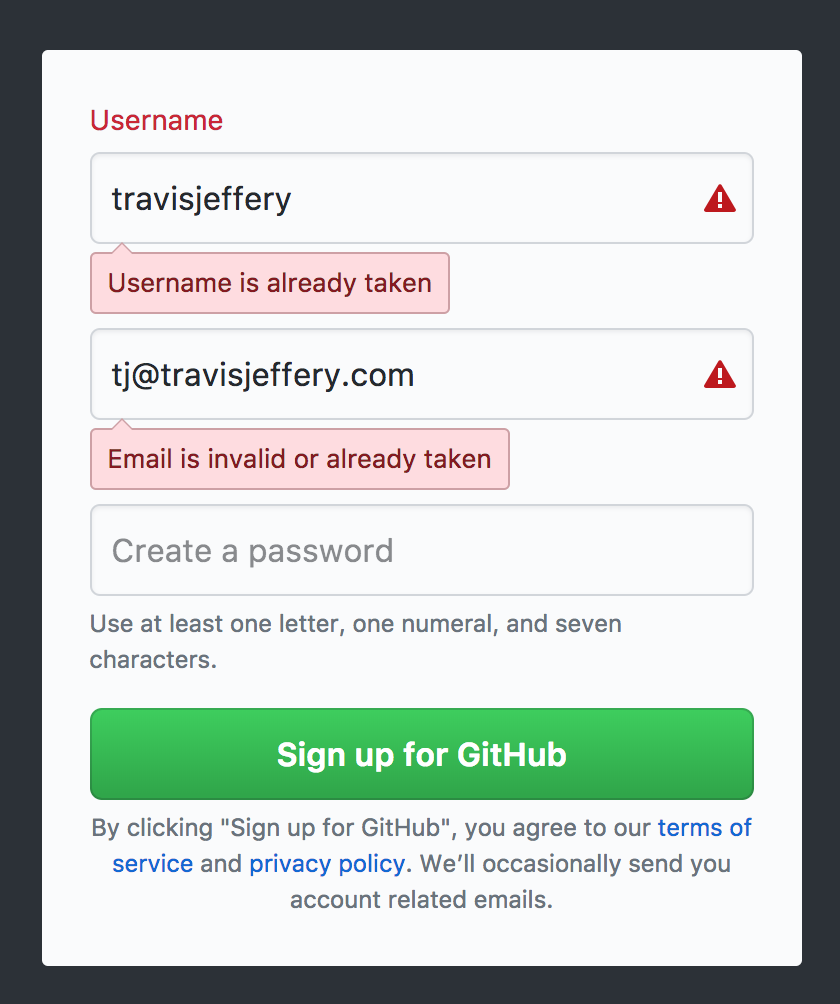
Travis Jeffery, writing for HackerNoon: There's a security best practice where sign ins aren't supposed to say "password is incorrect." Instead they're supposed to say the "username or password is incorrect." This "best practice" is bullshit. Stripe's and GitHub's sign ins for example follow this practice. The idea is if an attacker knows a username, he or she could concentrate on that account using SQL injection, brute forcing the password, phishing, and so on. Here's the problem. All a hacker has to do is sign up to know whether the username is valid or not. Why bother then with obfuscating the sign in? Only the dumbest, laziest hacker is stopped by the "username or password is incorrect" sign in. You gain no security, yet your customers lose clarity. Stripe has their form submission behind reCAPTCHA to prevent naive scripts attacking their sign up. However this has been broken multiple times and likely won't ever be perfect. Even if reCAPTCHA was perfect, a hacker could manually validate their usernames of interest by trying to sign up, then automate an attack on the sign in page.
Microsoft

Microsoft Considers Adding Python As an Official Scripting Language in Excel (bleepingcomputer.com) 181

An anonymous reader writes: Microsoft is considering adding Python as one of the official Excel scripting languages, according to a topic on Excel's feedback hub opened last month. Since it was opened, the topic has become the most voted feature request, double the votes of the second-ranked proposition. "Let us do scripting with Python! Yay! Not only as an alternative to VBA, but also as an alternative to field functions (=SUM(A1:A2))," the feature request reads, as opened by one of Microsoft's users.

The OS maker responded yesterday by putting up a survey to gather more information and how users would like to use Python inside Excel. If approved, Excel users would be able to use Python scripts to interact with Excel documents, their data, and some of Excel's core functions, similar to how Excel currently supports VBA scripts. Python is one of the most versatile programming languages available today. It is also insanely popular with developers. It ranks second on the PYPL programming languages ranking, third in the RedMonk Programming Language Rankings, and fourth in the TIOBE index.

Electronic Frontier Foundation

EFF: Accessing Publicly Available Information On the Internet Is Not a Crime (eff.org) 175

An anonymous reader quotes a report from EFF: EFF is fighting another attempt by a giant corporation to take advantage of our poorly drafted federal computer crime statute for commercial advantage -- without any regard for the impact on the rest of us. This time the culprit is LinkedIn. The social networking giant wants violations of its corporate policy against using automated scripts to access public information on its website to count as felony "hacking" under the Computer Fraud and Abuse Act, a 1986 federal law meant to criminalize breaking into private computer systems to access non-public information.

EFF, together with our friends DuckDuckGo and the Internet Archive, have urged the Ninth Circuit Court of Appeals to reject LinkedIn's request to transform the CFAA from a law meant to target "hacking" into a tool for enforcing its computer use policies. Using automated scripts to access publicly available data is not "hacking," and neither is violating a website's terms of use. LinkedIn would have the court believe that all "bots" are bad, but they're actually a common and necessary part of the Internet. "Good bots" were responsible for 23 percent of Web traffic in 2016. Using them to access publicly available information on the open Internet should not be punishable by years in federal prison. LinkedIn's position would undermine open access to information online, a hallmark of today's Internet, and threaten socially valuable bots that journalists, researchers, and Internet users around the world rely on every day -- all in the name of preserving LinkedIn's advantage over a competing service. The Ninth Circuit should make sure that doesn't happen.

Privacy

Researchers Identify 44 Trackers in More Than 300 Android Apps (bleepingcomputer.com) 87

Catalin Cimpanu, reporting for BleepingComputer: A collaborative effort between the Yale Privacy Lab and Exodus Privacy has shed light on dozens of invasive trackers that are embedded within Android apps and record user activity, sometimes without user consent. The results of this study come to show that the practice of collecting user data via third-party tracking code has become rampant among Android app developers and is now on par with what's happening on most of today's popular websites. The two investigative teams found tracking scripts not only in lesser known Android applications, where one might expect app developers to use such practices to monetize their small userbases, but also inside highly popular apps -- such as Uber, Twitter, Tinder, Soundcloud, or Spotify. The Yale and Exodus investigation resulted in the creation of a dedicated website that now lists all apps using tracking code and a list of trackers, used by these apps. In total, researchers said they identified 44 trackers embedded in over 300 Android apps.
Security

Iranian 'Game of Thrones' Hacker Demanded $6 Million Bitcoin Ransom From HBO, Feds Say (thedailybeast.com) 34

Anonymous readers share a report: The Department of Justice on Tuesday charged an Iranian national with allegedly hacking into HBO, dumping a selection stolen files, and attempting to extort the company by ransoming a treasure trove of the company's content. This summer, hackers released a bevy of internal HBO files, included scripts for Game of Thrones and full, unaired episodes of other shows. Behzad Mesri, aka "Skote Vahshat," at one point worked for the Iranian military to break into military and nuclear systems, as well as Israeli infrastructure, according to the newly released complaint. Under his Vahshat pseudonym, Mesri also defaced hundreds of websites in the U.S. and around the world, the complaint adds. Mesri started his hacking campaign in around May 2017, according to the complaint, probing HBO's systems and employees for weaknesses. Mesri managed to compromise multiple HBO employee accounts as well as other authorized users; from here, he allegedly stole confidential and proprietary information. These included unaired episodes of Ballers, Barry, Room 104, Curb Your Enthusiasm, and The Deuce, as well as scripts for Game of Thrones. Indeed, the hacker behind the HBO breach publicly dumped much of this material online this summer.

Slashdot Top Deals