Crime

SEC Sues Crypto Startup Unicoin and Its Executives For Fraud (reuters.com) 18

The SEC on Wednesday said it has charged cryptocurrency startup Unicoin and three of its top executives for false and misleading statements that raised more than $100 million from thousands of investors. "We allege that Unicoin and its executives exploited thousands of investors with fictitious promises that its tokens, when issued, would be backed by real-world assets including an international portfolio of valuable real estate holdings," said Mark Cave, Associate Director in the SEC's Division of Enforcement. "But as we allege, the real estate assets were worth a mere fraction of what the company claimed, and the majority of the company's sales of rights certificates were illusory. Unicoin's most senior executives are alleged to have perpetuated the fraud, and today's action seeks accountability for their conduct." From the release: The SEC alleges that Unicoin broadly marketed rights certificates to the public through extensive promotional efforts, including advertisements in major airports, on thousands of New York City taxis, and on television and social media. Among other things, Unicoin and its executives are alleged to have convinced more than 5,000 investors to purchase rights certificates through false and misleading statements that portrayed them as investments in safe, stable, and profitable "next generation" crypto assets, including claims that:

- Unicoin tokens underlying the rights certificates were "asset-backed" by billions of dollars of real estate and equity interests in pre-IPO companies, when Unicoin's assets were never worth more than a small fraction of that amount;
- the company had sold more than $3 billion in rights certificates, when it raised no more than $110 million; and
- the rights certificates and Unicoin tokens were "SEC-registered" or "U.S. registered" when they were not.

According to the SEC's complaint, Unicoin and Konanykhin also violated the federal securities laws by engaging in unregistered offers and sales of rights certificates. Konanykhin offered and sold over 37.9 million of his rights certificates to offer better pricing and target investors the company had prohibited from participating in the offering to avoid jeopardizing its exemption to registration requirements, as alleged.

PlayStation (Games)

Sony Mass-Bans Russian PlayStation Accounts (pravda.com.ua) 190

Sony has begun mass suspensions of PlayStation accounts linked to Russian users, including those registered in other countries like Turkiye and Kazakhstan, in an effort to crack down on circumvention of regional restrictions like PS Plus access. This move follows Sony's 2022 exit from the Russian market due to the war in Ukraine. Ukrainska Pravda reports: Russians are trying to bypass the blocks and are contacting PlayStation support, but these attempts are to no avail. Users with purchased accounts encounter the most problems -- Sony checks IP addresses for verification. There are already many similar reports. In some cases, accounts with thousands of roubles worth of games purchased have been blocked. Russian media outlets like RT are reporting the news.
Crime

A Ripe Target For Identity Thieves: Prisoners on Death Row 77

Identity thieves have found an insidious target: death row inmates. A SentiLink report published this week reveals scammers are stealing identities of Texas prisoners awaiting execution to orchestrate "bust-out" fraud schemes -- patiently building credit before disappearing with up to $100,000.

Nearly 10% of Texas' 172 death row inmates have fallen victim. The operation, active since March 2023, exploits inmates' isolation from financial communications. "They wouldn't receive text or email alerts from a financial institution," said Robin Maher of the Death Penalty Information Center.

Beyond opening credit accounts, NBC reports, fraudsters have registered fake businesses using inmates' identities, including a landscaping company created under Ronald Haskell's name -- a man imprisoned since 2014 for killing six people. TransUnion estimates bust-out scams now cost banks $1 billion annually.
Education

Draft Executive Order Outlines Plan To Integrate AI Into K-12 Schools (washingtonpost.com) 115

A draft executive order from the Trump administration proposes integrating AI into K-12 education by directing federal agencies to promote AI literacy, train teachers, and establish public-private partnerships. "The draft is marked 'predecisional' and could be subject to change before it is signed, or it could be abandoned," notes the Washington Post. From the report: Titled "Advancing artificial intelligence education for American youth," the draft order would establish a White House task force on AI education that would be chaired by Michael Kratsios, director of the Office of Science and Technology Policy, and would include the secretaries of education, agriculture, labor and energy, as well as Trump's special adviser for AI and cryptocurrency, David Sacks. The draft order would instruct federal agencies to seek public-private partnerships with industry, academia and nonprofit groups in efforts to teach students "foundational AI literacy and critical thinking skills."

The task force should look for existing federal funding such as grants that could be used for AI programs, and agencies should prioritize spending on AI education, according to the draft order. It would also instruct Education Secretary Linda McMahon to prioritize federal grant funding for training teachers on how to use AI, including for administrative tasks and teacher training and evaluation. All educators should undergo professional development to integrate AI into all subject areas, the draft order says. It would also establish a "Presidential AI Challenge" -- a competition for students and educators to demonstrate their AI skills -- and instruct Labor Secretary Lori Chavez-DeRemer to develop registered apprenticeships in AI-related occupations. The focus is on K-12 education, but the draft order says, "Our Nation must also make resources available for lifelong learners to develop new skills for a changing workforce."

Security

AI Hallucinations Lead To a New Cyber Threat: Slopsquatting 51

Researchers have uncovered a new supply chain attack called Slopsquatting, where threat actors exploit hallucinated, non-existent package names generated by AI coding tools like GPT-4 and CodeLlama. These believable yet fake packages, representing almost 20% of the samples tested, can be registered by attackers to distribute malicious code. CSO Online reports: Slopsquatting, as researchers are calling it, is a term first coined by Seth Larson, a security developer-in-residence at Python Software Foundation (PSF), for its resemblance to the typosquatting technique. Instead of relying on a user's mistake, as in typosquats, threat actors rely on an AI model's mistake. A significant number of packages, amounting to 19.7% (205,000 packages), recommended in test samples were found to be fakes. Open-source models -- like DeepSeek and WizardCoder -- hallucinated more frequently, at 21.7% on average, compared to the commercial ones (5.2%) like GPT 4. Researchers found CodeLlama ( hallucinating over a third of the outputs) to be the worst offender, and GPT-4 Turbo ( just 3.59% hallucinations) to be the best performer.

These package hallucinations are particularly dangerous as they were found to be persistent, repetitive, and believable. When researchers reran 500 prompts that had previously produced hallucinated packages, 43% of hallucinations reappeared every time in 10 successive re-runs, with 58% of them appearing in more than one run. The study concluded that this persistence indicates "that the majority of hallucinations are not just random noise, but repeatable artifacts of how the models respond to certain prompts." This increases their value to attackers, it added. Additionally, these hallucinated package names were observed to be "semantically convincing." Thirty-eight percent of them had moderate string similarity to real packages, suggesting a similar naming structure. "Only 13% of hallucinations were simple off-by-one typos," Socket added.
The research can found be in a paper on arXiv.org (PDF).
EU

Is WhatsApp Being Ditched for Signal in Dutch Higher Education? (dub.uu.nl) 42

For weeks Signal has been one of the three most-downloaded apps in the Netherlands, according to a local news site. And now "Higher education institutions in the Netherlands have been looking for an alternative," according to DUB (an independent news site for the Utrecht University community): Employees of the Utrecht University of Applied Sciences (HU) were recently advised to switch to Signal. Avans University of Applied Sciences has also been discussing a switch...The National Student Union is concerned about privacy. The subject was raised at last week's general meeting, as reported by chair Abdelkader Karbache, who said: "Our local unions want to switch to Signal or other open-source software."
Besides being open source, Signal is a non-commercial nonprofit, the article points out — though its proponents suggest there's another big difference. "HU argues that Signal keeps users' data private, unlike WhatsApp." Cybernews.com explains the concern: In an interview with the Dutch newspaper De Telegraaf, Meredith Whittaker [president of the Signal Foundation] discussed the pitfalls of WhatsApp. "WhatsApp collects metadata: who you send messages to, when, and how often. That's incredibly sensitive information," she says.... The only information [Signal] collects is the date an account was registered, the time when an account was last active, and hashed phone numbers... Information like profile name and the people a user communicates with is all encrypted... Metadata might sound harmless, but it couldn't be further from the truth. According to Whittaker, metadata is deadly. "As a former CIA director once said: 'We kill people based on metadata'."
WhatsApp's metadata also includes IP addresses, TechRadar noted last May: Other identifiable data such as your network details, the browser you use, ISP, and other identifiers linked to other Meta products (like Instagram and Facebook) associated with the same device or account are also collected... [Y]our IP can be used to track down your location. As the company explained, even if you keep the location-related features off, IP addresses and other collected information like phone number area codes can be used to estimate your "general location."

WhatsApp is required by law to share this information with authorities during an investigation...

[U]nder scrutiny is how Meta itself uses these precious details for commercial purposes. Again, this is clearly stated in WhatsApp's privacy policy and terms of use. "We may use the information we receive from [other Meta companies], and they may use the information we share with them, to help operate, provide, improve, understand, customize, support, and market our Services and their offerings," reads the policy. This means that yes, your messages are always private, but WhatsApp is actively collecting your metadata to build your digital persona across other Meta platforms...

The article suggests using a VPN with WhatsApp and turning on its "advanced privacy feature" (which hides your IP address during calls) and managing the app's permissions for data collection. "While these steps can help reduce the amount of metadata collected, it's crucial to bear in mind that it's impossible to completely avoid metadata collection on the Meta-owned app... For extra privacy and security, I suggest switching to the more secure messaging app Signal."

The article also includes a cautionary anecdote. "It was exactly a piece of metadata — a Proton Mail recovery email — that led to the arrest of a Catalan activist."

Thanks to long-time Slashdot reader united_notions for sharing the article.
The Almighty Buck

Argentinian President Promotes Memecoin. It Then Crashed 95% as Insiders Cashed Out (web3isgoinggreat.com) 128

gwolf (Slashdot reader #26,339) writes: On Friday, February 14, Libertarian Argentinian president, Javier Milei, promoted the just-created $LIBRA cryptocoin, created by the Viva la libertad project, strongly aligned with his political party, La Libertad Avanza. Milei tweeted, "This private project will be devoted to promote growth of the Argentinian economy, funding small startups and enterprises. The world wants to invest in Argentina!"

It is worth noting that the project's website was registered a mere three minutes before Milei tweeted his endorsement. The cryptocoin quickly reached a $4.6 billion market cap... Only to instantaneously lose 89% of its value, with nine core investers pulling the rug from under the enthusiast investors.
More details from the blog Web3 Is Going Just Great: [W]ithin hours of the launch, insiders began selling off their holdings of the token. The token had been highly concentrated among insiders, with around 82% of the token held in a small cluster of apparently insider addresses. Those insiders cashed out around $107 million, crashing the token price by around 95%. After the crash, Milei deleted his tweet promoting the project. He later claimed he was "not aware of the details of the project."
UPDATE: CNN reports that Argentine President Milei is now facing calls for impeachment. The presidency on Saturday announced an investigation into the matter, saying: "President Javier Milei has decided to immediately involve the Anti-Corruption Office to determine whether there was improper conduct on the part of any member of the national government, including the president himself."
Power

NYC Is Giving Free E-Bikes To Delivery Workers Using Unsafe Models (electrek.co) 38

New York City's Department of Transportation is offering delivery workers the opportunity to swap out uncertified e-bikes for safer UL-compliant models. "Millions of people rely on such workers for timely deliveries, yet the low wages and brutal conditions of the job have forced many riders to seek out low-cost electric bicycles to perform the work -- exactly the kind of e-bikes that are least likely to have received safety certifications," reports Electrek. From the report: The NYC DOT has already begun accepting applications for the new E-Bike Trade-In Program, which is open to delivery workers with non-compliant electric bicycles as well as the often-seen electric scooters/mopeds that don't really qualify as e-bikes, despite their ubiquitous use in the industry. Interestingly, the program even accepts gasoline-powered mopeds that are not able to be legally registered with the DMV, including those that lack VINs. In exchange for trading in a non-certified vehicle, the delivery worker will receive a new UL-certified electric bike with a spare UL-certified battery.

There are a few requirements for eligibility. The worker has to have earned at least US $1,500 by working in the food delivery industry last year in 2024, live in one of the five New York City boroughs, be at least 18 years old, and own/use one of the eligible devices for trade-in. The program is free to participate in with no additional cost for the delivery workers. However, the supply of free electric bicycles is described as "limited."
Those interested need to submit an application before the window closes on March 10, 2025.
Technology

Microchip Company Ceases Operations, Pet Owners Urged To Re-Register (cbsnews.com) 37

An anonymous reader quotes a report from CBS News: Animal shelters, rescues, and veterinarian clinics around the U.S. are posting on social media telling pet owners to check their four-legged friends' microchips after learning a major microchip company [called Save This Life] is no longer providing services. [...] If you're unsure which company your cats or dogs' chips are registered with, check them. "You can go to your local veterinarian office, a local police station, or even a local animal shelter like HARP, and we can help check that for you and scan your animal. And then you take that number that's on there and there's a tool online where you can go look it up," [said Dan Cody, Executive Director of Humane Animal Rescue of Pittsburgh].

He said you check the number by using the AAHA Universal Microchip Lookup Tool at this link. If you discover your pet's microchip was registered to the company that's ceased operations, you'll need to register with a different company. "So, if you find that you are affected by this, you're going to want to go to one of these other websites that do the registrations. So, things like AKC Reunite, and PetLink. 24PetWatch these are all large companies who've been around for a long time and have good reputations," said Cody.

The American Kennel Club shared a post from its AKC Reunite Facebook page, encouraging people to enroll in microchips with AKC Reunite. The post said in part, "If your dog or cat has a microchip number that starts with 991 or 900164 then it could be a Save This Life microchip. Save This Life suddenly closed, and your pet may not be protected." Cody said if your furry best friend isn't microchipped, take them to a vet or shelter like HARP to get one implanted under their skin so they have a permanent ID. Microchipping can be done at HARP's East Side and North Side Veterinary Medical Center by appointment.

Cellphones

Free 'T-Mobile Starlink' for Six Months Announced During Super Bowl. Also Available to Verizon and AT&T Customers 211

Today T-Mobile announced what they're calling "the next big thing in wireless" — T-Mobile Starlink. But the real surprise is "The beta is now open for absolutely everyone — yes, even Verizon and AT&T customers — to register for free access until July."

And, as they explained to Americans watching the Super Bowl, "If you can see the sky you're connected." Now in public beta, this breakthrough service, developed in partnership with Starlink, uses straight-out-of-a-sci-fi-movie satellite and mobile communications technology to help keep people connected — even you, Verizon and AT&T customers — in the more than 500,000 square miles of the country unreached by any carrier's earth-bound cell towers. That's nearly the size of two Texases...! The beauty of the service is its simplicity: users don't need to do anything out of the ordinary. When a user's cell phone gets out of range of a cell tower, the phone automatically connects to the T-Mobile Starlink network. No need to manually connect. Messages are sent and received just as they are today on a traditional network, even group texts and reactions. And it works on most smartphones from the last four years. It's not limited to a few smartphones or operating systems...

The beta is free until July at which point T-Mobile Starlink will be included at no extra cost on Go5G Next (including variations like Go5G Next 55+), T-Mobile's best plan. Business customers will also get T-Mobile Starlink at no extra cost on Go5G Business Next, first responder agencies on T-Priority plans and other select premium rate plans. T-Mobile customers on any other plan can add the service for $15/month per line. Through February, T-Mobile customers who have registered for the beta can secure a $10/month per line Early Adopter Discount, 33% off the full price.

AT&T and Verizon customers hate dead zones, too

When your service is amazing and different, you want as many people to try it as possible. T-Mobile is giving AT&T and Verizon customers the opportunity to try out T-Mobile Starlink satellite service on their existing phones... During the beta period, Verizon and AT&T customers can experience T-Mobile Starlink text messaging for free, and once the service launches in July, it will be available for $20/month per line... More details and consumer registration can be found here.

A Vision for Universal Coverage

As T-Mobile and Starlink continue to work towards eliminating mobile deadzones, the companies welcome wireless providers from around the world to join their growing alliance, which aims to provide reciprocal roaming for all participating carriers. So far, KDDI (Japan), Telstra (Australia), Optus (Australia), One NZ (New Zealand), Salt (Switzerland), Entel (Chile & Peru), Rogers (Canada) and Kyivstar (Ukraine) are among the providers that have signed on to join the cause and launch satellite-to-mobile technology. Learn more about the alliance and how providers can join at direct.starlink.com.
Data Storage

Archivists Work To Identify and Save the Thousands of Datasets Disappearing From Data.gov (404media.co) 70

An anonymous reader quotes a report from 404 Media: Datasets aggregated on data.gov, the largest repository of U.S. government open data on the internet, are being deleted, according to the website's own information. Since Donald Trump was inaugurated as president, more than 2,000 datasets have disappeared from the database. As people in the Data Hoarding and archiving communities have pointed out, on January 21, there were 307,854 datasets on data.gov. As of Thursday, there are 305,564 datasets. Many of the deletions happened immediately after Trump was inaugurated, according to snapshots of the website saved on the Internet Archive's Wayback Machine. Harvard University researcher Jack Cushman has been taking snapshots of Data.gov's datasets both before and after the inauguration, and has worked to create a full archive of the data.

"Some of [the entries link to] actual data," Cushman told 404 Media. "And some of them link to a landing page [where the data is hosted]. And the question is -- when things are disappearing, is it the data it points to that is gone? Or is it just the index to it that's gone?" For example, "National Coral Reef Monitoring Program: Water Temperature Data from Subsurface Temperature Recorders (STRs) deployed at coral reef sites in the Hawaiian Archipelago from 2005 to 2019," a NOAA dataset, can no longer be found on data.gov but can be found on one of NOAA's websites by Googling the title. "Stetson Flower Garden Banks Benthic_Covage Monitoring 1993-2018 -- OBIS Event," another NOAA dataset, can no longer be found on data.gov and also appears to have been deleted from the internet. "Three Dimensional Thermal Model of Newberry Volcano, Oregon," a Department of Energy resource, is no longer available via the Department of Energy but can be found backed up on third-party websites. [...]

Data.gov serves as an aggregator of datasets and research across the entire government, meaning it isn't a single database. This makes it slightly harder to archive than any individual database, according to Mark Phillips, a University of Northern Texas researcher who works on the End of Term Web Archive, a project that archives as much as possible from government websites before a new administration takes over. "Some of this falls into the 'We don't know what we don't know,'" Phillips told 404 Media. "It is very challenging to know exactly what, where, how often it changes, and what is new, gone, or going to move. Saving content from an aggregator like data.gov is a bit more challenging for the End of Term work because often the data is only identified and registered as a metadata record with data.gov but the actual data could live on another website, a state .gov, a university website, cloud provider like Amazon or Microsoft or any other location. This makes the crawling even more difficult."

Phillips said that, for this round of archiving (which the team does every administration change), the project has been crawling government websites since January 2024, and that they have been doing "large-scale crawls with help from our partners at the Internet Archive, Common Crawl, and the University of North Texas. We've worked to collect 100s of terabytes of web content, which includes datasets from domains like data.gov." [...] It is absolutely true that the Trump administration is deleting government data and research and is making it harder to access. But determining what is gone, where it went, whether it's been preserved somewhere, and why it was taken down is a process that is time intensive and going to take a while. "One thing that is clear to me about datasets coming down from data.gov is that when we rely on one place for collecting, hosting, and making available these datasets, we will always have an issue with data disappearing," Phillips said. "Historically the federal government would distribute information to libraries across the country to provide greater access and also a safeguard against loss. That isn't done in the same way for this government data."

Oracle

Oracle Won't Withdraw 'JavaScript' Trademark, Says Deno. Legal Skirmish Continues (infoworld.com) 68

"Oracle has informed us they won't voluntarily withdraw their trademark on 'JavaScript'." That's the word coming from the company behind Deno, the alternative JavaScript/TypeScript/WebAssembly runtime, which is pursuing a formal cancellation with the U.S. Patent and Trademark Office.

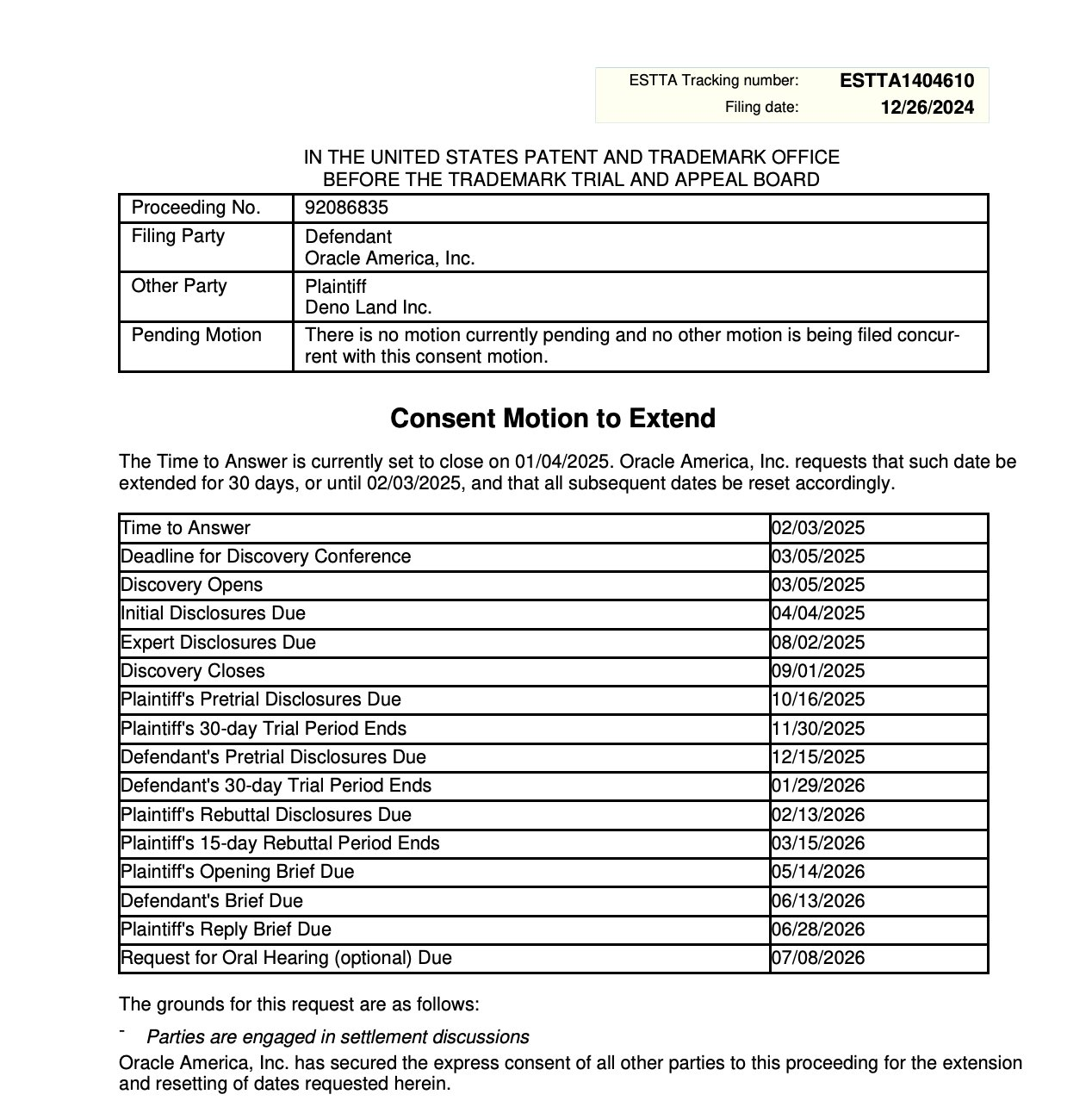
So what happens next? Oracle "will file their Answer, and we'll start discovery to show how 'JavaScript' is widely recognized as a generic term and not controlled by Oracle." Deno's social media posts show a schedule of various court dates that extend through July of 2026, so "The dispute between Oracle and Deno Land could go on for quite a while," reports InfoWorld: Deno Land co-founder Ryan Dahl, creator of both the Deno and Node.js runtimes, said a formal answer from Oracle is expected before February 3, unless Oracle extends the deadline again. "After that, we will begin the process of discovery, which is where the real legal work begins. It will be interesting to see how Oracle argues against our claims — genericide, fraud on the USPTO, and non-use of the mark."

The legal process begins with a discovery conference by March 5, with discovery closing by September 1, followed by pretrial disclosure from October 16 to December 15. An optional request for an oral hearing is due by July 8, 2026.

Oracle took ownership of JavaScript's trademark in 2009 when it purchased Sun Microsystems, InfoWorld notes.

But "Oracle does not control (and has never controlled) any aspect of the specification or how the phrase 'JavaScript' can be used by others," argues an official petition filed by Deno Land Inc. with the United States Patent and Trademark Office: Today, millions of companies, universities, academics, and programmers, including Petitioner, use "JavaScript" daily without any involvement with Oracle. The phrase "JavaScript" does not belong to one corporation. It belongs to the public. JavaScript is the generic name for one of the bedrock languages of modern programming, and, therefore, the Registered Mark must be canceled.

An open letter to Oracle discussing the genericness of the phrase "JavaScript," published at https://javascript.tm/, was signed by 14,000+ individuals at the time of this Petition to Cancel, including notable figures such as Brendan Eich, the creator of JavaScript, and the current editors of the JavaScript specification, Michael Ficarra and Shu-yu Guo. There is broad industry and public consensus that the term "JavaScript" is generic.

The seven-page petition goes into great detail, reports InfoWorld. "Deno Land also accused Oracle of committing fraud in its trademark renewal efforts in 2019 by submitting screen captures of the website of JavaScript runtime Node.js, even though Node.js was not affiliated with Oracle."
Earth

Hundreds of US Locations Had Their Hottest Year On Record (axios.com) 67

Communities across the U.S. experienced unprecedented warmth in 2024, with numerous cities breaking temperature records set just a year earlier. Phoenix recorded an average temperature of 90.5F and endured 70 days with highs at or above 110F, surpassing its previous record of 55 days.

Major metropolitan areas including Chicago, Nashville, Washington, Pittsburgh, Philadelphia, and Burlington, Vermont, all registered their warmest year. Even northern Maine cities like Caribou and Houlton saw record-breaking temperatures, reflecting broader global warming trends that made 2024 the hottest year on record worldwide.
Transportation

US Drone Sightings Provoke Reactions From New Jersey Legislature, Federal Government (apnews.com) 51

On Thursday New Jersey lawmakers passed a resolution "calling on the federal government to conduct a 'rigorous and ongoing' investigation into the drone sightings in the state," reports the Associated Press: Meanwhile, federal and local authorities are warning against pointing lasers at suspected drones, because aircraft pilots are being hit in the eyes more often. Authorities also said they are concerned people might fire weapons at manned aircraft that they have mistaken for drones...

White House national security spokesperson John Kirby said Monday that the federal government has yet to identify any public safety or national security risks. "There are more than 1 million drones that are lawfully registered with the Federal Aviation Administration here in the United States," Kirby said. "And there are thousands of commercial, hobbyist and law enforcement drones that are lawfully in the sky on any given day. That is the ecosystem that we are dealing with." The federal government has deployed personnel and advanced technology to investigate the reports in New Jersey and other states, and is evaluating each tip reported by citizens, he said. About 100 of the more than 5,000 drone sightings reported to the FBI in recent weeks were deemed credible enough to warrant more investigation, according to a joint statement by the Department of Homeland Security, FBI, Federal Aviation Administration and Department of Defense.

Speculation has raged online, with some expressing concerns the drones could be part of a nefarious plot by foreign agents or clandestine operations by the U.S. government. Pentagon spokesperson Maj. Gen. Pat Ryder said it's unlikely the drones are engaged in intelligence gathering, given how loud and bright they are. He repeated Tuesday that the drones being reported are not being operated by the Department of Defense. Asked whether military contractors might be operating drones in the New Jersey area, Ryder rebuffed the notion, saying there are "no military operations, no military drone or experiment operations in this corridor." Ryder said additional drone-detecting technology was being moved to some military installations, including the Picatinny Arsenal...

U.S. Sen. Andy Kim, a New Jersey Democrat, said he has heard nothing to support the notion that the government is hiding anything. He said a lack of faith in institutions is playing a key part in the saga.

Transportation

Driverless Bus Service In Scotland To Be Withdrawn Due To Lack of Interest (theguardian.com) 72

An anonymous reader quotes a report from The Guardian: The UK's first driverless bus service, originally heralded as a breakthrough of global significance, is being withdrawn from service because too few passengers used it. The autonomous buses, operated by Stagecoach, have been running between Fife and Edinburgh along a 14-mile route over the Forth road bridge since May 2023 to relieve the heavy congestion which can bring traffic to a standstill.

The CAVForth service, a collaboration between Fusion Processing, the coach-building company Alexander Dennis, Napier University in Edinburgh and the Bristol Robotics Lab -- a joint venture between the University of Bristol and the University of the West of England -- was touted as the most ambitious and complex in the world. Built at an estimated cost of more than 6 million pounds, partly funded by the UK government, the fleet of five single-decker buses had the capacity to carry 10,000 passengers a week but needed two crew on board for safety reasons.
Stagecoach said in a statement: "We are proud to have achieved a world first with our CAVForth autonomous bus service, demonstrating the potential for self-driving technology on a real-world registered timetable in East Scotland. Although passenger adoption did not meet expectations, the trial has significantly advanced the understanding of the operational and regulatory requirements for autonomous services, delivering what was expected from this demonstrator project. The partners remain committed to exploring new opportunities for self-driving technology in other areas across the UK, ensuring that this exciting innovation can play a transformative role in future transport networks."
Transportation

Two Drone Pilots Arrested Near Boston, and Drones Cause One-Hour Runway Closure at North New York Airport (go.com) 89

Saturday night two men were arrested near Boston "following a hazardous drone operation near Logan Airport's airspace," according to a police statement. They credit an officer "leveraging advanced UAS monitoring technology" who "identified the drone's location, altitude, flight history, and the operators' position." Recognizing the serious risks posed by the drone's proximity to Logan's airspace, additional resources were mobilized. The Boston Police Department coordinated with Homeland Security, the Massachusetts State Police, the Joint Terrorism Task Force, the Federal Communications Commission (FCC), and Logan Airport Air Traffic Control to address the situation.
"Both suspects face charges of trespassing, with additional fines or charges potentially forthcoming."

Meanwhile on Friday night "Officials at Stewart International Airport, located roughly 60 miles north of New York City, said they shut down their runways for an hour," reports ABC News, after America's Federal Aviation Administration "alerted them that a drone was spotted in the area around 9:30 p.m." Though officials say flight operations weren't impacted during the closure, the article notes that New York's governor is now calling for federal assistance, including more federal law enforcement officers, saying "This has gone too far." [Governor Hochul] called on Congress to pass the Counter-UAS Authority Security, Safety, and Reauthorization Act, which would strengthen the FAA's oversight of drones and give more authority to state and local law enforcement agencies to investigate the activity.
The article explores the larger problem of Americans reporting drone sightings: Officials from a wide range of federal agencies spoke with reporters Saturday on a phone call and emphasized that the federal investigation into drone sightings in New Jersey is ongoing. One FBI official said that out of the nearly 5,000 tips they have received, less than 100 have generated credible leads for further investigation. A Department of Homeland Security official said that they are "confident that many of the reported drone sightings are, in fact, manned aircraft being misidentified as drones." The FBI official also talked about how investigators overlaid the locations of the reported drone sightings and found that "the density of reported sightings matches the approach pattern" of the New York area's busy airports including Newark-Liberty, JFK, and LaGuardia.

But, an FAA official says that there have "without a doubt" been drones flying over New Jersey, pointing to the fact that there are nearly a million drones registered in the U.S. "With nearly a million registered [unmanned aircraft systems] in the United States, there's no doubt many of them are owned and operated here within the state," the FAA official said... A Joint Chiefs of Staff official said that there have been visual sightings of drones reported by "highly trained security personnel" near Picatinny Arsenal and Naval Weapons Station Earle in New Jersey. The official said that they do not believe the sightings "were aligned with a foreign actor, or that they had malicious intent."

"We don't know what activity is. We don't know if it is criminal, but I will tell you that it is irresponsible," the official said. "Here on the military side, we are just as frustrated with the irresponsible nature of this activity."

Later ABC News reported that the FAA had imposed temporary drone flight restrictions in New Jersey over the Picatinny Arsenal military base. And they added that America's Homeland Security Secretary Alejandro Mayorkas "said the federal government is taking action to address the aerial drones that have prompted concern among New Jersey residents. "I want to assure the American public that we in the federal government have deployed additional resources, personnel, technology to assist the New Jersey State Police in addressing the drone sightings...." There have been numerous reports of drone activity along the East Coast since November. Mayorkas cited the 2023 change of a Federal Aviation Administration rule that allows drones to fly at night as to why there might be an uptick in sightings. "I want to assure the American public that we are on it," he said, before calling on Congress to expand local and state authority to help address the issue.

"It is critical, as we all have said for a number of years, that we need from Congress additional authorities to address the drone situation," Mayorkas said. "Our authorities currently are limited and they are set to expire. We need them extended and expanded... We want state and local authorities to also have the ability to counter growing activity under federal supervision," he added, echoing sentiments from local officials...

Addressing national security concerns the sightings have prompted, Mayorkas said the U.S. knows of no foreign involvement and that it remains "vigilant" in investigating the drone sightings. [ABC News anchor George] Stephanopoulos pressed Mayorkas about past security threats drones have caused, including the arrest of a Chinese national last week who allegedly flew a drone over an Air Force base in California. "When a drone is flown over restricted airspace, we act very, very swiftly," the homeland security secretary said. "In fact, when an individual in California flew a drone over restricted airspace, that individual was identified, apprehended and is being charged by federal authorities."

EU

Apple Gets EU Warning To Stop Geo-Blocking on App, iTunes Stores (yahoo.com) 69

Apple was notified by the European Union that its geo-blocking practices are potentially in breach of consumer protection rules, adding to the iPhone maker's regulatory issues in the bloc. From a report: Apple's App Store, iTunes Store and other media services unlawfully discriminate against European customers based on their place of residence, according to a European Commission statement on Tuesday.

The notification comes as Apple is facing the first-ever fine under the Digital Markets Act, or DMA, for failing to allow app developers to steer users to cheaper deals, Bloomberg News reported last week. That penalty is set to come months after the Cupertino, California-based company was hit with a $1.9 billion fine for similar abuses under the bloc's traditional competition rules.

The geo-locating investigation was conducted together with a network of national consumer authorities and found Apple media services only allow users to use payment cards issued in the countries they registered their Apple accounts, according to the statement. The App Store also blocks users from downloading apps offered in other countries, the investigation found.

Iphone

Apple's New Feature Lets Brands Put Their Stamp On Emails, Calls To Your iPhone 27

Apple is enhancing its Business Connect tool, allowing companies to customize how they appear in emails, phone calls, and payment interfaces on iPhones. The Verge reports: Each registered business can confirm its info is accurate and add additional details like photos or special offers. Collecting verified, up-to-date business information could be useful for Apple if it ever launches its own search engine or inside features for Apple Intelligence instead of sending users to outside sources like Google, Yelp, or Meta. Branded Mail is a feature businesses can sign up for today before it starts rolling out to users later this year, potentially making emails easier to identify in a sea of unread messages.

Additionally, if companies opt into Business Caller ID, Apple will display their name, logo, and department on an iPhone's inbound call screen. This feature should come in handy when you're trying to figure out whether the random number that's calling you is spam, or if it's a legitimate business. It will start rolling out next year. A smaller update coming to Apple's Tap to Pay service will let companies show their logo when accepting payments instead of just displaying a category icon.
You can read more about it in Apple's press release.
Bitcoin

Trump's Coin Sale Misses Early Targets As Crypto Project's Website Crashes (cnbc.com) 136

Donald Trump's new crypto project, World Liberty Financial, had a rocky start today with frequent website outages during its token sale. According to CNBC, only about 4% of registered investors have bought tokens, and the project sold less than 3% of the 20 billion tokens available. From the report: WLF's website suffered regular and lengthy outages for much of the morning and early afternoon, contributing to a limited number of sales. Only about 4,300 unique walled addresses hold the token as of Tuesday afternoon, according to blockchain data tracked by Etherscan, representing roughly 4% of the total number of people who registered.

The platform says it has sold more than 532 million tokens at 15 cents per token. That is less than 3% of the 20 billion tokens made available for public sale. Over the course of the day, the website frequently showed a page saying, "We are under maintenance." The glitchy launch is a potential setback to the Republican presidential nominee with just three weeks until the election. Trump and his family have been touting the project since August, branding it as "The DeFiant Ones," a play on DeFi, which is short for decentralized finance.

Businesses

Why OpenAI Is at War With an Obscure Idea Man (bloomberg.com) 35

In a David vs. Goliath legal battle, AI powerhouse OpenAI is squaring off against a little-known entrepreneur who claims he conceived the company's name and mission months before its star-studded launch. Guy Ravine, a self-taught programmer with a history of near-misses in tech, registered the domain open.ai in March 2015. He envisioned a collaborative platform to develop artificial general intelligence (AGI) for the benefit of humanity. By year's end, Ravine had pitched his "Open AI" concept to industry luminaries and filed for a trademark. Then, in December 2015, Sam Altman and Greg Brockman announced the creation of OpenAI, backed by a promised billion dollars from Elon Musk and others.

The similarity was uncanny -- a non-profit aimed at developing AGI for the public good. "What the f---?" Ravine recalls thinking. He claims his idea was stolen, while OpenAI dismisses him as an opportunistic "troll" and a "fraud." The ensuing legal battle has consumed Ravine's life, Bloomberg Businessweek covers in great detail, and has raised thorny questions about idea ownership in Silicon Valley. It also casts a shadow over OpenAI's origin story as the company, now valued at $157 billion, shifts from its non-profit roots to a for-profit juggernaut. "It's humanity's asset," Ravine insists. "It's not his [Altman's] asset." For now, a judge has barred Ravine from using "Open AI" while the suit proceeds, but the inventor has vowed to fight on against what he calls "the most feared law firm in the world." An amusing excerpt from the story: But Ravine had poked the bear, and as he packed up his house on Aug. 11, 2023, he opened an email from a lawyer at the firm Quinn Emanuel Urquhart & Sullivan LLP, informing him that OpenAI was suing him in federal court over the domain and trademark. "I'm like, what the f---?" Ravine recalls. Altman, he says, "could have had it for free" -- or at least for the cost of a donation. "Instead, he decided to donate millions of dollars to literally the most feared law firm in the world, to sue me."

Again and again in our conversations, he returns to that phrase: "the most feared law firm in the world." Finally, I ask him how he knows this. He turns his laptop toward me and pulls up the email. The signature reads "Quinn Emanuel Urquhart & Sullivan LLP: Most Feared Law Firm in the World."

Slashdot Top Deals